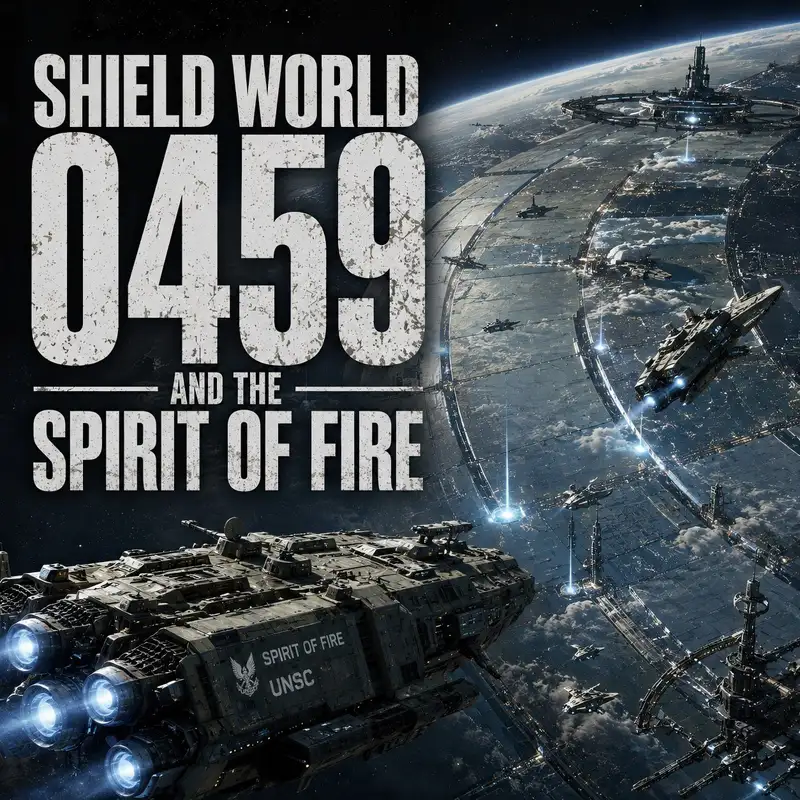
Shield World 0459 and the Spirit of Fire
Captain James Cutter had one chance to recover Professor Ellen Anders, and almost no way to know what waited beyond the jump. The Covenant ship carrying her was leaving Arcadia for uncharted space. No human battle group was standing by. No courier could bring reinforcement before the trail went cold. Cutter chose to follow with the Spirit of Fire, a modified colony ship already worn by continuous campaigning. If the pursuit failed, the ship and everyone aboard could vanish without even leaving the United Nations Space Command a useful location to search. That decision carried the Spirit of Fire to Shield World 0459 and turned a rescue mission into the destruction of an ancient military harbor.
The Spirit of Fire was unusually well suited to survive alone, though not because it was a superior warship. It had been built to transport colonists, industrial equipment, prefabricated buildings, vehicles, and the machinery needed to create settlements far from established support. Its military refit added magnetic accelerator cannons, missiles, point defense, troops, aircraft, and extensive repair capability. Large internal factories could produce vehicles and field structures. Cargo bays could move armor, engineers, and supplies directly into a ground campaign. A purpose-built cruiser would have been better in a naval duel. Few cruisers could land an army, build its bases, replace its vehicles, and repair themselves while doing it.
Shield World 0459 was formally known as the Etran Harborage and was also called Trove. It was not a natural planet. The Forerunners had constructed a hollow conservation sphere around an internal artificial star, with a habitable landscape curving around the inside of the shell. The installation was intended to preserve life from the Halo Array and the Flood, but it also contained the Apex Site, an immense harbor for numerous Sojourner-class dreadnoughts. The name shield world suggested refuge. In practice, 0459 was also an armory whose contents had been waiting for more than one hundred thousand years.
The Covenant had discovered that armory but could not fully activate it. Its forces understood how to maintain and adapt much Forerunner technology, yet access to the Apex fleet required something religious doctrine had not prepared them to admit. It required a human. After seeing Anders interact with Forerunner systems on Harvest and Arcadia, the Arbiter Ripa 'Moramee abducted her for the Prophet of Regret. The Covenant did not need Anders because she understood the dreadnoughts better than they did. It needed her because Forerunner systems recognized humanity as Reclaimers, a status the Covenant leadership concealed while exploiting whenever useful.
On February twenty-third, twenty-five thirty-one, the Spirit of Fire emerged in the Korinth Prior system and followed Anders's transponder toward the surface. Cutter possessed no current chart, no allied fleet, and no reliable estimate of the Covenant force already present. The proper naval decision might have been to mark the system, withdraw, and return with overwhelming support. The operational reality was less accommodating. Anders might be moved, killed, or forced to activate whatever the Covenant had found. Cutter committed reconnaissance teams, Sergeant John Forge, Marine formations, and Spartan Two Red Team before he fully understood the installation.
The first deployments showed why the Spirit of Fire mattered. Elephants carried command, communications, and heavy support across hostile terrain. Marines established a firebase while Shortsword bombers, armor, and Red Team cleared Covenant positions around the search area. The ship could create a functioning expeditionary base almost immediately because that had once been the civilian logic of its design. A colony ship carries the tools needed to turn empty ground into a community. A military support ship uses many of the same tools to turn contested ground into an operating base. The difference is usually found in the ammunition manifest.
The Covenant was not the only enemy on the surface. Recon Teams Echo and India disappeared after reporting contact with unidentified creatures. Forge and Red Team found the Flood, marking humanity's first known battlefield encounter with the parasite. Infection forms overwhelmed personnel at close range, while larger forms used accumulated biomass and infected hosts to defend the region. The surviving record does not fully explain how a conservation sphere designed to protect life from the Flood became so heavily contaminated. It does establish that the infection was already mature enough to coordinate local attacks and threaten every biological force on the planet.
The environment turned that biological threat into a logistical one. Dust in the exterior atmosphere degraded Pelican engines after only a few flights. Flood swarms contested the air, while growths blocked landing zones and routes. Air mobility, normally one of the Spirit of Fire's greatest advantages, became unreliable exactly when the ground force needed rapid extraction and medical evacuation. Marines used Wolverines to clear the air and heavy vehicles to reopen routes. The battle was not decided by whether the ship possessed dropships. It was decided by how many sorties those dropships could complete before the atmosphere converted them into maintenance problems.
Red Team identified a proto-Gravemind interfering with Anders's signal. This was not yet the fully developed intelligence that would later direct interstellar Flood campaigns, but it was capable of coordinating nearby forms and shaping the battlefield. Forge's force destroyed it and recovered enough signal clarity for Serina, the Spirit of Fire's smart artificial intelligence, to locate Anders beneath what appeared to be an ocean. The search had found its destination. It had not found a safe route to reach it.
When the Spirit of Fire moved over the signal, a submerged Forerunner portal opened beneath the ship. Automated docking systems seized the vessel and began pulling it into the installation. Cutter suddenly faced an evacuation problem measured in minutes. Three platoons and their equipment remained on the surface amid Flood attacks. Ground teams disabled Forerunner pylons long enough to slow the descent, cleared landing zones, and extracted the separated formations. The final troops reached the ship before the firebase was abandoned. The ship's size increased the extraction problem, but it also provided the aircraft, command capacity, and internal volume required to solve it.
The descent through the service conduit created a new kind of shipboard battle. Flood growths attached themselves to the hull, forcing Marines and aircraft to fight outside the vessel while it moved through the tunnel. Forerunner Sentinels initially attacked the Flood, then passed the Spirit of Fire through decontamination systems and classified its human crew as possible infection vectors. The machines were not choosing sides. They were following quarantine logic whose original context had vanished. Once the crew removed the visible contamination, the Sentinels disengaged and the ship continued inward.
The Spirit of Fire emerged into the shield world's interior almost directly in the path of the Covenant destroyer Proclamation's Tithe. The ships collided despite emergency maneuvers. A large section of the human vessel was torn away, and much of its heavy-lift capacity was destroyed with it. Covenant boarding parties attacked the exposed hull while plasma fire continued striking the ship. The Spirit of Fire had reached the inner world, but it was damaged, partially boarded, and trapped inside an installation whose exit systems it did not control.
The response depended on the vessel's support architecture. Cyclops-equipped technicians moved onto the hull to repair the power core. Marines, vehicles, and aircraft defended them from boarders. Serina coordinated damage assessment, force deployment, and the continuing search for Anders while Captain Cutter kept the ship maneuvering. This was not glamorous naval combat. It was engineering under fire, the process by which a ship remains a military unit instead of becoming wreckage with a hull number. The Spirit of Fire survived because it carried the people and machinery required to repair damage that a smaller combatant might have been unable to reach.
Inside the Apex Site, Ripa 'Moramee forced Anders to activate the ancient fleet. The dreadnoughts began to power up, and the Covenant guards became distracted by the apparent fulfillment of their religious expectations. Anders used a Forerunner teleporter to escape to the inner surface, where Forge recovered her. The rescue completed Cutter's original mission, but it also delivered the intelligence that made withdrawal unacceptable. The fleet was no longer dormant, and the Covenant now possessed proof that human captives could open systems their own specialists could not.
No one aboard the Spirit of Fire could calculate the precise combat performance of the Sojourner-class dreadnoughts. They did not need exact figures. The Covenant already held a decisive advantage over human fleets using technology derived only in part from Forerunner systems. A fleet of intact Forerunner warships would have made the early war's existing imbalance almost irrelevant. Human admirals were losing multiple ships to destroy one shielded Covenant vessel. They had no responsible plan for meeting an ancient dreadnought force crewed, directed, or exploited by the Covenant.
The command problem inside 0459 was distributed across people who each understood only part of it. Cutter held authority and had to decide what risks the ship would accept. Serina could process sensor data, coordinate repairs, and manage simultaneous deployments, but she could not infer every purpose built into a Forerunner installation. Anders understood the scientific danger and the meaning of the fleet. Forge and Red Team understood the ground routes and what could actually be moved through them under fire. The Spirit of Fire's decisive advantage was not one perfect commander. It was an organization capable of moving incomplete information from the surface to the bridge, turning that information into a plan, and revising the plan before the enemy closed the opportunity.
Cutter therefore faced a choice between two unacceptable outcomes. He could attempt to escape after recovering Anders and risk allowing the Covenant to launch the fleet. Or he could destroy the installation and accept that the Spirit of Fire might never return home. Anders proposed using the ship's Shaw-Fujikawa translight engine as a weapon. If its reactor were delivered into the artificial star and overloaded, the resulting instability could destroy the shield world, the dreadnoughts, the Covenant force, and the Flood infection together. The plan solved the strategic problem by consuming the ship's strategic mobility.
A slipspace drive was not spare ordnance. It was the system that turned a starship into an interstellar asset. Without it, the Spirit of Fire could still maneuver through normal space, support ground forces, and sustain its crew. It could not cross interstellar distances on a military timetable. Removing the drive also required engineers to disconnect one of the ship's most sensitive systems while the vessel was damaged and under threat. Humanity had found a weapon capable of destroying the Forerunner fleet. It happened to be the only equipment aboard that could carry the crew home.
The initial delivery plan used two Pelicans to move the drive toward the Apex Site. Covenant fire brought them down before they reached the platform. The mission shifted from air insertion to ground transport. An Elephant had to tow the reactor through a defended approach and up a series of ramps toward a teleporter. A new firebase was established at the base of the route. Armor, infantry, aircraft, and artillery then had to keep one slow, vulnerable vehicle moving while Covenant and Flood forces attacked from prepared positions.
This was where the Spirit of Fire's original design again became decisive. The ship could replace vehicles, deploy prefabricated defenses, repair damaged equipment, and sustain a combined-arms advance without a friendly port or supply depot. Red Team provided the striking power needed against fortified positions, but Spartans did not tow the reactor alone, clear every landing zone, operate every gun, or maintain the transport. The advance succeeded because engineers, pilots, vehicle crews, Marines, Serina, and the ship's industrial systems kept the mission connected. Exceptional soldiers created local superiority. The support vessel made that superiority usable across the battlefield.
At the Apex control center, Forge, Red Team, and a Marine lieutenant brought the drive to the elevator leading toward the artificial star. Ripa 'Moramee had concealed himself nearby with Sangheili guards. The Arbiter killed the lieutenant as the lift was activated, while his warriors attacked the Spartans. Red Team held the platform. Forge fought Ripa and killed him with the Arbiter's own energy sword after exploiting the Sangheili commander's confidence. The duel removed the Covenant officer most directly responsible for the campaign. It did not complete the mission.
The drive had begun to overheat, and remote detonation was no longer reliable. Someone had to accompany it toward the star and activate it manually. Jerome Zero Nine Two offered to remain behind. Forge refused because the war would need every surviving Spartan. The decision was not a judgment that one life possessed less value than another. It was a battlefield calculation about which person represented the rarer strategic asset. Forge stayed with the reactor while Red Team withdrew. The United Nations Space Command preserved three Spartans and lost the soldier who made that preservation possible.
The Spirit of Fire still had to escape. The nearest portal had sealed, and Covenant and Flood positions blocked the mechanisms controlling it. Red Team and conventional units attacked the interlocks while the ship provided fire support. Tanks, Vultures, bombers, cryogenic weapons, and orbital guns were used to break the resistance around the exit. The sequence matters because destroying the star without opening the portal would have converted strategic denial into collective suicide. A demolition plan is only a victory plan when the force has also solved extraction.
Forge detonated the translight reactor, destabilizing the artificial star. Its changing gravity began pulling the Spirit of Fire inward. Cutter and Serina used that same gravity to build speed, swing the damaged ship around the star, and drive it through the opened portal. The maneuver required a hull already torn by collision, engines operating under extreme demand, and a crew that had spent the campaign repairing the vessel faster than the battlefield could dismantle it. The ship cleared the installation moments before the chain reaction destroyed Shield World 0459.
At the tactical level, the Spirit of Fire had rescued Anders, defeated Ripa 'Moramee, broken the Covenant force, survived the Flood, and escaped a collapsing megastructure. At the operational level, its ground and naval elements had fought as one expeditionary system inside terrain no human planner had imagined. At the strategic level, the crew denied the Covenant a Forerunner fleet that could have ended meaningful human resistance. These were genuine successes. They were achieved by destroying the objective, sacrificing the drive, and accepting that no friendly command would know the full result.
The loss imposed consequences beyond one ship. The Spirit of Fire carried experienced Marines, pilots, engineers, vehicle crews, Spartans, a smart artificial intelligence, and a mobile industrial base. Early-war humanity needed all of them. None could be reassigned to Harvest, Reach, or the dozens of colonies entering the Covenant's path. The fleet had gained a strategic victory and lost the victorious force from the wider war. This is a recurring military problem. A formation may accomplish a mission so completely that it becomes unavailable for every mission afterward.
Without slipspace capability, the journey back to human space would take years or decades. Most of the crew entered cryonic sleep while a small watch maintained the vessel. Serina managed the slow voyage and continued planning for a future she was unlikely to share. The United Nations Space Command first listed the ship as missing. On February tenth, twenty-five thirty-four, it declared the Spirit of Fire lost with all hands. Families received administrative closure without wreckage, bodies, or a complete account of what the crew had prevented.
The shield world's destruction did not remove every consequence of contact with the Flood. At least one infection form had reached the Spirit of Fire. In twenty-five thirty-seven, the parasite spread among personnel in cryogenic storage before Jerome, Anders, and Serina contained the outbreak. Serina then reached the end of her operational life and terminated herself after leaving a final report for Cutter. The ship had escaped a contaminated installation. It had not escaped every trace of it. Quarantine failures are patient in ways military schedules rarely are.
Shield World 0459 also demonstrated how little either side understood the inheritance it was fighting over. The Covenant could locate and partially operate the installation but needed a human to unlock its fleet. Humanity could activate systems through Reclaimer status but could neither command nor reproduce the technology reliably. Forerunner Sentinels enforced quarantine without distinguishing rescuers from carriers. The Flood occupied a structure designed to resist it. Every faction possessed access to part of the system. None possessed complete control.
The Spirit of Fire succeeded because it was more than a ship and less than a fleet. It carried enough industry, ground power, air support, medical capacity, engineering, artificial intelligence, and command cohesion to operate independently after every planned support relationship disappeared. Red Team and Forge delivered the decisive action. Cutter, Anders, Serina, the Marines, pilots, technicians, and vehicle crews made that action possible. Shield World 0459 was not destroyed by one duel or one reactor. It was destroyed by an expeditionary force that kept adapting each time the original plan failed.
The defining image is the Spirit of Fire leaving the explosion at sublight speed, its crew alive and its route home effectively gone. The ship had once carried the machinery needed to build human worlds. At Etran Harborage, it used that same capacity to destroy a world before the Covenant could launch the fleet inside it. Humanity kept the ancient warships out of enemy hands. The people who accomplished that mission disappeared from humanity's war for nearly three decades. Shield World 0459 was a strategic victory because the Spirit of Fire sacrificed the one capability that would have allowed anyone else to learn it had won.