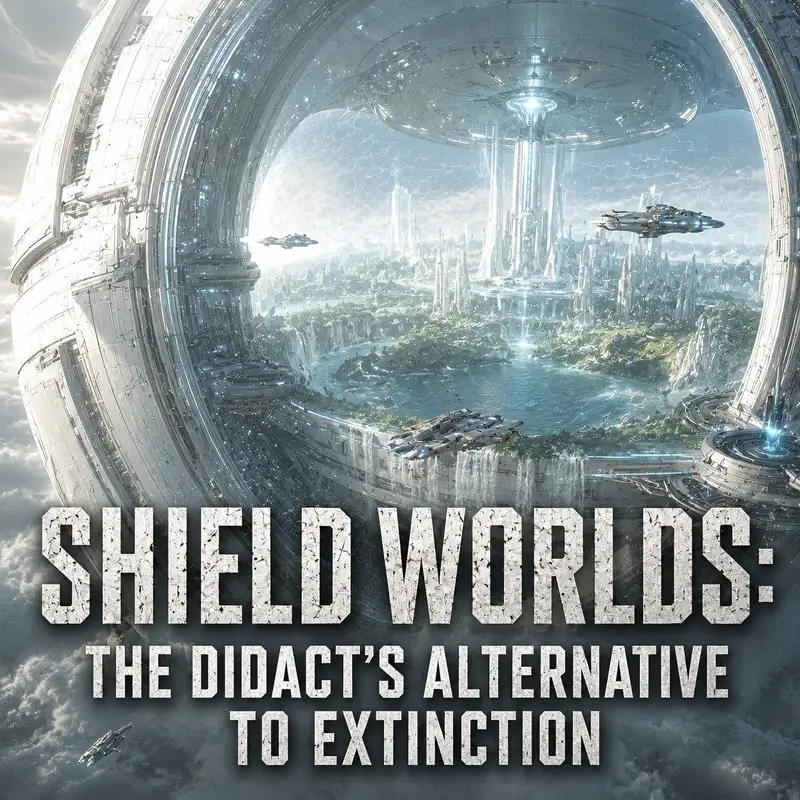
Shield Worlds: The Didact’s Alternative to Extinction
The portal inside Onyx remained open only long enough for a handful of survivors to cross. Behind them, Lieutenant Commander Kurt Ambrose detonated two nuclear warheads and denied the pursuing Covenant access. The artificial planet then came apart, revealing that much of its interior had been constructed from trillions of Forerunner Sentinels. Inside the portal waited a habitable sphere hidden within compressed slipspace, large enough to contain worlds beneath an artificial sun. The refuge worked. Its intended occupants had simply failed to arrive one hundred thousand years earlier.
Shield worlds were the Didact’s answer to a question the Forerunner government increasingly wanted answered by Halo. How could the ecumene survive the Flood without killing every sentient population it claimed a duty to protect? The Didact proposed a distributed system of fortresses, refuges, fleet bases, laboratories, and protected habitats from which the Forerunners could continue the war. Halo promised to remove the parasite’s access to thinking life in one final act. Shield worlds promised something less decisive and more difficult: preserve people, preserve military power, and keep fighting until the Flood could be contained or defeated.
The surviving evidence comes from Forerunner records, the later rediscovery of installations such as Requiem, Onyx, and Etran Harborage, and accounts written after the ecumene had already collapsed. Those sources show that shield worlds did not follow one universal design. Some were fortress worlds built around military command and heavy industry. Others were conservation spheres intended to shelter populations. Some concealed immense internal spaces within slipspace. Some carried fleets, laboratories, portals, and automated defenses. The common feature was not appearance. It was function. Each installation was meant to preserve capability in an environment where ordinary planets could no longer be defended.
Requiem, designated Shield World Zero Zero Zero One, was the earliest and most important model. It had been constructed long before the war with ancient humanity and before the Forerunners had conceived the Halo Array. It served as a fortress and operational hub for the Promethean class of Warrior-Servants. Its layered shell, internal transit systems, armories, forges, command facilities, and protected core gave the Didact a base able to survive attacks that would destroy conventional worlds. Later shield installations adapted that basic concept to the Flood crisis and, eventually, to the possibility that Halo itself might be fired.
That chronology matters. The shield-world strategy was not originally a shelter program created after Halo. It grew from an older Warrior-Servant tradition of fortified worlds and strategic redoubts. When the Flood reappeared, the Didact expanded the concept into a galactic defense system. Some planned installations would be mobile, able to enter infected systems, support local purges, and withdraw before the parasite could concentrate overwhelming strength. Others would receive evacuated populations and preserve them behind barriers the Flood could not easily penetrate. The Didact did not envision one bunker waiting for the end. He envisioned a network able to maneuver, absorb losses, and restore pressure.
The operational theory was stronger than the word refuge suggests. A shield world could serve as a fleet harbor where damaged vessels withdrew for repair, rearmament, and decontamination. It could hold reserve forces outside the enemy’s immediate reach. It could support research into the parasite without placing laboratories beside major civilian worlds. It could protect command staffs and ancillas whose loss would otherwise sever coordination across a region. If several installations remained secure, they could function as mutually supporting bases, forcing the Flood to search for dispersed targets while Warrior-Servant fleets chose when and where to reenter the fight.
The theory also preserved what Halo could not. A ring pulse could deny the Flood sentient hosts, but it could not preserve the political communities, military organizations, industrial labor, and accumulated experience already alive when the weapon fired. The Conservation Measure could reseed species afterward, but reseeding was not restoration. A population returned from genetic archives would not automatically recover its government, family networks, professional institutions, or historical memory. Shield worlds offered the possibility that living societies might survive intact enough to rebuild. The distinction was not sentimental. It was the difference between recovering a civilization and restarting biology.
For the Didact, that difference was inseparable from the Mantle. A guardian who destroyed every protected population in order to defeat the enemy had preserved life only in the most technical sense. The Warrior-Servant answer was to accept a longer, more expensive, and more dangerous campaign rather than erase the people under Forerunner protection. This did not make the Didact a modern humanitarian. His strategy still placed Forerunner command above every other species and assumed that the ecumene would decide who entered the shelters, who remained outside, and what political order emerged afterward. It was an alternative to extinction, not an alternative to Forerunner rule.
The Master Builder saw the same crisis through another institution. Faber’s Halo project promised a finite program with a measurable result. Build the rings, position them, and fire if containment failed. The Builders would control construction, testing, maintenance, and much of the command architecture. Shield worlds required continued investment in Warrior-Servants, fleets, garrisons, portals, reserve formations, and regional logistics. Halo concentrated authority. The shield-world network distributed it. The strategic dispute therefore became a political contest between rates whose power depended on different definitions of survival.
The Didact’s plan demanded patience from a government already losing confidence. A shield world could preserve a fleet, but that fleet still had to defeat the Flood somewhere outside the walls. A refuge could shelter a population, but transports had to reach it before local routes collapsed. A laboratory could study infection, but every sample introduced the possibility that the installation would become contaminated. None of these problems had one dramatic completion date. The system required thousands of correct decisions made across thousands of years. Halo required one final decision after everything else had failed. Bureaucracies often prefer the option that can be displayed as a finished project.
Scale created the first major limitation. The ecumene included roughly three million fertile worlds and populations distributed across an immense volume of the galaxy. Even a large shield-world program could not shelter everyone. Every installation required matter, energy, builders, engineers, ancillas, garrisons, and secure transportation links. Every population selected for evacuation displaced another population from available space and shipping. A refuge network could preserve substantial portions of civilization, but it could not make triage disappear. The Mantle did not provide additional transports merely because the moral problem was severe.
Selection would also be political. Which rates received protected facilities? Which regions were considered essential? Would subject species receive equal space, or would Forerunner officials classify them as biological archives rather than citizens? Would fleets take priority over civilians because military survival offered the best chance of rescuing everyone else later? A shield world could be large enough to contain landscapes and cities, yet still become the center of an argument over who was important enough to reach it. The Didact’s strategy avoided universal extermination. It did not avoid the power to decide who would be left outside.
Transportation was the next vulnerability. Evacuation required reliable slipspace routes, current intelligence, functioning portals, and enough warning to move populations before infection reached their ships. The Flood made each requirement less dependable. Captured vessels revealed routes. Compromised ancillas corrupted schedules and authentication. Star roads later distorted movement and isolated entire fleets. A refuge could remain physically secure while becoming operationally unreachable. The people most in need of protection would often be located on worlds whose communications and transportation had already begun to fail.
Incoming traffic also threatened the refuge itself. The Flood could hide inside crews, cargo, machinery, and captured intelligence systems. Screening had to identify biological infection, corrupted ancillas, hostile code, and false orders before a ship reached the protected interior. Decontamination systems could reduce the risk, but no procedure was perfect against an enemy that learned from every inspection. One missed infection form inside a crowded shelter could transform strategic depth into concentrated biomass. The larger the evacuation, the more opportunities the parasite gained to enter with the people being saved.
Etran Harborage later demonstrated both the power and fragility of the design. Shield World Zero Four Five Nine contained a habitable interior, automated defenses, cleansing systems, and an Apex Site holding a fleet of Forerunner dreadnoughts. Its exterior was nevertheless heavily infested by the Flood. The installation had kept the parasite from fully claiming its protected core, but it had not removed the threat. In twenty-five thirty-one, human and Covenant forces fought over access to the dormant fleet. The United Nations Space Command Spirit of Fire ultimately destroyed the shield world by destabilizing its internal star, sacrificing its slipspace drive to prevent the Covenant from acquiring ships that could have overwhelmed human defenses.
That later battle revealed the strategic danger of abandoned fortresses. A shield world preserved military power so effectively that the preserved force remained decisive one hundred thousand years after the government that built it disappeared. The installation did not understand the politics of the Human-Covenant War. Its fleets, portals, and security systems became objectives for whoever reached them first. Preservation without a living chain of command creates an arsenal waiting for a claimant. The Spirit of Fire prevented one catastrophe by destroying a facility originally intended to prevent another.
Shield World Zero Zero Six, hidden inside Onyx, represented a different approach. Its habitable Dyson sphere existed within a slipspace bubble compressed to a tiny presence in normal space. The artificial planet surrounding the entrance was composed of Sentinels and functioned as camouflage, security perimeter, and defensive force. Portals connected the interior to other locations, while automated systems maintained environments suitable for life. Here the refuge concept worked almost exactly as intended. The survivors who entered in twenty-five fifty-two were protected from the battle outside and from the destruction of the planetary shell.
Yet Onyx also proved why secrecy had to be nearly perfect. The Covenant discovered the installation and pursued the human force to its entrance. Kurt Ambrose’s nuclear demolition denied access, but only through a final rear-guard action that killed the officer responsible for the defense. The shield world could protect those who crossed the threshold. It could not protect the route leading to it, and it could not prevent an enemy from following unless someone held the entrance. Every refuge needs a gate. Every gate eventually becomes terrain.
Time inside the hidden sphere also passed differently from time outside. That offered protection and complicated command. A population sheltered in altered slipspace might experience only days while months passed in normal space. The effect could help occupants wait out a short crisis or avoid a Halo pulse. It could also sever them from the campaign. Orders, intelligence, and political conditions could change before they emerged. A fleet entering to refit might return after the battle it was meant to influence had ended. Strategic depth becomes strategic absence when the timing cannot be coordinated.
Requiem showed the fortress model at its most formidable. Its concentric internal structure, gravity control, teleportation network, weapons, and Promethean defenses allowed it to serve as the hub of the Didact’s operations across multiple wars. Its construction had been compartmentalized so thoroughly that even Builders responsible for components did not fully understand the final configuration. That secrecy protected the installation from political rivals and enemy intelligence. It also concentrated knowledge among a narrow Warrior-Servant elite. Once that elite was depleted, imprisoned, or corrupted, the fortress continued operating without the civilization needed to interpret its purpose.
The Didact’s later return to Requiem exposed a deeper problem in his strategy. After the Gravemind had broken his judgment, he used the Composer to turn loyal Warrior-Servants and unwilling humans into Promethean Knights. Requiem became the center of a campaign built not on preserving living civilization, but on converting minds into military units immune to ordinary infection. The commander who had opposed Halo because it destroyed life eventually treated life as material for his fortress. The shield-world concept did not cause that transformation. It did give the transformed commander a secure base, factories, and an army protected from outside review.
This is the essential weakness of every strategic refuge. It protects the people and institutions inside, including their errors. A fortress can preserve wise leadership, trained forces, and scientific knowledge. It can also preserve a failed doctrine, an unstable commander, or an automated system following orders whose context has vanished. Physical survival does not guarantee political legitimacy or sound strategy. Requiem endured because it was difficult to reach. The same isolation that protected it also allowed the Didact’s distorted interpretation of the Mantle to survive for one hundred thousand years.
The shield-world program suffered its decisive political defeat before the Flood reached its greatest strength. Builder influence convinced the Old Council that Halo offered the superior solution. The Didact continued advocating his strategy and was ordered to stop. He entered exile, the independent Warrior-Servant rate declined, and construction priorities moved toward the Array. Existing shield worlds remained useful, and some were incorporated into preservation planning, but the network never became the fully developed war system the Didact had envisioned. The ecumene built enough shelters to prove the concept and too few to make the concept its primary strategy.
Mendicant Bias then removed the advantage on which the surviving network depended. After the Primordial turned the ancilla against its creators, Mendicant revealed shield-world locations to the Flood. A distributed system remains resilient only while the enemy cannot identify and isolate its nodes. Once locations, portals, and access routes were compromised, evacuation plans became targeting information. The Forerunners could no longer assume that a population moved into a shield world had escaped notice. They might instead be concentrating civilians, military forces, and stored knowledge at a location the enemy already intended to attack.
By that stage, the Flood had also gained the means to defeat fixed fortifications without attacking them conventionally. Captured ancillas undermined security. Star roads disabled fleets and distorted slipspace. Key Minds coordinated operations across regions. A shield world could resist weapons designed by later civilizations and still be vulnerable to Precursor constructs operating outside normal Forerunner doctrine. The Didact had designed fortresses for a war in which the Forerunners retained control of movement, machines, and command. The final Flood offensive removed all three assumptions.
Could the shield worlds have worked if the Council had adopted them earlier? The available evidence supports a qualified yes. A larger, better-hidden network completed before the Flood achieved strategic intelligence could have preserved more populations, dispersed fleets, and given the Warrior-Servants secure bases for sustained counteroffensives. Requiem, Onyx, and Etran Harborage demonstrate that the installations could survive extraordinary spans and protect immense capability. The approach might have delayed collapse, reduced the need for Halo, or preserved a stronger civilization after firing.
That answer remains qualified because survival inside fortresses is not victory outside them. The Flood could consume the unprotected galaxy, gather resources, and wait. The Forerunners would still need a method to clear infected systems faster than the parasite could rebuild. They would still face compromised ships, artificial intelligences, and supply networks. A shield-world strategy required disciplined screening, reliable command, strategic patience, and political trust across the ecumene. Those were precisely the resources the Forerunners had allowed institutional rivalry to weaken.
Halo won the argument because it offered certainty where shield worlds offered responsibility. The rings promised an enemy deprived of hosts. The Didact’s plan promised a surviving force still required to make difficult decisions after entering the refuge. One system concentrated risk into a final command. The other distributed risk across generations of commanders, engineers, Lifeworkers, ancillas, and civilian authorities. Faber could point to a completed ring. The Didact had to point to a future campaign and ask the Council to believe that the military would eventually solve it.
The final Array stopped the Flood’s galactic advance, but it also confirmed the question that had produced the shield worlds. The Forerunners preserved life through indexed samples and reseeding rather than through the continued survival of their civilization. Their government, rates, families, and living memory disappeared. A small number survived outside the galaxy or within special protection, but the ecumene did not. Halo achieved the result Faber promised. It also produced the civilizational extinction the Didact had built his fortresses to avoid.
The later history of the shield worlds supplies the final judgment. Onyx became a refuge, research center, and eventually a multispecies settlement. Etran Harborage preserved a fleet so dangerous that humanity destroyed the installation rather than allow its capture. Requiem preserved the Didact, his army, and his unfinished war. Each installation succeeded at preservation. None could decide what the preserved power should be used for. That decision always belonged to whoever reached the command systems.
Shield worlds were the Didact’s alternative to extinction because they attempted to preserve more than genetic life. They preserved soldiers, institutions, knowledge, industry, and the possibility of political continuity. They failed as the ecumene’s primary defense because the Forerunners never built the complete network, never protected its secrecy, and never resolved who would control the civilization that emerged from shelter. The installations could shield life from Halo and fortify it against the Flood. They could not shield the Forerunners from their own politics. Onyx survived one hundred thousand years as a refuge whose builders never entered. The bunker was ready. The civilization had already chosen the weapon.