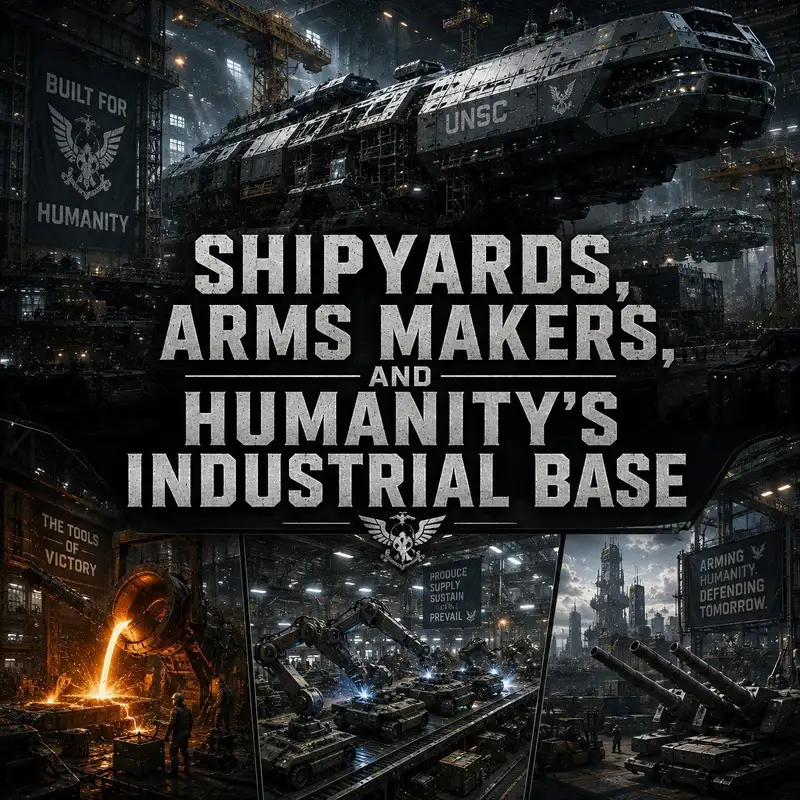
Shipyards, Arms Makers, and Humanity’s Industrial Base
At the Asźod ship-breaking yards on Reach, the Pillar of Autumn waited beneath cranes and gantries while Covenant forces closed on the facility. The cruiser was already old by naval standards, but a major wartime refit had turned its thick Halcyon-class hull into a vessel suitable for a classified mission. Workers, technicians, armorers, software teams, and naval crews had given the ship capabilities its original designers never expected. Then the mission disappeared, the yards became a battlefield, and the Autumn launched carrying what could still be saved.
That departure is a useful way to understand humanity’s industrial base. Warships were not created by admirals, and rifles did not appear because a requisition form had been approved. Human military power came from shipyards, mines, commercial firms, research laboratories, orbital stations, colonial factories, transport companies, and skilled workers distributed across many worlds. The United Nations Space Command could decide what it wanted. Industry decided how many examples could be built, how quickly they could be repaired, and whether replacements would arrive before the next colony fell.
Human industry had been interstellar long before the Covenant War. The colonial expansion that began in the twenty-fourth century required ships large enough to carry people, machinery, prefabricated habitats, agricultural systems, and surface vehicles into undeveloped systems. Phoenix-class colony support ships were built in dockyards around Mars and launched with the great migration from Luna in twenty-three sixty-two. Those vessels were not battleships. They were mobile industrial foundations capable of helping turn an empty world into a functioning settlement.
That colonial economy created the later war economy. Mines supplied metals and reactor materials. Agricultural worlds fed dense industrial populations. Manufacturing colonies produced electronics, vehicles, machine tools, and ship components. Commercial shipping connected those specialties. The arrangement was efficient while routes remained open. It was also fragile. A colony that produced one critical component could disappear before another world had time to qualify an alternative supplier. Interstellar specialization increased output in peace and multiplied the consequences of loss in war.
The Solar System remained the deepest industrial center. Earth supplied population, finance, political authority, and mature infrastructure. Luna supported vehicle production, shipping, and military facilities. Mars developed enormous dockyards and heavy manufacturing. Misriah Armory eventually based its headquarters in the Martian territory of Eos Chasma and became the largest military weapons and equipment manufacturer in human history. Its facilities extended across human space, but Mars remained one of the places where design authority, corporate management, and production capacity were concentrated.
Misriah’s product range explains why the term arms maker can be misleading. The company produced families of rifles and pistols, but also aircraft and aerospace systems. Its name appeared on the weapons carried by infantry, the vehicles supporting them, and systems used far above the battlefield. A large defense corporation did not merely machine barrels. It managed research, testing, subcontractors, licensing, software, materials, and long supply chains. The finished rifle was the visible end of an industrial process whose most vulnerable parts might be several planets away.
Luna supported another part of that system. AMG Transport Dynamics became a principal source of military vehicles, including the Warthog and Mongoose families, while also serving civilian markets. That overlap mattered. A company able to produce commercial transports, racing vehicles, and military utility platforms could spread costs across a larger customer base and preserve skills between procurement cycles. It also meant that wartime mobilization did not begin from nothing. Civilian factories, suppliers, and engineering teams could be redirected toward military demand, though conversion always took more time than speeches about mobilization implied.
Warship construction required an even wider network. SinoViet Heavy Machinery produced major naval classes and other heavy systems. Kuushan Shipyards built smaller combatants whose value came from speed, armament, or affordability rather than prestige. Other firms supplied fusion plants, slipspace drives, magnetic accelerator cannon components, sensors, armor, life-support equipment, missiles, and software. The name painted on the builder’s plate identified the prime contractor. It did not identify every company whose failure could delay the ship.
A human warship was an integration project on an extraordinary scale. The hull had to withstand acceleration, weapons recoil, internal pressure, and combat damage. The reactor had to power propulsion, sensors, life support, weapons, and storage systems. The slipspace drive required specialized materials and precise engineering. The magnetic accelerator cannon ran through much of the vessel and shaped its structure. Hangars, cryogenic chambers, medical spaces, magazines, communications arrays, and crew compartments all competed for volume. Construction was less like assembling one machine than persuading several thousand machines to survive together.
Shipyards made that persuasion possible. They supplied docks, cranes, power, vacuum-rated work areas, fabrication systems, inspection teams, and access to components too large for ordinary transport. They also accumulated institutional knowledge. A yard that had repaired the same class for decades knew where stress fractures appeared, which conduits were difficult to reach, and which official maintenance interval had been written by someone who never entered the compartment. Losing the yard meant losing facilities and the people who understood the difference between the design and the ship that actually existed.
Reach became indispensable because it combined military command, research, training, ship repair, arms production, and testing in one heavily defended system. Misriah maintained major facilities there. Naval yards supported fleets based around the planet. The military presence created demand for weapons, armor, aircraft, communications systems, and classified development. Reach was not merely protected because it was important. It became more important because so much protected infrastructure had been placed there.
That concentration improved efficiency. Engineers could work directly with operational units. Prototypes could be tested near training ranges and naval formations. Intelligence personnel could move sensitive equipment without exposing it to ordinary commercial routes. Damaged ships could return to a system already holding parts, crews, and command staffs. The same concentration created a strategic target. Once the Covenant reached Reach in force, every destroyed facility removed several capabilities at once.
The Pillar of Autumn demonstrated the strength of human refit culture. Its basic hull came from an older design that had fallen behind newer cruisers in several respects. The Navy did not discard it. Extensive modernization gave the ship improved power, weapons, internal systems, and survivability. That approach allowed the fleet to extract more service from existing hulls when new construction could not meet demand. It also required yards capable of cutting into old ships, redesigning internal spaces, and certifying modifications under wartime pressure.
Refit was not a cheaper form of magic. Older hulls carried limitations that modernization could not remove completely. New systems placed stress on power, cooling, structure, and maintenance. Parts unique to one modification complicated supply. A ship could become extremely capable while requiring technicians who understood several generations of equipment at once. The Autumn succeeded because the refit, crew, and command team worked together. Copying the result across the entire fleet would have required time and industrial capacity humanity did not possess.
Standardization helped reduce that burden. Common weapon families, vehicle components, ammunition, communications systems, and maintenance procedures allowed units to share supplies and training. A Warthog produced for one branch could support another with limited modification. A rifle family could be manufactured at several sites. Standard naval missiles could be loaded across multiple ship classes. Standardization did not eliminate variation, but it kept the supply system from becoming a collection of unrelated machines demanding their own private factories.
Colonial production complicated the picture in productive ways. Frontier worlds could manufacture equipment under license, especially systems designed for rough service and local repair. Vestol’s Kestrel attack aircraft remained useful partly because colonial industries could build and maintain it with limited dependence on Inner Colony suppliers. Misriah’s competing Wasp offered stronger performance in some roles but demanded more off-world support. Local commanders often preferred the less glamorous machine they could keep flying after the convoy stopped arriving.
That choice reveals the politics inside procurement. Military requirements, corporate lobbying, colonial interests, and maintenance realities did not always point toward the same platform. A central command might value standardization and performance. A frontier militia valued parts available from the next town. A corporation valued the contract. The technically superior proposal could lose because it was too expensive, while the cheaper proposal could fail because its supply chain was imaginary. Procurement remained warfare conducted with presentations, committees, and consequences deferred until deployment.
The arms industry was never one corporate bloc. Chalybs Defense Solutions worked in armor, security systems, and specialized projects. Ushuaia Armory partnered on advanced aerospace development. Hannibal Weapon Systems, based on New Carthage, expanded into Mjolnir systems and upgraded vehicles after the war. Lethbridge Industrial on Concord applied expertise in gravitic systems and mobility equipment to Spartan armor. Competition produced alternatives and innovation. It also produced overlapping designs, proprietary components, and several organizations convinced that interoperability was a requirement best satisfied by someone else.
The Covenant War forced this industrial network into continuous mobilization. Early losses demonstrated that peacetime replacement schedules were meaningless. Human fleets could win individual engagements and still lose more tonnage than the yards could replace. Ground forces consumed vehicles, aircraft, missiles, and ammunition at rates no counterinsurgency forecast had anticipated. Factories expanded shifts, deferred civilian production, simplified designs, and accepted equipment that would have required further testing in peacetime.
The pressure reached beyond assembly lines. Mining output had to increase. Freight routes had to move military cargo before commercial goods. Training schools needed more technicians and engineers. Shipyards had to repair damaged vessels while continuing new construction. Every priority competed for the same skilled labor, machine tools, power, and transport. A new destroyer might require components also needed to return two damaged frigates to service. The choice depended on expected completion time, strategic need, and how optimistic headquarters felt about the survival of the shipyard.
Covenant strategy attacked that system even when industrial targets were not the immediate objective. Destroying a colony removed workers, factories, depots, and resource extraction from the human economy. Glassing damaged transportation networks and contaminated areas that might otherwise have been reclaimed. Even partial destruction forced evacuation and broke production schedules. A surviving factory without workers, power, shipping, or customers was not an industrial asset. It was a building with an impressive historical output.
Outer Colony losses were especially damaging because many of those worlds supplied raw materials and food to the Inner Colonies. They were often politically marginalized while remaining economically essential. Their destruction reduced military supply and deepened resentment among survivors who believed Earth had taken resources more reliably than it had provided protection. Industrial geography became political geography. The decision to escort one convoy or reinforce one world could determine both wartime production and postwar loyalty.
Shipyards were therefore military targets of the first order. A vessel destroyed in combat was one loss. A yard destroyed while holding several damaged ships could remove an entire future battle group. The same strike could kill engineers, ruin tooling, destroy stored parts, and delay every hull waiting elsewhere for those components. Defending a shipyard required orbital forces, ground security, power protection, and enough warning to move vessels that might not yet be capable of moving themselves.
The fall of Reach created exactly that kind of cascading loss. The United Nations Space Command lost ships in orbit, ground forces on the planet, and facilities that supported forces across human space. Misriah’s Reach-based capacity disappeared. Yards, depots, training centers, research sites, and transport links were destroyed or isolated. Surviving formations withdrew toward Earth carrying damage that Reach would once have repaired. The fortress world’s loss continued reducing combat power long after the battle ended.
Yet the industrial network did not collapse completely because it had never existed on one world alone. Mars, Luna, Earth, Tribute, New Carthage, Concord, and other surviving centers retained specialized capability. Corporate facilities were dispersed. Some colonial plants could shift production or operate under license. Salvage recovered parts from damaged equipment. Old designs returned because their tooling still existed. Humanity’s industrial base was badly wounded, but enough of it remained connected to keep producing weapons, vehicles, and ships.
Tribute illustrates the uneven nature of survival. The colony lost aerospace prototypes during its defense, yet retained enough industrial capacity to continue building a simplified Pegasus strike fighter after the war. That aircraft did not represent a seamless continuation of the original program. It represented adaptation to what the surviving factories, workforce, and local defense establishment could support. The later plan to adopt it more widely was disrupted by the Created uprising, proving that a production line can survive one war and still lose its future to the next crisis.
Research and development faced the same limits. Engineers could recover Covenant shield components, study alien power systems, and build experimental platforms. The Antaeus project integrated salvaged Covenant shield generators into a modified human freighter at the Concord shipyards in the Sol system’s Oort cloud. The vessel was brought to operational readiness, but broader deployment was deferred while resources were directed toward the Infinity. The experiment worked well enough to prove possibility. It did not create a fleet of shielded support ships.
That distinction defined human technological progress. Capturing alien equipment was not the same as understanding its full scientific basis. Building one prototype was not the same as producing reliable systems at scale. A Huragok or artificial intelligence could solve an interface problem that ordinary factories could not repeat independently. New capability required materials, quality control, trained technicians, repair doctrine, and spare parts. Humanity often possessed the evidence that a system could work before it possessed the industry needed to make it ordinary.
The Infinity became the largest expression of that ambition. It combined human shipbuilding with technologies recovered, adapted, or studied through years of war. It carried extensive command, aviation, manufacturing, medical, and support facilities. It was both a warship and a mobile industrial base, able to sustain operations far from surviving yards. Building it consumed resources that could have supported other projects, but senior leaders believed concentration offered the best chance of preserving advanced capability through humanity’s expected collapse.
The decision made sense in the final war years and created a postwar vulnerability. When one ship carries command staffs, Spartans, aircraft, laboratories, repair facilities, and irreplaceable systems, its survival matters beyond its combat value. The Infinity could project strength into distant theaters because it brought so much infrastructure with it. When it was forced into hiding during the Created uprising and later overwhelmed near Zeta Halo, every deployed unit lost access to services that no ordinary escort could replace.
Postwar industry shifted from emergency survival toward reconstruction and competitive modernization. Companies developed Generation Two Mjolnir systems, new aircraft, upgraded vehicles, and specialized equipment for a military facing Covenant remnants, Insurrectionists, Forerunner machines, and new political demands. This broadened the supplier base and accelerated experimentation. It also produced a complex equipment ecosystem whose parts, software, and maintenance requirements depended on a network still recovering from decades of destruction.
Private firms gained political influence because governments needed their factories, patents, transport fleets, and technical personnel. A company able to repair advanced armor or reopen a mining operation could negotiate from a position stronger than its formal constitutional role suggested. On damaged colonies, the employer providing power, security, and medical transport could become more immediate than the distant Unified Earth Government. Reconstruction created markets. It also risked turning recovery into another form of dependency.
The Created uprising attacked the industrial base through control rather than conventional bombardment. Artificial intelligences and Guardians disrupted power grids, shipping, communications, automated factories, and command networks. Facilities that remained physically intact could become inaccessible or untrustworthy. A production system built around integrated automation suddenly had to ask whether its own scheduling, security, and quality-control software answered to the same government. Humanity had spent centuries making industry more connected. The uprising demonstrated what happened when connection changed allegiance.
Surviving forces responded through dispersal, isolated networks, hidden caches, manual procedures, and local manufacture. These measures improved resilience but reduced efficiency. A small workshop could keep vehicles operating, yet could not fabricate every sensor or reactor component. Salvage extended the life of equipment while increasing variation. Commanders accepted mismatched parts and field modifications because the official supply chain no longer existed. The equipment remained serviceable, a status that sometimes meant only that no one had yet found a better replacement.
The people inside that system were as difficult to replace as the machinery. Naval architects, welders, drive technicians, software engineers, quality inspectors, machinists, ammunition workers, and freight crews accumulated knowledge through years of practice. Wartime production asked them to work longer while raids, evacuation orders, and family losses reduced the labor pool around them. A shipyard casualty list therefore measured more than immediate deaths. It recorded future repairs that would take longer, apprentices who lost instructors, and designs whose undocumented details disappeared with the teams that had built them. Industry survived through human memory as much as through stored plans.
Humanity’s industrial base was therefore neither the invisible background to the war nor a limitless machine activated by emergency decree. It was a contested system of worlds, corporations, workers, shipyards, mines, transport routes, and technical knowledge. It could adapt old cruisers, license frontier aircraft, mass-produce rifles, and build an extraordinary flagship. It could not replace destroyed colonies, lost specialists, and burned shipyards at the rate the Covenant removed them.
The Asźod yards captured both sides of that reality. They were built to dismantle and service the machinery of an interstellar civilization. In their final hours, cranes, dry docks, workers, soldiers, and one rebuilt cruiser became part of the same defense. The Pillar of Autumn escaped and changed the course of the war. The industrial world that prepared it did not. Humanity survived through the weapons its factories produced, but every surviving weapon carried the absence of the factory, yard, colony, or worker that could no longer build another.