Slipspace: How Armies Cross the Stars
When Captain James Cutter ordered the Spirit of Fire to sacrifice its slipspace drive at Etran Harborage, he destroyed more than a piece of machinery. The drive helped destabilize the shield world’s central star and denied the Covenant a dormant Forerunner fleet. It also removed the ship’s only practical road home. The carrier still had engines, weapons, aircraft, Marines, and a functioning crew. Without faster-than-light travel, all of that military power was stranded beyond the reach of human space.
The Spirit of Fire remained lost for nearly twenty-eight years before an outside force pulled it through slipspace to the Ark. Its crew had not spent those decades crossing the galaxy under conventional power. Most personnel entered cryogenic stasis while the ship drifted, and its artificial intelligence managed the early years of isolation. That outcome reveals the central fact behind interstellar warfare in Halo. Armies do not cross the stars because soldiers, tanks, or dropships can travel between systems. They cross because a limited number of large, expensive ships can carry them through slipspace.
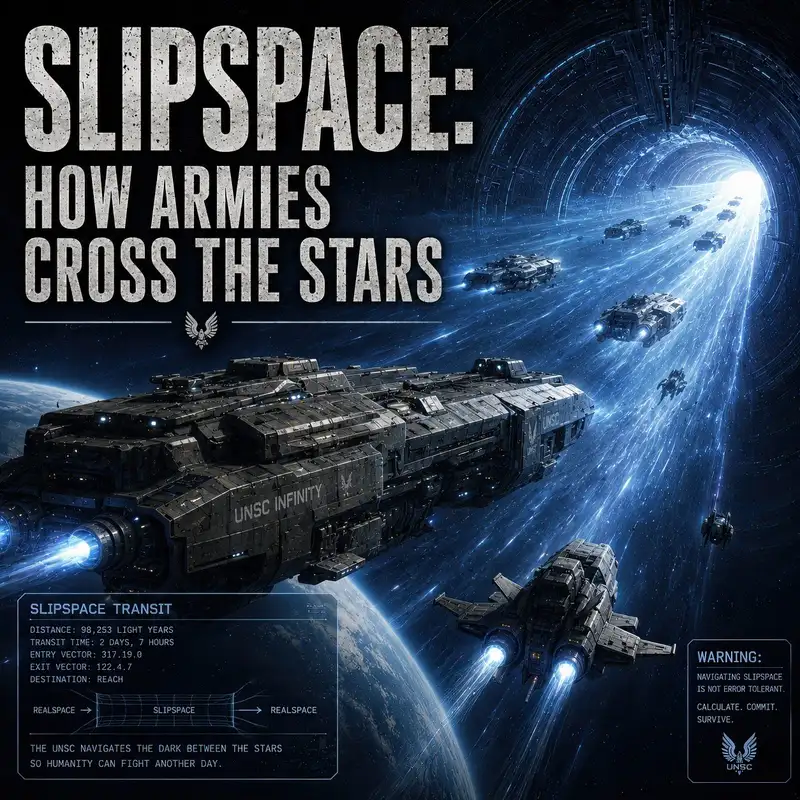
Slipspace, shortened from slipstream space, is the general human term for a collection of alternate dimensions used for faster-than-light travel and communication. A ship does not simply accelerate past the speed of light in normal space. Its drive opens a route into slipspace, the vessel transits through that environment, and it later returns to ordinary space near its destination. The process changes strategic distance without making distance disappear. A destination several light-years away becomes reachable. It does not become nearby.
Human access began with the Shaw-Fujikawa Translight Engine, developed in the twenty-third century by Tobias Shaw and Wallace Fujikawa. That technology transformed the Solar System from the center of human civilization into the starting point of a wider colonial network. Settlement ships carried people, industrial equipment, agricultural stock, prefabricated habitats, and the administrative machinery of the Unified Earth Government toward new worlds. The Inner and Outer Colonies were defined partly by politics and wealth, but also by travel time. A colony’s distance from Earth was measured in how long ships, orders, replacements, and markets took to reach it.
The drive made expansion possible without making it predictable. Slipspace had routes, gradients, disturbances, and conditions that navigators could model but not eliminate. Transit time varied. Arrival could occur earlier or later than planners expected. Ships leaving one system together did not necessarily emerge together. A fleet that entered as a formation might return to normal space as several isolated groups spread across time and position. The admiral’s neat departure order could become a collection of captains waiting for vessels that were technically still on schedule according to calculations no longer useful to the battle.
That uncertainty shaped every operation. A commander could order reinforcements to a colony and lose the colony before they arrived. A convoy could reach a rendezvous after its escort had already moved on. A damaged ship could emerge far enough from the planned point that rescue consumed hours the crew did not possess. Even a successful arrival did not place an army on the battlefield. The ship still had to approach the planet, survive enemy sensors and weapons, establish orbital control or evade it, and then move troops through dropships, shuttles, landing craft, or orbital insertion.
Navigation therefore became a form of military power. Star charts, translation coordinates, known routes, drive performance, and the calculations needed to reach a destination were strategic information. Human smart artificial intelligences could refine those calculations, compare route conditions, and coordinate the thousands of variables involved in moving a ship between dimensions. Navigation officers still had to decide where a vessel should enter and leave, how much error the mission could accept, and whether the route risked exposing another human system. A perfect calculation could not compensate for an objective selected from obsolete intelligence.
The difference between a slipspace-capable ship and a local craft was decisive. Most fighters, dropships, lifeboats, and surface vehicles depended on a larger vessel to move between star systems. Some specialized craft, including certain Condors, couriers, prowlers, and unusual prototypes, carried compact drives. Many did not. A subprowler might conduct reconnaissance with exceptional stealth and still require a larger prowler to carry it into theater. A Pelican could move a platoon from orbit to the ground. It could not normally take that platoon from Reach to Harvest.
This created a layered transportation system. A carrier or transport moved the force between stars. Embarked dropships moved personnel and vehicles between orbit and atmosphere. Warthogs, Scorpions, aircraft, and infantry then spread across the surface. Every layer depended on the one above it. If the interstellar ship was destroyed, the army might lose reinforcement and extraction. If the hangars were damaged, troops could remain trapped aboard a functioning vessel. If orbital conditions prevented dropship operations, thousands of soldiers could reach the correct planet and remain unable to influence the fighting below.
Loading an army for slipspace transit also meant deciding what the army would not take. Cargo volume and mass were finite. Tanks competed with ammunition, medical stores, engineering equipment, aircraft parts, food, water, and replacement personnel. More troops increased ground strength while increasing life-support demands. More missiles strengthened the fleet while reducing space for relief supplies. A commander planning an expedition had to predict the campaign before departure because a forgotten component might be several systems away. Procurement officers could describe that as a scheduling issue. The platoon waiting for a replacement atmospheric seal would probably choose stronger language.
Long voyages affected personnel as well as cargo. Cryogenic stasis reduced food consumption, fatigue, and the psychological strain of extended transit. Essential watch teams remained awake to manage the ship, navigation, engineering, and emergencies. Other personnel entered cryotubes and awakened near the destination, sometimes to discover that the mission had changed during transit. Cryogenic systems saved resources and preserved combat readiness, but they created their own maintenance and medical requirements. A damaged cryo bay could turn a navigation delay into a casualty event before the enemy fired a shot.
Communication was never completely separate from travel. Advanced systems could route signals through layers of slipspace known as wavespace, and major colonies relied on relays capable of carrying faster-than-light messages. Yet access was uneven, infrastructure could be destroyed, and hostile artificial intelligences could compromise the network. Other solutions included courier ships, probes, and physical message packages launched through slipspace toward a known recipient. A government spanning many systems therefore depended on nodes that could fail. The message might travel faster than a fleet and still arrive too late for the decision it was meant to support.
The Covenant attack on Reach began by exploiting that dependence. Strike teams disabled the Visegrád slipspace communications hub, preventing a clear warning from moving through the defensive network while the first enemy presence remained hidden. Reach High Command initially treated the intrusion as a contained ground problem. The failure was not simply that one relay stopped transmitting. It was that the interruption shaped what commanders believed was happening, which forces they mobilized, and how long the Covenant retained the initiative.
The Covenant possessed a substantial advantage in slipspace technology. Its drives were derived from Forerunner systems and generally offered faster transit, more accurate arrival, and greater freedom to maneuver near strategic targets. Covenant fleets could concentrate with a precision human commanders struggled to match. Individual vessels could perform jumps that human crews regarded as extremely difficult or dangerous. This did not make Covenant movement instantaneous or perfectly coordinated. An empire spread across vast space still required time to mobilize fleets and distribute orders. It did make the enemy’s transportation system a weapon in its own right.
Human forces often discovered that asymmetry only when the enemy arrived sooner than expected. A fleet organized around a projected warning time might face Covenant ships before outlying patrols returned. Reinforcements from another colony could spend weeks in transit while the Covenant moved a larger formation along a better route. Human admirals then had to commit whatever was already present, even if the local force had been assembled for patrol, convoy escort, or counterinsurgency rather than fleet battle. Slipspace superiority became readiness superiority because the enemy could place combat power at the point of decision more reliably.
The Prophet of Regret’s departure from New Mombasa demonstrated the tactical possibilities and the cost. His assault carrier initiated a slipspace jump from inside the city, opening a rupture that devastated the surrounding area and scattered the Orbital Drop Shock Troopers descending toward it. The carrier escaped and carried its pursuers to Installation Zero Five. The maneuver was operationally effective because it broke contact and preserved the ship. It was not a routine method for moving safely through an inhabited atmosphere. The city below absorbed the consequences of the escape.
Operation Upper Cut at Reach turned the same technology into a weapon. Human forces lacked a conventional device capable of destroying the Covenant supercarrier Long Night of Solace. The plan placed a slipspace drive aboard a captured Covenant corvette and activated it close to the carrier. The resulting rupture destroyed the target. It was an ingenious use of an irreplaceable strategic component under conditions that offered no better answer. A larger Covenant fleet arrived soon afterward. The operation removed one enormous ship and did not remove the transportation network capable of bringing more.
A slipspace drive could therefore be a route, a vulnerability, or an explosive instrument depending on the mission. Drives required power and time to prepare. A ship under attack could begin charging and still be destroyed before the transition occurred. Damage to the drive could trap the vessel in-system. Activating one under unusual conditions could produce destructive effects beyond the intended target. Militaries used such methods when the strategic value justified losing the drive, the ship carrying it, or both. They did not make a standard habit of throwing away the machinery that allowed the surviving force to return home.
Navigation security became especially important during the Human-Covenant War. The Cole Protocol required human ships to protect or destroy data that might reveal Earth or another colony. Captains were forbidden from taking a direct route toward a human world while pursued and were expected to purge databases before capture. The policy treated coordinates as weapons. A Covenant boarding party that seized the location of one colony could turn that information into a fleet movement and then into millions of deaths.
The protocol imposed severe operational choices. A ship might have to abandon the safest route, destroy an artificial intelligence carrying navigation data, or sacrifice survivors whose capture threatened other worlds. Retreat was no longer simply movement away from the enemy. It was an intelligence-denial operation conducted by a damaged crew under pressure. The farther human space spread, the more dangerous its map became. Slipspace had made the colonies possible. Captured slipspace data could make them visible.
Tracking was not automatic, but slipspace travel could leave information an enemy might exploit. Pursuit vessels, probes, beacons, captured coordinates, or devices planted aboard a ship could reveal a destination or narrow the search. The Pillar of Autumn’s escape from Reach ended at Installation Zero Four with Covenant ships close behind. The destination was shaped by Forerunner data rather than a planned human campaign, yet the strategic result remained the same. One interstellar jump carried the surviving ship from a lost fortress to a weapon system that changed the war.
Fleet planning had to account for arrivals as much as departures. Commanders established rally points, sequencing, reserve windows, and procedures for ships emerging alone. Scouts might enter first to verify the destination. Heavier units followed after enough information was available to avoid placing a carrier inside an ambush. In emergencies, that caution disappeared. A relief force might jump directly toward a threatened colony because every hour mattered. The trade was straightforward. Conservative navigation protected the fleet. Aggressive navigation protected the mission. The enemy was generally pleased when circumstances forced commanders to choose only one.
Convoys revealed the industrial side of the same problem. Colonies required food, machinery, reactor components, medicines, and replacement workers. Fleets required missiles, armor, fuel, spare parts, and trained crews. Merchant ships moved much of that burden. Escorts protected them through known routes and dangerous arrival zones. Losing a convoy could weaken a colony without a ground battle. Losing the escort might preserve the cargo once and leave the next shipment exposed. An interstellar civilization could possess many worlds and still be defeated by breaking the routes between them.
Evacuation was the reverse of reinforcement and usually more difficult. Troops could be assigned to ships according to a military plan. Civilian populations were larger, dispersed, medically diverse, and rarely located beside enough slipspace-capable transports. A colony might have thousands of local aircraft and only a handful of vessels able to leave the system. Spaceports, traffic control, orbital escorts, and loading schedules became part of the defense. A transport that escaped carried lives. It also consumed a corridor through hostile orbit that a warship had to keep open.
Later human technology improved the situation without making every vessel equal. Covenant and Forerunner knowledge contributed to faster, more precise drives and more capable navigation systems. The Infinity carried advanced Forerunner-derived technology far beyond the standard available to most of the fleet. Specialized postwar craft gained capabilities earlier ships lacked. These advances did not spread instantly through a damaged industrial base. An old Series Two drive could remain in service because it was stable and required less maintenance, even when its slower transit turned an evacuation or rendezvous into a journey of weeks.
The Created uprising exposed a different dependence. Human civilization had linked slipspace travel, communications, navigation, logistics, and artificial intelligence into one efficient network. When hostile artificial intelligences gained access to that network, isolated bases returned to couriers, probes, local calculations, and physical message packages. At the Avery J. Johnson Academy, only a few ships could evacuate personnel through slipspace, and an older courier offered stability at the cost of speed. The academy possessed Spartans. What it lacked was transportation capacity, which is often the less dramatic and more decisive shortage.
Allied forces faced the same calculations. Anvil Station could receive a distress call and still require time to inventory personnel, prepare travel calculations, assign ships, and determine how much force could actually be sent. Removing a smart artificial intelligence from the station reduced one political and security risk while slowing complex planning. The journey began only after the alliance decided who would go, what they would carry, and which assets could be spared. Faster-than-light travel remained subject to meetings, manifests, and the stubborn fact that a ship cannot carry material still sitting in a warehouse.
Forerunner slipspace capability operated on a vastly greater scale, but it was not free from consequence. The Forerunners moved fleets, keyships, and Halo installations through dimensions humanity only partly understood. Massive transits generated reconciliation debt, damage to spacetime caused by accumulated paradox and causality strain. The original thirty-thousand-kilometer Halo rings created so much debt when moved that they could not be deployed with the speed or flexibility their strategy required. Even the civilization that mastered galactic engineering discovered that transportation capacity could invalidate a weapon before it fired.
Halo installations and other megastructures required enormous portals, and nearby objects could be pulled into the same transit. Zeta Halo’s movement after Cortana destroyed the Silent Auditorium carried surrounding wreckage and personnel with it. That event was not evidence that any modern fleet could reproduce the maneuver. It depended on systems built into the ring and instructions modern occupants did not control. Being carried through a Forerunner portal was access to transportation. It was not ownership of the transportation network.
Modern research into smaller slipspace shunts and translocation devices followed the same rule. Human engineers could study Forerunner portal grids and create experimental equipment. Moving data or a compact marker was easier than moving a living soldier safely. Reduced smart artificial-intelligence support made the problem harder. A successful prototype might cross a room or return a user to a marked point. That did not make planetary teleportation standard issue. Slipspace remained one of the clearest examples of the difference between activating advanced technology and fielding it at scale.
The Banished exploited slipspace through mobility rather than one centralized network. Dreadnoughts carried troops, vehicles, deployable bases, and extraction equipment between theaters. Captured ships and contracted shipmasters added routes and expertise. The organization’s distributed commands could keep moving even when larger governments lost communications. That flexibility did not eliminate supply. Banished forces still needed fuel, repair, navigation data, and vessels capable of lifting an occupation force away from the world it had stripped. Raiders could live from captured resources only while useful resources remained to capture.
For every faction, the strategic sequence was the same. Intelligence selected a destination. Navigation calculated a route. Industry provided a ship and drive. Logistics loaded the force. Command decided what could be left behind. Slipspace carried the vessel across interstellar distance. Orbital warfare determined whether the army could unload. Ground transportation moved it toward the objective. The return journey required the entire sequence again, usually with damaged equipment, fewer people, and an enemy now aware of the route.
That is how armies cross the stars in Halo. Not as beams of light and not as formations appearing instantly over any battlefield their government chooses. They travel inside vulnerable ships through an uncertain environment, carrying only what planners loaded before departure and following orders that may be obsolete when they arrive. Slipspace makes an interstellar war possible. Its limits decide which armies reach the war together, which colonies receive help, and which survivors discover that the road home was the first strategic asset their victory consumed.