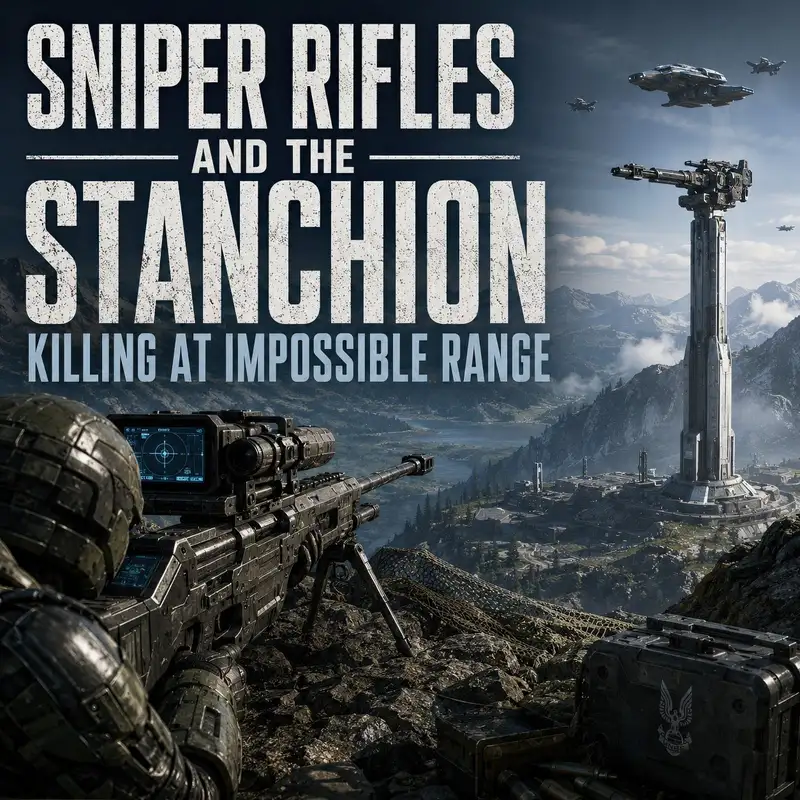
Sniper Rifles and the Stanchion: Killing at Impossible Range
August-099 watched the Arcadian clearing through the scope of an M ninety-nine Stanchion. Three Kig-Yar salvagers stood beside a captured Phantom, convinced their transaction had ended successfully. Omega Team was already in position. August gave the signal and fired three rapid shots. The tungsten projectiles crossed the distance so quickly that the targets had almost no interval in which to recognize the ambush. The scene lasted seconds. The capability behind it had taken decades of weapons development, specialized manufacturing, trained observation, and a shooter able to distinguish the decisive target from everything surrounding it.
That is the central problem of long-range killing. Distance protects the shooter, but it also magnifies every mistake. A small error in range, wind, target movement, weapon alignment, or identification becomes a complete miss or a fatal hit on the wrong person. The United Nations Space Command answered that problem with two related but very different approaches. The S R S ninety-nine family used an enormous conventional cartridge and became the dependable anti-materiel rifle of human forces. The Stanchion used electromagnetic acceleration to make several kilometers feel uncomfortably close.
The familiar S R S ninety-nine was never simply a large rifle intended for dramatic headshots. Misriah Armory built the family as a semiautomatic anti-materiel system. Its standard fourteen point five by one hundred fourteen millimeter ammunition placed it in a class far above ordinary infantry rifles. Armor-piercing sabot projectiles gave trained users the ability to engage personnel, exposed equipment, light material, and vulnerable components at ranges where assault rifles had become little more than optimistic noise. A four-round magazine reflected the weapon’s purpose. Each shot was expected to solve a specific problem.
The rifle’s bullpup layout kept much of its action behind the firing grip, preserving a long barrel without creating an even longer overall weapon. That helped, although no arrangement could make the system small. The ammunition was heavy, the optic was substantial, and recoil management demanded a stable firing position and disciplined technique. Marines, Army personnel, Orbital Drop Shock Troopers, and Spartans all used members of the family. The rifle did not require augmentation. A Spartan could carry it farther, fire it from less forgiving positions, and recover more quickly, which is not the same thing.
Long-range accuracy began before the trigger was touched. The shooter or spotter had to locate the target, confirm identity, measure distance, study movement, judge atmospheric conditions, and decide whether the surrounding terrain offered a safe line of fire. On a human battlefield, the same uniform might appear on both sides during an insurrection. During the Covenant War, species and armor made identification easier at first glance, but energy shields, active camouflage, decoys, and unfamiliar equipment created new problems. Precision was not merely the ability to hit a point. It was the ability to know which point deserved a shot.
The sniper team also served as a reconnaissance element. An optic that could find a commander could also count vehicles, identify weapon emplacements, watch a landing zone, and warn a unit that the enemy was moving around its flank. Jun-A266’s use of an S R S ninety-nine on Reach illustrates this broader role. From concealed observation, he did not merely wait for a target to enter the reticle. He watched the formation approaching Noble Team’s position and reported what the rest of the unit could not yet see. The information often mattered before the rifle fired.
Smart-linked optics expanded that function. A scope could pass imagery and aiming data into a helmet display, while Mjolnir systems could combine the rifle’s view with motion tracking, communications, and other sensors. Later optics offered stronger processing and more flexible magnification. None of this abolished marksmanship. A computer could provide a solution based on available data. It could not guarantee that the wind estimate remained valid halfway to the target, that the target would continue moving at the same speed, or that the intelligence report had identified the correct officer.
Time of flight becomes an operational issue at extreme distance. Even a very fast conventional projectile takes time to cross several kilometers. The target may step, turn, enter cover, or be obscured by another person after the shooter commits. Air density, crosswind, elevation, and the angle between shooter and target affect the result. Halo’s weapons benefit from advanced sensors and ammunition, but the physical problem remains recognizable. The farther the shot, the more the engagement resembles a coordinated calculation conducted under pressure rather than an individual act of instinct.
The S R S ninety-nine’s semiautomatic action gave the shooter an important advantage when the first calculation proved incomplete. A second round could follow without manually cycling the weapon. That mattered against moving targets and against enemies protected by personal energy shields. The first impact might weaken or collapse the shield without reaching the body beneath it. Another shooter could strip the protection with plasma or automatic fire, allowing the sniper to exploit the opening. A perfectly placed round remains dependent on what is protecting the target when it arrives.
This is one area where gameplay creates a misleadingly tidy history. A shielded Sangheili does not become universally vulnerable because a reticle reaches the head. Shield strength varies with equipment, rank, prior damage, and circumstance. Jiralhanae armor and physical resilience can demand follow-up fire. Mgalekgolo present an entirely different target problem. The rifle was lethal because it concentrated substantial kinetic force with unusual accuracy. It was not a ceremonial guarantee that every enemy would fall in one shot.
Anti-materiel work often offered better returns than firing at the most visible soldier. A marksman could damage a sensor, disable an exposed weapon operator, penetrate light cover, or destroy a component that an entire enemy position depended upon. A rifle team overlooking a landing zone might delay a dropship’s ground operation by targeting personnel and equipment rather than trying to destroy the aircraft itself. The effect was operational rather than theatrical. One well-chosen shot could prevent an enemy system from functioning long enough for friendly forces to maneuver.
The weapon’s limitations followed it everywhere. Four rounds disappeared quickly in a sustained fight. Spare magazines and fourteen point five millimeter ammunition were heavy. The rifle’s report and projectile shock revealed that a powerful weapon was active even when they did not immediately reveal the exact firing point. Dust, glass, precipitation, thermal conditions, and damaged optics reduced effectiveness. A sniper who remained in the same hide after several shots invited artillery, air attack, patrols, counter-sniper fire, or a Covenant response involving rather more plasma than the original position had been designed to absorb.
The S R S ninety-nine family changed across decades without abandoning its central purpose. Early C-series rifles, later D-series weapons, the S five configuration used during the fall of Reach, and postwar systems all reflected changes in optics, materials, ergonomics, and combat integration. The S seven carried the role into the fighting around Zeta Halo. These were not identical rifles wearing different labels, but neither did every new model make the previous one useless. Armories retained what could still be supplied, repaired, and trusted.
That continuity explains the rifle’s broad service. A conventional cartridge could be produced through established ammunition plants. Armorers already understood the operating system. Training programs existed across several branches. A unit could carry the weapon without also transporting a unique electrical infrastructure. The result was not inexpensive in any ordinary sense, especially when high-grade optics and precision ammunition were included. It was affordable enough to distribute, supportable enough to deploy widely, and powerful enough to remain relevant against enemies humanity had never expected to meet.
Exceptional shooters pushed the platform beyond what ordinary qualification standards suggested. Linda-058 was the clearest example. Her skill with sniper weapons allowed Blue Team to control spaces that other units could not safely enter, and her customized rifle, Nornfang, reflected a relationship between shooter and weapon developed through long service. Her record should not be treated as the normal performance of every Spartan or every S R S ninety-nine. It demonstrates what the system could achieve when extraordinary perception, augmentation, armor integration, and experience aligned.
The same caution applies to every famous sniper. A shooter’s reputation can make the shot appear solitary, but the position was often reached by aircraft, vehicle, ship, or a team moving through hostile terrain. Intelligence selected the objective. Communications passed the order. Armorers maintained the rifle. Logistics delivered the ammunition. Other troops secured the escape route or created the diversion. The rifle’s most celebrated moment may involve one person and one trigger. The operation supporting that moment is rarely a one-person achievement.
The M ninety-nine Stanchion took the pursuit of range in a different direction. Its full designation identified it as a special-application scoped rifle, but that understated what the weapon actually did. The Stanchion was a coilgun. Instead of relying on expanding propellant gases to drive a large projectile down the barrel, electromagnetic coils accelerated a much smaller tungsten round to extraordinary speed. It shared the broad principle behind human magnetic accelerator weapons, although calling it a handheld ship cannon gives both the rifle and the ship cannon rather unfair expectations.
Original technical records describe a five point four millimeter projectile leaving the M ninety-nine at roughly fifteen kilometers per second. The rifle carried ten rounds and weighed about twenty kilograms when loaded. Its useful killing distance extended across several kilometers. At those velocities, a target four kilometers away could be struck in a fraction of a second. Lead and projectile drop did not disappear, but their window became dramatically smaller. The shooter could engage a moving target before the target’s last observed position had become ancient history.
The small caliber did not mean a small effect. At hypervelocity, the Stanchion’s narrow tungsten projectile delivered concentrated energy and exceptional penetration. It was intended for anti-materiel work as much as personnel. The result could pass through protective material that would stop ordinary rifle ammunition, then continue into whatever lay behind it. That capability created a demanding responsibility. A safe backstop was not a range-safety formality. It was part of target selection, especially near pressure vessels, civilian structures, vehicles carrying hazardous material, or friendly forces beyond the objective.
The Stanchion’s first important history was not written against the Covenant. In March of twenty-five oh two, Corporal Avery Johnson used one during Operation KALEIDOSCOPE to assassinate Jerald Mulkey Ander, a separatist leader connected to unrest on Harvest. Johnson and a spotter established a distant firing position, waited for Ander’s vehicle, and completed the mission with a precision shot. The weapon that later became associated with humanity’s survival had first served the government’s campaign against other humans.
That origin matters. Precision weapons are often described as cleaner because they can reduce the area exposed to force. The description is technically reasonable and politically incomplete. The Stanchion allowed a state to remove an individual from great distance with limited warning and little opportunity for response. Whether a target is a battlefield commander, an armed separatist, or a political figure depends on intelligence and authority outside the weapon. The projectile is exact. The decision may be based on uncertain reporting, contested legitimacy, or a classified policy the public will never examine.
The original M ninety-nine’s production run ended before the Human-Covenant War had reached its most destructive years, but the weapon did not vanish. Existing rifles remained in inventories, later versions appeared, and isolated forces found reasons to reproduce the capability. This is a common military pattern. A specialized system may leave mass production while surviving in armories because no ordinary replacement performs the same task. The Stanchion was old enough to acquire a reputation and rare enough that seeing one still meant someone expected an unusually difficult target.
Rarity explains why the Stanchion never replaced the S R S ninety-nine. It was heavier, more specialized, dependent on magnetic acceleration systems, and supported by ammunition and components that were not standard across every infantry formation. Its power was often unnecessary. A conventional anti-materiel round could solve most targets at the ranges a squad could observe and support. Issuing a Stanchion for every sniper problem would have been like assigning a demolition team to every locked door. Effective, perhaps, but difficult to defend in the maintenance budget.
The electromagnetic system also changed the failure modes. A conventional rifle with intact ammunition can remain useful after losing its advanced electronics. A coilgun depends on its power, capacitors, coil alignment, control systems, and specialized projectiles. Damage that leaves the frame visibly intact may still make the weapon unable to accelerate a round safely. Lack of chemical propellant reduces some signatures, but it does not make a hypervelocity shot silent. In atmosphere, the projectile and its impact provide their own announcement, and every surviving enemy now knows that ordinary cover may not be enough.
During the Human-Covenant War, that level of penetration was attractive against armored personnel, hardened equipment, and targets protected by distance. It still did not erase energy shields. A shield capable of absorbing enormous kinetic energy could interfere with even a Stanchion shot, depending on its condition and strength. The rifle improved the shooter’s options. It did not make enemy protection irrelevant. Skilled teams still selected timing, exploited prior damage, and avoided wasting rare ammunition on targets that a more ordinary weapon could defeat.
The Spirit of Fire provides one of the clearest examples of logistics shaping precision warfare. Stranded far from United Nations Space Command support after its disappearance in twenty-five thirty-one, the ship could not request a new rifle from a depot or wait for a manufacturer’s representative. Its workshops eventually produced a Stanchion for Lance Corporal Sparks, the designated marksman of Sunray One-One. The smart-link scope he favored came from Mars, while the weapon itself came from the ship. It was a sophisticated rifle created by an isolated force making use of the industrial tools it still possessed.
That achievement did not mean every ship could begin manufacturing Stanchions. The Spirit of Fire had unusual fabrication capacity, technical personnel, stored plans, and a crew forced to maintain a self-contained war effort. Producing one specialized weapon is different from establishing a distributed supply chain for thousands of them. The rifle still required compatible ammunition, maintenance, and a user worth assigning to it. Humanity had preserved the capability. It had not made the capability routine.
By twenty-five sixty, August-099’s use of an M ninety-nine during Omega Team’s operation on Arcadia showed that the weapon remained relevant in the postwar security environment. The targets were Kig-Yar salvagers involved in an illicit exchange, not Covenant troops advancing in formation. The mission combined surveillance, intelligence collection, interdiction, and recovery of dangerous matériel. August’s three rapid shots were the visible conclusion to a plan already shaped by hidden observers, team positioning, and a decision to allow the transaction to progress far enough to reveal its participants.
Avery Johnson’s association with the Stanchion also continued beyond Operation KALEIDOSCOPE. Later records place his personal weapon in the operations immediately preceding the battle on Installation Zero Four. That creates an unusual continuity across his career. The same Marine who had used the rifle in humanity’s internal conflict carried the type into the opening phase of a confrontation involving the Covenant and a Forerunner installation. The weapon did not change the nature of the war by itself. It followed a soldier whose enemies, missions, and political context changed around it.
Enemy countermeasures ensured that extreme-range dominance was temporary. Active camouflage complicated visual tracking. Energy shields absorbed or disrupted the first impact. Sensors could search for optics, thermal differences, electromagnetic activity, or firing signatures. Aircraft and orbital platforms could examine terrain that ground patrols could not approach safely. Jiralhanae commanders could send expendable scouts toward a suspected hide. A sniper who made one impossible shot and remained to admire the result was volunteering to become the target of the next weapons system in the enemy chain.
Close security was therefore inseparable from long-range capability. Snipers needed someone watching routes that never appeared in the scope. They required plans for withdrawal, medical evacuation, ammunition resupply, communications failure, and the possibility that the target would never arrive. A Stanchion did not become lighter because the mission lasted three days. Its power system and ammunition still had to be carried with water, food, concealment equipment, and every other item needed to keep the team alive while it waited.
The contrast between the S R S ninety-nine and the Stanchion explains the United Nations Space Command’s precision doctrine better than either weapon alone. The S R S ninety-nine was the workhorse. It combined substantial range, destructive effect, semiautomatic follow-up fire, and a supply system large enough to support conventional units. The Stanchion was the specialist. It reached farther, struck faster, and penetrated more deeply, but demanded more from manufacturing, maintenance, planning, and the person carrying it.
Neither rifle made distance simple. The conventional weapon required the shooter to manage flight time and atmosphere. The coilgun reduced those variables while magnifying target-identification and collateral-risk problems. Both depended on intelligence that might be wrong, optics that might be deceived, and orders shaped by political authorities far from the hide. Precision improved the ability to place force. It did not guarantee that force was being placed for the right reason.
That is why Halo’s impossible-range shots matter most when the rifle is placed back inside the operation. The projectile may cross kilometers before the target can react, but the shot begins much farther away. It begins in an intelligence file, an armory, a fabrication bay, a command decision, and a route that must still bring the shooter home. The S R S ninety-nine made long-range precision dependable enough to become doctrine. The Stanchion made distance briefly surrender. Neither could make the consequences disappear.