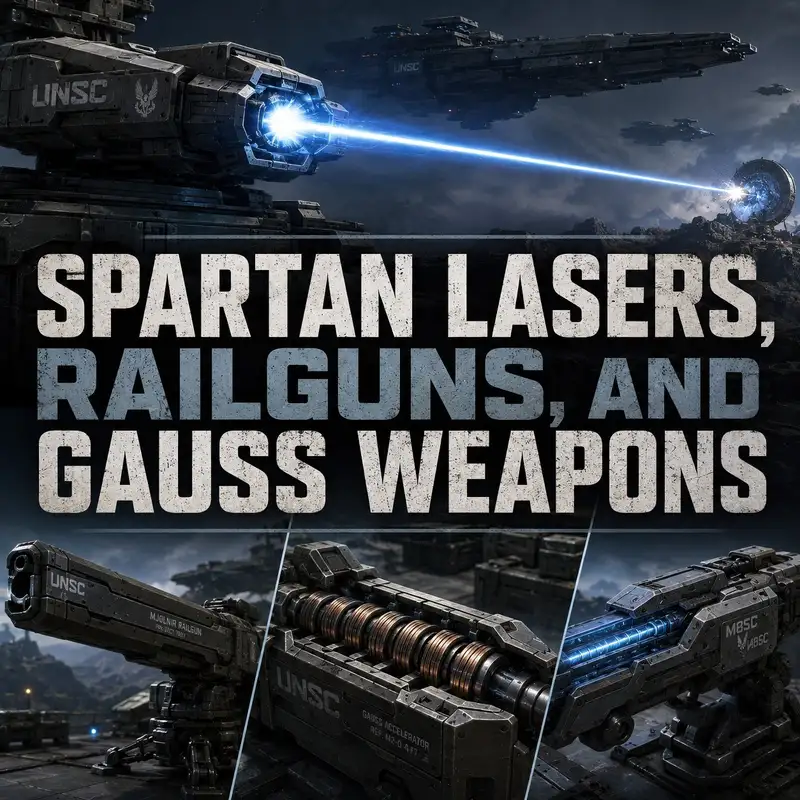
Spartan Lasers, Railguns, and Gauss Weapons
In twenty-five twenty-six, Blue Team reached the Karpos Mountain Range above the Samalat Gorge with an anti-armor plan that had already been destroyed. The militia’s Gauss Warthogs were burning below. Their vehicle crews had lost mobility, protection, and the mounts needed to stabilize the guns. The Spartans tore six M sixty-eight cannons from the wrecks, dragged them uphill, and placed the enormous weapons on the ground. Even augmented soldiers had to fire them prone. From that improvised line, they struck a Covenant convoy of Wraiths, bridging vehicles, and support equipment until Yanme’e defenders forced them to withdraw. The ambush proved that human electromagnetic weapons could break alien armor. It also proved how much had to go right before one could fire.
Spartan Lasers, railguns, and Gauss weapons are often grouped together because they appear to do the same thing. They point at a difficult target, charge or cycle, and deliver destructive force before the target can easily react. Their military purpose was to compress the engagement. A rocket could be guided, intercepted, or evaded during flight. A conventional cannon needed propellant, recoil management, and a sufficiently large platform. These newer systems tried to place anti-vehicle power in the hands of smaller units while reducing the delay between decision and impact. They did not use the same technology, and they did not solve the same problem in the same way.
The terminology requires some discipline. The M six Spartan Laser was a directed-energy weapon. It sent a brief pulse of light rather than a projectile. The A R C nine twenty was a true railgun, accelerating a conductive projectile along parallel rails through an immense electrical current. The M sixty-eight and M seventy Gauss cannons used staged magnetic fields to accelerate ferric ammunition through a coilgun-style system. Troops sometimes called the M sixty-eight a rail gun because battlefield vocabulary is not normally reviewed by an electrical-engineering committee. The distinction still mattered to the people designing the power system, cooling arrangement, ammunition, and maintenance procedures.
Humanity had long experience with magnetic acceleration. United Nations Space Command warships used magnetic accelerator cannons as primary naval weapons, and planetary defenses used even larger systems. Those weapons demonstrated the value of launching dense projectiles at extreme velocity. They also occupied ships, stations, and fortifications with reactors able to supply them. The engineering challenge on the ground was not discovering that kinetic energy could destroy armor. It was shrinking the accelerator, power storage, fire control, and cooling systems until a Warthog, emplacement, or exceptionally strong infantry operator could carry them into a moving battle.
The Gauss lineage reached back into the Insurrection. The Colonial Military Authority fielded the M sixty-five before the United Nations Space Command’s M sixty-eight became the more familiar system. Misriah Armory designed the later cannon for long-range anti-armor and anti-materiel work. The most common wartime version, the M sixty-eight B, served Army and Marine Corps units throughout the Human-Covenant War. It was not an infantry rifle enlarged beyond reason. It was a crew-served or vehicle-mounted cannon intended to give light formations a direct-fire weapon capable of threatening vehicles that ordinary machine guns could only irritate.
The M sixty-eight accelerated a twenty-five-millimeter ferric-tungsten projectile to hypersonic speed through sequential electromagnetic forces. The projectile traveled so quickly that the shot appeared nearly immediate to the gunner. In atmosphere, it produced a violent sonic report and a blue-white trail as the surrounding air heated. The cannon’s integrated optics and firing computer helped the operator select and track targets, and it could smart-link with advanced helmet systems. None of that made the shot quiet. Personnel near the weapon required hearing protection, and the flash, shock, and impact informed everyone nearby that a Gauss position had begun work.
Mounted on an M twelve G one Warthog, the cannon created a fast light anti-armor vehicle. The driver placed the gun where it could see the target, the gunner delivered the shot, and the vehicle moved before enemy fire arrived. Remote garrison crews trained for both anti-tank and limited anti-aircraft work because a fast projectile and responsive mount could threaten low-flying aircraft as well as ground vehicles. Against Ghosts, Choppers, and other light armor, the combination was especially dangerous. Against a Wraith, the gunner still needed a good angle, repeated hits, or cooperation from other weapons. High velocity did not remove armor geometry.
The Warthog’s mobility was also its protection, because there was not much protection available elsewhere. The gunner stood exposed behind a shield that covered only part of the body. The vehicle could be damaged by plasma fire, mines, infantry weapons, or terrain that forced it to slow. A competent enemy did not need to duel the Gauss cannon from the front. It could suppress the gunner, strike the driver, attack from the air, or force the vehicle into ground where the Warthog’s speed no longer mattered. Hunter-killer tactics depended on reconnaissance and movement. A stationary Gauss Warthog was a light vehicle carrying a very persuasive reason for the enemy to shoot first.
The cannon also required both ammunition and electrical power. Its large rotary feed carried specialized ferric-tungsten rounds, while the accelerator and cooling system depended on the vehicle or emplacement. This was an important difference from a rocket launcher. The gun could deliver many rapid follow-up shots without replacing a launch tube after every engagement, but it needed a mount, a power architecture, and a heavy ammunition supply. A Gauss section therefore traveled with drivers, gunners, maintainers, recovery capability, and transport. The weapon looked like a single barrel. Operationally, it was a small organization.
That organization followed human forces from Harvest and Arcadia to Reach, Mombasa, and the Ark. Gauss Warthogs supported mobile defense, escorted vulnerable movement, and joined armored pushes against Covenant positions. Their persistence reflected more than battlefield popularity. The M sixty-eight fit the Warthog’s standardized turret system, allowing commanders to place a different weapon on a familiar chassis. Drivers and mechanics already understood the vehicle. The cannon changed the target set without requiring an entirely new fleet of carriers. Modularity is less dramatic than a new weapons program, which is one reason it so often survives the war.
The ambush at Mesra showed the boundary of that modularity. When Blue Team removed the cannons from destroyed vehicles, the Spartans preserved the firepower but lost nearly everything that made it practical. They had to move weapons weighing well over one hundred kilograms, establish prone firing positions, and abandon the mobility that normally kept the gun alive. Conventional troops could not treat the M sixty-eight as a shoulder weapon. Even Spartans used it as an emergency emplacement. The feat demonstrated augmentation and improvisation. It did not establish a doctrine in which every infantry squad carried a miniature naval gun and hoped the terrain was cooperative.
Postwar development produced the M seventy electromagnetic launcher. It combined established coilgun principles with Covenant-derived pulsed-power systems, reverse-engineered components, and an internal capacitor that removed the older need for a power tether. The design began as the X five fifty-five testbed during classified operations on Requiem before moving through another designation and entering service as the M seventy. This was meaningful progress in integration and portability. It was not a dramatic increase in penetration. Misriah Armory had improved how the weapon could be powered and deployed without proving that alien components automatically made every projectile more lethal.
The M seventy could serve on selected Gauss Warthogs or as a portable turret. It also revealed the limits of reverse engineering. Humanity could incorporate Covenant-derived power technology into a working system, but doing so required classified testing and industrial support. Possessing alien hardware was not the same as possessing the scientific culture that created it. The new cannon bridged human and Covenant technology, but remained too specialized to replace every older gun.
The Spartan Laser approached the anti-vehicle problem without ammunition in the conventional sense. Misriah Armory developed the M six family alongside the Gungnir Mjolnir project as supplementary equipment for the Spartan Two program. Its name was therefore institutional before it became descriptive. The weapon weighed roughly twenty kilograms, used a solid-state laser, and integrated smart-linked optics. It could be carried by conventional personnel, but its mass, cost, and firing cycle favored highly trained operators who could remain exposed, track a target, and control the weapon while the enemy attempted to prevent all three.
Firing the M six required commitment. The operator pressed the trigger, a visible red designator painted the target, and an audible tone rose as the weapon charged for several seconds. The charge could be aborted before discharge, preserving the battery if the target disappeared or the shot became unsafe. Once committed, the weapon released a microsecond pulse capable of burning through thick armor and striking objects aligned behind the first target. Heat then forced a brief standby period. The laser’s time of flight was effectively immediate. The decision to fire was not.
That delay created a distinctive contest between gunner and target. A rocket operator could launch and move while the missile continued toward its aim point. A Spartan Laser operator had to maintain line of sight during the charge. The targeting beam and sound warned attentive enemies. A Wraith could turn, move behind cover, or fire on the position. A Banshee could change direction. Infantry could suppress the operator before the main pulse arrived. The laser rewarded ambush, concealment, stable tracking, and a target that had already committed to a predictable route. It punished anyone who confused destructive power with permission to stand in the open.
When the shot arrived, the advantages were substantial. There was no ballistic arc to calculate and almost no opportunity for a moving target to evade after discharge. The beam could attack vehicles, aircraft, hardened positions, and heavily armored personnel. Its ability to penetrate along a straight line made target selection especially important. A successful hit could continue into friendly equipment, civilians, pressure boundaries, or critical infrastructure behind the intended object. The absence of an explosive warhead did not make the weapon automatically precise in its consequences. Overpenetration is simply collateral damage traveling in a particularly orderly direction.
The battery replaced the ammunition magazine, but it did not eliminate supply. Wartime M six variants carried only a handful of full-power discharges before requiring recharge or replacement support. Some used a non-removable battery with a dedicated charging unit. Field complaints noted that the charger and weapon did not always arrive together, an achievement suggesting that advanced energy weapons had not defeated the ancient military tradition of shipping two essential items on different schedules. A depleted laser remained heavy, expensive, and unable to negotiate with the laws of stored energy.
Cost limited distribution just as severely. The weapon was ruinously expensive when introduced. Later production improvements reduced that condition to merely extraordinarily expensive. During the Human-Covenant War, Spartans and Orbital Drop Shock Troopers received the most reliable access. Related laser technology appeared on aircraft such as Sparrowhawks and certain Pelican configurations, where larger platforms could support power and cooling more easily. The M six was never evidence that the United Nations Space Command had converted its infantry arsenal to directed energy. It was evidence that humanity could build a few specialized systems when the mission justified the bill.
Variants adjusted the weapon around different missions without changing its nature. The M six R emphasized reconnaissance and the destruction of critical assets before a larger force deployed. The M six V placed greater attention on operator safety. The postwar M six E used miniaturized components from aircraft systems against heavier armor, while the M six X changed the battery arrangement. None removed the need to charge, expose the operator, manage heat, and count the remaining discharges.
The A R C nine twenty railgun emerged from postwar breakthroughs that made a different electromagnetic system portable enough for combat. Acheron Security produced it as a limited-production weapon for the United Nations Space Command. It weighed roughly fifteen kilograms and combined a disposable power cell with a single ferric-shelled, high-explosive projectile. The weapon was lighter than earlier handheld railguns, though still too cumbersome for routine use by most unaugmented personnel. It occupied the space between a conventional anti-materiel rifle and the much heavier anti-vehicle systems carried on mounts.
Unlike a coilgun, the A R C nine twenty sent electrical current through parallel conducting rails and the projectile assembly between them. The resulting electromagnetic force accelerated the round to extreme speed. The projectile then added its own explosive effect to the kinetic impact. The weapon required a brief charge before firing and had to be reloaded after each shot. Early handling also imposed a hard limit on how long a user could hold the charge before the system fired automatically. The feature prevented indefinite holding and became inconvenient when the target had not yet agreed to appear.
The railgun’s tactical appeal was flexibility. It combined a brief charge with a devastating impact against personnel or armor, and did not require the vehicle mount of a Gauss cannon. An augmented operator could move it with a fireteam and bring electromagnetic anti-materiel force into structures, landing zones, or terrain inaccessible to a Warthog. The compromise was a single ready projectile, limited production, and no standard optical magnification. The shooter received less warning time before discharge than with the laser, but also less opportunity to correct a poor firing decision once the charge reached its limit.
Later variants show what designers believed needed improvement. Whiplash reduced the charge cycle, carried two rounds, and added proximity airburst capability. Arclight emphasized armor-piercing high-explosive ammunition and allowed the charge to be held indefinitely, accepting longer preparation. One favored faster engagement and a second shot. The other favored penetration and control over the firing moment. Each moved the weapon toward a different tactical problem after the first model met troops, weather, and enemy fire.
Placed beside one another, the three systems formed a spectrum. The Spartan Laser offered almost immediate effect after a long and visible charge, with no physical projectile but severe power and heat limits. The railgun offered a brief preparation cycle and a compact explosive slug, but only one shot before reloading and a burden suited mainly to augmented users. The Gauss cannon offered repeated long-range fire, advanced optics, and vehicle-level ammunition capacity, but required a mount, crew, and mobility plan. The question was never which weapon was strongest. It was which set of limitations a commander could support for the target that had to be stopped.
This is why rockets remained in service. A rocket launcher could carry a larger warhead, use guidance, attack a broader set of targets, and be issued to ordinary infantry without requiring them to transport a precision accelerator or advanced laser assembly. Different warheads could produce anti-armor, antipersonnel, or specialized effects. Rockets also had disadvantages, including visible flight, backblast, bulky reloads, and the possibility of interception or evasion. They survived because electromagnetic and laser weapons did not make those tradeoffs disappear. A force with several tools could match the weapon to the target instead of asking one expensive system to behave like all the others.
Energy weapons did not free the army from ammunition accounting. The laser consumed battery capacity. The railgun consumed a power cell and a specialized projectile. The Gauss cannon consumed power and ferric-tungsten rounds. Chargers, capacitors, cooling assemblies, control electronics, and smart-link components joined magazines and ammunition boxes in the supply chain. A unit that received the weapon without the correct cell, cable, charger, or diagnostic support possessed an impressive object rather than a combat capability. Advanced logistics are still logistics. They simply contain more items that cannot be replaced with something found in the nearest motor pool.
Maintenance created another barrier to mass issue. Electromagnetic launchers depended on precise alignment, high-current components, insulation, and power electronics. Lasers depended on focusing assemblies, heat control, optical protection, and battery health. Dust, impact, and improvised repairs could degrade systems that appeared intact. Armorers could support them only if the necessary training, tools, and replacement modules traveled with the weapon. The United Nations Space Command could manufacture these systems. It could not sustain them as simply as a rocket tube or machine gun.
Enemy defenses prevented any of them from becoming a guaranteed answer. Energy shields could absorb or reduce an initial hit. Heavy Covenant armor rewarded attacks on vulnerable aspects. Active camouflage complicated detection, fast aircraft shortened tracking time, and infantry screens could suppress the operator while vehicles maneuvered. The Banished later combined captured human weapons, shielding, and heavy armor in ways that made target selection harder. The best counter to an extraordinary direct-fire weapon was often ordinary combined arms: scouts, suppression, terrain, and someone willing to attack the gunner.
The weapons were therefore most effective inside teams. A Gauss Warthog needed a driver who understood firing positions and escape routes. A Spartan Laser operator needed security during the charge and observers who could identify the correct vehicle. A railgun user needed a fireteam that could cover the reload and protect the expensive weapon if its operator fell. Sensors and artificial intelligence could improve target data, but they could not decide how many shots the unit could spend or whether destroying the vehicle was more valuable than capturing it. Fire control remained a command judgment.
Their strategic significance was not that humanity had matched Covenant technology. Most human troops still carried conventional firearms and rockets. Most vehicles still depended on familiar guns, missiles, and armor. Spartan Lasers, railguns, and Gauss weapons showed that human industry could pursue several advanced paths at once: direct energy, rail acceleration, and coil acceleration. The systems were fielded, improved, and sometimes integrated with captured technology. They remained limited by cost, power density, maintenance, operator strength, and production. Technological progress had widened the arsenal without removing the industrial reality behind it.
The six cannons above the Samalat Gorge summarize that reality. Blue Team could drag them from ruined Warthogs, fire them from the ground, and tear into a Covenant convoy before the defenders adapted. The shots were extraordinarily fast. The operation around them was not. Vehicles had carried the weapons. Militia crews had maintained them. Intelligence had identified the route. Spartans had moved the guns. Enemy infantry eventually forced a withdrawal. Humanity’s most advanced direct-fire weapons could make distance and armor briefly less important. They could not make crews, power, ammunition, protection, or an escape route unnecessary.