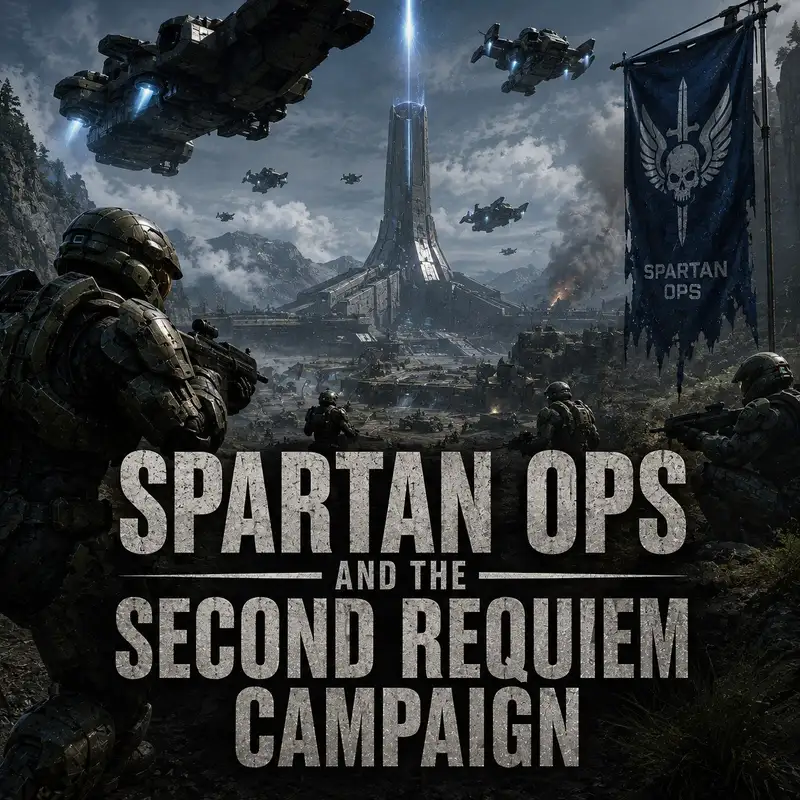
Spartan Ops and the Second Requiem Campaign
On February seventh, twenty-five fifty-eight, the United Nations Space Command Infinity emerged above Requiem and tore through a Covenant armored cruiser almost before either side could establish a firing solution. Escorting frigates moved to secure the approaches while dropships carried Army, Marine, Air Force, Navy, and Spartan personnel into the shield world. The opening looked like the arrival of an overwhelming expeditionary force. It was also exactly what Jul ’Mdama had wanted. Humanity believed it was returning to occupy Requiem. Jul had helped ensure that it returned to a prepared trap.
The campaign later remembered as Spartan Ops was not a collection of disconnected raids. It was the ground and special-operations component of a larger attempt to seize, study, and exploit Shield World Zero Zero One. Infinity served as fleet headquarters, research platform, logistics base, and strategic reserve. Captain Thomas Lasky commanded the ship. Spartan Commander Sarah Palmer directed the embarked Spartan force. Fireteams such as Crimson, Majestic, Castle, Shadow, Lancer, and Switchback operated alongside conventional units holding bases, flying transport, guarding scientists, and trying to turn temporary access into lasting control.
The central question is why that system failed to secure Requiem despite repeated tactical victories. Infinity possessed superior mobility, advanced sensors, powerful weapons, and hundreds of Spartan Fours. Its forces established bases and defeated Covenant formations across the interior. Yet the campaign ended with the ship trapped, Doctor Catherine Halsey in enemy hands, the Janus Key divided, and Requiem moving toward its star. The answer was not that the Spartans fought poorly. It was that tactical success could not compensate for a false intelligence picture and an ancient battlespace whose controlling systems belonged to neither modern army.
Six months had passed since the first battle on Requiem. During that earlier crisis, John One One Seven and Cortana had released the Ur-Didact, Infinity had been dragged inside the shield world, and the Didact had carried the Composer toward Earth. His attack was stopped only after New Phoenix had been emptied of seven million people. Jul ’Mdama remained on Requiem after the Didact’s departure. He possessed Covenant warships, religious authority as the Didact’s Hand, and access to Promethean forces created from composed human essences.
Jul used the intervening months to fortify excavation sites, establish supply points, study Requiem’s portals, and strengthen his position among competing Sangheili leaders. Later evidence indicates that he also allowed information about his plans to reach human intelligence. Requiem offered technology valuable enough that the United Nations Space Command could not ignore it. It also offered Jul a place where human forces would fight through terrain he understood better, against machines that appeared to answer his cause. He intended to exhaust Infinity, remove unreliable followers, and turn humanity’s appetite for Forerunner knowledge against it.
Human planners had compelling reasons to accept the risk. Leaving Requiem to Jul could provide his Covenant with weapons, transportation systems, and political legitimacy. Destroying the site from orbit was neither technically simple nor strategically attractive. Requiem was a fortress enclosed within an armored shell, and its interior held information humanity desperately wanted. The chosen solution was occupation through dispersed bases. Copernicus, Galileo, and Magma became research and security hubs linked by aircraft, ground routes, and portals whose behavior was still being mapped.
That design made Infinity indispensable. The flagship could deploy personnel, armor, aircraft, internally carried frigates, laboratories, medical facilities, and command networks from one platform. It could also concentrate the campaign’s vulnerabilities in one hull. Most of the expedition’s intelligence fusion, resupply, specialized maintenance, and senior command passed through the ship. A fireteam on Requiem could survive losing a Pelican. The campaign could not easily survive losing Infinity, its artificial intelligence Roland, or the logistics network connecting dozens of scattered positions.
Orbital control did not solve the interior war. Infinity and its escorts could destroy Covenant ships approaching along known routes, but Requiem’s armored shell and internal transit systems separated space superiority from control of the surface. Enemy aircraft could launch from fortified sites below, and Forerunner portals could move troops without exposing a conventional supply line. On February fourteenth, Fireteam Shadow destroyed the light cruiser Panom’s Canticle from within while Crimson held the Refuge site below. The action removed a serious air threat. It did not prevent another cruiser, portal, or excavation from creating the next one.
Every foothold also created a logistical obligation. Pelicans carried ammunition, power cells, medical teams, replacement personnel, and scientists through airspace contested by Banshees and ground defenses. Warthogs and Scorpions needed transport and maintenance after deployment. Research stations required security forces that could not be used elsewhere. When a base was attacked, a Spartan fireteam might break the assault, but conventional troops still had to treat casualties, restore sensors, and hold the perimeter afterward. Requiem rewarded rapid action while steadily consuming the support structure that made rapid action possible.
Fireteam Crimson became the most frequently used response force within that network. The identities of its members were not publicly emphasized, but the fireteam’s operational role is clear. Crimson reinforced conventional troops, destroyed communications equipment, seized vehicles, recovered artifacts, hunted commanders, defended bases, and repeatedly moved into locations where the situation had already changed faster than headquarters could revise the plan. Fireteam Majestic, led by Paul DeMarco and including Gabriel Thorne, Carlo Hoya, Tedra Grant, and Anthony Madsen, performed similar work while also becoming central to the campaign’s political crisis.
The use of Spartan Fours reflected a genuine postwar innovation. Adult volunteers could be augmented, equipped with Generation Two Mjolnir armor, and organized in enough fireteams to support a sustained expedition. They brought experience from conventional service and could operate with less direct supervision than an ordinary infantry squad. Yet Requiem also exposed the danger of treating elite adaptability as a substitute for a stable operational environment. Crimson was repeatedly redirected because another unit had been cut off, another base had lost contact, or another artifact had produced an effect no briefing had predicted.
The opening landings secured footholds, but holding terrain inside Requiem was unusually difficult. The shield world’s valleys, caverns, artificial weather, towers, and portals were parts of one immense machine. A position that appeared isolated could receive Promethean reinforcements through translocation. A Covenant force driven from one valley could reappear through a portal near another base. Human troops could capture a structure without knowing whether its security systems had accepted their presence or merely paused. Maps described geography. They did not reliably describe access.
Jul’s forces also used familiar Covenant equipment in a less centralized war. Sangheili commanders led Unggoy, Kig-Yar, and Mgalekgolo units supported by Wraiths, Ghosts, Phantoms, Banshees, and surviving cruisers. Their organization lacked the ministries and industrial depth of the old Covenant, but Requiem reduced the importance of long-term sustainability. Jul needed his followers to hold excavation sites, delay human research teams, and protect selected Forerunner systems long enough for those systems to produce results. Some troops were valuable precisely because he considered them expendable.
The first major intelligence breakthrough became the campaign’s most damaging security failure. At a Covenant excavation site called the Cauldron, Crimson recovered one of three unusual Forerunner devices. A Pelican carried it through enemy air attacks and delivered it to Infinity. Recovering a contested artifact was exactly the kind of mission the expedition had been designed to perform. The problem was that no one knew what the device actually did, and the safest place available for study was also the campaign’s command ship.
Doctor Henry Glassman examined the artifact aboard Infinity and activated it accidentally. The device translocated him from the ship to Requiem, where Jul’s forces captured him and compelled him to work on a structure associated with the Librarian’s imprint. The artifact was not a passive object being transported to a laboratory. It was part of Requiem’s slipspace network, connected to other devices inside the shield world. By bringing it aboard, the expedition had installed an unverified Forerunner access point within its own headquarters.
Lasky requested Halsey because no other available scientist matched her experience with Forerunner systems. She arrived as a prisoner, not a trusted member of the command staff. The Office of Naval Intelligence had detained her for disobedience, the abduction of a Spartan, and crimes connected to the Spartan Two program. Infinity now depended on the expertise of a person its own government considered too dangerous to leave free. That arrangement was operationally necessary and institutionally unstable, which describes a surprising number of classified research programs.
Halsey determined that the artifact was communicating with Infinity’s systems, including its engines, and transmitting information back to Requiem. Jul then contacted her through the same network. He offered knowledge concerning the Prometheans and the Librarian. To prove that he possessed something worth trading, he placed another object where Crimson would recover it. The item called the Didact’s Gift contained the essence of a Promethean Knight who had once been human, composed during the destruction of New Phoenix.
Crimson delivered the object to Galileo Base while Covenant troops staged an attack that made the recovery appear accidental. Majestic transferred it to Infinity, where Halsey confirmed its significance. Jul had now demonstrated three capabilities. He could predict where human forces would operate, manipulate what they recovered, and communicate through technology already inside their ship. The expedition still treated its artifact collection as intelligence gain. Jul was using the same collection process as a controlled channel into human command.
Halsey’s conduct deepened the crisis. She concealed her exchange with Jul, used an override phrase to seize temporary control of Roland, accessed restricted records, and attempted to negotiate directly with the Covenant commander. Her motives included scientific access, distrust of the Office of Naval Intelligence, and the belief that she could manage Jul more effectively than the officers around her. She may have been correct about some technical questions. That did not give her lawful authority to compromise a shipboard artificial intelligence during an active campaign.
Lasky and Palmer placed Halsey under arrest. Before she could be secured in cryogenic detention, Jul activated the next phase of the trap. Promethean Knights translocated directly into Infinity through the recovered artifact while much of the ship’s combat force was deployed below. Covenant warships arrived outside. Boarders attacked internal systems, disabled weapons, and planted stolen HAVOK nuclear warheads in critical compartments. The campaign’s supposedly secure rear area became the most dangerous ground in the theater without an enemy transport crossing its outer defenses in the normal way.
Crimson returned in a captured Phantom and was nearly destroyed by Infinity’s own automated defenses, which could not distinguish the friendly hijacked craft from the mass of hostile traffic. The fireteam survived a violent landing, cleared hangars and engineering spaces, disarmed the nuclear devices, restored data links, and brought the ship’s weapons back online. Other fireteams and Marines fought throughout the vessel. Infinity repelled the attack and destroyed hostile ships. Tactically, the defense succeeded.
Strategically, Jul achieved the more important result. A Promethean Knight seized Halsey and translocated her to Requiem. The slipspace artifact anchored Infinity in place, preventing the ship from maneuvering away from the shield world. The Covenant fleet had failed to destroy the flagship, but the attack had captured the scientist Jul needed and turned humanity’s command platform into a fixed target. It was a reminder that a boarding action does not need to conquer every compartment when it can remove one person and disable one essential capability.
The ground campaign continued amid the crisis. Gabriel Thorne and Glassman escaped Covenant captivity and were pursued by Gek ’Lhar, one of Jul’s most dangerous commanders. Majestic reached them before Gek could finish the fight and recovered a map of Requiem. Crimson escaped another capture, hijacked transport, penetrated Covenant positions, and discovered missing nuclear warheads at a supply depot. Other teams were less fortunate. Fireteam Switchback disappeared while investigating a Harvester, and multiple Spartan and conventional units were lost across the campaign.
These events show what Spartan Ops accomplished at its best. Small teams could restore momentum after a larger plan failed. They rescued specialists, exploited captured communications, destroyed supply points, activated defenses, and kept isolated bases from being overrun. They also show what it could not accomplish. Every successful raid generated another requirement to hold, analyze, transport, or secure what had been found. A Spartan fireteam could seize an artifact. It could not make the artifact safe, interpret its purpose, or prevent senior leaders from disagreeing over how to use it.
The disagreement became open once Halsey entered the Librarian’s shrine. Admiral Serin Osman, now commanding the Office of Naval Intelligence, ordered that Halsey be killed before Jul could extract strategic information from her. Lasky resisted the order. Palmer departed to carry out the termination mission, while Lasky separately directed Majestic to recover Halsey. Two United Nations Space Command elements entered the same objective area with incompatible missions issued through the same chain of command.
Halsey reached the Librarian’s imprint and received the Janus Key, a two-part device capable of identifying Forerunner technology across the galaxy. The artifact represented more than a scientific discovery. In the hands of one faction, it could become a strategic map to weapons, installations, archives, portals, and production systems that no modern civilization could fully defend. Jul took one half. Halsey passed the other to Thorne. Palmer shot Halsey in the shoulder, a wound that later cost her the arm, but a Promethean Knight escaped with Jul and the injured scientist.
No side obtained the complete prize. The United Nations Space Command held one half of the Janus Key. Jul held the other and gained Halsey’s cooperation, whether motivated by anger, survival, or calculation. Lasky preserved the possibility of recovering a uniquely valuable scientist but openly undermined an Office of Naval Intelligence order. Palmer executed the mission she had been given and still failed to prevent the enemy extraction. The campaign had reached the point where tactical success could no longer produce a politically coherent outcome.
Jul then activated Requiem’s self-destruct sequence and ordered his ships to evacuate. The shield world began moving toward Epoloch, the system’s star. Infinity remained trapped by an interdiction web generated through three connected artifacts, one aboard the ship and two buried within Requiem. The expedition that had arrived to occupy a fortress now had to abandon its bases, recover scattered personnel, and free its flagship before the entire battlespace entered the star.
Glassman used the captured map to identify the two ground nodes. Palmer and Majestic attacked one. Crimson returned to a Covenant excavation where the second lay behind solid rock. The fireteam had to restore a disabled Harvester, recover a replacement power supply, and use the machine’s plasma drill to reach the Forerunner structure. This was not elegant planning. It was battlefield engineering conducted while gravity disturbances shook the shield world apart and evacuation aircraft tried to recover the last surviving teams.
Crimson deactivated its node. Palmer and Majestic fought through Covenant troops who continued defending the other despite having been abandoned by Jul’s evacuation order. Thorne shut that system down as well. The third artifact released Infinity, which jettisoned the device toward the star. Lieutenant T. J. Murphy recovered Crimson, and the last Spartan teams returned under conditions that left little margin for delay. Infinity entered slipspace as the energy event behind it destroyed Epoloch and erased Requiem from human sensors.
For years, the accepted conclusion was that Requiem had been destroyed in the star. Later records changed that assessment. The shield world survived, severely damaged, and was displaced into unknown space. Some of Jul’s faithful remained within it and were transformed through Forerunner systems into machine-cell and hard-light forms. The campaign therefore did not destroy the installation humanity failed to secure. It removed Requiem from the strategic map and left it inhabited by forces beyond either side’s immediate control.
Measured tactically, the United Nations Space Command won many of the campaign’s engagements. Its forces established bases, killed Covenant commanders, destroyed ships and supply sites, defended Infinity, recovered one half of the Janus Key, and escaped a planetary trap. Measured operationally, the result was mixed. Infinity survived, but the research presence collapsed and the shield world was lost. Measured strategically, Jul gained Halsey and half the key while losing Requiem as an accessible stronghold and sacrificing large numbers of his own troops.
Spartan Ops proved that the Spartan Four generation could sustain a campaign rather than appear only for isolated missions. Crimson and Majestic operated as parts of a larger joint force, dependent on pilots, Marines, scientists, technicians, artificial intelligence, orbital fire, and conventional units holding the terrain between objectives. Their effectiveness was real. The campaign’s constant emergencies also exposed the limit of elite forces. Spartans repeatedly rescued the operation from immediate failure. They could not repair the false assumptions on which the operation had been authorized.
The second Requiem campaign failed to produce control because neither side truly controlled Requiem. Jul understood more of its portals and manipulated its artifacts more effectively, but he still relied on systems he could not reproduce and ultimately attempted to destroy the world he claimed as sacred. Humanity brought the stronger expeditionary institution, but treated recoverable technology as though it could be isolated from the network that made it function. Both sides confused access with ownership.
Infinity escaped because its people adapted faster than Jul’s final trap could close. That was a legitimate victory. It was also a costly substitute for understanding the battlefield before entering it. The ship returned with one half of a map to Forerunner power, a fractured relationship between its captain and the Office of Naval Intelligence, dead personnel across multiple services, and no secure base on Requiem. The campaign began with humanity’s flagship breaking an enemy cruiser apart on arrival. It ended with the same flagship fleeing a world that had never accepted human occupation in the first place.