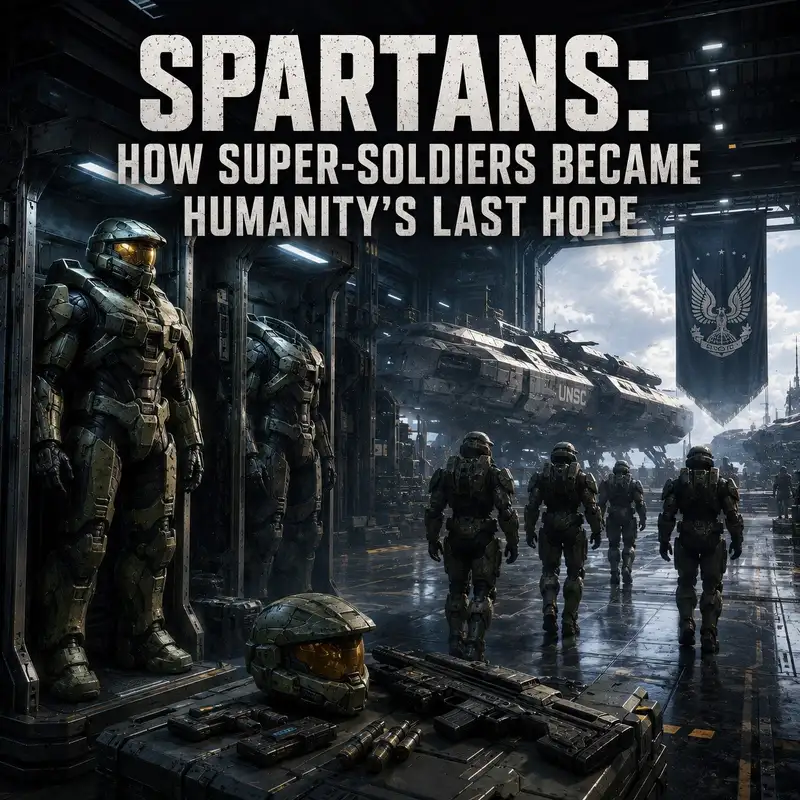
Spartans: How Super-Soldiers Became Humanity’s Last Hope
The first Spartan Two lost in the Covenant War knew exactly why he could not leave. Plasma fire had breached Samuel Zero Three Four’s Mjolnir armor while his team boarded an alien ship above Chi Ceti Four. The damaged suit could no longer protect him in vacuum, and the extraction route back to the human vessel required crossing open space. Samuel remained aboard with a nuclear warhead intended to destroy the ship. His teammates escaped. The weapon detonated. Humanity had found soldiers capable of boarding a technologically superior warship, and discovered in the same mission that even its best armor could not make them invulnerable.
That engagement in twenty-five twenty-five explains both the power and the limitation of the Spartan idea. A small team could accomplish what a larger conventional force could not. It could penetrate, improvise, and strike a target whose destruction mattered far beyond the number of soldiers involved. Yet every success still depended on transport, intelligence, ammunition, engineering, medical support, and a route home. Spartans became humanity’s last hope not because they replaced fleets and armies, but because commanders repeatedly sent them to the point where a failing campaign still offered one narrow chance to change the result.
The idea began before the Covenant appeared. Project Orion attempted to improve adult soldiers through biological augmentation, specialized training, advanced equipment, and better integration between the operator and the weapon system. Avery Johnson was among its candidates. Orion produced capable personnel and useful research, but it did not create a force that met the ambitions of its designers. Adult bodies imposed limits on the available augmentation procedures, and the program never achieved the combination of physical enhancement, powered armor, and institutional support that later planners wanted. It did, however, leave a foundation and a name.
Catherine Halsey’s Spartan Two program was conceived as a response to the Insurrection. Unified Earth Government analysts feared that colonial rebellion could expand into an interstellar civil war, disrupt strategic resources, and kill millions. Halsey and the Office of Naval Intelligence concluded that a very small force of exceptionally capable operators might capture or eliminate insurgent leadership before the conflict reached that scale. The strategic argument was preventive. The method was criminal. Children with rare genetic and psychological profiles were abducted, replaced with flash clones, and removed from families who were told nothing of the state’s decision.
The candidates were taken to Reach and placed under the training of Chief Petty Officer Franklin Mendez while still six years old. Their education combined military discipline, mathematics, history, tactics, physical conditioning, and constant competition. They learned to operate as teams before most children learn to navigate ordinary independence. The training built trust, resilience, and rapid decision-making. It also deliberately replaced family identity with unit identity and service. The Spartans later displayed loyalty, compassion, humor, and individual judgment, but those qualities developed inside a system designed to make refusal almost unthinkable.
The resulting cohesion mattered as much as the augmentation. Spartan teams communicated with short signals, anticipated one another’s movement, and trusted assignments that left little time for explanation. That reduced friction during boarding actions and covert missions, where a delayed decision could expose the entire force. It also made casualties especially damaging. Losing one Spartan meant losing an operator, but it also altered a team whose members had trained together since childhood.
The biological augmentation procedures carried out in twenty-five twenty-five transformed the surviving candidates and killed or disabled many others. Their bones were reinforced. Their muscles and cardiovascular systems were enhanced. Their reaction times, senses, and neural processing were altered. The procedures did not create identical results, and the medical losses were not an unfortunate side note. They were part of the program’s cost. Some candidates initially judged unfit were later rehabilitated, while others never returned to combat service. The survivors were extraordinarily capable because selection, training, surgery, and years of shared experience had been combined at enormous human expense.
Mjolnir powered assault armor turned that capability into a battlefield system. Early Mark Four armor used a compact fusion power source, reactive components that amplified movement, hardened protection, sensors, communications, and a direct neural connection with the wearer. An ordinary human could not safely use the same system. The armor responded too quickly and forcefully for an unaugmented operator. Even for a Spartan, Mjolnir required technicians, secure facilities, replacement components, calibration, and transport. The suit made one soldier faster, stronger, better protected, and more informed. It did not manufacture ammunition or repair a damaged spacecraft.
The Spartan Twos proved their original purpose before they ever fought aliens. Their first operational missions targeted Insurrectionist leadership and demonstrated that a small team could infiltrate defended locations, identify the correct objective, and complete a politically sensitive operation with limited conventional support. To the Office of Naval Intelligence, the program had validated its strategic theory. That conclusion deserves caution. Tactical success against a target did not resolve the political grievances driving colonial unrest. It showed that the government had built an effective clandestine weapon. It did not prove that using that weapon would produce a stable union.
Spartans were not intended to be ordinary infantry with better armor. They were designed as strategic special operators. A team could conduct reconnaissance, direct action, boarding, recovery, sabotage, and personnel capture without assembling a different unit for each task. Their physical enhancements allowed commanders to consider insertion methods, loads, and timelines that conventional special forces could not safely accept. That concentration of capability shortened the distance between finding a target and acting against it. It also created a temptation to use Spartans whenever planning had failed to produce a less dangerous option. A rare asset can become a strategic reserve. It can also become the answer attached to every impossible requirement.
The Covenant transformed the program almost immediately. Human intelligence knew little about the enemy’s government, species, technology, or military depth. Human fleets were severely outmatched in space. On the ground and inside ships, however, the difference could be narrowed. Spartans could survive acceleration, impact, and close combat that would disable ordinary troops. They could carry heavy weapons, exploit captured systems, and make decisions with very little supervision. Their training allowed them to treat unfamiliar technology as a problem to be solved rather than a reason to stop. Samuel’s death showed the price of that adaptability before the war was a year old.
Early Spartan operations focused on intelligence, sabotage, boarding, rescue, and strikes against valuable Covenant targets. The objective was rarely to kill as many enemy troops as possible. It was to destroy a staging base, capture navigation data, recover personnel, delay an offensive, or learn how the enemy fought. A Spartan team could convert a few hours of access into information useful to an entire theater. That made the team strategically valuable even when the wider battle remained unfavorable. It also encouraged senior leaders to assign missions whose risk would have been unacceptable for almost any other personnel.
The Spartans mattered because the war offered so few efficient exchanges. Destroying a Covenant ship might require several human vessels, coordinated magnetic accelerator fire, nuclear weapons, and losses that humanity could not replace. A successful special operation sometimes offered another route. Sabotage could destroy a target from within. Captured intelligence could reveal a fleet movement. A boarding action could recover technology. None of those missions was cheap, but the force involved was smaller than a fleet engagement. In a war of industrial attrition, commanders naturally valued any unit capable of producing effects larger than its physical size.
That value did not make Spartans self-sufficient. They reached objectives aboard Navy ships, Pelicans, Longswords, prowlers, drop pods, or other transports. They depended on artificial intelligence, signals intelligence, orbital reconnaissance, conventional troops, and technicians. A Spartan behind enemy lines without resupply eventually became a highly trained soldier with diminishing ammunition and a damaged suit. When orbital control was lost, extraction might disappear. When a shipyard fell, armor repairs became harder. Their most famous operations can obscure the logistics because the Spartan is visible at the decisive moment while the support network remains outside the frame.
Attrition created another problem. The Spartan Two program had produced only a small number of operational soldiers, and the Covenant War steadily reduced them. Each casualty removed years of training that could not be replaced quickly. The Office of Naval Intelligence concealed losses and allowed the public to believe that Spartans did not die, but were merely missing. The message protected morale and denied the enemy useful information. It also turned human beings into symbols whose deaths could not be acknowledged honestly. The state that had hidden their creation now found strategic value in publicizing a carefully edited version of their existence.
By twenty-five thirty-one, Colonel James Ackerson proposed a new approach. Spartan Threes would be less expensive, more numerous, and trained for missions too dangerous to assign to the scarce Spartan Twos. The candidates were largely children orphaned by Covenant attacks. They were offered a chance to fight the enemy that had destroyed their homes, but the word offered requires context. Traumatized children were recruited into a classified military program by adults who already knew the missions being considered. Consent was more visible than in the earlier abductions, but it was not uncomplicated.
Kurt Zero Five One, removed from ordinary Spartan Two service and given a new identity, trained the Spartan Threes with Mendez at Camp Currahee on Onyx. Kurt understood what the candidates would face because he had lived through Halsey’s program. He attempted to give them the discipline, teamwork, and survival skills needed to endure. The training remained severe. Alpha, Beta, and Gamma Companies were built at different times, with changes in augmentation and doctrine. The result was not a cheaper copy of the Spartan Twos. It was a separate program designed around larger formations, stealth equipment, and wartime urgency.
Most Spartan Threes used Semi-Powered Infiltration armor rather than full Mjolnir. The suit enhanced mobility and strength and used photo-reactive panels to reduce visibility. It lacked the compact fusion reactor and energy shielding associated with later Mjolnir systems, but it could be produced in far greater numbers. That choice reflected mission economics. Hundreds of infiltration suits could support operations that the government could never equip with hundreds of full Mjolnir systems. The armor was appropriate for stealth and mass deployment. It offered much less protection once surprise failed and the enemy concentrated fire.
Alpha Company’s Operation Prometheus in twenty-five thirty-seven and Beta Company’s Operation Torpedo in twenty-five forty-five demonstrated both the effectiveness and the brutality of the concept. The companies struck Covenant targets of major strategic value and suffered near-total losses. Their missions were not meaningless charges. They damaged infrastructure the Covenant needed and bought humanity time. Neither should they be described as ordinary victories. A force can achieve its operational objective and still reveal a procurement strategy built around casualties senior command already considered likely.
The Spartan Three program was more varied than those two operations suggest. Some candidates were reassigned before company-level missions. Headhunter teams conducted reconnaissance, sabotage, and assassination in very small elements. Noble Team and other specialized units wore Mjolnir and operated alongside conventional forces. Individual Spartan Threes developed distinct specialties, relationships, and careers. Gamma Company received additional neurological alterations intended to keep its soldiers fighting through extreme injury. Those changes increased combat resilience but required stabilizing medication, adding a logistical and medical risk to a program already shaped by secrecy.
By twenty-five fifty-two, Spartans were deployed wherever the strategic situation had become most dangerous. At Reach, different Spartan elements defended orbital-support facilities, protected evacuations, pursued classified objectives, and attempted to preserve assets needed for the defense of Earth. Noble Team’s final operations helped deliver crucial intelligence to the Pillar of Autumn. Other Spartans fought in space and on the surface under plans that changed faster than command could distribute them. Their actions saved lives and preserved options. Reach still fell, which is the clearest possible reminder that exceptional troops cannot compensate indefinitely for lost orbital control.
John One One Seven became the best-known Spartan because his operational record intersected with the decisive crises of the war. His leadership, judgment, partnership with Cortana, and repeated survival made him unusually effective even among Spartan Twos. He was never the entire program. Blue Team, Red Team, Gray Team, Spartan Three companies, Headhunters, Noble Team, and many individual operators carried out missions across the war. The Master Chief became the public image because institutions prefer one recognizable symbol. Military history is less cooperative. It keeps returning the names of people who fought without becoming the symbol.
Mjolnir also continued to evolve. Mark Five armor brought integrated energy shielding and the computing capacity to support a smart artificial intelligence within the system. That combination allowed a Spartan and an artificial intelligence to share sensor data, analyze threats, penetrate networks, and react faster than either could alone. It was a major capability increase, not a guarantee of success. Shielding could be overwhelmed. Power and components could fail. An artificial intelligence could provide an excellent recommendation that the operator still had to judge. The suit remained part of a larger command and technical network.
The final campaigns of the Covenant War made the Spartan symbol almost impossible to separate from human survival. John and Cortana prevented the firing of Installation Zero Four, destroyed the ring, returned with intelligence, helped disrupt the Covenant attack on Earth, and fought through the campaign that ended Truth’s attempt to activate the Array from the Ark. Those events were extraordinary. They depended on naval crews, Marines, Orbital Drop Shock Troopers, Army personnel, artificial intelligences, scientists, technicians, civilians, and Sangheili allies. One Spartan repeatedly reached the decisive point. Other forces created the possibility that the decisive point could be reached.
After the war, the Unified Earth Government could no longer treat Spartans only as a tiny classified experiment. The Spartan Four program recruited adult volunteers, many of them experienced personnel from the existing armed services. Improved augmentation methods made it possible to enhance mature bodies more safely and consistently than Orion had managed. A dedicated Spartan branch formalized training, command, and deployment. Generation Two Mjolnir broadened the range of armor manufacturers and mission configurations, while later Generation Three systems attempted to combine improved protection with greater resilience against disrupted supply and hostile networks.
Spartan Fours were not inferior Spartan Twos produced by easier standards. They arrived with adult identities, professional experience, and a voluntary decision to accept augmentation. Their training had to integrate people shaped by different branches, habits, and previous units. Their armor and medical support compensated for differences in baseline augmentation. They could be deployed in larger numbers for reconnaissance, counterinsurgency, artifact recovery, ship defense, and high-risk assault. They also carried the ordinary problems of any expanded institution: uneven experience, command friction, procurement variation, political expectations, and the possibility that a famous title might be mistaken for identical capability.
The postwar conflicts proved that Spartans remained vulnerable to strategic defeat. On Requiem, they fought Forerunner constructs and Covenant remnants while commanders struggled to understand the environment. During the Created uprising, human dependence on advanced networks turned into a liability. At Zeta Halo, the Banished ambushed the Infinity, scattered its personnel, and killed Spartans who had entered the operation expecting support from the most capable ship in the fleet. Survivors continued resistance in isolated groups, but their armor did not restore orbital control, replace lost command networks, or create ammunition from an empty supply cache.
The institution also could not escape the politics of its origin. Spartan Two survivors remained people abducted by their own government. Spartan Threes remained war orphans recruited for missions with expected losses that adults would have struggled to accept for themselves. Spartan Fours improved the question of consent, but they also expanded irreversible augmentation into a larger military population. As enhancement technology spread, the United Nations Space Command’s monopoly weakened. The long-term effects on veterans, civilian society, private security, and rival powers became new strategic questions. A weapon system can be retired. An augmented person eventually has to live outside the mission.
The phrase humanity’s last hope is therefore both accurate and misleading. Spartans became the force commanders called when conventional options had failed, when a target had to be reached despite enemy superiority, or when a few people could still prevent a larger disaster. Their presence often changed the morale of nearby troops because Spartans represented competence under conditions that had defeated everyone else. Yet they could not build ships, hold every colony, replace casualties across the services, or create political legitimacy. Humanity’s survival depended on a military and civilian system far larger than the armored figures used to symbolize it.
What made the Spartans decisive was concentration. Selection, training, augmentation, armor, intelligence, and mission authority were concentrated into individuals and small teams able to act at the point of greatest consequence. What made the programs dangerous was the same concentration of power in the hands of the institutions that selected the children, classified the losses, and decided what level of sacrifice counted as necessary. The Covenant War gave those programs a purpose no one could easily dismiss. It did not erase why they had been created or who paid for them.
Samuel remained aboard that first Covenant ship because his armor was breached and his team still had a mission to complete. The moment contains the entire Spartan history in miniature. Advanced technology created an extraordinary opportunity. Logistics and physics imposed a limit. Training turned the limit into a decision. Loyalty made the decision personal. Command received the military effect, while a young soldier absorbed the cost. Spartans became humanity’s last hope because they could still act when nearly every other option had closed. The armor made that action possible. The people inside it made the sacrifice real.