The Ambush of Infinity and the Rubicon Protocol
On December twelfth, twenty-five fifty-nine, Spartan Bonita Stone stood beneath a collapsing section of the United Nations Space Command Infinity and held the overhead structure in place while trapped personnel ran toward the lifeboats. Banished weapons had torn open the surrounding compartments. Smoke and atmosphere were venting through the breach. The evacuation routes changed every few seconds as hangars, corridors, and escape craft were destroyed. Humanity’s largest warship was still firing. Inside it, the battle had already become an evacuation.
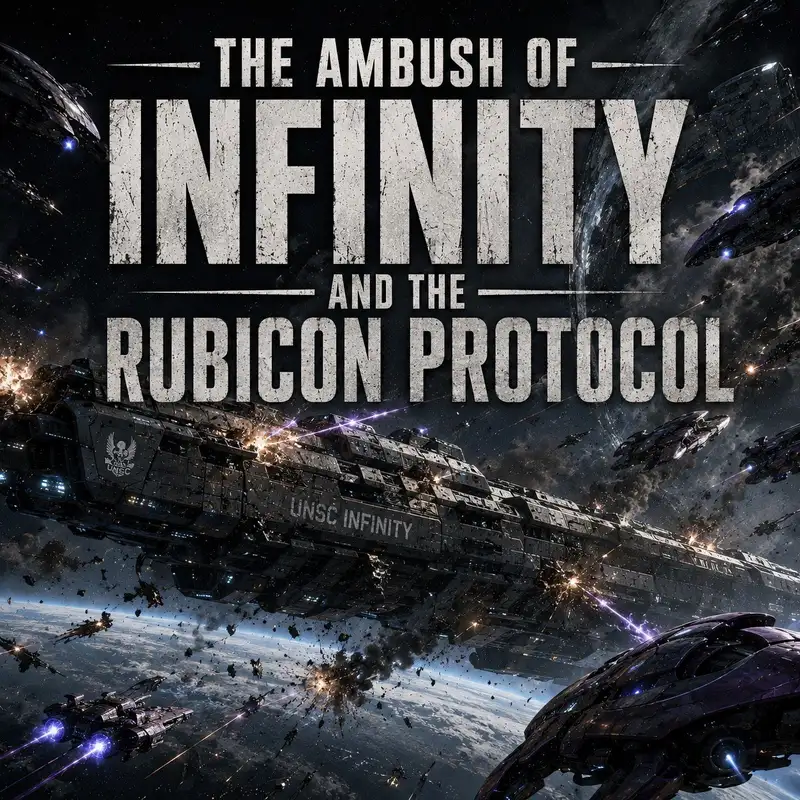
Infinity had arrived at Zeta Halo to execute a precision operation against Cortana. Instead, it encountered a Banished fleet already positioned to strike. Multiple dreadnoughts closed at short range, rammed the supercarrier, and delivered boarding forces into the hangars and internal passageways. The central question is not how a powerful ship could lose a battle. Every ship can be defeated. It is how the Banished dismantled Infinity’s advantages so quickly, and how the people thrown from that defeat continued fighting for six months under the Rubicon Protocol.
The human plan depended on the Weapon, a new artificial intelligence created from the same neurological foundation as Cortana. The Weapon had been designed to enter Zeta Halo’s systems, imitate Cortana closely enough to contain her, and prepare the Created leader for deletion. Infinity would deploy the intelligence, recover Cortana, and carry the result away. It was a narrow plan built around rare personnel, unique software, and a flagship whose survival was assumed to be part of the solution.
Infinity reached the operation after more than a year on the run from the Created. Normal shipyards, depots, and planetary command networks could not be trusted. The crew had scavenged equipment from abandoned facilities and maintained the vessel without the industrial system normally supporting a ship of its size. A later scan associated roughly seven thousand one hundred fifty personnel with the flagship, far below its earlier complement of more than seventeen thousand. Many were civilian contractors, scientists, technicians, supply workers, and other support personnel rather than combat troops.
That condition did not make Infinity helpless. It still carried heavy magnetic accelerator weapons, missiles, point defenses, energy shielding, aircraft, Marines, Orbital Drop Shock Troopers, and Spartan teams. It did make the ship less tolerant of surprise. Reduced personnel meant thinner damage-control parties, fewer replacements, and less depth inside every maintenance and security function. A warship may remain officially combat effective while quietly losing the people needed to keep several emergencies from becoming one catastrophe.
The Banished did not offer Infinity the battle its design favored. They did not remain at range and wait for the supercarrier to organize firing solutions around its main batteries. Dreadnoughts struck from prepared positions and rammed the hull. Boarding parties entered while the naval engagement was still developing. Banished forces attacked hangars, movement corridors, weapons access, and command routes. Their objective was not merely to damage armor. It was to prevent the ship from acting as one coordinated military system.
Ramming was costly, but the Banished could accept damage to individual dreadnoughts in exchange for compromising a unique enemy flagship. Once contact was made, the difference in long-range firepower mattered less than the condition of the compartments around each breach. Jiralhanae, Sangheili, Kig-Yar, and Unggoy boarders could force defenders into local fights while additional ships attacked from outside. Infinity’s immense size created more routes to defend and more distance between units trying to reinforce one another.
Atriox led one of the boarding actions personally. He expected to seize the Weapon, not knowing that she had already been deployed to the ring. John One One Seven fought through the damaged ship and attempted to preserve the evacuation. In a hangar, Atriox defeated him and threw him into space. The Master Chief’s removal mattered tactically, but the ship was not lost because one Spartan fell. The attack had already compromised the launch bays, command movement, and internal defense across multiple sectors.
Captain Thomas Lasky ordered the crew to abandon ship. Spartan Commander Sarah Palmer directed evacuation efforts while Spartans held corridors, moved casualties, and protected escape craft. The order was necessary and devastating. Infinity had served as headquarters, hospital, supply depot, carrier, barracks, intelligence center, and home. Evacuation separated all of those functions at once. Personnel reached the surface with whatever equipment happened to fit inside a lifeboat, drop pod, Pelican, or damaged shuttle.
Stone loaded others into escape craft before taking a remaining seat. Nina Kovan descended separately in a drop pod. Tomas Horvath tried to answer a distress call from a damaged lifeboat. Other Spartans remained aboard long enough to clear routes or escort senior personnel. Conventional troops, pilots, technicians, medics, and contractors made their own descents through enemy aircraft and debris. There was no controlled landing zone waiting below. The survivors were being distributed across enemy-held terrain by the machinery of a failing evacuation.
The following catastrophe removed even the limited order that survived the landing. Cortana destroyed part of Zeta Halo to deny Atriox control of the Silent Auditorium and initiated an emergency translocation that moved the damaged ring into an unknown system. The explosion fractured the installation. Terrain separated. Communications failed. Personnel who had landed within supporting distance of one another were divided by chasms, dislocated sections, and Forerunner systems changing around them.
The displacement created an intelligence problem as serious as the military one. The outside galaxy no longer knew where Zeta Halo had gone. Survivors could not assume a distress signal would reach friendly space, and rescuers could not follow coordinates that were no longer valid. The ring’s movement also carried much of the orbital debris with it, including John drifting unconscious beyond the surface. Infinity’s crew had escaped the ship and disappeared from the strategic map.
Survival began at the level of the lifeboat. Lieutenant T J Murphy brought down a damaged craft whose passengers included field medic Lucas Browning and several personnel with little combat experience. Stone rescued them after Horvath was cut off by the ring’s fracture. Kovan gathered another group and linked with Stone. The resulting unit became known as the boat crew, less because the name sounded impressive than because nobody had enough surviving administration to issue something better.
The boat crew included technicians, supply personnel, and civilians who had boarded Infinity to maintain a mobile warship, not conduct guerrilla operations on a Halo installation. They knew machinery, medicine, records, and logistics. Those skills became more valuable as ammunition and trained infantry disappeared. Stone and Kovan supplied security and judgment, but the group survived because ordinary personnel learned to move quietly, share water, repair equipment, and accept that every transmission might attract a Banished patrol.
Horvath experienced the same campaign in isolation. The destruction event stranded him on a separated fragment with the Jiralhanae Bloodstar Gorian. They formed a temporary alliance to cross the breach using salvaged Sentinel technology, then resumed trying to kill one another when the immediate obstacle was removed. Gorian’s betrayal left Horvath wounded and separated from every known human position. For months, he continued tracking the Banished officer while searching for any route back to friendly forces.
On December fifteenth, Spartan Vedrana Makovich located the wreck of the Mulsanne-class frigate Mortal Reverie and identified it as a defensible base. By December nineteenth, Stone, Kovan, and the boat crew had reached it. The frigate had crashed near a cliff and could not return to orbit, but its hull offered shelter, communications equipment, weapons, medical spaces, and a recognizable point around which scattered survivors could gather.
Commander Etana Hensler and Spartan Hudson Griffin became the principal ad hoc leaders at the wreck. Navy personnel, Army troops, Marines, Orbital Drop Shock Troopers, Spartans, contractors, researchers, and support workers arrived in separate groups. Many had no previous ground-combat experience. Lieutenant Murphy and other veterans began teaching them weapons handling, field discipline, and basic defensive tasks. The surviving military had become a mixed community that needed to turn itself into a garrison before the Banished found it.
The Mortal Reverie offered advantages and obligations. Its remaining point-defense guns could contest enemy aircraft. Wrecked compartments provided cover and storage. The surrounding pass narrowed the approach for ground forces. The same fixed position required food, power, medical care, ammunition, patrols, and early warning. Every person who reached the base improved its manpower and increased what the base had to sustain.
The Banished were building the opposite kind of system. Their dreadnoughts deployed prefabricated bases, artillery, repair facilities, communications relays, and production sites across the ring. Riven Gate controlled movement through key routes. The Forge of Teash repaired and fabricated machinery supporting excavation. Communications outposts tracked human activity and connected distributed forces. The Banished had not merely won the space battle. They were converting victory into occupation infrastructure.
Stone and Kovan reconnoitered Banished territory and noticed that rivalry among the occupying units created a possible weakness. Escharum held competing packs and commanders together through authority, rewards, and fear. Griffin believed removing him might fracture the occupation. On January twenty-third, he departed with Spartans Panago, Malik, and Sarkar to assassinate the war chief. Bertold Vettel remained behind to help command the Spartans at the Reverie.
Escharum anticipated the attempt. His forces ambushed Griffin’s team, killed the other three Spartans, and captured Griffin after he was badly wounded. Griffin still transmitted enough of a warning for the Reverie to understand that a major attack was coming. The assassination mission failed in its stated objective and gave Escharum another propaganda asset. It succeeded only in providing a final opportunity to prepare the defense.
Stone confirmed the scale of the threat near Riven Gate on January thirty-first. Chieftain Tremonius and Captain Arthoc were assembling a large force to strike the base. The defenders laid mines, established two barricade lines through the pass, placed Wolverines, Warthogs, and Scorpions where they could support the infantry, and prepared the frigate’s surviving guns for air defense. Support personnel were paired with experienced units. The plan did not promise victory. It attempted to make the Banished pay enough for the base that some defenders might escape.
The attack lasted into February second. Banished infantry, armor, and aircraft pressed through the pass while plasma mortars struck prepared positions. Minefields and point-defense guns delayed the advance. Spartans moved among the barricades to reinforce threatened sectors. The defenders had local cover and courage. The Banished had depth, air power, replacement forces, and an occupation network feeding the assault.
Once heavy damage destroyed the Reverie’s starboard defenses and silenced its point-defense guns, Banished aircraft overwhelmed the remaining ground positions. Vettel resisted abandoning the base because the wreck contained almost everything the survivors had accumulated. Kovan and Makovich convinced him that remaining would convert the garrison into prisoners and bodies. The retreat scattered survivors into the mountains while Banished troops pursued, killed, and captured them.
The fall of the Mortal Reverie ended organized resistance in that region. Tremonius converted the wreck into an outpost bearing his name. Banished forces discarded captured supplies, erected their own landing platforms, and turned the human refuge into another node in the occupation system. The site’s symbolic value was obvious. Humanity’s improvised headquarters had become a Banished forward base.
Lucas Browning surrendered himself to draw a patrol away from other survivors. He was moved through the Redoubt of Sundering and Chak ’Lok’s Tower, where interrogation and torture supported the wider search for human access to Forerunner systems. The Banished eventually forced him to interface with a cylix and release the Harbinger. The survivors had lost more than a medic. Through one captive Reclaimer, the enemy gained access to a new ally and a threat the human resistance did not yet understand.
By March third, the last remaining human forward operating bases on the local fragment had fallen. Makovich, Vettel, and Theodore Sorel invoked the Rubicon Protocol. Its practical order was to stop or delay the Banished and deny them useful assets by whatever means remained available. The protocol did not promise rescue, territorial recovery, or a restored chain of command. It assumed that those conditions had already been lost.
The name described a threshold. Once invoked, surviving units were no longer preserving strength for a conventional counteroffensive they could not organize. They were spending strength to prevent the Banished from converting Zeta Halo into secure strategic power. A bridge, data node, supply convoy, excavation machine, prisoner, or communications tower could become the objective. Survival remained important because living personnel could continue denial operations. Survival detached from action was not enough.
Unofficial groups carried out that mission. The boat crew, the Gravediggers, Hatetriox, isolated Spartans, and scattered conventional personnel attacked supply runners, bridges, patrols, and minor installations. Kovan turned the boat crew into a capable guerrilla element by matching tasks to skills rather than pretending every survivor had become an infantry specialist. Mechanics kept equipment working. Medics preserved manpower. Scouts studied routes. People who had maintained Infinity now disrupted the system built from its defeat.
Horvath found another strategic requirement while hunting Gorian. An injured Office of Naval Intelligence operative told him that the ring’s internal Conspectus network contained its galactic coordinates. Recovering that data offered the only realistic way to tell friendly space where Zeta Halo had moved. The mission aligned perfectly with the Rubicon Protocol. The coordinates had to be denied to the Banished and transmitted to humanity, even if the personnel attempting it could not expect extraction.
Stone and Kovan later infiltrated Outpost Tremonius after identifying unusual air traffic. They found Browning alive but could not remove him. Stone continued into the excavation beneath the outpost and discovered Banished personnel extracting a Conspectus data node through a human prisoner. She attacked, copied the data, and ordered her personal artificial intelligence, Ouco, to corrupt the original. Jega ’Rdomnai killed her during the escape.
Stone did not survive the mission, but the denial worked. The Banished recovered a damaged node and initially failed to recognize that the useful data had been copied onto Stone’s equipment. The boat crew later recovered her body and the surviving information. The protocol’s harsh logic was visible in the result. The operator was lost. The enemy was denied an immediate gain. The mission continued through whoever could carry the data next.
The submonitor Adjutant Veridity revealed that the copied material included Zeta Halo’s new coordinates. Decryption required the installation monitor Despondent Pyre, who remained locked down inside the Conservatory. Kovan’s group eventually reunited with Horvath, freed the monitor, and obtained the access needed to use one of the ring’s beacon towers as a supraluminal transmitter.
The final movement to the beacon was not a rescue attempt. It was a communications operation conducted by exhausted survivors who knew the transmission would reveal their position. Horvath cleared the approach and provided overwatch. Kovan protected the interface. Murphy, Erik Bender, Robin Dimik, and Isaiah Cameron carried explosives, ammunition, and the technical burden of making the tower work under attack.
On May fourteenth, the beacon transmitted Zeta Halo’s coordinates toward human space. Murphy shielded the control point from plasma fire and was killed. Cameron died beneath a Banished vehicle. Horvath killed Gorian after their months-long pursuit, then was carried away when a translocation pad activated beneath him. Kovan, Bender, and Dimik survived with help from Veridity. The message left the ring. The people who sent it had no way to know whether anyone would receive it in time.
Other Spartan actions ended with similar losses. Makovich and Sorel moved against Banished forces entering the Conservatory and were killed in separate engagements. Vettel announced an attempt to rescue Griffin from Chak ’Lok’s fortress, then disappeared from the available record. Griffin remained in captivity until John later reached the Tower, where the wounded Spartan died after passing on the intelligence he still possessed.
On May twenty-fifth, Horvath transmitted that he was leaving Banished territory to search for survivors and the missing members of Fireteam Intrepid. Within days, Fernando Esparza recovered John from the debris field. The Master Chief awakened into a battlefield shaped by six months of actions he had not directed. Outpost Tremonius stood around the wreck of the Mortal Reverie. Stone’s armor lay near the excavation she had sabotaged. Griffin waited in the Tower. Scattered Marines remained alive because other survivors had kept them moving.
Escharum’s claim that Infinity fell in four minutes was useful propaganda and an incomplete operational description. The Banished neutralized the flagship quickly because they arrived prepared, attacked at close range, rammed the hull, boarded the hangars, and disrupted the ship’s ability to coordinate its weapons and people. Infinity’s technology did not fail to exist. The conditions required to use that technology were stripped away faster than the crew could restore them.
The Rubicon Protocol did not reverse the defeat. It did not save the Mortal Reverie, prevent the Harbinger’s release, or preserve a unified human command. It did slow the occupation, corrupt valuable data, keep Banished resources under pressure, awaken the monitor, and send the ring’s coordinates beyond the battlefield. It converted defeat into continuing denial. That is a smaller result than victory and a much larger result than disappearance.
Infinity’s final physical fate remained unconfirmed, but its operational fate was settled on the day of the ambush. The ship ceased to function as the headquarters holding its crew together. The resistance that followed was built from the people and equipment expelled from it. Spartans mattered, but so did pilots, mechanics, medics, supply workers, contractors, and technicians who learned how to fight without becoming interchangeable copies of Spartans.
The Banished destroyed humanity’s strongest ship by attacking the system around its weapons. The survivors answered by attacking the system around the Banished occupation. They could not retake Zeta Halo before John returned. They could make every convoy, excavation, data node, and prisoner cost more than the enemy expected. The Rubicon Protocol was not a plan for winning after Infinity fell. It was the decision that defeat would not be allowed to become uncontested possession.