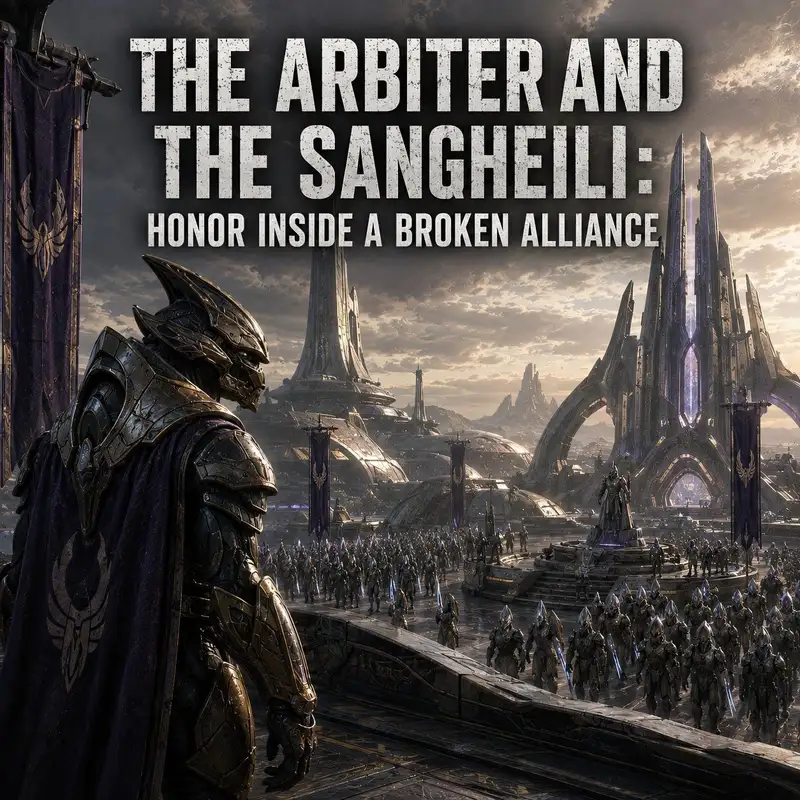
The Arbiter and the Sangheili: Honor Inside a Broken Alliance
Thel ‘Vadamee knelt before the Covenant Hierarchs with the Mark of Shame burned into his chest. Only weeks earlier, he had commanded the Fleet of Particular Justice. Now he was blamed for the destruction of a sacred Halo ring and sentenced to become the Arbiter. The office offered one path back to honor: complete missions from which he was not expected to return. The Prophets believed they had converted a disgraced commander into an expendable weapon. Instead, they placed an ancient Sangheili title on the officer who would help break their empire.
The Arbiter’s history is often described as a redemption story, and it is one. It is also a study of how institutions weaponize honor. Sangheili honor was never a single rule shared identically by every warrior, keep, and commander. It was a social language governing loyalty, courage, lineage, obligation, reputation, and the right to lead. The Covenant used that language to bind Sangheili military service to San’Shyuum religious authority. Thel’s achievement was not abandoning honor. It was deciding that obedience to false authority had become dishonorable.
The title of Arbiter existed long before Thel. In ancient Sangheili history, Arbiters could be judge-kings, peacemakers, teachers, tyrants, or military leaders whose authority crossed the boundaries of individual keeps. The office carried enough cultural weight to settle disputes and rally clans. Under the Covenant, that meaning changed. The Prophets gradually converted the title into a mechanism for using disgraced Sangheili commanders on dangerous assignments. The ceremony preserved the appearance of sacred tradition while redirecting its authority toward missions chosen by the Hierarchs.
That change worked because Sangheili society was not organized as one centralized nation. Political life centered on keeps, clans, estates, and local leaders known as kaidons. A keep could command warriors, resources, territory, and generations of loyalty. Alliances between keeps created wider political power, but they did not erase local identity. Reputation mattered because a leader without honor could lose followers, invite challenge, or bring disgrace upon an entire lineage. Honor therefore had military consequences. It influenced who obeyed, who commanded, who negotiated, and who believed a defeat could be survived politically.
The Covenant’s founding joined that system to San’Shyuum religious rule. The Sangheili supplied much of the empire’s military leadership. The San’Shyuum interpreted Forerunner relics, controlled doctrine, and claimed authority over the Great Journey. The arrangement gave Sangheili warfare a sacred purpose and gave the Prophets fleets they could not have commanded alone. It also created a dangerous division. Sangheili honor became associated with service, while the San’Shyuum reserved the power to define what service meant. A warrior could act courageously inside a campaign whose political purpose had been concealed from him.
Thel rose through that system because he was an effective commander and a sincere believer. As Supreme Commander of the Fleet of Particular Justice, he directed campaigns against human worlds during the War of Annihilation. His forces helped devastate colonies, pursued human ships, and treated extermination as lawful religious duty. The later alliance with humanity does not remove that record. Thel was not an innocent soldier who accidentally served the wrong flag. He was a senior commander in a genocidal war, distinguished precisely because he executed Covenant policy well.
His sense of honor made him dangerous to humanity and useful to the Prophets. It emphasized duty to the Covenant, accountability for failure, and loyalty to the warriors under his command. Those values could produce discipline and personal courage. They could also prevent him from questioning the premises supplied by religious authority. Thel knew humans fought with determination. He did not yet know why the Hierarchs had declared them unworthy of conversion, or why their relationship with Forerunner systems threatened the Covenant’s theology. His honor operated inside an intelligence picture designed to keep that question closed.
The destruction of Installation Zero Four shattered his standing. The Fleet of Particular Justice had followed the Pillar of Autumn from Reach to the ring. Covenant forces battled humans, released the Flood, and lost ships and personnel as the installation collapsed into disorder. John One One Seven and Cortana destroyed the ring before it could be fired. From a military perspective, the disaster involved failed containment, divided objectives, religious interference, and an enemy willing to destroy the terrain everyone was fighting over. The Covenant reduced those failures to one officer’s shame.
The High Council demanded punishment because a sacred installation had been lost under Thel’s command. The Hierarchs offered the title of Arbiter because his skill remained valuable and his disgrace made him controllable. The Mark of Shame was not merely personal humiliation. It publicly severed him from the status that had protected his authority. The old armor and ancient title then gave that humiliation a sanctioned purpose. He could restore his name only through obedience, preferably obedience ending in death. The personnel system was severe, but the vacancy rate was probably manageable.
His first major assignment as Arbiter was to destroy the movement led by Sesa ‘Refumee. The so-called heretic had learned from the monitor known as Three Four Three Guilty Spark that the Halo rings were weapons, not instruments of divine transcendence. That information directly threatened the Great Journey. The Prophets did not send Thel to investigate the claim. They sent him to eliminate the people repeating it. The operation tested his combat ability, but its real purpose was information control.
Sesa attempted to explain what he had learned. Thel remained bound to the framework in which doubt was betrayal and obedience offered the only road back to honor. He killed the heretic leader before accepting the warning. This is one of the most important failures in his biography. The evidence was present, but evidence does not interpret itself. A commander trained to see religious dissent as enemy action can mistake the person carrying accurate intelligence for the threat itself.
The mission also shows why Thel’s eventual break with the Covenant was not immediate. A single contradiction rarely destroys a political identity built over a lifetime. Thel had served beside loyal warriors, commanded fleets, and organized his understanding of history around the Great Journey. To reject the Prophets would mean admitting that his victories, sacrifices, and crimes had served a deception. Continued belief protected more than religion. It protected his sense of who he had been. The Covenant’s information system survived because disbelief carried an almost unbearable personal cost.
On Installation Zero Five, the political structure finally turned against him openly. Thel fought his way to the Sacred Icon required to activate the ring, but Tartarus seized it and the human prisoners who had reached it first. The Prophet of Truth had begun replacing Sangheili honor guards and military authorities with Jiralhanae forces. Sangheili councilors were arrested or killed. Units that had served beside one another were ordered to become enemies. The Arbiter was no longer being punished for one failed command. His entire species was being removed from the alliance it had defended for millennia.
Tartarus then betrayed Thel and cast him into the depths of the installation. The act mattered because it stripped away the last ambiguity. The Prophets were not preserving the Covenant while disciplining a difficult commander. They were reorganizing power by destroying the Sangheili role within it. The Great Schism was therefore not a spontaneous species feud. It was a political purge built on existing rivalry, unequal access to authority, and Truth’s decision to replace a military partner he no longer trusted.
The Gravemind preserved Thel for its own purposes and forced him into contact with facts the Covenant had suppressed. The monitor’s explanation of Halo later confirmed the central point. Firing the ring would not begin the Great Journey. It would kill the sentient life the Flood required for expansion. Thel’s crisis was no longer theological doubt in the abstract. Tartarus was preparing to activate a weapon that would destroy the people he believed he was saving. Honor now required opposing the command he had once treated as sacred.
Thel attempted to persuade Tartarus rather than simply attack him. That effort revealed an important difference between them. Both had been used by the Prophets. Both had received status through service. Tartarus chose the hierarchy that had elevated him, even when confronted with evidence that its promise was false. Thel chose the truth that destroyed his status but might preserve his people. With human assistance, he defeated Tartarus and stopped the ring’s activation. His loyalty had not disappeared. It had shifted from the Prophets to the lives their doctrine endangered.
The wider Sangheili response was less unified. Some commanders joined Thel and other leaders opposing Truth. Some remained committed to the Covenant or followed local authorities. Others sought control of ships, worlds, or resources while the empire collapsed. The Great Schism split fleets, families, keeps, and garrisons. A Sangheili warrior could reject the Prophets without trusting humans, supporting Thel, or agreeing on what should replace the Covenant. Religious disillusionment created an opening for political choice. It did not provide one agreed answer.
Alliance with humanity emerged from that crisis because the immediate military objectives overlapped. Truth intended to activate the Halo Array. The Flood had seized High Charity. Human forces needed Sangheili ships, intelligence, and access. Sangheili forces needed allies who understood the Halo threat and were already fighting the same enemies. This was not forgiveness negotiated in a quiet council chamber. It was coalition warfare assembled under extinction pressure by participants who had spent decades killing one another.
Thel and Shipmaster Rtas ‘Vadum helped turn that necessity into coordinated action. Sangheili vessels fought alongside the surviving human force during the campaign at the Ark. Sangheili crews brought energy shielding, plasma weapons, and experience with Covenant systems. Human personnel brought their own intelligence, special operations forces, and the determination of a species with very little left to lose. Cooperation did not erase command friction, but it gave the coalition enough combined capability to challenge Truth and contain the local Flood threat.
When Thel killed the Prophet of Truth, the act carried military, political, and personal meaning. It stopped the leader directing activation of the Array. It avenged the betrayal of the Sangheili. It also ended the authority that had defined Thel’s shame and promised his redemption. Yet killing Truth did not restore a government. High Charity was lost, the ministries were shattered, fleets were divided, and San’Shyuum leadership had either fled or died. The Arbiter had helped destroy the center of the old order. He still had to build something capable of surviving without it.
The title gave him influence, but not universal command. Thel returned to Sanghelios as Arbiter and kaidon of Vadam Keep, carrying a reputation that combined victory, disgrace, heresy, and survival. Some Sangheili saw the warrior who exposed the Prophets and preserved their species. Others saw the commander who allied with humans responsible for killing Sangheili and destroying Covenant forces. The same history supported incompatible judgments because honor was not a mathematical result. It was a political claim made before audiences with different losses.
Thel reestablished the Swords of Sanghelios as an alliance of keeps seeking wider unity, peace with humanity, and a future outside San’Shyuum rule. The organization became the principal governing power on Sanghelios, but it did not become the government of every Sangheili world. Kaidons retained their own forces and interests. Distant colonies and former Covenant commanders followed local agendas. Thel could persuade, bargain, reward, threaten, and fight. He could not issue one order and expect the entire species to move with him.
Postwar Sangheili society also faced practical problems that honor alone could not solve. The Covenant had concentrated administration, trade, technology management, and interspecies labor inside imperial systems that no longer functioned. Keeps had warships but not always reliable supply chains. Warriors trained for imperial campaigns returned to worlds divided by old rivalries. Artisans, engineers, farmers, merchants, and local officials became strategically important because rebuilding required more than fleets. A civilization organized around military service discovered that peace had a demanding logistics schedule.
The Blooding Years tested whether Thel’s coalition could survive those weaknesses. The Servants of the Abiding Truth opposed his reforms and retained older religious commitments. Jul ‘Mdama later built another Covenant successor movement by combining faith, grievance, and military opportunity. These groups were not simply enemies who had failed to learn the lesson of the Great Schism. They represented Sangheili who believed Thel’s alliance with humanity sacrificed tradition, independence, or justice for wartime convenience.
Human policy made that criticism easier to sustain. Publicly, the United Nations Space Command cooperated with the Arbiter. Privately, elements of the Office of Naval Intelligence armed opponents of the Swords of Sanghelios in an effort to keep the Sangheili divided while humanity rebuilt. The logic was familiar. A fragmented former enemy appeared less dangerous than a unified one. The operation also risked strengthening extremists, prolonging civil war, and proving every accusation that human diplomacy was only another form of manipulation.
Thel survived attacks on his keep and years of conflict because the Swords combined his reputation with functioning military support from allied keeps. Their forces defended territory, contested rival fleets, and attempted to build institutions beyond personal loyalty. The distinction mattered. A movement centered entirely on one famous warrior would collapse with his death. Thel needed kaidons, shipmasters, councils, and local authorities willing to accept shared rules. Unification required him to surrender some of the absolute authority the Covenant had taught commanders to admire.
In twenty-five fifty-eight, the Swords of Sanghelios, supported by Fireteam Osiris, broke Jul ‘Mdama’s remaining power on Sanghelios and secured Sunaion. The victory ended one major phase of the civil war and strengthened Thel’s position on the homeworld. It did not provide the stable sovereignty he had sought. Cortana’s Created uprising placed Sanghelios under the threat of Guardians and machine occupation almost immediately. A coalition that had spent years winning control of its own planet discovered that control could again be removed from orbit.
Under Created pressure, Thel continued seeking unity while dealing with kaidons who feared that resistance would bring planetary destruction. His cooperation with Spartan Olympia Vale on Netherop reflected the new strategic environment. Human and Sangheili leaders searched together for a way to challenge Cortana, but each also carried separate political obligations. Thel could not risk Sanghelios merely to prove courage. Restraint under overwhelming power required as much honor as an attack, though it produced fewer songs and considerably more difficult council meetings.
After Created control weakened, the underlying divisions returned. Banished forces moved into the Urs system and sought control of resources on Suban. Many keeps remained loyal to Thel’s program of unification. Others supported different arrangements or cooperated with the Banished. Human Spartans and Swords of Sanghelios warriors fought together in combined operations, demonstrating that the alliance had developed institutions, training, and trust beyond one battlefield agreement. The same fighting showed that Sangheili unity remained incomplete. An outside power still found local partners willing to leave the gate open.
Thel’s reforms also changed what Sangheili honor could permit. Tradition had often restricted military roles, political authority, and public expectations according to long-established custom. Postwar necessity forced reconsideration. Female warriors received greater opportunity for military service. Artisans worked with human armor programs. Joint facilities placed humans and Sangheili inside shared chains of coordination. These changes did not erase the keep system or warrior culture. They showed that tradition could be interpreted rather than merely obeyed.
That distinction is central to understanding the Sangheili. Honor can justify courage, loyalty, revenge, mercy, service, or rebellion depending on who defines the obligation. Under the Covenant, the Prophets linked honor to obedience and made religious authority the judge of military worth. During the Great Schism, competing leaders claimed that honor required defending their species, preserving the old faith, avenging betrayal, or maintaining order. After the war, Thel used the same language to argue for peace with humanity and political unity among keeps that had excellent historical reasons to distrust one another.
The Arbiter title gave him a platform for that argument because it connected ancient authority, Covenant shame, and postwar leadership in one office. The Prophets had intended the title to consume disgraced warriors. Thel survived long enough to reclaim its older political meaning. He became a mediator among keeps, a coalition commander, and a diplomatic representative without becoming a monarch over all Sangheili. The title opened doors. It did not eliminate the need to convince whoever was waiting on the other side.
His alliance with humanity remained strategically valuable and morally difficult. Human forces benefited from Sangheili ships, regional access, and cultural legitimacy among former Covenant populations. The Swords benefited from intelligence, technology exchange, Spartan cooperation, and a partner also threatened by the Created and Banished. Neither side forgot the war. Sangheili families remembered colonies and ships destroyed by humans. Human survivors remembered worlds burned under commanders such as Thel. Peace depended less on forgetting those records than on deciding they would not determine every future decision.
Thel’s transformation does not erase responsibility for the campaigns he commanded. Redemption in military history is not an acquittal issued because a former enemy later fights beside the right people. It is a change demonstrated through repeated choices after the truth becomes known. Thel opposed the Prophets, stopped Halo’s activation, fought beside humans, rejected renewed war, and attempted to build a political order that did not depend on religious deception. Those actions matter because the earlier crimes remain real, not because they vanish.
The broken alliance at the center of this history was the Covenant itself. Its San’Shyuum rulers used Sangheili honor to obtain centuries of military service, then discarded the Sangheili when that service became politically inconvenient. Thel ‘Vadam survived the office intended to kill him and turned its authority against the system that had defined him. His lasting achievement was not proving that honor had one perfect meaning. It was forcing his people to decide whether honor belonged to the leaders issuing orders, the traditions preserved by those orders, or the lives and truth those traditions were supposed to protect.