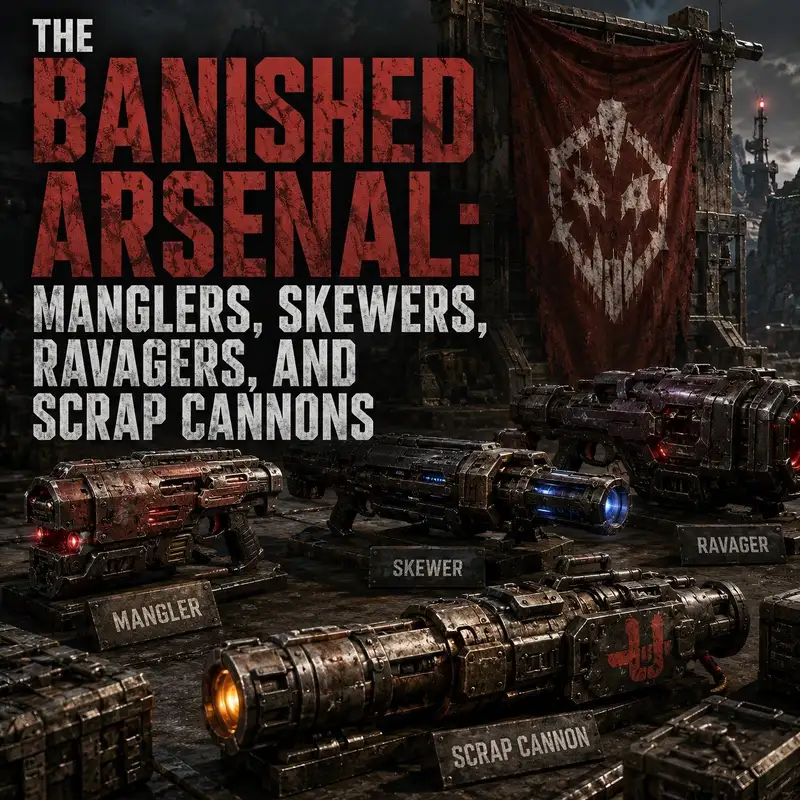
The Banished Arsenal: Manglers, Skewers, Ravagers, and Scrap Cannons
By the time United Nations Space Command survivors understood what the Armory of Reckoning was doing, the Banished had already turned occupation into production. Alloys and captured matériel arrived from nearby salvage sites. Weapons were serviced, repaired, and returned to units across the ring. Munitions printers ran so heavily that only three remained functional when the position was finally attacked. The outpost was not simply an armory. It was proof that Escharum’s forces did not intend to raid Zeta Halo and leave. They intended to manufacture the means of staying.
The Banished arsenal makes sense only when read inside that occupation system. Manglers armed individual warriors at close range. Skewers gave infantry an answer to armored vehicles. Ravagers drove defenders from cover and contaminated the ground they needed to cross. Scrap Cannons provided sustained explosive fire from fixed positions and could be torn from their mounts when a sufficiently strong operator needed to move. Together, they formed a layered set of tools for assault, defense, pursuit, and control.
These weapons are often described as Jiralhanae arms, and most of them are. That description is accurate but incomplete. They were carried inside a multi-species organization that included Sangheili, Unggoy, Kig-Yar, Lekgolo colonies, human auxiliaries, mercenaries, engineers, salvagers, and artisans from many traditions. The Banished did not reject Covenant technology. They rejected Covenant authority over technology. Plasma weapons, spike weapons, captured human firearms, Forerunner devices, and locally fabricated systems could all be used if they served the campaign.
That practical approach distinguished the Banished from the empire Atriox had abandoned. Covenant ministries controlled sanctioned patterns, religious interpretation, and access to production. The Banished replaced much of that hierarchy with war chiefs, clans, workshops, alchemy corps, contracts, coercion, and battlefield salvage. This did not create an egalitarian military. It created a more flexible one. A commander with influence could request a modified weapon, and a forge with the necessary expertise might produce it without waiting for a prophet to declare the improvement doctrinally acceptable.
The Mangler shows how the Banished could modernize without abandoning Jiralhanae history. It is a large, revolver-like sidearm that launches heavy spikes at high velocity. Jiralhanae had used weapons of this general tradition for centuries, long before their incorporation into the Covenant. Adoption of plasma arms did not erase those designs. The Mangler preserved a weapon form associated with hunting, pack warfare, and native industry while placing it into the hands of a force operating among starships, energy shields, and ancient installations.
Its role was not identical to that of a human pistol. The weapon was heavy, powerful, and built for users whose size and strength made its recoil and balance manageable. A Mangler could be carried as a sidearm, but it also functioned as a close-assault weapon. The blade beneath its frame made the transition from shooting to striking almost immediate. That mattered inside ships, fortifications, excavation tunnels, and outposts where an engagement could collapse from several meters to arm’s length before either side had time to reload.
The spike itself reflected the Jiralhanae preference for force concentrated into a simple physical mechanism. It did not require the delicate containment fields of a plasma bolt or the charging infrastructure of an energy weapon. It required a strong launcher, manufactured ammunition, and a target that could be penetrated. Against unshielded personnel, exposed systems, and light material, the result was severe. Against energy shields or heavy armor, the operator still needed repeated hits, a vulnerable angle, or support from another weapon.
That limitation is important because a large projectile does not become a universal solution merely by looking unpleasant. A Mangler carrier confronting a shielded Spartan still faced an opponent protected by Mjolnir, trained to move, and capable of returning accurate fire. The weapon’s value came from close-range impact, rapid presentation, and the ability to remain dangerous after the ammunition was spent. It rewarded aggression, but only when aggression was supported by position, numbers, and timing.
Balkarus’s Riven Mangler illustrated Banished customization. The warlord commissioned an altered design through the alchemy corps at Riven Gate. It fired three spikes in a single discharge, sacrificing some speed of follow-up fire for a denser strike. The modification was not a new standard for every warrior. It was a personal weapon produced for an influential commander who valued precision and overwhelming impact. Banished innovation could move quickly because it was often local. That same local character made universal standardization much harder.
The Skewer expanded the spike tradition into the anti-armor role. Its origins also predated the Jiralhanae alliance with the Covenant. The weapon launched a massive sharpened projectile with enough force to threaten armored vehicles and penetrate titanium alloy at range. Banished packs used it against tanks, aircraft, fortifications, and personnel. The last category says something about Jiralhanae battlefield culture. A weapon designed to stop armor was considered perfectly acceptable for stopping one particularly troublesome soldier.
The Skewer’s great advantage was immediacy. A rocket carried an explosive warhead and could offer guidance, but it also required a motor, a seeker in some variants, and time in flight. The Skewer sent a dense projectile along a direct path with tremendous kinetic effect. Against a moving vehicle, the shooter still needed lead, range judgment, and a clear firing lane. Once the projectile arrived, there was no blast radius required to make a poor impact point useful. The hit itself had to matter.
Reloading was the cost. The Skewer was a single-shot cannon, and placing another enormous projectile into the weapon was difficult under fire. The operator needed time, cover, and access to additional spikes that were neither light nor compact. A team could protect the gunner and carry ammunition. A lone warrior could fire once and then discover that the enemy had survived long enough to express an opinion. The weapon was devastating, but its tactical rhythm depended on what happened during the reload.
That made the Skewer an ambush weapon as much as an anti-tank gun. A concealed team could wait for a Warthog, Scorpion, dropship, or exposed heavy weapon to enter a prepared lane. The first shot might disable mobility, kill a crew member, or force the target to break formation. Other Banished forces could then close with Choppers, Ghosts, plasma fire, or boarding troops. The Skewer did not have to destroy the vehicle completely. It had to change the engagement before the vehicle’s weapons changed it first.
Ik’novus the Devourer carried the Volatile Skewer, a personalized variant whose projectile detonated on impact. The alteration combined the standard weapon’s penetration with an explosive effect, although at reduced effective range. Its history tied the weapon to older Jiralhanae stalker-pack traditions and to Avitus, the veteran warlord once known as the Thrallslayer. The weapon was therefore more than an upgraded cannon. It connected pre-Covenant hunting culture, personal patronage, and Banished battlefield engineering in one object.
The Ravager solved a problem the Mangler and Skewer could not. It was designed not merely to hit a target, but to make an area difficult to occupy. The weapon fired three-round bursts of volatile plasma and could build a charged discharge that left a burning pool at the point of impact. Jiralhanae warlords favored it for flushing infantry from fortified positions. A defender behind cover could avoid direct fire and still be forced to move when the floor, doorway, or escape route became lethal.
Area denial changes the geometry of a fight. A rifle attacks the person visible through the sight. A Ravager attacks the place where that person intends to remain. It can seal a passage, divide a room, protect a flank, or force troops out of a vehicle bay before an assault element enters. The weapon is especially useful during boarding and occupation, where defenders know the structure and can turn narrow routes into strongpoints. Incendiary plasma gives the attacker a way to rewrite those routes.
The same effect creates risks for the user. A burning pool does not recognize friendly markings. Banished infantry advancing too quickly could enter their own hazard. Fire and corrosive material could damage equipment, prisoners, artifacts, or infrastructure the force intended to capture. Inside a ship, heat and secondary ignition could turn a successful breach into a damage-control emergency. Ravager doctrine therefore required more than pointing at a doorway. It required commanders to decide which spaces mattered after the defenders were gone.
Captain Arthoc’s Rebound Ravager showed how the Banished adapted the weapon to confined environments. Its projectiles could ricochet before erupting, allowing fire to reach around cover and into small compartments. The variant drew on work associated with the Forge of Torograd and Banished alchemists studying infusion matter found in Forerunner facilities. It was effective precisely because human ships contained narrow spaces where defenders could not always see the weapon that was attacking them.
That experimentation also revealed a Banished vulnerability. Infusion matter and related substances were useful, but prolonged exposure could damage body and mind. The alchemy corps could apply dangerous materials to weapons and vehicles without fully controlling every consequence. The Banished were willing to accept those risks because they valued immediate capability and expected subordinates to endure costs that senior leaders did not always share. Their innovation was genuine. So was their habit of making someone else stand closest to it.
The Scrap Cannon represented the opposite approach. Where the Ravager manipulated terrain with energy, the Scrap Cannon overwhelmed it with sustained ballistic fire. It was a fully automatic heavy weapon firing explosive rounds, with a rate of fire that increased as the gun continued operating. Mounted at a defensive position, it could suppress infantry, break light vehicles, and dominate an avenue of approach. The operator did not need a delicate firing solution. The weapon created its own argument through repeated impacts.
Its detachable construction was central to Banished doctrine. A mounted cannon benefited from stability, ammunition supply, and prepared fields of fire. A Jiralhanae heavy gunner could tear the weapon free and carry it when the battle moved beyond the emplacement. Mobility came at a price. Once detached, the gun had only the ammunition immediately available and lost whatever support the mount provided. The operator gained freedom of movement while accepting that the weapon would soon become an extremely large object with nothing left to fire.
Conventional human troops would normally treat such a system as crew-served. It needed ammunition bearers, security, maintenance, and a position capable of supporting its weight. Jiralhanae strength allowed one warrior to perform tasks that required a human team, but strength did not refill the feed system or repair a damaged firing mechanism. Banished imagery often celebrates the lone heavy gunner. The logistics behind him remain a group activity, even when the group has been instructed not to appear in the heroic painting.
The Scrap Cannon’s explosive ammunition made it useful against cover as well as personnel. Sustained impacts could force defenders away from firing ports, damage light structures, and keep a rescue team from reaching casualties. Its rising rate of fire rewarded a gunner who could hold the target area and survive return fire. It also increased ammunition consumption and made the weapon’s position difficult to conceal. Once the cannon opened fire, every United Nations Space Command marksman and vehicle crew nearby had a strong incentive to end the performance.
These four weapons fit together because their limitations overlap. The Mangler was portable but short-ranged. The Skewer could defeat armor but fired once before a difficult reload. The Ravager controlled space but depended on heat, energy, and careful coordination. The Scrap Cannon sustained pressure but demanded ammunition and exposed its operator. A Banished unit using them together could cover each weakness. Manglers protected the heavy team. Ravagers forced defenders into the open. Scrap Cannons fixed them in place. Skewers destroyed the vehicle sent to rescue them.
Not every Banished fighter could use each weapon equally well. Jiralhanae strength made the Mangler’s weight, the Skewer’s reload, and the detached Scrap Cannon more practical. Other species contributed precision fire, shielding, engineering, scouting, and ammunition handling. The organization gained capability by assigning weapons around bodies and specialties rather than pretending one standard rifle suited every member. That diversity complicated training, but it also made Banished formations difficult to read from a single silhouette.
Maintenance separated a dramatic weapon from a dependable one. Manglers and Skewers still needed straight projectiles, sound launch mechanisms, and replacement parts. Ravagers needed power regulation, thermal control, and safe handling of volatile material. Scrap Cannons needed feed systems, barrels, explosive ammunition, and mounts able to absorb sustained operation. The Banished could repair and fabricate these systems because workshops traveled with the occupation. A raiding party could improvise. An occupying army had to establish armorers.
Human countermeasures focused on interrupting the weapon’s preferred engagement. Distance reduced the Mangler’s advantage. Suppression during a Skewer reload prevented the second shot. Dispersal and alternate routes reduced Ravager area denial. Snipers, rockets, and vehicle weapons targeted Scrap Cannon crews before the gun reached its highest rate of fire. None of these methods guaranteed survival. They forced the Banished to spend time, ammunition, and supporting troops to restore the advantage.
The arsenal also served intimidation. A heavy spike embedded in a vehicle, burning plasma across an evacuation route, or explosive fire tearing through a defensive wall communicated that the Banished could apply force in several ways at once. Escharum used captured structures and prisoners to turn occupation into theater. The weapons fit that message, but their psychological value depended on real capability. Fear lasts longer when the object being displayed can actually destroy the position resisting it.
The system became more dangerous when combined with weapons borrowed from elsewhere. Shock Rifles disabled vehicles and attacked shields. Pulse Carbines tracked targets at useful combat ranges. Plasma weapons supplied familiar Covenant energy effects. Human rifles and rocket launchers could be captured and redistributed. Forerunner arms could be used when access allowed it. The Banished arsenal was not doctrinally pure. It was assembled around the belief that victory justified possession.
Zeta Halo gave the Banished an environment in which that belief could become an industrial method. Dreadnoughts deployed drop-bases, artillery, and prefabricated strongpoints. Riven Gate controlled movement. The Forge of Teash fabricated and repaired machines. Ransom Keep stripped United Nations Space Command matériel and ground titanium into feedstock. The Armory of Reckoning serviced weapons and consumed alloys through munitions printers. Outposts communicated, supported excavation sites, guarded prisoners, and supplied forces beyond their immediate perimeter.
This infrastructure explains why the word scrap can be misleading. The Banished did not simply bolt wreckage together and hope anger completed the circuit. Salvage was sorted, processed, and fed into an organized production system. Workshops preserved clan expertise. Engineers modified Covenant technology. Alchemists experimented with dangerous materials. Captured machines were repaired, dismantled, or used as examples. The finished arsenal looked rough because intimidation and field repair were part of its design language. Rough did not mean accidental.
It also did not mean uniform. Different clans contributed different workshops, traditions, and preferred weapons. Commanders commissioned personal variants. A forge on the Ark could develop a solution that a unit on Zeta Halo had never received. Local resources determined what could be produced. A shortage of alloys, power, printer capacity, trained artisans, or ammunition could reduce a formidable arsenal to whatever remained in the rack. Banished flexibility helped the organization absorb variation. It did not eliminate the cost of variation.
The destruction of Doisac made that industrial flexibility even more important. Cortana’s Guardians shattered the Jiralhanae homeworld, killing an immense population and destroying cultural, political, and productive centers that cannot be replaced by one captured ring. The Banished needed new bases, new resources, and new places where Jiralhanae society could survive under their control. The Ark and Zeta Halo were not merely military prizes. They were potential foundations for a power whose original home had been broken.
That context changes the meaning of the arsenal. The Mangler and Skewer preserve pre-Covenant Jiralhanae weapon traditions. The Ravager demonstrates an appetite for adapting alien energy and infusion technologies. The Scrap Cannon turns industrial material into immediate battlefield pressure. Together, they communicate a political claim. The Jiralhanae will no longer depend on San’Shyuum approval or Sangheili command to define what their weapons should be. They will build, seize, and modify for themselves.
Freedom from Covenant rule did not produce freedom for everyone beneath Banished rule. Their occupation on Zeta Halo included prison processing, torture, forced combat, extraction, and the conversion of captured human matériel into the means of hunting human survivors. Unggoy laborers, subordinate packs, prisoners, and coerced allies paid for the flexibility celebrated by Banished commanders. The arsenal represented self-determination for some Jiralhanae and domination for many others. An empire can reject another empire’s religion while preserving much of its appetite for obedience.
United Nations Space Command survivors experienced that contradiction at the muzzle. The Mangler made close approaches lethal. The Skewer threatened the few vehicles that could move personnel and supplies between isolated positions. Ravager fire denied cover and complicated casualty recovery. Scrap Cannons protected outposts whose production kept the occupation expanding. Destroying one weapon team provided immediate relief. Destroying the forge, salvage site, or munitions network behind it offered a chance to reduce the next attack as well.
That is why the Banished arsenal cannot be judged only by individual weapon performance. Its real strength came from matching ancestral designs, captured technology, local industry, and occupation doctrine. None of the four weapons was perfect. Each carried visible limitations in range, reload, heat, ammunition, or mobility. The Banished accepted those limitations because their formations and infrastructure allowed one system to support another.
At the Armory of Reckoning, the remaining munitions printers were wearing out because the occupation demanded more ammunition than even the local system could comfortably provide. That detail matters more than the shape of any blade or spike. The Banished had built a war machine capable of feeding itself from conquered ground, but not without strain. Their arsenal was powerful because it could turn salvage into control. It was vulnerable because every forge, printer, alloy shipment, and ammunition carrier became part of the same chain. Break enough links, and even the weapon built to survive on scrap eventually runs empty.