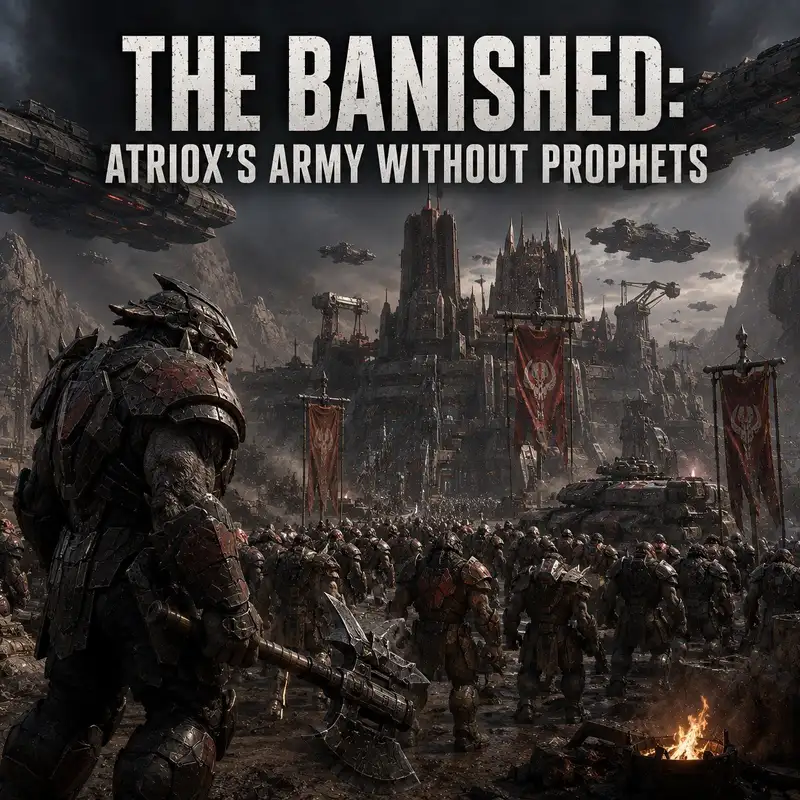
The Banished: Atriox’s Army Without Prophets
The Banished attack on the United Nations Space Command Infinity began as a military operation, not a sermon. Dreadnoughts closed on the human flagship near Zeta Halo while boarding forces struck its hangars and internal compartments. Atriox entered the ship himself, defeated John One One Seven, and moved toward the artificial intelligence meant to contain Cortana. The attackers did not promise transcendence or demand conversion. They wanted the ring, the intelligence inside it, and the strategic position it could provide. That practical focus was the first clue that the Banished were not merely the Covenant wearing red armor.
The Covenant had held its empire together through the Great Journey, a species hierarchy, and the authority of the San’Shyuum Prophets. Atriox built something different. His organization welcomed soldiers, raiders, ship crews, mercenaries, engineers, criminals, and political outcasts from across the former imperial order. It offered no shared salvation. It offered survival, payment, status, weapons, and the chance to stop serving masters who treated them as expendable. The central question is how that collection of competing interests became a military power capable of fighting the Covenant, the Created, the United Nations Space Command, and the Swords of Sanghelios without collapsing under its own contradictions.
The answer begins with the way the Covenant used the Jiralhanae. After incorporating their species, the empire valued their physical strength, pack organization, and willingness to conduct violent ground operations. It also restricted their access to technology and placed them beneath San’Shyuum political authority. Sangheili commanders often treated Jiralhanae units as disposable assault forces. Atriox survived repeated attacks in which the warriors sent beside him did not. The Covenant described those deaths as service to a sacred journey. Atriox came to see them as waste imposed by leaders who would not share the risk.
His rebellion was therefore personal, military, and political at the same time. When Covenant authorities attempted to execute him for defiance, Atriox killed the executioner and inspired other Jiralhanae to turn on their commanders. Decimus became one of his earliest and most important followers. The new movement was called the Banished because its founders had been cast out of the order they rejected. This happened before the Covenant finally collapsed. Atriox did not wait for the empire to become harmless. He built a hostile organization inside its strategic shadow and survived while the Covenant still possessed fleets capable of erasing far larger rebellions.
Early survival required avoiding the kind of war the Covenant preferred. The Banished could not defend a capital, maintain a fixed frontier, or match the empire ship for ship. They raided supply lines, captured weapons, recruited disaffected personnel, and disappeared before a larger force could concentrate. Covenant officials understood them as pirates, heretics, or a local security problem. Those labels were politically convenient and strategically misleading. A pirate takes what can be sold. Atriox took ships, workshops, specialists, and followers that could make the next operation larger than the one before it.
The Banished grew because membership was not tied to one species or one theology. Jiralhanae packs formed the core, but Sangheili shipmasters and warriors joined when service protected their crews or offered a new purpose. Unggoy served as laborers, technicians, infantry, and specialists. Kig-Yar brought commercial networks, scouting, ship handling, and the useful ability to locate equipment that had recently belonged to somebody else. Lekgolo colonies supplied heavy combat power. At least some human rebel and mercenary groups also found common cause with the organization. Admission could be broad. Equality was not.
Atriox’s promise was freedom from the Covenant’s false gods, not freedom from authority. Banished recruits were expected to sever loyalties that might compete with the organization and to recognize strength as the basis of power. Payment came through protection, spoils, status, and access to resources. Some members joined voluntarily. Others entered through coercion, defeat, debt, or the need to keep a crew alive. The organization did not require atheism, and old beliefs could persist so long as they did not override Banished orders. It could absorb a local faction without giving its members the same standing as Atriox’s oldest Jiralhanae followers. The Banished rejected the Covenant caste system while preserving hierarchy in a more negotiable and often more brutal form.
That distinction explains why the Banished could recruit Sangheili after the Great Schism. Many Sangheili had lost faith, political direction, and the logistical system that had sustained their ships. Atriox offered fuel, supplies, targets, and continuity of command. Let ‘Volir joined because the arrangement could keep the crew of the assault carrier Enduring Conviction together. His service did not mean he had adopted Jiralhanae culture or forgotten the war between their species. It meant the contract solved a problem no Sangheili council had solved for him. Atriox understood that material security could achieve what sermons no longer could.
The organization was held together through overlapping chains of personal loyalty. Atriox stood as warmaster. Senior war chiefs directed major forces and advised him. Beneath them operated clan leaders, pack chieftains, legionmasters, shipmasters, workshop leaders, and mercenary captains whose authority often came from the personnel and equipment they brought with them. Escharum, Decimus, Let ‘Volir, Pavium, Voridus, and other leaders did not command identical formations. Each controlled different relationships, specialties, and resources. The Banished were less a standardized national army than a military coalition built around Atriox’s ability to reward success and punish disobedience.
This structure gave field commanders unusual freedom. A Banished leader could modify equipment, recruit local allies, raid a target of opportunity, or build a force suited to the terrain without waiting for a ministry on High Charity to approve the correct ritual. That flexibility increased operational speed. It also increased risk. Voridus breached the quarantine around the ruins of High Charity on the Ark because he wanted access to valuable material. The resulting Flood outbreak nearly created a disaster larger than the campaign he was trying to support. Initiative is useful. Initiative near a Flood containment zone benefits from adult supervision.
Pavium and other Banished forces contained that outbreak only by abandoning hard-won ground, destroying infected concentrations, and preventing the formation of a Gravemind. Atriox accepted the losses because preserving the wider force mattered more than holding one position. The response showed the Banished at their best. They adapted quickly, combined heavy defenses with mobile attacks, and changed objectives when the original mission became irrelevant. The outbreak also showed their central weakness. A commander motivated by acquisition could create a strategic emergency before higher authority knew the risk existed.
The Banished war economy was built on taking control of material rather than inheriting a stable imperial budget. Raiders seized Covenant stores, human equipment, ships, fuel, weapons, and industrial machinery. Mining operations fed an expanding demand for raw materials. Excavators and harvesters stripped resource worlds that former Covenant authorities could no longer manage. Local Jiralhanae packs were offered absorption or faced destruction. Useful specialists were retained. Workshops modified whatever survived. The result was not an elegant economy, but it converted conquest into the means for further conquest with uncomfortable efficiency.
This is why Banished technology should not be dismissed as scavenged Covenant hardware. The organization began with captured and inherited systems, then developed its own workshops, production runs, and design practices. Banished engineers combined Covenant components, Jiralhanae preferences, and lessons taken from human doctrine. Armor became more modular. Vehicles were rebuilt for aggression, ease of repair, and local manufacture. Weapons often favored physical impact, shock, heat, and visible intimidation because those qualities suited both Jiralhanae combat culture and the practical need to break fortified positions. The appearance was brutal because the doctrine was brutal, but the machinery was not improvised at random.
Its naval growth followed the same pattern. Early Banished forces relied heavily on captured vessels and individual shipmasters whose loyalty had to be purchased or negotiated. As the organization expanded, Atriox directed resources toward larger fleets and heavily modified Covenant hulls. Banished dreadnoughts became platforms for planetary assault, carrying troops, aircraft, artillery, and deployable bases. They were not merely symbols of status. They allowed a fleet to arrive, establish ground infrastructure, and begin extracting value before a conventional occupation authority could have finished distributing its forms.
The deployable base became one of the organization’s most revealing systems. Banished forces could drop fortified installations directly into contested territory, then connect defenses, repair points, prisons, excavation equipment, and artillery around the position. This reduced dependence on intact local infrastructure and made early orbital advantage translate into a rapid ground presence. It did not guarantee control of the surrounding population or terrain. It did make the first counterattack much harder. By the time defenders understood which site mattered most, the Banished often had a wall, a gun, and several excavation crews already working behind it.
Atriox sought the Ark because it could transform that war economy into something far greater. Installation Zero Zero was a Forerunner foundry capable of producing Halo rings and controlling systems of immense strategic value. The Banished arrived in twenty-five fifty-eight, destroyed the human research presence they encountered, and began occupying key sites. Their objective was not worship. It was possession. The Ark offered energy, manufacturing potential, portals, ships, weapons, and knowledge. It was the largest prize a movement built on acquisition could imagine, which also meant nearly every automated defense and ancient containment failure on the installation could become part of the supply problem.
The arrival of the Spirit of Fire in twenty-five fifty-nine exposed the limits of Banished superiority. Atriox’s forces possessed greater numbers, established bases, and the Enduring Conviction overhead. The human ship carried an aging crew cut off from normal resupply and unaware that the Covenant War had ended. Captain James Cutter nevertheless organized a campaign that destroyed Banished bases, killed Decimus, and helped eliminate the carrier. Atriox still held much of the Ark, but one human task force denied him complete control. The Banished had occupied critical ground. They had not secured the installation’s systems or eliminated every force able to interfere with them.
The campaign also demonstrated why personal command mattered. Decimus was powerful, loyal, and militarily useful, but retained a reverence for Forerunner structures that sat uneasily beside Atriox’s rejection of Covenant belief. Let ‘Volir placed the survival of his crew above broader ideology. Pavium preferred deliberate defense and artillery. Voridus favored speed, experimentation, and risk. Atriox did not require these leaders to think alike. He required them to produce results and remain inside his authority. The arrangement increased adaptability while making the organization dependent on one leader’s ability to balance personalities that would otherwise become rival commands.
When Atriox returned from the Ark to the Milky Way, he left Let ‘Volir responsible for the Banished forces that remained there. The appointment showed that species did not automatically determine command and that failure did not always result in execution. It also kept a capable Sangheili commander tied to responsibilities larger than his lost ship. The Ark campaign continued as a separate theater while Atriox pursued Zeta Halo. The Banished could divide effort across interstellar distance because its formations already carried their own command relationships, supply methods, and reasons for staying in the fight.
The Created uprising gave the Banished both an enemy and an opportunity. Cortana’s Guardians disrupted governments, communications, and fleets across the galaxy. Centralized powers suffered because their networks and command centers could be disabled. The Banished were harder to paralyze. Their distributed forces could raid, relocate, and continue operating under local leaders. They still depended on ships, fuel, and communications, but they did not require one capital or one priesthood to legitimize every action. The political disorder that weakened states also opened abandoned depots, isolated colonies, and frightened factions to Banished recruitment or seizure.
Atriox refused Cortana’s demand for submission. She answered by destroying Doisac, shattering the Jiralhanae homeworld and devastating its moons and surrounding populations. The loss transformed the Banished. It remained a mercenary alliance and predatory military power, but it also became a refuge and vehicle for a species that had lost its center. Grief, revenge, and the need for a new home strengthened support for Atriox among many Jiralhanae. That did not make every Jiralhanae Banished. It gave the organization a civilizational cause more powerful than payment and more immediate than any Covenant promise of transcendence.
Zeta Halo offered a possible replacement. The ring contained Forerunner infrastructure, weapons, manufacturing systems, hidden records, and territory beyond ordinary planetary limits. Control could give the Banished security after the loss of Doisac and leverage over every rival power. Atriox also received intelligence that the Infinity intended to strike at Cortana there. War Chief Severan, a son of Tartarus, helped place the Banished in position for the ambush and later commanded major fleets that remained elsewhere in the galaxy. This was not a chance meeting above an ancient ring. It was an intelligence-led operation against an exhausted flagship committed to a different enemy.
The attack succeeded because the Banished combined naval concentration, boarding, surprise, and clear priorities. Infinity had spent more than a year evading the Created and entered the operation with reduced personnel and limited support. Banished dreadnoughts struck while assault teams compromised hangars and forced a ship-wide evacuation. Atriox personally sought the Weapon, the artificial intelligence designed to contain Cortana. Escharum later claimed the flagship fell in four minutes, a useful statement for morale and intimidation, though not a reliable stopwatch reading. The important fact is that Infinity lost the initiative before its command could restore a coherent defense.
Cortana’s destruction of the Silent Auditorium fractured Zeta Halo and moved the installation through slipspace. Atriox disappeared from the view of most of his forces, and Escharum assumed command of the occupation. For the next six months, Banished units captured key sites, hunted survivors, interrogated prisoners, built outposts, and attempted to control the machinery repairing the ring. Their bases combined logistics with theater. Prisons produced intelligence and control. The House of Reckoning turned combat trials into training, punishment, and propaganda. Escharum had rejected Prophets, but he understood the value of ritual when it served military identity.
Banished occupation was effective without being complete. Human survivors established resistance cells, recovered supplies, and used wreckage as shelter and headquarters. Spartans attacked excavation sites and communications. The ring’s Sentinels followed their own priorities. The Harbinger pursued the release of the Xalanyn, whose interests overlapped with Banished goals without becoming identical to them. Escharum controlled the strongest organized force in the local sector. He did not control Zeta Halo. No commander did. The installation remained a battlefield whose most important systems were understood only in fragments by everyone trying to possess them.
The death of Escharum and the loss of other senior leaders disrupted that local command. John One One Seven destroyed outposts, recovered forward operating bases, killed members of the Hand of Atriox, and broke the structure supporting the immediate Banished campaign. Later fighting confirmed that the Banished leadership on Zeta Halo had entered a period of chaos rather than disappearing. This is an important distinction. A conventional army may collapse when headquarters falls. The Banished can lose a war chief and continue fighting through clans, packs, ship crews, and local commanders who still possess weapons and reasons to resist.
Atriox also survived. He was last seen beneath Zeta Halo opening cylixes connected to the Xalanyn, while the consequences of that decision remained unresolved. Elsewhere, Let ‘Volir continued directing Banished operations on the Ark. Severan emerged as the effective leader of major Banished fleets outside the Ark and Zeta Halo during Atriox’s absence. These commands were related, but not interchangeable. The Banished had become large enough to operate in several theaters under leaders with different information and priorities. That breadth made the organization resilient. It also raised the question of whether personal loyalty to Atriox could maintain strategic unity when he was absent for long periods.
The Banished succeeded without Prophets because they replaced theology with a functioning exchange. Leaders received personnel, ships, protection, and opportunity. Atriox received loyalty, resources, intelligence, and military reach. Local formations retained enough identity to operate effectively, while shared hostility toward submission gave them a common political language. Their workshops and extraction sites turned captured technology into sustained force. Their distributed command survived disruption that would have crippled a centralized ministry. Their willingness to recruit across old species lines let them use talent the Covenant had restricted through caste.
None of this made the Banished a free alliance in the ordinary sense. The right to reject one master was often followed by an obligation to serve another. Conquered packs could be absorbed at weapon point. Prisoners were exploited. Colonies and installations were treated as resources before they were treated as homes. Atriox opposed the Prophets because they spent lives for a false promise and demanded submission to distant authority. He built a system that valued results, loyalty, and strength, but still allowed the powerful to define what everyone else would sacrifice.
That is the contradiction inside Atriox’s army. The Covenant required belief in the Great Journey and shattered when the Prophets lost control of that belief. The Banished require no single religion, capital, or species hierarchy, which makes them harder to break with one revelation or one political defeat. Their cohesion rests instead on material success and confidence in leaders who can keep rewards flowing. When those leaders are separated, killed, or unable to provide victory, the organization does not vanish. It fragments into armed commands whose ambitions may no longer align.
A Banished drop-base on Zeta Halo contains no shrine promising salvation. It contains weapons, repair systems, holding cells, extraction machinery, and a command post connected to whoever currently holds the ground. That is why the Banished became more than another Covenant remnant. They turned rejection into recruitment, salvage into industry, and personal loyalty into an interstellar army. They escaped the Prophets’ empire, but not the older political temptation beneath it: the belief that freedom belongs first to those strong enough to decide what everyone else must surrender.