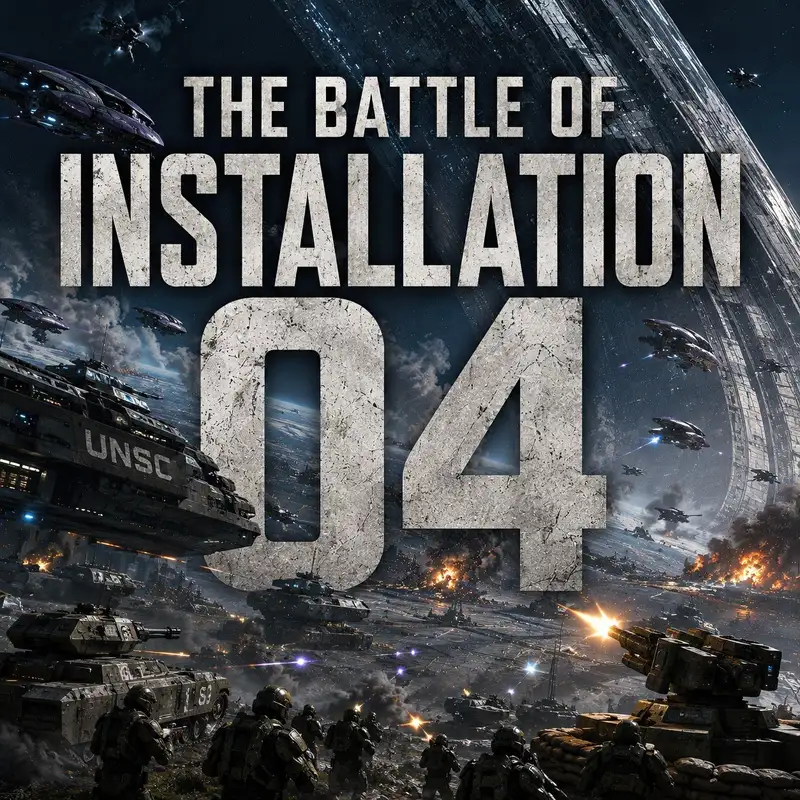
The Battle of Installation 04
Thel ‘Vadamee had the human cruiser trapped, but the Prophet of Stewardship would not let him destroy it near the ring. The order was religious before it was military. Installation Zero Four was a sacred Forerunner relic, and plasma fire that might damage it was unacceptable. The Fleet of Particular Justice therefore shifted from annihilation to capture while the Pillar of Autumn launched lifepods, Pelicans, and drop pods toward the surface. That restraint saved the ship long enough for Captain Jacob Keyes to crash it onto the installation. The Covenant had won the pursuit from Reach. Its own faith prevented it from finishing the victory cleanly.
The Battle of Installation Zero Four lasted from September nineteenth through September twenty-second, twenty-five fifty-two. It began as a pursuit between a damaged human cruiser and a superior Covenant fleet. It became a struggle for an ancient installation. Then the Flood escaped containment, and control ceased to be a meaningful objective. Humans wanted survival and a way off the ring. The Covenant wanted possession of a holy site. The monitor wanted containment restored through activation of Halo. The Flood wanted hosts, vehicles, and a route into the wider galaxy. By the final day, destroying the battlefield was the only action that denied every other participant its preferred outcome.
Installation Zero Four, later called Alpha Halo, orbited the gas giant Threshold in the Soell system. Its habitable inner surface contained forests, oceans, mountains, deserts, swamps, artificial weather, transportation networks, and research facilities. It appeared to be a constructed world. It was actually one element of the Halo Array, built by the Forerunners as a final response to the Flood. The ring was not designed simply to burn visible infection forms. Its strategic purpose was to kill sentient life across a vast radius, depriving the parasite of the hosts and accumulated intelligence needed to continue expanding. The Forerunners had also preserved Flood specimens for study.
The installation’s custodian was the monitor Three Four Three Guilty Spark. For roughly one hundred thousand years, he had maintained the ring under orders written for a war that ended before any human or Covenant soldier was born. He controlled Sentinels, doors, transport systems, containment procedures, and activation protocols. He did not possess a current political context. When the Flood escaped, he followed ancient instructions. His logic was internally consistent. It was also prepared to solve a local outbreak by killing civilizations that had no idea the outbreak existed.
The human force reached the ring in poor condition. The Pillar of Autumn had escaped Reach after heavy damage and the loss of most of its intended Spartan assault force. Its crew included Navy personnel, Marines, Orbital Drop Shock Troopers, pilots, technicians, medical teams, and one combat-effective Spartan Two, John-One One Seven. Cortana provided navigation, fire control, electronic warfare, and intelligence analysis. Major Antonio Silva commanded the shock-trooper battalion, with First Lieutenant Melissa McKay as executive officer and the military artificial intelligence Wellsley supporting battlefield coordination. This was enough to form a capable ground force. It was not enough to hold a ringworld against a fleet.
The Covenant force was stronger, but less unified than its weapons suggested. Thel ‘Vadamee commanded the Fleet of Particular Justice and had followed the Autumn from Reach. He needed to destroy the survivors, secure the installation, and preserve its religious value. The Prophet of Stewardship could interfere with military decisions in the name of doctrine. Sangheili commanders had to protect sacred structures, prevent human access, and satisfy a political observer whose priorities did not always match battlefield necessity. The Covenant possessed orbital control. It did not possess freedom of action.
The first phase was a contest to turn scattered survivors into organized forces. Lifepods and dropships landed across wide areas of the ring. Some were destroyed in the air. Others crashed far from friendly units, leaving Marines and naval personnel isolated among Covenant patrols. John carried Cortana away from the Autumn because her data could not be captured. He then helped gather survivors and secure extraction points while Pelicans moved between landing zones. These actions mattered less for the number of enemy troops killed than for the people and radios recovered. A scattered battalion is a collection of targets. A battalion with transport, communications, and a defensible base can influence a campaign.
Captain Keyes did not reach that base immediately. Covenant troops captured him and other personnel, then transferred them to the battlecruiser Truth and Reconciliation. Major Silva assumed local command and established Alpha Base on a mesa strengthened by Forerunner structures and Covenant fieldworks. The position offered observation, defensible approaches, landing areas, and space to organize survivors. Wellsley managed the battlenet, while McKay coordinated the practical work of rebuilding units from whoever had landed nearby. Weapons had to be collected, wounded personnel treated, aircraft assigned, and supplies recovered. The base was improvised, but improvisation was the only logistics system available.
The rescue of Keyes demonstrated the advantages and limits of human initiative. John led Marines in an assault on the Truth and Reconciliation, penetrating a ship held above the ring and recovering the captain. The operation restored command authority and denied the Covenant a valuable prisoner. It did not capture the cruiser or remove the fleet overhead. Human forces could raid a superior enemy when surprise, terrain, and a Spartan concentrated the fight. They still lacked the naval strength to prevent reinforcements or bombardment. The rescue solved a command problem. It did not solve the blockade.
Keyes interpreted the ring through the war humanity had just survived. The Covenant considered it important, which meant it might be a weapon or source of leverage. If the United Nations Space Command could understand its systems, Halo might offset the technological imbalance that had destroyed Reach. The reasoning was understandable and dangerous. Every faction entering a Forerunner installation tended to treat access as control. The Covenant believed sacred inheritance conferred legitimacy. Humans assumed technical exploitation might produce military advantage. Neither side knew the installation’s purpose, and neither had time to study it safely.
Cortana and John searched for the Silent Cartographer, a facility that mapped the ring’s systems. Once its information identified the control room, human forces assaulted through terrain already occupied by Covenant troops. Aircraft, armor, Marines, and the Spartan pushed toward the structure while the Covenant defended it as both a military objective and religious site. The operation succeeded because conventional forces carried John to the critical point and held the approaches long enough for him to enter. Cortana accessed the installation’s network and discovered that Halo was far more dangerous than Keyes had imagined.
At almost the same time, Keyes led a separate mission toward what appeared to be a Covenant weapons cache. The report pointed to a containment facility in a swamp. Covenant personnel had already entered the complex and broken seals around the Flood specimens held below. Their troops were being attacked, but the information reaching human command was incomplete. Keyes and his Marines entered expecting enemy matériel and found signs of a battle that did not match known Covenant weapons. By the time they understood that the installation contained a biological threat, the parasite was already spreading.
The Flood converted the campaign from a contest over terrain into a containment emergency. Infection forms sought biological hosts. Infected humans and Covenant personnel became combat forms able to use weapons, open doors, and exploit skills and memories taken from the bodies they consumed. Carrier forms spread additional infection. The parasite did not need factories or normal supply lines. Every casualty could become manpower, intelligence, and matériel. A defensive position that accumulated bodies also accumulated resources for the Flood. Holding ground became unstable. Killing an attacker was useful only if the remains could not be converted or the area could be abandoned before infection arrived.
The Flood also erased the security provided by species and uniform. Covenant troops could no longer assume a Sangheili shape was friendly. Marines could not assume a human voice indicated a survivor. Communications became vulnerable because the parasite absorbed knowledge from hosts. Vehicles and ships were no longer merely equipment to defend. They were possible escape systems for the outbreak. The Flood did not have to defeat the Covenant fleet. It needed to place infected personnel aboard one vessel capable of leaving the system.
Keyes was captured and infected during the containment failure. The parasite retained him because his command experience and knowledge were valuable. On the Truth and Reconciliation, his body became part of a developing Proto-Gravemind, an early concentration of biomass and absorbed intelligence. Keyes knew human navigation procedures, military organization, and the significance of Earth. The Cole Protocol had been designed to prevent the Covenant from acquiring such information. It had not been written for an enemy that could extract memory by consuming the officer who carried it.
John entered the containment facility after Cortana recognized that Keyes’s mission was in danger. He found the surviving record of the attack and encountered the Flood directly. Guilty Spark then transported him away and identified him as a Reclaimer capable of retrieving the Activation Index. The monitor offered direction with the confidence of a custodian following emergency procedure. He did not begin with a complete explanation of what activation would do to John, the Marines, the Covenant, or every other sentient population within range. Ancient protocol apparently considered informed consent less important than timely compliance.
The Library held the Index required to fire the ring. Guilty Spark guided John through the structure while Sentinels fought the Flood. The Sentinels were effective against infection, but they were security machines, not an army capable of restoring the entire installation after multiple factions breached it. Their priorities also differed from human survival. They destroyed infected forms and later attacked uninfected personnel who interfered with containment. John recovered the Index because he believed it offered a way to stop the outbreak. His mission succeeded. The intelligence supporting it was incomplete.
Cortana had remained inside the control room’s systems. During that time, she learned Halo’s nature and understood the consequence Guilty Spark treated as routine. When John returned with the Index, she prevented activation and took control of it. This was the decisive intelligence action of the battle. A Spartan had completed the assigned task, the monitor possessed the procedure, and the installation was ready to fire. One artificial intelligence, operating inside an alien network she did not fully understand, recognized that mission success would be strategic catastrophe.
Stopping activation made Guilty Spark an enemy. His Sentinels pursued John and Cortana while the Flood and Covenant continued fighting across the ring. Cortana proposed disabling three phase pulse generators near the control room. Their destruction would interfere with the installation’s ability to fire and force the monitor to divert attention toward repairs. John carried out the sabotage while Covenant troops, Flood forms, and Sentinels fought one another across the same terrain. This was not a stable three-way balance. Every local clash changed which faction controlled a route, vehicle, or access point minutes later.
Alpha Base could not remain outside that collapse. Covenant forces assaulted it repeatedly, and the Flood eventually overran the position. The human command structure fractured again. Survivors moved toward aircraft, the Pillar of Autumn, and the Truth and Reconciliation. Supplies recovered from the grounded cruiser had sustained the defense, but the ship itself was increasingly exposed. Its ammunition, vehicles, medical stores, and reactors made it valuable to every side. The Covenant wanted to deny the humans a base. The Flood wanted transport and hosts. Cortana saw enough fusion power to destroy the ring.
Major Silva pursued a different escape plan. His shock troopers boarded and captured the Truth and Reconciliation, taking the Prophet of Stewardship prisoner. A functioning Covenant battlecruiser offered slipspace capability, advanced weapons, intelligence, and a way to carry hundreds of survivors home. Under ordinary conditions, capturing such a vessel would have been an extraordinary victory. Conditions were not ordinary. Flood forms had infested the cruiser, and no human team could prove that every compartment, ventilation route, or hidden infection form had been cleared. Returning the ship to Earth could deliver the parasite to humanity’s home system.
First Lieutenant McKay recognized that risk and the Cole Protocol problem. A captured Covenant ship might be tracked, its navigation systems compromised, or surviving personnel capable of revealing the destination. Silva believed the prize justified the danger and appears to have been influenced by the personal value of returning with a Prophet and warship. McKay concluded that the evacuation had become a species-level threat. She severed the primary control connection between the bridge and engineering, causing the cruiser to crash. The action killed the human boarding force, including McKay and Silva. It also denied the Flood a slipspace-capable escape vessel.
Cortana and John returned to the Truth and Reconciliation for a different reason. They needed Keyes’s neural implants and command authorization to initiate the Autumn’s self-destruct system. They arrived too late to rescue him. John destroyed the Proto-Gravemind holding the captain and recovered the implants. The mission reduced a commander and veteran of Reach to the data carried inside his body. It was necessary because the Autumn’s safeguards still recognized lawful command authority after most of the command structure had died. Military systems are designed to prevent unauthorized destruction. On Installation Zero Four, those protections became an obstacle to destroying the correct target.
The plan was a wildcat destabilization of the Autumn’s fusion drives. Rather than hold the ring, recapture every facility, or trust Guilty Spark with the Index, Cortana would use the cruiser’s reactors to fracture the installation. John reached the ship while Covenant troops and Flood forms converged on it. Human rear guards, including Fireteam Raven, fought outside the crash site and delayed Covenant assault elements. Their actions did not promise evacuation. They bought the Spartan time to reach engineering.
Cortana used Keyes’s authorization to begin the self-destruct sequence. Guilty Spark intervened through the ship’s systems and canceled it. The monitor had moved from withholding critical information to preserving the installation against those trying to prevent its use. John therefore had to rupture the reactor system manually by damaging the machinery regulating the fusion drives. It was an inelegant solution to an advanced-security problem. The artificial custodian could cancel a command code. It could not easily prevent a heavily armored soldier from breaking the hardware.
The final escape route was a Longsword strike craft stored aboard the Autumn. Pelican pilot Carol Rawley attempted to reach John and Cortana, but Covenant aircraft shot her transport down. That loss removed the expected extraction and forced the Spartan to cross the damaged cruiser toward the remaining spacecraft while the reactors moved toward overload. Covenant special operations troops pursued him, including Zuka ‘Zamamee, a Sangheili officer who had spent much of the battle trying to kill the human the Covenant called the Demon. Personal vendetta, religious duty, and strategic necessity converged inside a ship about to become a bomb.
John launched the Longsword shortly before the Autumn’s reactors detonated. The explosion broke Installation Zero Four apart. Sections of the ring collided, fell toward Threshold, scattered across the system, or attempted automated emergency responses too late to preserve the whole. The blast destroyed the cruiser, killed the forces still on the installation, stopped the activation attempt, and eliminated the principal route by which the local Flood outbreak might escape. It did not produce a neat casualty report. The battle had dispersed personnel across a structure larger than a conventional theater, and later evidence showed that a small number of human and Covenant survivors escaped by other means.
The destruction did not eliminate every Flood specimen associated with the ring. Later recovery operations in the debris field proved that biological material had survived, and the Office of Naval Intelligence made the hazardous decision to study it. The immediate battle was still won in the only meaningful sense available. The installation could not fire. The Fleet of Particular Justice could not secure it. Guilty Spark could not complete his protocol. The outbreak lost the intact ships and infrastructure required for rapid interstellar expansion.
For the Covenant, the loss was military, religious, and political. A sacred ring had been found and destroyed within days under Thel ‘Vadamee’s command. The Prophet’s interference and the Flood outbreak complicated responsibility, but Covenant leadership did not reward complicated explanations. Thel was stripped of rank, condemned, and later forced into the role of Arbiter. Guilty Spark’s survival and later testimony helped inspire a heretical movement that challenged the Covenant’s understanding of Halo. The battle did not cause the Great Schism by itself, but it exposed the instability created when military authority depended on religious claims contradicted by the installation’s actual function.
For humanity, the victory was equally uncomfortable. The Pillar of Autumn was lost. Most of its crew, Marines, shock troopers, and pilots died. Keyes, Silva, McKay, Fireteam Raven, and countless personnel whose actions kept the force functioning did not leave the ring. John and Cortana prevented activation, but they did so by destroying one of humanity’s surviving cruisers and much of the evidence it had crossed interstellar space to find. Their success preserved the possibility of a future campaign. It did not provide a fleet, a secure route home, or proof that Reach’s survivors still had a government capable of using what they had learned.
The Battle of Installation Zero Four was decided because no participant could safely control the objective. Covenant faith prevented efficient military action and encouraged dangerous contact with systems it misunderstood. Human commanders divided their effort between survival, intelligence collection, and captured technology while lacking a complete threat picture. Guilty Spark followed containment doctrine without regard for the civilizations inside his weapon’s range. The Flood turned every body, vehicle, and ship into a means of expansion. Destroying the ring was not conquest. It was denial on a civilizational scale.
The final image is a damaged Longsword moving away from the debris while Cortana searches for survivors. The human force had reached Halo hoping an ancient weapon might change the war. It did, but not by becoming humanity’s weapon. Installation Zero Four revealed that the Covenant’s promised salvation was a mass-killing system, that the Forerunners had preserved the enemy they built it to contain, and that control of advanced technology is meaningless without understanding, judgment, and the power to deny it to everyone else. The battle was won when the objective ceased to exist.