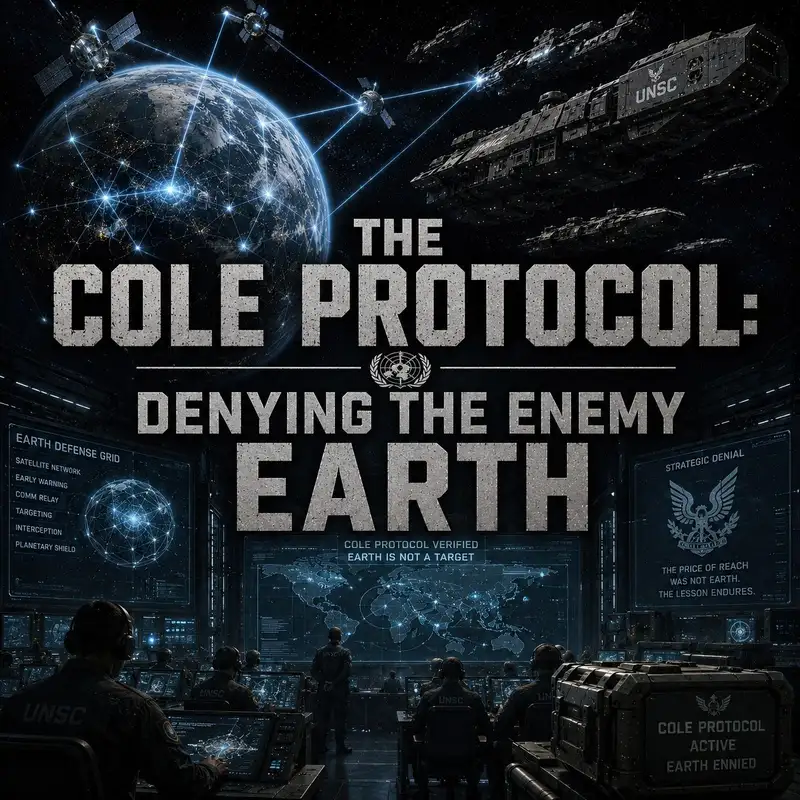
The Cole Protocol: Denying the Enemy Earth
The Covenant had already killed almost everyone aboard the destroyer Heart of Midlothian when Sergeant Michael Baird awoke from surgery. The ship’s artificial intelligence, Mo Ye, had been cut away from most of her systems. Covenant boarders controlled the vessel, and its navigation records remained intact. Baird’s task was not to retake the ship. It was to make certain that no one left it carrying the route to Earth.
He reached the command systems by promising the boarding force access to the information it wanted. Once Mo Ye was reconnected, Baird provoked the Sangheili commander into killing him. With no surviving human aboard to protect, the artificial intelligence could complete the destruction sequence. The Heart of Midlothian and the Covenant force around it disappeared in the detonation. The ship, the crew, and its accumulated intelligence were lost. Earth remained hidden.
That was the Cole Protocol in its most severe form. It treated navigation data as a strategic weapon and a captured ship as a possible attack route toward every human population center still unknown to the enemy. The order did not ask whether a vessel had won its battle, whether its crew could still escape, or whether the hardware might be recovered later. If capture would expose Earth or another colony, denial took priority. The ship was expendable. The map was not.
The protocol emerged from a weakness humanity could not solve through firepower. Covenant warships were faster, better protected, and more destructive than their human opponents. Yet during the early war, the Covenant did not possess a complete map of human space. It found colonies through captured information, reconnaissance, tracking, accident, and the Forerunner-seeking instruments known as Luminaries. Humanity could not stop every fleet. It could make the enemy search for the next world instead of leading it there.
Preston Cole recognized the value of that ignorance after the Battle of the Great Bear in twenty-five thirty. A surviving Sangheili confirmed that the Covenant intended to destroy humanity, but the interrogation also revealed that the enemy understood very little about the civilization it had condemned. It knew that human worlds existed. It did not know the full network connecting them, and it had not located Earth. Cole began developing a doctrine that would turn secrecy into a defensive layer.
By twenty-five thirty-five, the doctrine had become Emergency Priority Order zero nine eight eight three one A dash one, better known as the Cole Protocol. Its first article required ships and stations facing Covenant contact to purge navigation databases, verify that backups had also been erased, and deploy software intended to scavenge surviving fragments. Retreating vessels were forbidden from jumping directly toward Earth, the Inner Colonies, or any other human population center. If capture became imminent, the vessel was to destroy itself.
Violation could be treated as treason and punished by imprisonment or execution. That severity reflected the scale of the danger. A captain who saved one ship by retreating along a familiar route might reveal a colony holding millions of people. A technician who preserved one backup because the data seemed too valuable to erase could provide the Covenant with years of route history. The protocol converted what looked like an individual survival decision into a question of civilization-wide risk.
Its early planning went beyond destruction. Human vessels fleeing the Covenant were to use randomized vectors away from core worlds. Office of Naval Intelligence planners also proposed broadcasting old human carrier signals through slipspace in an effort to complicate any attempt to triangulate Earth. The principle was consistent across each measure. Human movement, emissions, and records created patterns. The protocol tried to make those patterns misleading, incomplete, or fatal to recover.
A navigation database contained more than one set of planetary coordinates. It could include previous routes, safe translation points, rendezvous sites, relay locations, fleet bases, repair yards, convoy schedules, and the identity of destinations hidden behind military designators. Even routine maintenance records could reveal where a ship had been serviced. Cargo manifests could identify industrial worlds. Crew files could link personnel to colonies and commands. Capturing the map was dangerous. Capturing the administrative context around the map could be almost as useful.
Shipboard artificial intelligences created an even greater concern. A smart artificial intelligence might know navigation data, fleet deployments, weapons research, communications procedures, and classified operations extending far beyond one vessel. It could also interpret fragmented records that an enemy analyst might misunderstand. Article Two of the protocol therefore treated destruction or capture of a shipboard artificial intelligence as unacceptable. Removing, purging, or destroying the intelligence became part of abandoning the ship.
The protocol was not one switch beside the captain’s chair. It depended on data architecture, network discipline, command procedures, engineering access, and repeated drills. Crews had to know which systems held navigational information, where redundant copies existed, and how to verify a purge after damage had severed parts of the network. Commanders needed self-destruct options that could still function after boarding. Artificial intelligences required instructions for denial and transfer. A protocol designed for the final minutes of a ship had to be prepared during every ordinary day before them.
Randomized withdrawal created its own hazards. Human slipspace travel already involved uncertain timing and imperfect coordination. A ship leaving on a vector chosen primarily to conceal its destination might emerge far from repair, fuel, medical support, or friendly communications. Several vessels retreating from the same battle could become separated. Civilian transports might carry wounded people and limited provisions into a route selected because it was secure rather than survivable. The protocol protected the destination by transferring danger to the people making the jump.
The order also complicated rescue and rendezvous. A damaged ship escaping a battle could not simply choose the nearest colony or familiar naval base. Survivors might carry copied data, compromised artificial intelligences, or an enemy tracking device no one had detected. Rescue ships therefore had to inspect hulls, isolate computers, transfer crews, and sometimes scuttle vessels that could otherwise have been repaired. Alternate assembly points protected the colonies while placing damaged formations farther from medical care and shipyards. The protocol’s safest answer was often operationally harsh: recover the people when possible, deny the ship when necessary, and never allow the urgency of rescue to reveal the location of everyone waiting behind it.
This burden fell hardest on the frontier. Earth and the Inner Colonies were protected partly by ensuring that ships fleeing destroyed Outer Colonies did not return directly toward them. The logic was defensible. It was also politically revealing. Colonists already suspicious of Earth’s authority now faced inspections, movement restrictions, data seizures, and orders allowing the military to destroy civilian vessels if their records threatened the core worlds. The government called it information security. A refugee captain could reasonably experience it as being told that home was too dangerous to approach.
The Rubble crisis in twenty-five thirty-five placed that conflict at the center of an operation. The Rubble was a hidden settlement built from linked asteroids in the Twenty-Three Librae system. Much of its population consisted of survivors from Madrigal and people aligned with the Insurrection. Their ships carried navigational information leading toward Earth and other colonies. To the residents, that data represented mobility and independence. To the United Nations Space Command, it represented a route through which the Covenant might reach the human core.
The threat was not theoretical. Kig-Yar traders had established contact with the settlement, supplying Covenant weapons while seeking human slipspace drives and navigation data. Elements within the Covenant leadership saw the arrangement as a way to locate additional human worlds. Political leaders inside the Rubble disagreed over whether cooperation offered survival, profit, or betrayal. The settlement had escaped both Covenant destruction and Earth’s authority. The maps in its possession made that independence strategically dangerous to everyone else.
Spartan Two Gray Team was sent behind enemy lines to destroy the vulnerable data. Lieutenant Jacob Keyes and the frigate Midsummer Night became involved after pursuing Insurrectionist shipping into the system. The resulting conflict included Covenant forces, Kig-Yar interests, Rubble defenders, insurgents, civilians, and United Nations Space Command personnel who did not begin with a common political objective. The Cole Protocol supplied one point of agreement that could not be negotiated away. The Covenant could not leave with the coordinates.
The operation did not end with the United Nations Space Command simply destroying the settlement and everyone inside it. Gray Team secured the navigation threat while Keyes and the surviving forces helped evacuate roughly a million residents through the Exodus Project to Falaknuma. The Rubble itself was lost, but the population was not treated as an acceptable substitute for the data. Cole considered the evacuation a victory and promoted Keyes. The episode showed that the protocol could be enforced with judgment rather than as an automatic order to kill anyone possessing a map.
It also showed why judgment was necessary. Many Rubble residents were Insurrectionists or distrusted Earth, but they were still human civilians facing Covenant manipulation and attack. Destroying their navigation records protected other colonies while removing their freedom of movement. Saving them required ships, cooperation, and a destination willing to receive a politically difficult refugee population. The protocol solved the intelligence problem. It did not solve the politics created by enforcing it.
As the war continued, the order became routine enough that naval personnel were required to review it repeatedly. Routine did not make compliance easy. A captain had to consider the protocol while fighting damage, organizing evacuation, protecting classified systems, and deciding whether the ship was truly beyond recovery. Self-destruction destroyed evidence, equipment, and any wounded people who could not be moved. Waiting too long risked capture. Acting too early could kill a crew that still had a chance to escape.
The Heart of Midlothian demonstrated the final form of that dilemma in twenty-five forty-eight. Covenant special operators boarded the destroyer after it emerged from slipspace. A Huragok helped isolate Mo Ye from the ship, preventing her from purging the records or initiating destruction. Baird survived only because he had been unconscious during a medical procedure and was mistaken for dead. The protocol’s success therefore depended on one wounded Orbital Drop Shock Trooper crossing a captured ship and restoring an artificial intelligence’s access.
Baird’s sacrifice was not a conventional victory. He did not rescue the crew, recover the vessel, or return with intelligence. He denied all of those things to the enemy. This is the uncomfortable arithmetic of information warfare. The value of the action came from events that never occurred afterward. No captured database led a Covenant fleet toward Earth. No interrogation of Mo Ye exposed human deployments. The protected lives remained invisible because they were scattered across worlds that never knew what had almost revealed them.
Reach exposed a different weakness. The Office of Naval Intelligence prowler Circumference was docked at Gamma Station while isolated from the station’s normal computer network to protect classified stealth work. When Covenant forces attacked, the station’s artificial intelligence could not reach Circumference’s systems and execute the required purge. The secrecy intended to protect one program had created a direct violation of the protocol defending all human population centers.
John One One Seven, Linda Zero Five Eight, and James Zero Zero Five were diverted to destroy the exposed navigation database manually. They succeeded, but James was lost and Linda was critically wounded. At the moment Reach required every available Spartan for planetary defense and Operation RED FLAG, three of them were committed to eliminating data aboard a friendly ship. The decision appears extreme only if the ship is viewed as a piece of equipment. In protocol terms, Circumference had become a weapon aimed at Earth.
The incident also revealed a recurring institutional problem. Compartmentalization protected information from enemies and unauthorized personnel, but it could prevent friendly systems from enforcing common safeguards. Gamma Station did not know enough about the docked prowler to protect it correctly. The Office of Naval Intelligence had secured the project from its own network and thereby secured the Covenant’s access if the station fell. The protocol was uncompromising. The organizations implementing it remained human.
Reach was discovered despite decades of data denial. Separate Covenant forces reached the system through methods the protocol could not completely prevent, including Forerunner artifact searches and a tracking probe attached to the destroyer Iroquois after Sigma Octanus Four. The probe did not require the ship to set a prohibited course or surrender a database. It simply traveled with the vessel. The Cole Protocol could control human records and procedures. It could not guarantee that every enemy sensor, beacon, or ancient map had been detected.
That limitation did not make the protocol ineffective. Security measures are judged by the risks they reduce, not by whether they make discovery physically impossible. The Covenant had many routes to information, but each required time, luck, intelligence work, or access to Forerunner systems. Without disciplined denial, every damaged freighter and captured patrol ship could have supplied another direct path. Humanity could not prevent the enemy from searching. It could prevent itself from making the search easy.
The Pillar of Autumn carried the protocol from Reach to Installation Zero Four. Its escape course did not lead toward another human world. Cortana selected coordinates derived from the Forerunner data recovered at Sigma Octanus Four, turning what appeared to the crew as a compliant departure into a jump toward an unknown installation. The decision satisfied the central security requirement while demonstrating how much operational discretion still existed inside it. Randomized withdrawal was a means of denial, not a requirement that every captain surrender judgment to chance.
When the Autumn was boarded and its defense failed, Captain Keyes invoked Article Two. Cortana had to leave the ship because her capture would reveal far more than Earth’s coordinates. She held intelligence on fleet strength, military research, and human strategy. John carried her away while Keyes attempted to bring the cruiser down on the ring. The ship’s artificial intelligence became the most important item evacuated from a vessel filled with weapons, Marines, and technical systems.
The Covenant eventually captured Keyes, but not Cortana. John and Cortana later overloaded the cruiser’s reactors, eliminating the ship and Installation Zero Four together. That outcome was not the execution originally imagined by the protocol, yet it achieved the same denial. The enemy did not obtain an intact shipboard intelligence or a navigational archive leading back to human space. It acquired a battlefield full of surviving personnel, wreckage, and partial information, which was dangerous enough.
Earth’s concealment ended on October twentieth, twenty-five fifty-two, when the Prophet of Regret arrived with the Fleet of Sacred Consecration. The fleet was following Forerunner information pointing toward the portal to the Ark, not a captured human route, and Regret did not understand that the destination was humanity’s homeworld until he encountered Earth’s defenses. The protocol had prevented the obvious form of discovery. It could not hide a planet that ancient machines had already placed on an alien map.
This distinction is important when judging success. The Cole Protocol did not promise that Earth would remain unknown forever. It denied the Covenant the most accessible paths through human navigation records, artificial intelligences, and retreat routes. Earth was discovered through a separate intelligence chain shaped by Covenant religion and Forerunner technology. By then, the war had reached its final year, Reach had fallen, and humanity had gained more than seventeen years after the protocol’s formal adoption to mobilize, build defenses, train personnel, and continue resisting.
The price of that delay was not evenly distributed. Outer Colonies were destroyed while the protocol protected locations deeper inside human space. Crews died rather than retreat directly. Civilian ships lost records and freedom of movement. Refugees were diverted toward uncertain destinations. Intelligence personnel made decisions affecting entire populations without public debate. The protocol helped preserve humanity, but it did so through a hierarchy of risk in which people at the edge were often ordered to protect a center they might never see.
After Earth was known and the Covenant fragmented, the original directive lost much of its immediate purpose. Its underlying principle survived. During the Created uprising, the United Nations Space Command revived Cole Protocol safeguards to protect hidden worlds, bases, and surviving command locations. New restrictions addressed the risk posed by artificial intelligences that might defect or expose secure networks. The enemy had changed from alien fleets searching for coordinates to digital minds already familiar with human infrastructure. Information denial remained useful because the military still could not defend every location openly.
The Cole Protocol was therefore not merely an emergency order to erase navigation computers. It was a strategy for a weaker civilization that could not protect all of its territory through force. It converted ignorance into time, forced commanders to treat data as a weapon, and made self-destruction part of navigation doctrine. Its effectiveness depended on discipline at the precise moment when damaged crews, frightened civilians, isolated artificial intelligences, and secretive agencies were least likely to act in perfect coordination.
It denied the enemy Earth by ordering human ships not to run home. That is the contradiction at the center of the protocol. The world being protected could offer no immediate refuge to the people carrying its secret. Their duty was to turn away, erase the route behind them, and destroy the vessel if the enemy came aboard. Earth survived in part because sailors, civilians, artificial intelligences, and special operators accepted that the safest course for humanity might be the one that gave them the smallest chance of returning to it.