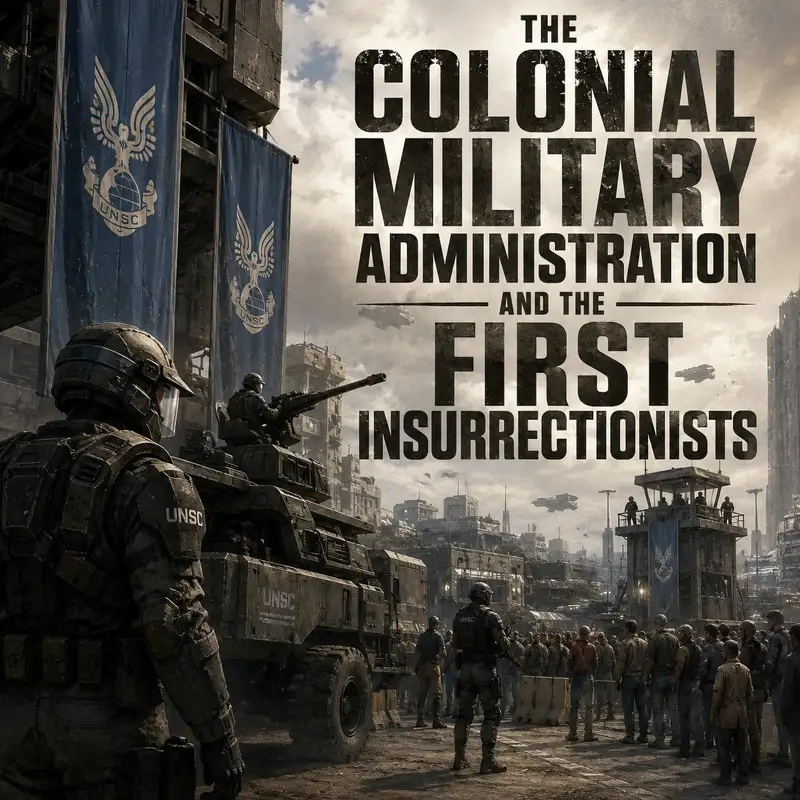
The Colonial Military Administration and the First Insurrectionists
The decisive finding in Operation VERITAS was not a rebel base, a stolen warship, or a hidden weapons factory. It was a list of nonofficial-cover agents from the Secessionist Union working inside senior offices of the Colonial Military Administration. The force created to protect the colonies had not merely failed to stop the rebellion. Parts of its own command structure had been penetrated by it. In twenty-four ninety-seven, that discovery gave the United Nations Space Command the security justification it needed to begin dismantling the colonial military and absorbing its responsibilities.
That decision is easy to describe as a purge of a compromised organization. It is harder to understand why the compromise occurred. The colonial military was neither simply corrupt nor secretly united behind independence. It was an institution divided by geography, mission, recruitment, and loyalty. It represented the central government in communities that increasingly distrusted central rule, while drawing many of its personnel from those same communities. The first Insurrectionists did not need to infiltrate a foreign occupation force. They needed to persuade neighbors, relatives, veterans, administrators, and officers that colonial loyalty mattered more than obedience to Earth.
Official records use both Colonial Military Authority and Colonial Military Administration. The abbreviation is the same: C M A. It was established in twenty-three ten beside the civilian Colonial Administration Authority. Together, these organizations formed the Colonial Authority, the structure through which the Unified Earth Government planned, governed, supplied, and protected settlements beyond the Solar System. The civilian administration handled colonial development and regulation. The military arm controlled ships and ground forces assigned to colonial protection.
The distinction looked orderly on an organization chart. In practice, it created overlapping authority from the beginning. The United Nations Space Command already possessed Naval Command and Unified Ground Command. Those institutions defended Earth and the Solar System and retained greater prestige, funding, and political access. Colonial protection was initially treated as a secondary responsibility, useful for reassuring settlers who feared piracy, lawlessness, and isolation but not equal to the defense of the human core. Forces transferred to the C M A were therefore carrying out a mission the central military often regarded as peripheral.
Human expansion changed the importance of that mission. Inner Colonies became wealthy industrial and population centers. Outer Colonies supplied food, minerals, fuel, and strategic access across the Orion Arm. By the beginning of the twenty-fifth century, Naval Command and Unified Ground Command were extending their own presence into the Inner Colonies, where shipyards, military facilities, and major commercial routes had become too valuable to leave under a separate colonial structure. The C M A increasingly shifted outward. The frontier became its province, not because the frontier mattered less to its residents, but because other institutions had claimed the more valuable core.
That movement shaped the C M A’s identity. Much of its manpower came from the Outer Colonies. Its soldiers and sailors regarded themselves as frontiersmen who understood remote settlements better than personnel arriving from Earth or Reach. They knew which ports could repair a patrol craft, which local militias could be trusted, which shipping firms concealed contraband, and which administrator’s orders would be ignored the moment the courier vessel departed. This local knowledge made the colonial military useful. It also created loyalties that did not always point toward the same capital.
The C M A Navy spent much of its history on work that sounded modest until it failed. Its ships conducted search and rescue, suppressed piracy and smuggling, enforced trade restrictions, tended routes, and maintained a government presence where a larger naval force could not remain. These missions demanded endurance more often than heavy firepower. They also placed crews directly inside political disputes. A patrol vessel searching a freighter was enforcing law from the government’s perspective. To a colonial merchant, the same action could look like armed interference by a distant authority that controlled trade but did not share the local risk.
The C M A Marine Corps occupied an equally uncomfortable space between military force and law enforcement. Its units protected power plants, space elevators, ports, and other infrastructure. They coordinated colonial militias, conducted peacekeeping, and responded to terrorism and civil disorder. A Marine might spend one deployment defending settlers from raiders and the next guarding a tax office from those settlers. The equipment could remain the same while the political meaning of the mission changed completely.
The colonial Navy and Marines were not always organized for close joint operations. Much of the fleet was built for patrol, rescue, and enforcement rather than sustained expeditionary warfare ashore. Large vessels could support prolonged campaigns, and the Punic-class space-control carriers were intended to sustain major colonial operations for months. They were exceptions within a force whose ordinary work depended on smaller ships, local bases, improvised logistics, and cooperation with civilian authorities. The C M A could show the flag in many systems. It could not impose continuous control across all of them.
That limitation mattered because the political grievance was distributed across distance. Outer Colonies objected to economic restrictions, taxes, resource extraction, uneven representation, and administrative decisions made far from the worlds affected. These complaints were not identical, and they did not produce one colonial ideology. A prosperous trading settlement could demand looser regulation. A mining community could resist corporate control. A local government could seek greater autonomy while opposing armed separatists. The term colonial unrest covered disagreements that ranged from legal protest to organized violence.
Civil uprisings appeared across several colonies between twenty-four seventy-five and twenty-four eighty-three. Some movements still sought change through negotiation. Others concluded that petitions were merely a slower method of being refused. In twenty-four eighty-seven, the People’s Occupation and the Secessionist Union submitted sovereignty demands on behalf of roughly a dozen worlds. The Unified Earth Government rejected them. The refusal did not instantly turn twelve colonies into a unified rebel state. It did strengthen the argument that formal channels would never produce meaningful independence.
The first Insurrectionists were therefore not one army waiting for a declaration of war. They were political organizers, clandestine cells, local militias, smugglers, defectors, saboteurs, and armed factions that shared opposition to central control but disagreed about methods and end states. Some wanted negotiated sovereignty. Some wanted the complete removal of Unified Earth Government authority. Some attacked official buildings and military targets. Others embraced kidnappings, assassinations, bombings, and attacks that endangered civilians. Their common label concealed real differences in legitimacy, discipline, and political purpose.
The C M A stood directly inside this fragmentation. Local recruitment gave colonial personnel credibility that Earth-centered forces lacked, but it also exposed the organization to the same grievances spreading through the population. A quartermaster sympathetic to independence could divert ammunition without ever joining a guerrilla unit. A communications officer could warn a settlement that an inspection team was coming. A shipyard worker could delay repairs, alter records, or conceal the identity of a vessel. A senior official could shape contracts and deployments so that weapons and ships reached people who were not supposed to have them.
None of this means the entire colonial military supported rebellion. Many C M A personnel fought Insurrectionists, protected civilians, and remained loyal to the Unified Earth Government. Others may have sympathized with colonial grievances while rejecting terrorism. The intelligence problem was determining where sympathy ended and active support began. An institution built around local relationships could not simply remove those relationships without destroying the knowledge that made it effective. The same proximity that enabled good policing also enabled concealment.
The government’s response deepened the contradiction. In twenty-four ninety-one, the C M A and the Office of Naval Intelligence revived the ORION project to produce enhanced operators for counterinsurgency missions. The colonial military was therefore helping create a classified force to strike rebel leadership at the same time that rebel agents were penetrating its offices. This was not evidence of one coherent conspiracy. It was evidence of an organization splitting internally under political pressure.
Far Isle and the Callisto incident accelerated that process. The nuclear destruction of Far Isle in twenty-four ninety-two demonstrated how far the state might go when conventional suppression failed. The capture of the corvette Callisto and the nuclear ambush of a United Nations Space Command battle group in twenty-four ninety-four demonstrated how far organized militants could go in return. Neither event created the C M A’s loyalty problem, but both made moderation harder. Colonial personnel were being asked to enforce a system that some residents now associated with annihilation, while central commanders faced insurgents capable of stealing warships and destroying naval forces.
The decisive institutional crisis developed in the Eridanus system. In June twenty-four ninety-four, the Secessionist Union began a coordinated campaign on Eridanus Two under former United Nations Space Command Marine colonel Robert Watts. Watts was not a frontier amateur. He had served the government, fought separatists, and become disillusioned with the policies he was ordered to enforce. His defection showed that the loyalty crisis extended beyond the C M A. The colonial military later endured the scandal, but one of the most capable rebel leaders had come from the regular Marine Corps.
Watts combined military experience with support from sympathizers inside the C M A command hierarchy. His forces carried out bombings, kidnappings, assassinations, and attacks that disrupted shipping and weakened the Eridanus government. Colonial contacts helped the rebels obtain equipment and assemble a small fleet. That support transformed the campaign. A protest movement can obstruct a government. A force with trained leadership, military stores, transport, intelligence, and armed spacecraft can attempt to replace it.
By January twenty-four ninety-five, the Secessionist Union effectively controlled Eridanus Two. This was more than a series of terrorist attacks. A recognized colonial government had lost practical authority over its own world. Shipping was threatened, local institutions were penetrated or defeated, and the rebels had enough force to contest access to the system. The United Nations Space Command now faced a problem at several levels. It had to restore the local government, defeat armed ships, destroy or capture rebel formations, and prevent the campaign from becoming a model for other colonies.
The Eridanus government requested outside assistance in December twenty-four ninety-four. The major response did not arrive until January twenty-four ninety-six. Interstellar delay, force assembly, intelligence preparation, and the difficulty of organizing a campaign all contributed to the gap. That delay also carried political meaning. For a government under attack, one year is long enough to learn that distant sovereignty may not provide immediate protection. For the rebels, it was time to consolidate, disperse, and prepare escape routes.
Operation CHARLEMAGNE retook Eridanus Two through naval action, ground operations, and the first tactical deployment of ORION operators. The operation broke the Secessionist Union’s open control of the colony, but it did not eliminate Watts or his network. Surviving rebels escaped into the system’s asteroid belt, where terrain, concealment, local navigation knowledge, and civilian shipping complicated pursuit. The government recovered the planet. The insurgency retained experienced leaders, hidden infrastructure, and the ability to return.
This distinction between recovering territory and destroying an insurgent organization became one of the central problems of the wider conflict. A fleet could defeat armed rebel vessels in open space. It could not search every asteroid, inspect every freighter, or distinguish every sympathizer from an uninvolved civilian. Ground forces could occupy government buildings and transportation hubs. They could not manufacture political trust. The more personnel required for searches and security, the more opportunities existed for abuse, resentment, and intelligence leaks.
Operation VERITAS exposed the depth of the institutional threat. In late twenty-four ninety-six or early twenty-four ninety-seven, ORION operators obtained a list of Secessionist Union agents serving under nonofficial cover in high-level C M A offices. The surviving public record does not describe every detail of the mission, and the identities involved remain largely outside the open history. The conclusion was unmistakable. Rebel access was not limited to a few rifles disappearing from a warehouse. Secessionist agents had reached positions where they could influence decisions, contracts, deployments, and information.
The United Nations Space Command moved to shut down the C M A and transfer its resources to Naval Command and Unified Ground Command. In twenty-four ninety-seven, the colonial military’s involvement with the rebels became public. From a counterintelligence perspective, centralization was logical. A compromised chain of command cannot safely control warships, depots, mobilization plans, or classified operations. The government needed trusted communications, standardized command, and forces whose allegiance did not have to be reevaluated before every mission.
The political cost was equally logical. The C M A had been the military institution most closely identified with colonial service. Removing it shifted more authority toward commands associated with Earth and the Inner Colonies. The takeover told loyal colonial personnel that their entire institution was suspect because some officers had betrayed it. It told separatists that the central government would respond to divided loyalty by eliminating local control. The security reform addressed infiltration while reinforcing the political narrative that had made infiltration possible.
The transfer also damaged the ORION project. Because ORION had been funded through the C M A structure, the dissolution and redistribution of colonial resources helped strip the program of support. The enhanced operators had exposed the agents whose discovery undermined their own institutional sponsor. It was an efficient result by the standards of classified bureaucracy: the mission succeeded, the target network was revealed, and the program that carried it out lost its foundation.
The C M A did not disappear in a single day. Its useful ships, personnel, bases, and responsibilities were gradually absorbed or reassigned. What remained was pushed toward remote patrols, logistical support, fuel depots, navigation infrastructure, installation security, and riot control. Budgets declined. Equipment aged. Training standards deteriorated. By twenty-five twenty-five, some colonial recruits received only enough instruction to handle a weapon, follow basic military routine, and operate common vehicles before being sent to duty. An organization once presented as the shield of the frontier had become a second-line force asked to perform politically sensitive work with declining resources.
That decline created another self-reinforcing cycle. Poorly equipped units could perform unevenly, and some units leaked information. Their failures justified further cuts and greater United Nations Space Command control. The cuts produced more resentment among personnel who believed the regular services had taken their mission, their best equipment, and their reputation. Some remained loyal despite the insult. Some left military service. Some defected. The first Insurrectionist forces gained more than stolen weapons from the colonial military. They gained trained people who understood patrol routines, military culture, logistics, and the habits of the units sent to find them.
The rebel movement also evolved. Jerald Ander and the Secessionist Union represented an early clandestine and political network with ties across several colonial causes. Watts provided experienced operational leadership in Eridanus. Records do not always define the boundaries among the Secessionist Union, the People’s Occupation, the People’s Occupation Government, and related organizations with perfect consistency. That uncertainty reflects the conflict itself. Cells shared personnel, ideology, contacts, and martyrs without always sharing a durable command structure.
By twenty-five oh nine, Watts had drawn several surviving groups into what became known as the United Rebel Front. The name suggested unity more complete than the reality, but the organization was capable of sustained armed resistance. The conflict had moved beyond petitions and isolated uprisings into an undeclared civil war involving fleets, fortified bases, covert action, assassination, and large counterinsurgency campaigns. The C M A had not created every rebel faction. Its collapse helped provide the personnel and material through which scattered opposition became militarily credible.
The colonial military’s final major irony came at Harvest. When contact with the agricultural colony was lost in twenty-five twenty-five, the weakened C M A performed the mission for which it had originally been created. It sent the scout ship Argo to investigate. When Argo failed to report, Battle Group Four followed. The force did not find separatists, smugglers, or pirates. It found a devastated colony and a Covenant warship possessing weapons and defenses beyond anything in the human inventory. Two ships were destroyed, and the damaged Heracles escaped with the warning.
On November first, twenty-five twenty-five, the remaining C M A combat forces were placed under Naval Command and Unified Ground Command for the duration of the crisis. The arrangement became permanent as the Human-Covenant War expanded. The institution that had been marginalized because of divided colonial loyalty was absorbed just as humanity encountered an enemy that did not care whether a person came from Earth, Reach, Eridanus, or Harvest. The political divisions remained. The separate colonial command did not.
The first Insurrectionists emerged because distance had become identity, economic control had become political grievance, and military institutions were asked to enforce a relationship they could not make legitimate. The Colonial Military Administration was especially vulnerable because it belonged to both sides without being fully trusted by either. It served the Unified Earth Government, recruited from the colonies, protected frontier communities, enforced unpopular restrictions, fought rebels, armed some of them through betrayal, and helped create the operators sent to destroy them.
Its dismantling solved a genuine counterintelligence emergency. It did not solve the colonial conflict. Central command gained tighter control over ships, troops, and information, while losing an institution that possessed local knowledge and at least the possibility of local legitimacy. The first Insurrectionists gained proof that trained defectors and internal sympathizers could turn government power against itself. The frontier gained another reason to see Earth’s security policy as the replacement of representation with command.
The most revealing legacy of the C M A is therefore not a particular ship or uniform. It is the sight of the same colonial training, weapons, navigation knowledge, and military habits appearing on opposite sides of the same engagement. The organization built to separate lawful defense from rebellion became one of the places where the boundary between them collapsed. When its insignia disappeared from active combat forces, the loyalties that had divided it did not disappear. They moved into the United Nations Space Command, the Insurrection, and the long war that followed.