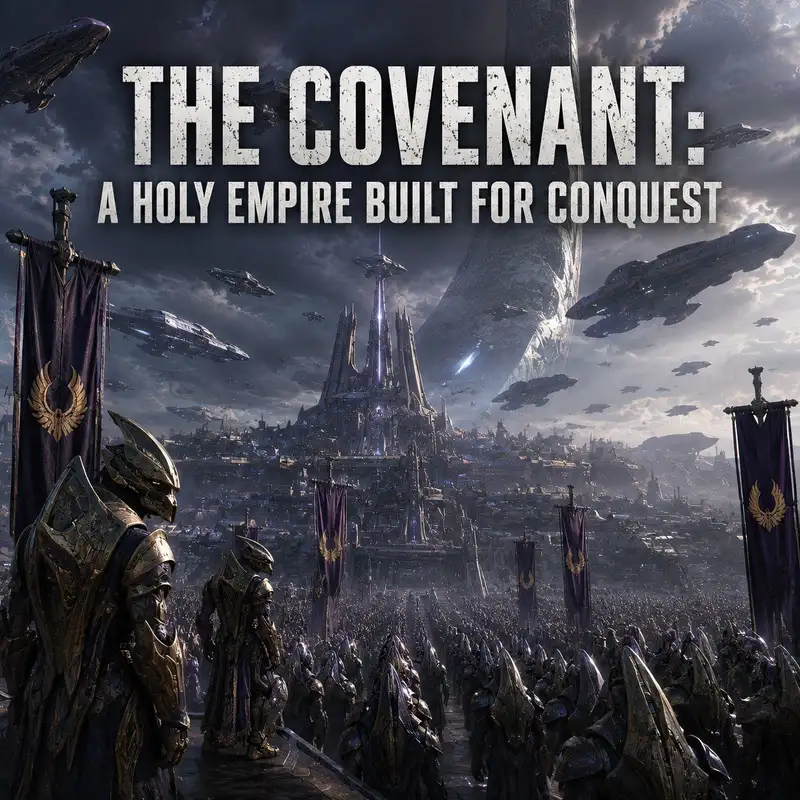
The Covenant: A Holy Empire Built for Conquest
A Covenant vessel entered the Harvest system carrying a luminary intended to locate Forerunner relics. The device marked thousands of signals across the world, and the crew assumed the planet was rich in sacred artifacts. When the data reached High Charity, a fragment of the ancient artificial intelligence Mendicant Bias supplied the dangerous explanation. The symbols did not identify objects awaiting reclamation. They identified the humans themselves as Reclaimers. For three ambitious San’Shyuum officials, this was evidence capable of destroying the political order they intended to lead.
They chose concealment, elevation, and war. The officials who became the High Prophets of Truth, Regret, and Mercy buried the discovery and declared humanity an offense against the gods. The Covenant did not approach the new species as another potential member. It opened a campaign of extermination. The Covenant was a religious union, a political hierarchy, an economic system, and a military instrument. Its faith gave conquest a sacred purpose. Its institutions made conquest routine. The same design made truth an existential threat.
The Covenant began thousands of years earlier with a war between the San’Shyuum and the Sangheili. The San’Shyuum Reformists had fled their homeworld aboard a Forerunner keyship, carrying advanced technology and a willingness to study, adapt, and use sacred artifacts. The Sangheili revered the Forerunners as divine predecessors, but many considered such manipulation sacrilege. The dispute became the War of Beginnings. San’Shyuum control of the keyship provided a major technological advantage. Sangheili numbers, martial organization, and resistance prevented a simple victory. Neither side could impose a stable peace by force alone.
The settlement was the Writ of Union. It joined San’Shyuum religious authority and technical interpretation with Sangheili military power. The agreement did more than end a war. It created a division of labor that would shape the next three millennia. The San’Shyuum became clerics, ministers, interpreters of relics, and managers of imperial policy. The Sangheili became protectors, fleet commanders, enforcers, and the senior military caste. Each side needed the other. The San’Shyuum lacked the strength to dominate the galaxy alone. The Sangheili accepted a faith and political structure that made their service part of a divine mission.
That founding compromise was never a merger of equals. The San’Shyuum controlled doctrine, access to sacred knowledge, ministerial appointments, and the language through which discoveries were explained. The Sangheili retained military prestige, command authority, and influence through the High Council. The Covenant survived because neither group openly challenged the bargain at its center. Its stability depended on a shared belief that the Prophets interpreted the path and the Sangheili defended it. Once either side suspected betrayal, the entire empire became vulnerable.
High Charity embodied the union. The immense mobile capital was built around the Forerunner keyship the Covenant called the Dreadnought. The vessel’s presence made the city a holy site, political headquarters, industrial center, and strategic base. Hierarchs ruled from its council chambers. Ministries competed through its bureaucracy. Pilgrims approached it as the heart of the faith. Fleets drew guidance, personnel, and material from it. High Charity concentrated authority so effectively that its survival became inseparable from the survival of the state. Centralization is efficient until the capital becomes a battlefield, at which point efficiency develops a regrettable second meaning.
At the top of the Covenant stood three Hierarchs, commonly called the High Prophets. They presided over the High Council and presented political decisions as religious guidance. The council included San’Shyuum and Sangheili members, but did not represent the empire’s species equally. Lower castes had little meaningful voice. Beneath it operated ministries with overlapping authority over relic recovery, security, military deployments, conversion, and trade. Rival offices limited any one minister’s independence while ensuring that policy could be delayed by competition disguised as devotion.
The ministries were more than civilian departments. They controlled ships, personnel, intelligence, and access to technology. A fleet might serve a religious mission, a ministerial interest, a commander, and the Hierarchs at the same time. Those purposes did not always align. Covenant officers operated inside a system where doctrinal standing and political sponsorship could matter as much as tactical competence. An operation could be militarily sound and politically unacceptable, or militarily wasteful and spiritually prestigious. No species has ever required alien technology to discover that problem.
The Great Journey gave this structure its unifying purpose. Covenant doctrine taught that the Forerunners had transcended through the activation of the sacred rings. The faithful would follow them by locating the rings and beginning the same process. Forerunner relics were therefore not archaeological curiosities. They were evidence, scripture, navigation aids, weapons, and steps toward salvation. Every recovered artifact strengthened religious authority. Every newly discovered world offered the possibility of another relic. Expansion was not merely desirable. It was a sacred obligation tied to the ultimate destiny of every believer.
That belief was sincere for many Covenant citizens and soldiers. An Unggoy infantryman, a Sangheili shipmaster, and a San’Shyuum minister did not share the same education or status, but all could believe that service advanced the Great Journey. Faith gave troops endurance and commanders a language for sacrifice. It also gave the state a method for defining dissent. To question a campaign could become heresy. Political and religious obedience were woven together so tightly that separating them became dangerous.
The empire expanded by encounter, coercion, negotiation, and conquest. Species that possessed useful capabilities were incorporated into a hierarchy designed before they arrived. Their place was determined less by equal citizenship than by what the Covenant wanted from them. Some communities accepted membership for protection, trade, or access to technology. Others resisted and were defeated. Conversion could preserve local structures when those structures served imperial needs. It could also destroy autonomy. The Covenant called itself an alliance, and in a limited sense it was one. It was also an empire whose senior partners reserved the authority to define the terms.
The Sangheili dominated much of the military establishment. Their keeps, clans, martial traditions, and long service gave them a professional officer culture that extended from ground commands to major fleets. Sangheili commanders could display initiative, operational skill, and a serious understanding of logistics and naval warfare. They were not merely ceremonial warriors with energy swords. Their conceptions of honor shaped conduct, but honor did not create one universal doctrine. Some valued disciplined service. Some pursued political advancement. Some treated subordinate species with contempt. Others earned loyalty across species lines. The empire depended on their competence while keeping final theological authority elsewhere.
The San’Shyuum were far fewer in number, but they controlled the system’s interpretive center. They staffed the senior clergy, ministries, and offices that decided what a relic meant and who could use it. Their power came from institutional position. They could authorize fleets, bless campaigns, restrict technology, and label opponents heretics. Some were sincere scholars or administrators. Others manipulated doctrine for personal or factional advantage. The Covenant’s tragedy was not that every Prophet knew the faith was false. It was that a small leadership class could suppress inconvenient evidence.
Other species entered the empire on unequal terms. Lekgolo colonies became formidable military assets after a violent first encounter. Kig-Yar retained strong commercial traditions and served as scouts, marksmen, privateers, traders, and intermediaries. Their loyalty could be practical rather than devotional. Yanme’e hives supplied labor, technical skill, and airborne combat forces while preserving social structures outsiders only partly understood. These peoples were not interchangeable battlefield categories. The empire assigned them roles, but role did not erase culture, ambition, or resentment.
The Unggoy occupied the lowest and most heavily exploited position among the major client species. They provided labor and mass infantry, frequently under coercive conditions and with little political protection. Their treatment eventually contributed to the Unggoy Rebellion, a conflict serious enough to threaten Covenant stability. The empire crushed the uprising, but it also made concessions and recognized greater military status for Unggoy service. The episode exposed a recurring truth. A caste system can describe a population as expendable. It still has to survive what happens when that population stops cooperating.
Huragok were even more revealing. These Forerunner-created biological engineers could repair, maintain, and improve systems that Covenant operators did not fully understand. They were indispensable technical specialists and often treated as property, protected resources, or coerced servants rather than political participants. Their existence allowed the Covenant to sustain advanced machinery without distributing the knowledge or authority associated with it. A shipmaster could command a vessel whose most sophisticated repairs depended on a being with no seat at the council table. Technical importance did not produce political power. The Covenant preferred expertise that could be controlled.
The Jiralhanae joined late in the empire’s history, only decades before the war with humanity. They brought pack-based military organization, physical power, and a society recently devastated by its own internal conflict. Covenant authorities restricted portions of their technological access while using them as soldiers and enforcers. Their rivalry with the Sangheili grew from more than species temperament. Both groups competed for status, command, weapons, and the favor of the Prophets. The Hierarchs could manage that rivalry by keeping responsibilities divided. Truth later discovered that he could also use it as the basis for a coup.
Conquest required an economy. Covenant tithe worlds, fortress systems, trade networks, resource sites, and subject populations supplied fleets that operated across enormous distances. Assembly forges produced weapons, vehicles, equipment, and components from established design patterns. Major industrial functions were concentrated aboard High Charity, large vessels, and important outposts rather than recreated on every conquered world. Huragok and other specialists kept difficult systems functioning. The empire could deploy immense force, but it still depended on fuel, power, munitions, maintenance, food, atmosphere, transport, and trained crews. Religious purpose did not exempt a carrier from replenishment.
Covenant technology was superior to humanity’s in many decisive areas. Energy shielding increased ship and infantry survivability. Plasma weapons could burn through armor and devastate surface targets. More capable slipspace systems improved strategic movement and accuracy. Gravity control, advanced sensors, compact power systems, and inherited manufacturing methods gave Covenant fleets advantages human commanders could rarely match directly. Those advantages were real. They were not proof that every Covenant officer understood the underlying science. Much of the empire’s technology had been derived from Forerunner examples, then adapted through centuries of practical engineering, ritual restriction, and controlled innovation.
That relationship with technology created strength and fragility at once. The Covenant could manufacture reliable weapons and warships at scale. It was not simply scavenging individual artifacts. Yet religious rules shaped what could be examined, altered, or distributed. Access depended on rank and species. Leaders could suppress research that threatened doctrine. Engineers might reproduce a design without understanding every principle behind it. The empire possessed a mature military-industrial system, but placed theological boundaries around inquiry. It could build a plasma rifle. It could not safely ask every question raised by the machine it copied.
Its fleets reflected the same pattern. Covenant naval forces were powerful, but not one perfectly standardized service. Different ministries, commanders, and eras produced differences in readiness, composition, and mission. Carriers, cruisers, destroyers, corvettes, support vessels, fighters, and dropships operated in formations shaped by purpose and patronage. Sangheili shipmasters often exercised considerable authority once deployed. San’Shyuum officials could direct major expeditions. Political oversight might provide clarity, or an order designed to protect a minister’s reputation. Superior firepower cannot simplify a chain of command that makes theology part of targeting.
Against most opponents, the system worked. A Covenant fleet could arrive with little warning, defeat local defenses, seize relics, compel submission, and punish resistance from orbit. Mixed-species forces gave commanders infantry, scouts, engineers, heavy assault troops, aerial units, and specialists within one expedition. The hierarchy turned diversity into military specialization. Its brutality reduced the need for prolonged occupation. If a population resisted and offered no further value, the empire could destroy its military centers, devastate its cities, and render large regions uninhabitable. Conquest did not always require administration after the shooting stopped.
Humanity created a different problem because the Hierarchs prohibited incorporation. The Covenant could not offer surrender into the imperial order without risking the secret at the center of the war. Humans interacted with Forerunner systems in ways that contradicted official doctrine. Their existence suggested that the Prophets were not the exclusive interpreters of the divine inheritance. The leadership therefore named the conflict the War of Annihilation. A species that might have become another subject population had to be erased before ordinary believers understood why it mattered.
The decision produced nearly twenty-eight years of genocide. Covenant fleets destroyed colony after colony, usually overcoming human naval forces through stronger shields, heavier plasma weapons, and better slipspace performance. Human commanders won individual engagements through ambush, concentration, nuclear weapons, orbital defenses, artificial intelligence, and extraordinary sacrifice. Those victories did not reverse the strategic balance. The Covenant retained greater depth and superior technology. Humanity survived partly because the enemy still had to locate each settlement across interstellar space. A fleet could burn a world only after intelligence, navigation, and logistics brought it there.
The extermination policy also denied the Covenant the normal political benefits of victory. It could not recruit human specialists, absorb human industry, or turn human governments against one another through promises of status. It could exploit captured information and seize artifacts, but it had defined every living human as an enemy. That simplified doctrine and complicated strategy. There was no negotiated end state short of extinction. Every surviving colony remained a future battlefield. Every evacuated population could carry resistance elsewhere. The empire’s method of conquest had become a campaign requiring it to find and destroy an entire interstellar civilization.
Even during the war, Covenant performance varied. Some commanders were skilled and adaptive. Others allowed ritual priorities to distort operations. Fleets competed for religious prestige and access to relics. Ministries concealed information from rivals. Sangheili officers often resented San’Shyuum interference, while Jiralhanae commanders received increasing favor from Truth’s faction. The war machine remained dangerous because its technology and experienced personnel could absorb a considerable amount of institutional dysfunction. That tolerance encouraged leaders to mistake continued victory for structural health.
The discovery of Halo transformed those hidden weaknesses into open crisis. The sacred rings were real, but their purpose was not divine ascension. They were weapons designed to destroy sentient life and deny the Flood the hosts required for galactic expansion. Evidence of that truth reached Covenant personnel unevenly. Some rejected it. Some investigated. Some broke with the Prophets. Others doubled down because faith, loyalty, and personal identity had been built around the Great Journey. An empire can survive bad news. It has greater difficulty surviving proof that its highest political authority depends on preventing citizens from understanding the bad news.
Truth responded by attacking the founding bargain. After Regret’s death, he replaced Sangheili honor guards with Jiralhanae forces and accelerated the transfer of military authority. Sangheili councilors and troops recognized the change as more than a personnel decision. Their status had been guaranteed by the Writ of Union and justified by centuries of service. The purge that followed turned rivalry into civil war. Jiralhanae units attacked Sangheili forces. Sangheili commanders turned their weapons on former allies. The Great Schism was not an accidental barracks fight expanded to fleet scale. It was a political consolidation that used existing resentment as ammunition.
The timing was catastrophic. The Covenant was fighting humanity, contesting a Halo installation, and confronting a Flood outbreak while its command structure divided. High Charity became a battlefield and was overrun. The central government, sacred capital, industrial hub, communications center, and symbol of unity failed almost at once. Truth departed to pursue activation of the Array. Sangheili factions sought survival, revenge, or a new political order. Jiralhanae forces followed competing leaders. Lower castes chose according to local commanders, belief, fear, and opportunity. The hierarchy fractured along every line it had created.
Human and Sangheili forces then cooperated against shared threats, but that alliance should not be mistaken for instant reconciliation. The Sangheili had spent decades directing or participating in humanity’s destruction. Human survivors had little reason to forget. What changed was the strategic problem. Truth’s attempt to activate the Array threatened every species. The Flood threatened every living population. Cooperation became possible because the old Covenant political order no longer controlled the meaning of loyalty. Former enemies did not agree on history. They agreed that survival required stopping the same immediate danger.
The Covenant collapsed because its leadership destroyed the balance that had held the empire together. Human resistance mattered. Sangheili skill mattered. The Flood’s capture of High Charity mattered. The truth about Halo mattered most because it struck at legitimacy, while Truth’s purge converted a theological crisis into a military one. The empire had been built to defeat outside enemies, absorb useful populations, and suppress local revolts. It was not designed to survive a moment when its enforcers, subjects, and believers all had reason to question the authority issuing orders.
Its successor factions inherited ships, weapons, doctrines, symbols, and grievances, but none recreated the original union. Some tried to preserve the faith. Some sought regional power. Some joined the Swords of Sanghelios. Others entered mercenary forces, pirate networks, local governments, or the Banished. The Covenant name retained weight because the empire had shaped thousands of years of political life. Its institutions had organized trade, war, worship, and identity across many worlds. Collapse ended the central authority. It did not erase the cultures, military habits, or inequalities that authority had produced.
The Covenant was built for conquest because it turned expansion into worship, hierarchy into force structure, and technological inheritance into political legitimacy. It was effective because the San’Shyuum supplied doctrine and administration, the Sangheili supplied military leadership, and the subject species supplied specialized labor and combat power. It was fragile because every part of that system depended on the Prophets controlling what the Forerunners meant. At Harvest, three leaders chose genocide to protect that control. On High Charity, the empire finally paid the full cost of the decision. Its fleets still possessed superior weapons when they began firing on one another.