The Covenant: Faith, Caste, and Imperial Power
The machine at the heart of High Charity did not identify humanity as a military threat. It identified humanity as a threat to the religion that held the Covenant together. In twenty-five twenty-five, a fragment of the ancient artificial intelligence Mendicant Bias examined symbols found on the human colony of Harvest. Covenant officials had assumed those symbols marked Forerunner relics awaiting recovery. The oracle corrected them. The symbols identified Reclaimers, and the humans associated with them possessed a relationship to the Forerunner legacy that Covenant doctrine could not safely explain. Three ambitious San’Shyuum understood the danger immediately. They did not publish the discovery. They turned it into a coup, became the High Prophets of Truth, Mercy, and Regret, and ordered a war of extermination.
That decision reveals the Covenant more clearly than any battlefield formation. The empire was held together by sincere faith, enforced caste, unequal access to technology, and a political system that treated religious interpretation as state power. It could mobilize fleets across enormous distances, combine the military abilities of several species, and sustain a genocidal campaign for almost three decades. It could not tolerate evidence that challenged the authority of those at the top. The central question is therefore not simply why the Covenant was powerful. It is how faith, caste, and imperial administration made that power possible, and why the same structure eventually turned one political crisis into the destruction of the empire.
The Covenant began with a war over holy technology. San’Shyuum Reformists had fled their homeworld aboard the Forerunner vessel later known as the Anodyne Spirit. They believed ancient relics could be studied and used. The Sangheili revered the Forerunners as divine predecessors, but many considered the disassembly or exploitation of their artifacts to be sacrilege. First contact between the two species ended in bloodshed, and the War of Beginnings followed. The San’Shyuum possessed the Dreadnought and the technological advantages derived from it. The Sangheili possessed larger numbers, powerful fleets, and a military culture able to absorb terrible losses. Neither side could secure a clean victory without risking mutual ruin.
In eight hundred fifty-two B C E, the Writ of Union ended the conflict and created the Covenant. It was both a peace treaty and a division of imperial labor. The San’Shyuum became the principal interpreters of Forerunner will and the senior religious authorities. The Sangheili became the defenders of the Prophets and the military backbone of the new alliance. The Dreadnought was decommissioned and placed at the center of High Charity, the mobile capital built around it. The arrangement looked balanced because both species held seats in the High Council. It was never fully equal. The San’Shyuum controlled doctrine, relic distribution, and the legitimacy of political office. The Sangheili controlled most day-to-day military power, but that power was exercised in the name of a religion interpreted by someone else.
The Covenant’s faith centered on the Great Journey. Its adherents believed the Forerunners had activated the Halo installations and transcended beyond biological existence. The faithful expected that another activation would elevate them as well while cleansing the galaxy of unbelievers. This was an incorrect interpretation of ancient records. The Halo Array had been fired to deny the Flood the sentient life it required for expansion. Yet the Covenant religion was not merely a cynical fabrication maintained by leaders who all knew better. Belief varied, but it was genuine across species and social levels. Many San’Shyuum were devout. Sangheili warriors accepted death as service to a sacred destination. Unggoy deacons preached the same promise under conditions their rulers had made almost unbearable.
Faith supplied the Covenant with more than consolation. It established strategic objectives. Forerunner sites were not archaeological curiosities. They were holy ground, sources of weapons, and possible steps toward transcendence. Ministries sponsored expeditions to locate relics, recover them, and decide which client species could receive the technologies derived from them. Zealots and other religious military orders protected sacred sites or seized them from outsiders. Luminaries searched for signs of Forerunner presence. A fleet commander could therefore pursue religious prestige, political advancement, technological gain, and military advantage through the same operation. The Covenant did not separate church, state, intelligence collection, and weapons acquisition. It made them departments of the same imperial project.
Expansion followed a familiar pattern. A newly encountered species might be invited to accept the Great Journey and Covenant authority. If it resisted, missionary work could become coercion, blockade, invasion, or annexation. The result was called conversion even when the persuasive portion of the process had been delivered by plasma fire. Yet incorporation did not produce equality. Covenant society assigned status largely by species, then refined that hierarchy through office, military rank, lineage, religious standing, and political patronage. The system did allow exceptional individuals to gain influence. It did not permit a successful Unggoy commander to become San’Shyuum, or a Kig-Yar merchant to claim the Prophets’ authority to interpret the gods.
The Lekgolo were the first major species annexed after the Covenant’s founding. Initial conflict grew from a problem only an empire built around relic worship could produce: some Lekgolo colonies consumed Forerunner materials without recognizing their sacred status. Once the Covenant learned to communicate with them and distinguish useful colonies from those considered threats to relics, the species was incorporated. Mgalekgolo gestalts became formidable shock troops, while other Lekgolo forms served technical and military functions. Their inclusion demonstrated the Covenant’s practical flexibility. A species could be culturally opaque and biologically unlike its rulers, yet still receive a place in the empire if that place enhanced Covenant power.
The Yanme’e entered the Covenant centuries later and served as mechanics, laborers, and soldiers. Their flight and hive organization gave commanders capabilities that other species could not easily reproduce. The Kig-Yar entered through a more transactional relationship. Their experience in trade, privateering, navigation, scouting, and commerce made them useful throughout Covenant space. Many retained strong loyalties to family, ship, and profit rather than to the empire as an abstract political community. Covenant authority tolerated this because the Kig-Yar moved goods, gathered information, and supplied specialized military skills. Loyalty was desirable. Utility was often sufficient.
The Unggoy received a harsher settlement. The Covenant found Balaho technologically vulnerable and forced its people into the lowest levels of labor and military service. Unggoy populations were moved into crowded districts, assigned dangerous work, and treated as expendable by species above them. Their environmental requirements increased dependence on Covenant equipment and supply systems. Some accepted the faith sincerely. Others complied because the empire controlled transport, food, housing, and armed force. When mistreatment and conflict with the Kig-Yar helped ignite the Unggoy Rebellion in twenty-four sixty-two, the revolt spread across Covenant society and proved that the empire’s lowest caste could fight with discipline and determination.
The Covenant ended the rebellion by attacking the relationship the Unggoy could not abandon. A fleet began glassing portions of Balaho, threatening the populations still on the homeworld. The rebels surrendered. The planet remained largely intact, and the surviving Unggoy gained greater military recognition, including a more established right to bear arms. Their caste position did not become equal. The episode showed how imperial adaptation worked. The Covenant could learn from military performance and revise the role of a subordinate species. It could also preserve the hierarchy by threatening mass destruction. Reform came not because the system accepted Unggoy dignity, but because resistance proved that continued contempt was operationally expensive.
The Jiralhanae were the last major species absorbed before the war with humanity. Their civilization had nearly destroyed itself in nuclear conflict and rebuilt unevenly. Covenant technology offered rapid military advancement, while service offered ambitious chieftains access to ships, weapons, and authority beyond their home system. Their pack structures and traditions remained important, but Covenant leaders placed them within the imperial caste order. The San’Shyuum soon recognized another advantage. Jiralhanae commanders could be promoted as a counterweight to Sangheili power. The rivalry between the two species was not an inevitable biological feud. It was intensified by unequal status, competition for commands, and deliberate political manipulation from above.
The Huragok occupied a different position. They were Forerunner-created biomechanical engineers with extraordinary ability to repair, maintain, and improve advanced systems. Covenant forces depended on them while rarely granting them meaningful political power. A Huragok could understand a machine better than the officers who claimed to own it, but technical mastery did not translate into authority. This was a useful summary of the empire’s relationship with knowledge. The Covenant valued expertise when it served doctrine and hierarchy. It feared expertise when it threatened interpretation. An engineer could keep a sacred warship operational. Only the ruling institutions were permitted to decide what the warship meant.
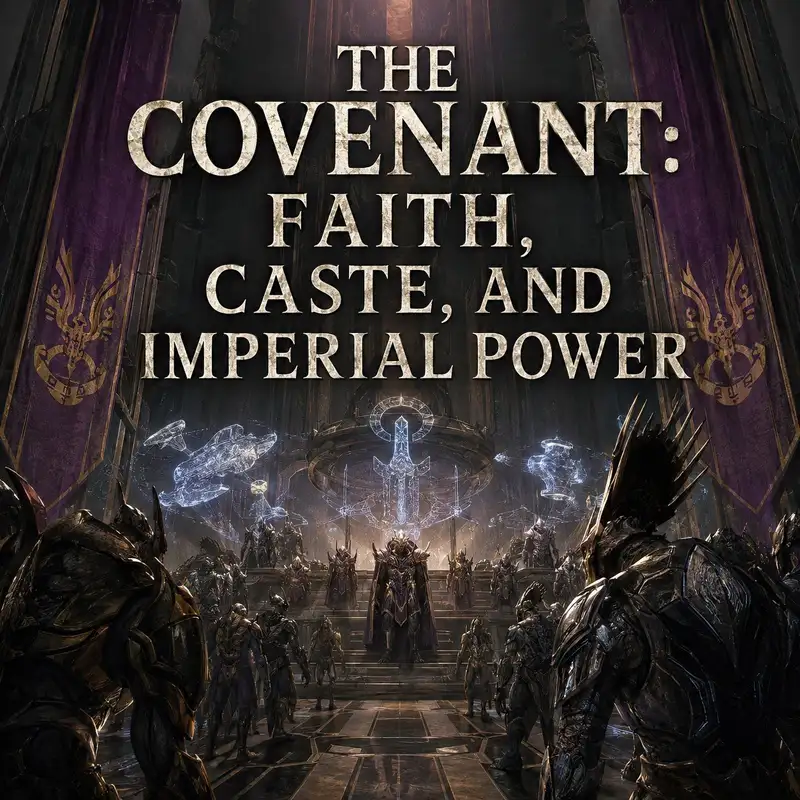
High Charity made those institutions visible. The mobile holy city housed the Hierarchs, the High Council, major ministries, religious authorities, military commands, industries, and populations drawn from across the empire. More than two hundred San’Shyuum and Sangheili Councilors participated in the central government, with ministers directing bodies responsible for war, relic recovery, diplomacy, security, conversion, technology, and other imperial functions. The Council gave the Covenant a place where elite interests could be negotiated. The three Hierarchs still possessed the final authority. They could reorganize fleets, establish ministries, appoint an Arbiter, distribute relics, and issue religious orders with political force.
The ministries were not a clean cabinet under a modern civil service. Their jurisdictions overlapped, their leaders competed, and several controlled military assets of their own. The Covenant military was therefore not one unified service with a single transparent chain of command. It was a collection of forces connected to ministries, fleets, religious mandates, local commanders, and the will of the Hierarchs. This arrangement encouraged initiative and allowed powerful institutions to pursue distant objectives without waiting for one headquarters to direct every movement. It also created duplication, secrecy, rivalry, and incentives to conceal failure. A lost ship could be a military problem, a theological embarrassment, and an opportunity for another ministry to take its budget.
Covenant technology reinforced this political structure. The empire fielded energy shields, plasma weapons, advanced slipspace drives, gravity manipulation, and warships superior to most human equivalents. Much of that advantage came from studying, adapting, and imitating Forerunner systems. Understanding was uneven. Religious rules restricted who could modify sacred technology, while ministries controlled distribution and access. Huragok and specialized artisans kept systems functioning that many users could operate but could not reproduce from first principles. The arrangement preserved San’Shyuum influence and limited unauthorized innovation. It also meant that technological superiority could coexist with intellectual dependence. The Covenant had inherited a remarkable arsenal. It had not inherited the civilization that designed it.
Imperial power also required ordinary production. Covenant fleets consumed fuel, replacement components, food, methane, weapons, armor, and trained personnel. Worlds and client populations supplied labor, raw materials, agriculture, manufacturing, shipyards, and transport. Species hierarchy shaped who performed the most dangerous work and who received the benefits of the system. High Charity’s grandeur depended on supply lines reaching places the Hierarchs would never visit. Religious language gave those flows a sacred purpose, but cargo still had to arrive. Even an empire seeking divine ascension required accountants, dock crews, technicians, and enough functioning containers to keep methane from becoming a battlefield emergency.
On campaign, caste became force structure. Sangheili generally occupied senior combat leadership and commanded fleets. Unggoy served in large numbers as infantry, laborers, and support personnel. Kig-Yar provided scouts, marksmen, security, and naval experience. Yanme’e offered mobility and technical labor. Mgalekgolo delivered heavy combat power. Jiralhanae formations brought physical strength, pack cohesion, and increasingly important command elements. These roles were not absolute, and individuals varied widely. The pattern still allowed commanders to assemble mixed forces with complementary capabilities. Covenant combined arms could be fast, aggressive, and technically overwhelming. Its weakness was that cooperation existed inside a social order built on contempt.
The same hierarchy distorted intelligence. Lower-caste personnel could observe a problem without possessing the authority to challenge a superior. Sangheili commanders could report operational facts while San’Shyuum ministers decided whether those facts supported the official interpretation. Failure might be punished as insufficient faith, personal dishonor, or political disloyalty. This did not make Covenant officers universally incompetent. Many were experienced, adaptive, and formidable. It meant the institution often converted bad news into a test of loyalty. An empire can survive occasional false reports. It becomes brittle when the truth itself must pass a theological inspection before reaching command.
Humanity triggered that weakness at the highest level. The discovery on Harvest suggested that humans were not simply another species awaiting conversion. Their designation within Forerunner systems undermined the Covenant’s account of inheritance and ascension. The future Hierarchs faced a choice between honest theological crisis and controlled external war. They chose war, suppressed the evidence, displaced the sitting leadership, and presented humanity as an offense against the gods. Unlike earlier client species, humans were not offered a stable place in the caste order. Their continued existence was dangerous because it could prompt the faithful to ask why the supposed inheritors of the Forerunners stood outside the Covenant.
The War of Annihilation turned imperial religion into strategic mobilization. Fleets searched for human worlds, destroyed military forces, attacked populations, and glassed colonies. Covenant technology gave individual fleets enormous destructive power. Religious certainty made compromise unnecessary. Political secrecy made extermination safer for the Hierarchs than investigation. Yet the war effort remained divided among ministries and commanders with their own ambitions. Relic recovery could compete with immediate military objectives. Commanders pursued prestige, rival institutions withheld information, and failures were concealed. Humanity was materially weaker, but the Covenant did not always apply its strength as one coordinated instrument.
The empire nevertheless came close to succeeding. Human fleets usually faced superior weapons, stronger shields, and faster slipspace capability. Colony after colony was lost. The Covenant’s caste system generated vast manpower and specialized formations. Its faith allowed leaders to sustain casualties that might have forced a secular coalition to reconsider the war’s purpose. Its control of information protected the original lie from most of the population. The reason humanity survived was not that Covenant society was an empty shell. It was that a powerful, functioning empire carried a political fracture inside its command structure, and the final year of the war placed that fracture under unbearable pressure.
Sangheili control of the military had troubled San’Shyuum leaders for centuries. The Prophets depended on Sangheili fleets, guards, and commanders, yet feared that the same institutions could turn against them. The rise of the Jiralhanae offered the High Prophet of Truth an alternative power base. Jiralhanae units received new commands, better equipment, and responsibilities previously reserved for Sangheili. Every promotion carried a political message. To the Jiralhanae, advancement appeared to correct generations of insult. To the Sangheili, it violated the founding compact. To Truth, both reactions were useful because rivalry prevented either military caste from challenging him as a unified force.
The crisis accelerated in twenty-five fifty-two. Installation Zero Four was destroyed. A Sangheili commander was publicly disgraced and converted into an Arbiter. A heretic movement learned that Halo was a weapon rather than a gateway to salvation. The Prophet of Regret launched an ill-prepared expedition to Earth without understanding the strength or identity of the world he had found. After his death on Installation Zero Five, Truth blamed Sangheili failure and transferred the protection of the Hierarchs to the Jiralhanae. These were not isolated personnel decisions. They were steps in a planned consolidation of power.
The Great Schism began when Truth’s faction moved from replacement to purge. Jiralhanae forces attacked Sangheili Councilors and commanders while fleets turned their weapons on former allies. Old resentment gave the violence energy, but policy gave it timing and direction. The Covenant’s military strength divided along the same species lines the caste system had spent millennia enforcing. Soldiers who had fought under one banner suddenly discovered that religious loyalty now required killing those who had commanded them days earlier. The empire possessed advanced communications, enormous fleets, and a shared sacred language. None of those systems provided a neutral institution trusted by both sides.
High Charity then became the empire’s final vulnerability. The city concentrated government, religion, records, industry, population, and the Forerunner Dreadnought that powered its authority. Centralization had allowed the Covenant to present one sacred capital to billions of subjects. During the Schism, it created one target whose loss could sever every major function at once. The Flood entered the city as Sangheili and Jiralhanae forces fought each other. The Prophet of Truth departed aboard the Dreadnought, abandoning the capital while carrying the means to continue his plan. High Charity fell, the High Council ceased to function, and the ministries lost the center that had connected their authority.
The Covenant did not collapse because every believer suddenly learned the truth. Many never did. Some survivors retained faith in the Great Journey, formed successor sects, or used the Covenant name to claim legitimacy. Others rejected the Prophets while preserving parts of the old hierarchy and military culture. The empire collapsed because its central bargain failed. The San’Shyuum could no longer provide accepted religious authority. The Sangheili would no longer provide military obedience. The Jiralhanae would not surrender the power they had been promised. Client species and local commanders were left to choose among belief, survival, revenge, independence, and opportunity.
Faith, caste, and imperial power made the Covenant durable because each reinforced the others. Faith made hierarchy sacred. Caste converted entire species into military, economic, and technical functions. Imperial control over relics and technology rewarded obedience while limiting alternatives. The system could absorb foreign peoples, move fleets across interstellar space, and turn a hidden political lie into a war that killed billions. It failed because truth threatened legitimacy, status interfered with competence, and military loyalty remained attached to species and patronage rather than to a shared political community.
The Covenant’s soldiers often stood in the same formation, traveled in the same ships, and died for the same promised destination. They did not stand as equals. When the Prophets forced the empire to choose between preserving their authority and preserving the alliance, the caste system answered exactly as it had been designed to answer. Each group defended its assigned place, or fought to escape it. The Covenant could coordinate the armies of many worlds. It could not survive the moment those armies asked who had defined the journey, who controlled its rewards, and why the road to salvation required them to destroy one another.