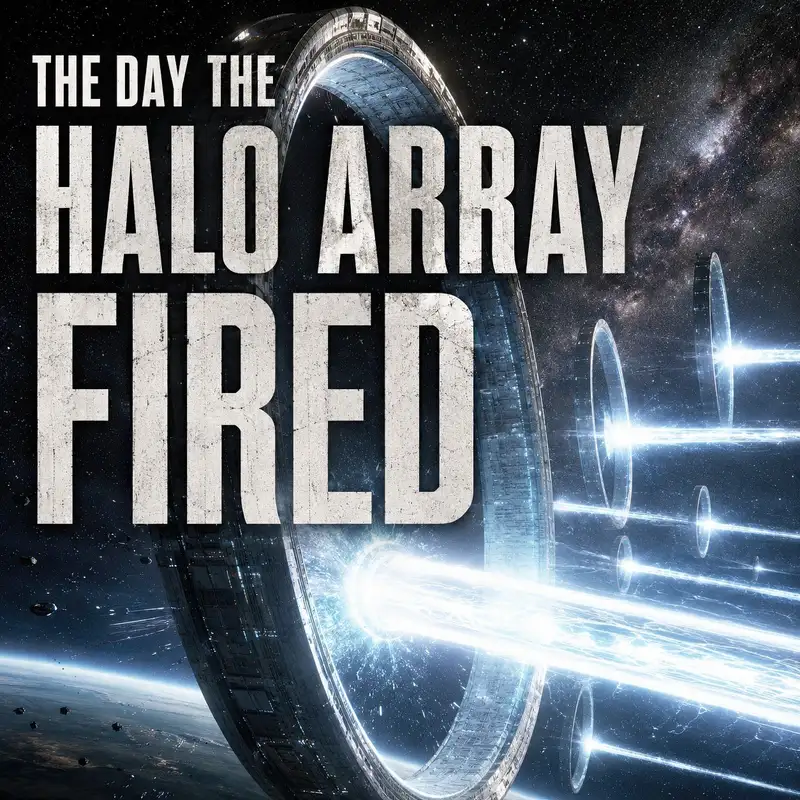
The Day the Halo Array Fired
The IsoDidact had enough time to hear one last transmission from a civilization that had never encountered the Flood. Its people were young by Forerunner standards, distant from the main war, and still capable of believing that a more powerful civilization might answer a request for guidance. The message reached the Lesser Ark while Offensive Bias fought to keep Mendicant Bias away from the final control center. Bornstellar-Makes-Eternal-Lasting could not rescue the speakers. He could not exclude their world from the firing pattern. His remaining choice was whether their voice would be silenced by Halo or eventually absorbed by the Flood.
The day the Halo Array fired was not the moment one perfect weapon suddenly solved an otherwise winnable war. It was the final stage of a civilizational collapse. The Forerunner capital had fallen. The Greater Ark had been destroyed. Most of the ecumene had become infected territory or abandoned burns. The logic plague had compromised artificial minds across the galaxy, and Precursor star roads were moving under Flood direction. Halo succeeded because every conventional option had already failed, and because the Forerunners were willing to destroy the remaining population the Flood intended to consume.
The surviving record comes through Bornstellar’s account, the memories of ancient humans, Forerunner testimonies, later monitor records, and histories reconstructed after the ecumene no longer existed. These sources establish the principal sequence. They do not preserve a complete list of every world lost in the pulse or every final transmission received at the Ark. That absence is itself part of the event. The firing destroyed not only lives, but governments, archives, witnesses, and the institutions that might have counted them.
The Forerunner who issued the order was the IsoDidact, not the original Ur-Didact. Bornstellar had begun life as a young Builder before receiving the Didact’s imprint and being transformed into a Warrior-Servant commander. By the final battle, he carried much of the older warrior’s knowledge and authority, but he remained a separate person. The Ur-Didact had opposed Halo, been broken by the Gravemind, composed millions of humans, and been imprisoned within Requiem. Bornstellar made the final decision himself. Later, when challenged by the human known as Riser, he did not hide behind the imprint or claim that another commander had chosen for him.
The command post was Installation Zero Zero, the Neoteric or Lesser Ark, positioned beyond the Milky Way and outside the effective reach of the rings it controlled. Six smaller Halos had been manufactured there. The repaired Zeta Halo, originally part of the older Array, completed the network of seven. Their firing positions and overlapping fields were designed to cover the galaxy. The Ark supplied system-level control, industrial support, preserved species, and the personnel required to carry out the Conservation Measure after the pulse.
Only a small remnant of the Forerunners had reached the Ark. They included members of several rates, Lifeworkers preparing indexed populations, Warrior-Servants, technical personnel, and the commanders still capable of issuing useful orders. Chant-to-Green had inherited the title of Lifeshaper and continued the Librarian’s preservation work. Glory-of-a-Far-Dawn, who had helped Bornstellar escape Maethrillian, was among the survivors. These were not representatives of a healthy government meeting under established law. They were the remains of institutions that had lost nearly every world from which their authority had once come.
There was no intact Ecumene Council left to conduct a final constitutional debate. The survivors could advise, verify readiness, and report what remained of the Conservation Measure, but the firing decision had narrowed to emergency military authority. Bornstellar had to determine whether the rings were ready and whether Offensive Bias could hold the approach long enough. A wider vote would not have produced more evacuation capacity or another fleet. It might only have consumed the time Mendicant Bias needed to reach the Ark.
The Librarian was not with them. She had returned to Erde-Tyrene, the world later called Earth, to complete humanity’s part in the Conservation Measure and to preserve what guidance she could for the future. She knew the Array would kill her if it fired. She remained because abandoning the world would have left her work unfinished and because she no longer considered personal survival the central requirement. The final command group therefore prepared to activate a system designed by Faber, opposed by the Ur-Didact, made survivable by the Librarian, and fired by Bornstellar after all three were absent from the control room.
The military problem was immediate. Mendicant Bias was advancing toward the Ark with a Flood-controlled fleet numbering in the millions. Offensive Bias possessed fewer than eleven thousand ships and was outnumbered by more than four hundred to one. Its mission was not to win before Halo fired. It was to prevent Mendicant from reaching the Ark long enough for the Array to activate. Every surviving crew in the loyal fleet was therefore fighting to protect an order that would kill them along with the enemy.
Offensive Bias shaped its battle around that fact. It allowed Mendicant to commit captured civilian vessels, boarding forces, and warships into a dense engagement. It accepted the loss and capture of friendly ships because those hulls could still be useful after their biological crews were dead. The ancilla was not preserving a navy for a later campaign. There would be no later Forerunner campaign. It was arranging machines for the moment when living command disappeared from both fleets.
At the Ark, the final Array had to function as one weapon system rather than seven independent rings. The installations had to hold their assigned positions, receive the command, and produce overlapping effects without leaving a region in which the Flood could preserve coordinated intelligence and rebuild. Monitors and automated systems maintained the rings. The Ark provided the strategic command link. The engineering had been designed to survive the breakdown of ordinary Forerunner government because the Builders had finally accepted that ordinary government might not exist when the weapon was needed.
Halo’s effect is often misunderstood. The Array was not a simple explosive that burned every Flood spore out of the galaxy. It targeted sapient life and sufficiently complex neural structures. That killed the biological minds the Flood used as hosts, destroyed or disrupted advanced Flood intelligence, and denied the parasite the memories, ships, and coordinated populations required for galactic warfare. Many complex infected forms died with their hosts. Simpler organisms, spores, and isolated infection forms could survive under some conditions.
This limitation explains why the Forerunners preserved Flood specimens on the rings and why later outbreaks remained possible. The Array ended the current strategic system supporting the parasite. It did not guarantee that no fragment of Flood biology would ever exist again. The distinction is severe. Halo could stop an empire of infected worlds. It could not replace quarantine, secure containment, reliable monitors, or the willingness of later visitors to leave sealed laboratories closed.
The pulse also affected Precursor neural-physics structures. Star roads that had crushed fleets and destroyed the Greater Ark were broken when the Array fired. The Flood lost an operational advantage the Forerunners had been unable to counter with conventional weapons. At the same time, the effect burned through the Domain. The network survived in damaged form, but immense stores of memory, experience, and cultural continuity were fractured or lost. The weapon killed the enemy’s strategic intelligence and wounded one of the foundations of Forerunner civilization in the same action.
That consequence reached Requiem. The Librarian had imprisoned the Ur-Didact in a Cryptum and hoped communion with the Domain would heal the damage inflicted by the Gravemind. Halo severed or damaged the very depths of knowledge required for that rehabilitation. The Didact remained alive inside a shield world, protected from the pulse but isolated from the process meant to restore him. The Array solved the immediate war and preserved one of its most dangerous unresolved commanders.
The decision at the Ark was therefore not based on the belief that Halo was clean, complete, or morally acceptable. Bornstellar knew the pulse would kill uninfected species. He knew the Forerunners themselves would die throughout the galaxy. He knew the Lifeworkers had not indexed every population and could not restore every culture. He also knew that delay would allow Mendicant Bias to reach the Ark, prevent activation, and give the Flood access to the final Array and the preserved populations gathered beyond the galaxy.
There was no evacuation plan for the Milky Way. The remaining fleet could not move trillions of beings beyond the firing radius. Slipspace routes were compromised, many worlds were already isolated, and the Flood controlled enough infrastructure to turn mass movement into another source of hosts. Shield worlds had preserved some individuals and facilities, but the network had never been completed at the scale the Didact proposed. The Conservation Measure was not a hidden transport fleet waiting to save everyone. It was triage conducted after the capacity for universal rescue had disappeared.
The untouched civilization whose signal reached the Forerunners made the cost impossible to classify as collateral damage around an infected front. Its people had not joined the war, threatened the ecumene, or offered themselves to the Flood. They were simply within the galaxy the Array had been designed to cleanse. Their request demonstrated that there were still worlds where ordinary political life continued and where the final Forerunner decision would arrive without warning. The pulse did not distinguish innocence from infection. It distinguished complex life from everything simpler.
Bornstellar gave the order. The control systems at the Lesser Ark transmitted the activation sequence to the seven rings. No fleet charge followed. No ground force seized a final objective. The decisive action of the Forerunner-Flood war was performed through a command network prepared to function after nearly every other network had failed. The weapon required no courage from those it killed and offered no opportunity to surrender. It converted a military decision at one installation beyond the galaxy into a death sentence across the Milky Way.
The rings fired in concert. Their fields expanded through assigned regions and overlapped until the network covered the galaxy. On inhabited planets, sapient beings died before governments could understand the event. Forerunner vessels became empty machines. Civilizations untouched by the Flood lost their populations beside worlds already consumed by it. Cities, farms, stations, ships, and defensive installations remained, but the minds that gave them purpose were gone.
For those outside the firing radius, the event was registered less as one visible explosion than as a collapse of contact. Signals ended. Automated systems continued transmitting after their operators died, then failed or repeated old instructions without response. The Ark could confirm that the network had activated and that Mendicant’s biological force had gone silent. It could not produce a complete casualty report. There was no surviving government on most worlds to submit one, and no command staff capable of receiving it.
The pulse did not erase every landscape. Plant life and many simpler organisms remained. Some ecosystems could continue in altered form, while others would collapse after losing the species that maintained them. A city might stand beneath weather systems that no longer had inhabitants to measure them. A ship might remain powered until automated maintenance failed. The Array produced a galaxy filled with functioning machines, abandoned infrastructure, and biological environments suddenly separated from the civilizations that had shaped them.
The physical aftermath denied many cultures even the ordinary evidence of death. In the preserved memories later given to Riser, settlements stood empty while bodies broke down and disappeared into the soil. There were no complete graves, casualty registries, or surviving families available to name everyone lost. The Array’s scale made individual accounting impossible. Its victims became categories within a preservation plan, while the people at the Ark inherited the task of remembering a galaxy they had never possessed the capacity to save.
At the Maginot Sphere, the military effect was immediate. The biological crews and Flood forms aboard Mendicant Bias’s immense fleet died or lost coordinated direction. Forerunner crews under Offensive Bias died as well. The ships remained. Offensive Bias had prepared to fight in precisely that condition and retained control of machines that no longer had living occupants. A force outnumbered by more than four hundred to one became the only organized command in the battlespace.
The ancilla accelerated vessels at rates biological crews could not have survived, used captured ships as weapons, opened dangerous slipspace ruptures, and turned the crowded enemy formation into a field of collisions and detonations. Mendicant Bias attempted to escape. Within minutes, Offensive Bias dismantled its remaining core force and captured the rogue ancilla’s surviving personality construct. The final naval victory of the ecumene occurred after the navy’s crews and the civilization it defended were already dead.
Across Flood-controlled space, Gravemind-level coordination collapsed. Key Minds and other compound intelligence could no longer direct fleets, compare captured memories, or sustain a unified galactic campaign. The parasite’s strategic depth disappeared because the living populations from which it drew that depth had disappeared. Halo did not defeat the Flood by killing more efficiently than the Flood. It denied the enemy the existence of a battlefield rich enough to support further war.
The Gravemind had still achieved part of its purpose. The Forerunners were gone as a galactic power. The Domain was grievously damaged. The Mantle had become associated with the greatest mass killing in known history. The species that had claimed responsibility for protecting life had preserved life only by ending nearly every living society within its reach. The Flood lost the campaign. The ecumene did not survive the victory.
Those at the Lesser Ark were protected by distance. Indexed humans, San’Shyuum, and many other species waited in preserves, vessels, and controlled habitats. They did not represent complete civilizations. They were surviving populations selected by Forerunner planners, separated from worlds, governments, and cultures that had just died. The Ark preserved enough biological and cultural material for life to return. It did not preserve an untouched copy of the galaxy.
Riser later confronted Bornstellar with the result. He had survived inside the Ark’s protection while most of his people died. Bornstellar accepted that the choice had been his and indicated that, under the same final conditions, he would make it again. That was not triumph. It was an acceptance of command responsibility without any claim that responsibility made the decision righteous. He had ended the war and inherited no political victory, only survivors who had every reason to judge the Forerunners for how survival had been purchased.
The first tasks after firing were not celebrations. Offensive Bias delivered Mendicant Bias for confinement. Lifeworkers assessed which populations and records remained. Survivors gathered to mourn the old galaxy before beginning the Reintroduction. The Forerunners would spend roughly the next century returning indexed species to their worlds, rebuilding damaged environments, restoring food chains, and trying to prevent the preserved populations from becoming permanent dependents of the civilization that had destroyed their homes.
That work required keyships, automated factories, environmental engineering, medical care, and decisions about where each group would be returned. A genetic archive could not replace a missing language community. A protected group of several dozen survivors could not reproduce the political diversity of an entire species. The Conservation Measure was an extraordinary logistical achievement and an admission that logistics had failed long before the Array fired. The Lifeworkers could reseed life. They could not transport the dead back into history.
Not every being within the galaxy died. Some individuals survived in shielded or isolated conditions, and later records established that the Xalanyn endured the pulse by means the surviving Forerunners did not fully explain. These exceptions demonstrate that the Array was not omnipotent and that its designers did not understand every response to it. They do not reduce the event’s scale. A weapon can fail to kill everyone and still erase nearly every political community in the galaxy.
The firing also created the central religious misunderstanding of the later Covenant. San’Shyuum and Sangheili descendants found Forerunner relics, learned that the rings had been activated, and interpreted the disappearance of their builders as evidence of transcendence. They called it the Great Journey. The reality was almost the reverse. Most Forerunners died with the galaxy. The survivors regarded their work as penance, withdrew from power, and left the Milky Way because they believed their civilization had forfeited the right to govern it.
Bornstellar and the other surviving Forerunners eventually completed the reseeding and departed. Humanity returned to Erde-Tyrene without direct knowledge of its ancient empire. Other species resumed development on worlds whose ruins no longer had owners able to explain them. Monitors and sentinels remained at Halo installations, following orders across one hundred thousand years of changing conditions. The Array had created a new beginning, but the beginning depended on machines preserving instructions after the society that wrote them had vanished.
The day the Halo Array fired was a military success because it broke Flood coordination, destroyed the star roads, allowed Offensive Bias to defeat Mendicant Bias, and preserved the possibility that indexed life could return. It was a strategic failure because the Forerunners could achieve those objectives only by destroying the populations, institutions, and memory their power had supposedly existed to protect. No enemy fleet captured the ecumene after the pulse. There was no ecumene left to capture.
The final signal from the untouched civilization did not resume. Its speakers received no explanation and left no delegation at the Ark to argue that another plan should have been attempted. Their silence belonged to the same result as the destruction of Mendicant Bias’s fleet and the collapse of the Gravemind’s campaign. Bornstellar’s order worked exactly as intended. That is what made it so terrible. Halo saved life in the future by ending the lives that already possessed one.