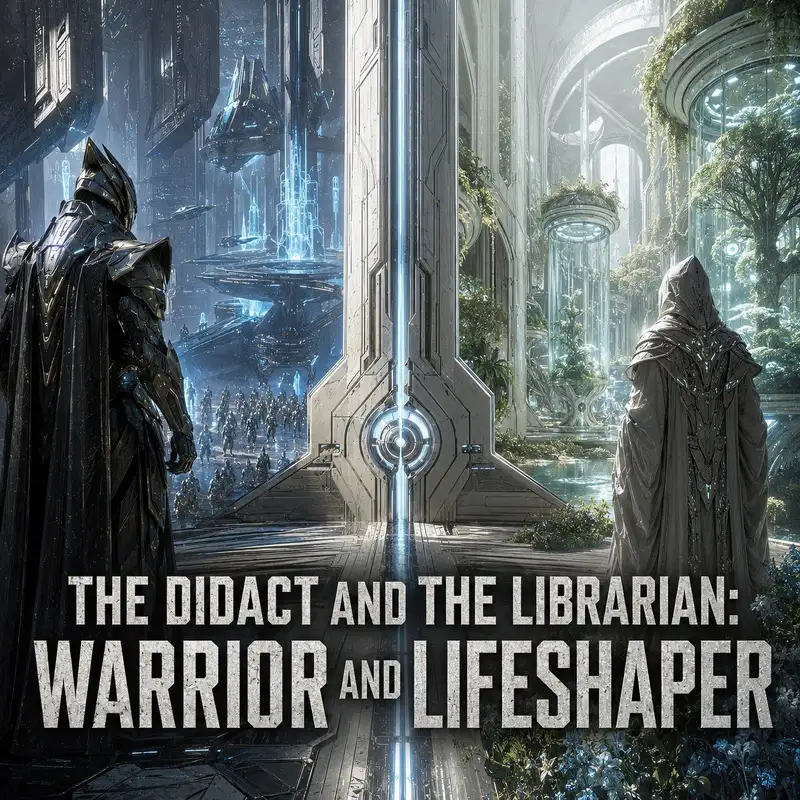
The Didact and the Librarian: Warrior and Lifeshaper
At Requiem, the Librarian faced a decision no military doctrine had prepared her to make. Her husband had taken the Composer, converted two million preserved humans into machine soldiers, and gathered those victims into an army meant to fight the Flood. He still rejected the Halo Array as an intolerable surrender. He still claimed to be defending life. Yet the commander she had once trusted now treated living minds as ammunition. With the Warrior-Servant Endurance-of-Will beside her, the Librarian chose containment. She sealed the Didact inside a Cryptum rather than kill him, hoping the Domain would heal what war and the Gravemind had broken. It was an act of opposition, punishment, and love, all carried out against the same person.
Their relationship is the clearest personal expression of the Forerunners’ final political crisis. The Didact was a Warrior-Servant shaped to defend the ecumene through command, force, and strategic preparation. The Librarian was the Lifeshaper, the senior Lifeworker responsible for studying, preserving, and guiding living species. One planned how civilization would survive an enemy. The other asked what would remain worth saving after the plan succeeded. Their marriage crossed rates, institutions, and competing interpretations of the Mantle. It survived the destruction of their children, political exile, and the end of the galaxy they knew. It could not survive every answer they gave to the same question: what may a guardian destroy in order to preserve life?
The title Didact requires an early distinction. The original commander was Shadow-of-Sundered-Star, later called the Ur-Didact. Near the end of the Forerunner age, he imprinted his memories and strategic identity onto the young Builder Bornstellar-Makes-Eternal-Lasting. Bornstellar became the IsoDidact and eventually fired the Halo Array. The Librarian’s husband was the Ur-Didact, although Forerunner imprinting made the later relationship with the IsoDidact more complicated than a simple replacement. The two Didacts shared memory, doctrine, and aspects of identity. They were not the same individual. Confusing them removes one of the central tragedies of the story: the warrior who opposed Halo did not fire it, while the young successor carrying his imprint did.
Shadow-of-Sundered-Star entered the Warrior-Servant tradition through loss and discipline. His parents were executed after the Kradal conflicts and erased from the public record. The decorated commander Bitterness-of-the-Vanquished became his guardian and trained him within a culture that treated service to the Mantle as both military duty and personal identity. He learned strategy, fleet command, and the burden of protecting a civilization whose political leaders did not always respect its soldiers. Before meeting the Librarian, he shared a close bond with Endurance-of-Will, another Warrior-Servant. His decision to marry outside his rate was therefore not ordinary. In a society that shaped bodies, education, and status around professional caste, it crossed a serious institutional boundary.
The surviving record places their first meeting at Charum Hakkor, the human capital whose Precursor structures later resisted the Forerunner military for fifty-three years. The details of their courtship are not preserved as a complete narrative. What is established is that the warrior chose the Lifeworker. The union was unconventional because rates were more than occupations. Mutation adapted Forerunners physically and psychologically for their place in society. Marriage across those divisions joined communities with different habits of thought, political allies, and definitions of responsible action. Their household became a small coalition inside the ecumene. Like many coalitions, it worked best before emergency forced every disagreement into an operational decision.
Their strengths initially complemented one another. The Didact understood that a protected population still needed fleets, fortified depth, secure movement, and commanders willing to act before an enemy reached the core worlds. The Librarian understood that a military victory could preserve territory while destroying the diversity, memory, and future that gave the territory value. He saw the Mantle through the obligations of defense. She saw it through the continuity of life. Neither view was complete by itself. A Lifeworker program without security could become a carefully indexed casualty list. A Warrior-Servant strategy without preservation could become a clean map of systems no longer inhabited by anyone the strategy was meant to protect.
They raised twelve children, and all twelve followed their father into the Warrior-Servant rate. Every one of them died during the war against ancient humanity. The record does not support inventing private conversations around those deaths, but it does support their importance. The family’s loss was inseparable from the war that defined both parents. For the Didact, humanity was no abstract rival. Human resistance had consumed the lives of his children and many Warrior-Servants under his command. For the Librarian, those deaths did not erase the distinction between defeating a civilization and exterminating a species. Grief gave them common pain. It did not produce a common policy.
The Didact directed the Forerunner campaign against humanity and its San’Shyuum allies. His operational approach exploited the ecumene’s advantages in slipspace control, industrial depth, ancilla coordination, and replacement capacity. Forerunner fleets bypassed lesser systems and attacked the nodes that held the human realm together. Humanity remained tactically dangerous, but it was already fighting the Flood and could not replace ships and populations at the rate the ecumene could. The campaign contracted toward Charum Hakkor, where human defenses were built around Precursor star roads and structures that Forerunner weapons struggled to destroy. The Didact’s victory required isolation, sustained pressure, and the patience to let logistics accomplish what firepower could not.
Charum Hakkor should have confirmed his reputation as protector of the ecumene. Instead, the victory exposed the limits of that role. The battle destroyed the last organized human resistance and broke the alliance with the San’Shyuum. It also placed the Primordial in Forerunner custody and revealed that humanity had been fighting a threat the ecumene had misunderstood. The Didact met the Lord of Admirals among the defeated and learned more about the Flood. Victory did not erase his concerns. It increased them. The commander had conquered the enemy his government recognized and inherited the enemy the humans had tried to contain.
The Librarian intervened when the Builder-led Council considered humanity’s fate. She argued against extinction, partly because humans appeared to possess information about a cure for the Flood. The cure was an enemy deception, but the Forerunners did not yet know that. Her argument saved the species from immediate annihilation. It did not spare humanity from devolution, forced relocation, the Composer, and the loss of its interstellar civilization. The Librarian participated in plans that placed ancient memories and geas within human descendants. Her actions preserved potential while denying consent. She was more compassionate than the officials who favored extinction, but she remained a Forerunner authority deciding what form another species would retain.
This is why the pair cannot be reduced to a cruel warrior and a benevolent scientist. The Didact opposed the Halo Array because it would kill the galaxy’s sentient life and destroy the civilization the Mantle required him to defend. The Librarian supported the Conservation Measure because she increasingly believed Halo might become unavoidable. He defended living populations through military survival. She prepared genetic archives, protected reserves, and reseeding plans for a future after those populations died. His position could appear more humane in the immediate crisis. Her position proved more realistic as the Flood expanded. The disagreement was not over whether life mattered. It was over when preservation had to become preparation for catastrophe.
The Didact’s answer was strategic depth. He commissioned shield worlds, fortified refuges designed to protect populations and military forces from both the Flood and the effects of Halo. These installations supported resistance rather than universal extermination. Requiem became the center of that approach. Shield worlds could shelter fleets, laboratories, weapons, and communities. They also required time, resources, and control of access routes. A refuge that could not be reached before infection spread was only impressive architecture. The Didact believed the ecumene still possessed enough strength to fight. The Master Builder increasingly believed the military no longer had a workable victory plan.
Faber, the Master Builder, turned the strategic disagreement into a political struggle. Halo promised a decisive technical solution and strengthened the Builder rate that designed, supplied, and controlled the project. The Didact’s shield worlds preserved the importance of Warrior-Servants and placed the military at the center of defense. Procurement, institutional power, and survival policy became the same argument. The Librarian opposed Builder arrogance, but her Conservation Measure depended on space aboard Halo installations and the Arks. She needed access to a weapons program she found catastrophic because it offered the only protected infrastructure large enough to save species at scale. It was emergency logistics with the galaxy as cargo.
The Didact lost the political contest and entered his first exile in a Cryptum on Erde-Tyrene. A Cryptum was intended for long meditation and connection with the Domain, not merely imprisonment. The Librarian’s planning and genetic guidance helped place Bornstellar, Chakas, and Riser on the path that awakened him. When the old warrior emerged, he found his rate diminished, the Master Builder dominant, Mendicant Bias missing, and Halo no longer a proposal that one council debate could stop. He was a commander returning after the government had reorganized the war around a different strategy. The enemy had not waited.
Bornstellar received the Didact’s brevet mutation and imprint. The process transmitted memories, knowledge, and patterns of identity while transforming the young Builder into something closer to a Warrior-Servant. It also created a succession problem no ordinary chain of command could explain. The IsoDidact could draw on the original’s experience and increasingly occupy his office, but he remained Bornstellar. The Librarian therefore worked beside a commander who carried much of her husband and was not her husband. Their cooperation was essential during the final crisis. It was also evidence that Forerunner technology could preserve function while making personal identity considerably less tidy than the administrative record preferred.
The Ur-Didact’s own return to the war ended in betrayal. The Master Builder captured him and abandoned him aboard a derelict vessel in Flood-controlled space. There the Gravemind subjected him to prolonged psychological torture. The Flood did not simply seek military intelligence. It used the Forerunners’ crime against the Precursors, the deaths of the Didact’s children, his resentment of the Builders, and his fear of humanity to reshape his judgment. When he escaped, he still believed he was resisting Halo and defending the Mantle. His strategic reasoning had been poisoned. The commander returned carrying the enemy’s influence without becoming a conventional infected host.
He attempted a new mutation in hopes of making himself immune to the Flood. The procedure failed and altered his body without solving the biological problem. He then turned to the Composer, a device able to convert biological minds into digital essences. The concept offered an apparent escape from infection. If warriors no longer depended on vulnerable bodies, they might fight the Flood without becoming hosts. Some loyal Prometheans submitted voluntarily and achieved limited success as machine soldiers. That limited success encouraged expansion before the moral, technical, and command consequences were understood.
The Didact needed numbers. At Omega Halo, he composed two million devolved humans preserved under the Librarian’s protection and used their essences to enlarge his Promethean army. This was not merely another disagreement over strategy. It was an attack on her life’s work and on the populations she had saved from the Council. The warrior who once rejected Halo because it destroyed life now converted unwilling minds into weapons. He could still claim that the operation preserved those minds in another form and created forces able to resist the Flood. The victims had no authority over that definition of survival. Military necessity had become ownership of the people being defended.
The Librarian pursued him to Requiem. Endurance-of-Will assisted her despite deep loyalty to the Didact and the Warrior-Servant tradition. Together they sealed him inside another Cryptum. The Librarian did not order his execution, even after the Composer campaign. She hoped meditation and reconnection with the Domain would remove the Gravemind’s influence. She also imagined a later role for him as humanity’s teacher, guiding the species toward the Mantle once the crisis passed. That hope reveals both love and Forerunner paternalism. She wanted her husband restored. She also expected a healed Forerunner commander to instruct humanity in responsibilities her own civilization had failed to fulfill.
The plan failed because the larger system failed. The Halo Array damaged the Domain and interrupted the healing connection on which the Cryptum depended. The Didact remained confined for one hundred thousand years, conscious enough to preserve rage and isolated from the corrective process the Librarian intended. Requiem’s defenses kept the prison secure, but security preserved the prisoner’s condition rather than curing it. The installation followed its purpose with extraordinary reliability and inadequate context. The Forerunners built a facility capable of surviving their civilization. They did not build a mechanism able to reconsider the sentence when every assumption behind it changed.
The Librarian returned to Erde-Tyrene to complete humanity’s preservation and reseeding arrangements. Near the end, the Gravemind used the composed essence of Forthencho to deliver a final revelation: firing Halo would also burn through the Domain. By then, she could not undo every decision or return to Requiem in time. She remained on Earth while the final plans moved forward. Her biological life ended with the civilization she had tried to preserve, but imprints, genetic plans, records, and installations carried aspects of her purpose into later ages. The Lifeshaper survived less as one continuous person than as a network of instructions, memories, and prepared opportunities.
The commander who fired the Array was the IsoDidact. Bornstellar reached the Neoteric Ark, accepted that conventional resistance had failed, and activated the rings. That distinction is essential to the marriage. The Ur-Didact opposed Halo until his judgment collapsed into the Composer campaign. The Librarian prepared for Halo while hoping her husband might someday emerge to repair what remained. The IsoDidact carried the original’s imprint and performed the act the original considered a betrayal of the Mantle. The final order was connected to the Didact’s identity without being issued by the Librarian’s husband. Forerunner continuity preserved responsibility and divided it across persons.
One hundred thousand years later, the Ur-Didact awakened into a galaxy shaped by the Librarian’s plans. Humanity had returned to the stars, gained access to Forerunner systems, and survived the Covenant War. He saw not a species fulfilling her hope, but the resurgence of the rival he had defeated and distrusted. He recovered the Composer, attacked Ivanoff Station, and used the device on New Phoenix. Seven million humans were reduced to digital essences for a renewed Promethean force. The scale changed. The logic did not. People remained military material inside a campaign justified as protection of the Mantle.
A Librarian imprint intervened through the Master Chief. She accelerated elements of humanity’s genesong, granting him protection from the Composer and explaining enough of the ancient conflict for him to act. This was not the biological Librarian returning from death. It was a preserved aspect of her knowledge and intent operating through systems prepared long before. Their old argument played out through successors. The Didact brought coercive force, strategic certainty, and the claim that humanity required containment. The Librarian’s imprint provided a human soldier with the ability to resist. Neither stood on the battlefield in the ordinary sense, yet their marriage still shaped who could survive the weapon.
The Didact’s physical form was later destroyed and his essence entered the Domain. His final journey forced him to confront memories he had buried, the manipulation of the Gravemind, the consequences of his war against humanity, and the bond he had shared with the Librarian. That reckoning did not reverse the deaths at Omega Halo or New Phoenix. It did allow him to reject the identity the Flood had cultivated and complete a redemptive journey rather than continue as its instrument. The Librarian had once feared her husband was beyond redemption. The surviving record supports a more complicated answer. He could not undo what he had become, but he could finally choose not to remain it.
Their relationship mattered because each possessed part of the strategy the Forerunners needed. The Didact understood that survival required force, preparation, and an enemy-focused command structure. The Librarian understood that power without conservation could win battles while erasing the purpose of victory. Both also carried the defects of their civilization. He treated authority as the right to compel sacrifice. She treated superior knowledge as the right to guide species that never consented to her plans. His shield worlds were more humane than Halo, but insufficient against the final Flood advance. Her Conservation Measure saved life, but only after accepting the destruction of living societies. Neither emerged morally clean because their institutions had spent too long avoiding the truth.
The warrior and the Lifeshaper were not opposites who canceled one another. They were two versions of Forerunner guardianship joined inside one family. Their marriage crossed the rates and briefly suggested that defense and preservation could operate as one policy. War exposed the limits. Their children followed the warrior and died. Humanity survived through the Lifeshaper and lost its freedom. The Didact opposed galactic killing and later composed millions. The Librarian opposed his coercion and still placed commands inside humanity’s future. Love allowed each to see beyond one institution. It could not make either surrender the belief that they knew what the galaxy required.
At Requiem, the Librarian sealed the Cryptum because she could no longer trust the warrior standing before her, yet she still trusted the person he might become. That distinction preserved hope and created one hundred thousand years of suffering when the Domain failed. It also defined their history. The Didact looked at life and saw something that had to be defended by strength. The Librarian looked at life and saw something that had to continue beyond any one victory. The Forerunners needed both judgments and built a political order unable to reconcile them. Their marriage endured longer than the ecumene. Its failure was not that love disappeared. Its failure was that love could not substitute for strategy, consent, or institutions capable of limiting power.