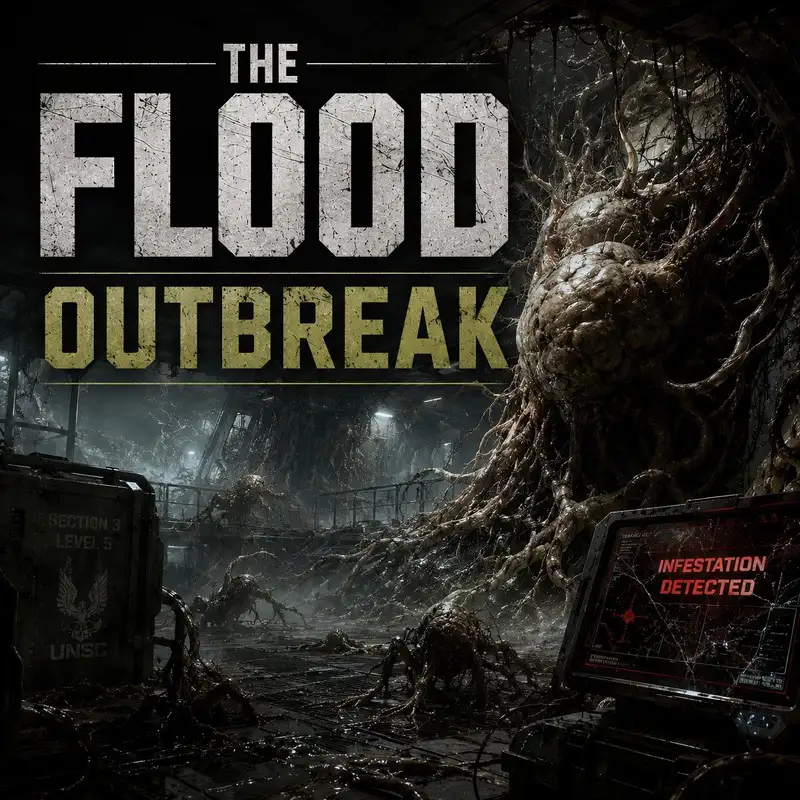
The Flood Outbreak
The first confirmed evidence of the outbreak was not a medical report. It was a helmet recording recovered from a missing Marine’s equipment. The image showed Captain Jacob Keyes and his patrol moving through a Forerunner containment facility that human intelligence had identified as a Covenant weapons cache. The rooms were already littered with Covenant bodies. Sealed doors had been forced open. The atmosphere was still breathable, the lights still worked, and nothing in the architecture explained why an enemy force had died without withdrawing. Then the small forms came through the openings. Within seconds, rifles were firing in every direction and the patrol was no longer fighting the Covenant. It was becoming part of the Flood.
The outbreak on Installation Zero Four did not become catastrophic because one parasite was unusually strong. It became catastrophic because every military system around it was prepared for the wrong enemy. Human forces were searching for weapons and intelligence. Covenant forces were searching for sacred Forerunner technology. Both had troops moving through unknown structures, both were taking casualties, and both possessed aircraft and ships capable of carrying infection beyond the original site. The Flood entered a battlefield already filled with hosts, ammunition, communications networks, and transportation. It did not have to build an army. Two armies had brought one with them.
The Forerunners had created the conditions long before humanity or the Covenant reached the ring. Installation Zero Four was part weapon, part research complex, and part biological prison. Dormant Flood specimens had been preserved so later custodians might study the parasite and perhaps discover a cure or more reliable means of control. That decision reflected scientific purpose and strategic arrogance in equal measure. The Forerunners had used the Halo Array because every earlier solution failed. They still retained samples of the enemy whose defeat required the destruction of galactic civilization. The specimens remained behind locked systems, supervised by machines expected to preserve instructions across one hundred thousand years.
Three Four Three Guilty Spark was the monitor responsible for the installation. Sentinels, environmental controls, security barriers, and automated quarantine systems existed under his authority. Those measures were formidable, but they were designed around Forerunner access protocols and a custodian who understood the ring as an integrated system. They were not designed for two younger civilizations cutting into restricted sites during a religious war. A sealed door can contain a biological threat for millennia. It stops being a containment system once armed intruders decide that whatever lies behind it must be valuable.
Covenant troops entered the facility first. Their empire had spent centuries recovering Forerunner relics and interpreting ancient machinery through religious doctrine. A locked Forerunner chamber was therefore not merely a hazard. It was a possible repository of sacred knowledge, military advantage, or evidence of the Great Journey. The Covenant possessed specialists capable of activating ancient systems, but technical access did not provide biological understanding. The troops who breached the site appear to have realized too late that the sealed rooms contained prisoners rather than weapons. Their losses then became the first available hosts.
Human intelligence repeated the error from the opposite direction. Covenant activity around the facility suggested military value. The surviving report described a weapons cache, and Keyes chose to investigate personally with Marines including Sergeant Avery Johnson and Private First Class Wallace Jenkins. The decision was aggressive but not irrational. The survivors of the Pillar of Autumn needed weapons, information, and leverage. They were stranded on an installation controlled from orbit by the Covenant. A captured stockpile might improve their position. What they lacked was any reason to imagine that the enemy had opened a biological prison built by a civilization extinct for one hundred thousand years.
The helmet recording shows why early warning failed. The patrol found signs of combat, but the evidence did not match known Covenant weapons. There were bodies without an obvious firing line, abandoned equipment, and movement in spaces thought to be cleared. The team had no biological-hazard sensors calibrated for Flood tissue, no quarantine specialists, and no doctrine for an organism capable of using a casualty as both food and replacement infantry. By the time the Marines recognized that the small organisms were attacking bodies rather than merely swarming around them, the distinction was mostly academic.
The first Flood forms encountered were infection forms. Their battlefield purpose was not to kill in the conventional sense. It was to seize a suitable host and convert that body into a combat platform. Once infection succeeded, human and Covenant personnel became combat forms able to move, fight, carry weapons, open routes, and exploit portions of the host’s memory. Carrier forms served another function, transporting and releasing additional infection forms when their altered bodies ruptured. These were different stages of one system. The Flood did not field separate infantry branches because it had designed them. It reshaped available biomass according to immediate need.
That is why describing the outbreak as a zombie attack misses the military problem. A combat form was not simply a corpse moving toward gunfire. It could use a rifle, recognize terrain, operate equipment, and exploit learned behavior retained from the host. The parasite gained more than muscle. It gained access to training, language, routes, procedures, and familiarity with friendly positions. A fallen Marine could return carrying a human weapon and enough memory to approach a human defense. An infected Sangheili brought greater strength, energy-shield familiarity, and knowledge of Covenant systems. Every successful infection expanded both manpower and intelligence.
Johnson escaped the facility by fighting his way through the outbreak. Later accounts once suggested that a medical condition made him biologically immune. That explanation did not survive closer examination. His survival came from experience, aggression, physical conditioning, and a considerable amount of fortune. His earlier ORION augmentations may have contributed to his performance, but they did not make him immune to the Flood. The distinction matters because false confidence is dangerous in containment warfare. A survivor is not proof of resistance. Sometimes a survivor is simply the person who found a route out before it closed.
Jenkins was less fortunate and, in one respect, more revealing. The infection form that reached him had been weakened by its long confinement, leaving him partially aware even as the parasite controlled his body. He could perceive what was happening without reliably stopping it. His condition showed that infection did not necessarily erase the host’s mind at once. It could trap memory and consciousness inside a body being repurposed by another intelligence. For human commanders, that transformed the Flood from a medical threat into an interrogation and information-security nightmare. The enemy did not need prisoners to cooperate. It could take what they knew through infection.
The containment facility should have become the center of an immediate quarantine zone. Instead, it remained inside an active campaign. Survivors fled. Covenant units attempted to recover personnel and secure the site. Human teams searched for Keyes and the missing Marines. Dropships continued operating. Radios carried incomplete warnings through a network already strained by combat. Every rescue effort risked moving infection outward, and every vehicle entering the area offered the Flood a possible transport. The outbreak expanded not through one organized breakout, but through multiple forces doing what military organizations normally do when units disappear: send more people to find them.
Guilty Spark recognized the threat and activated his installation’s defensive response. Sentinels attacked Flood forms and attempted to restore quarantine. The monitor also identified John-One One Seven as a Reclaimer who could retrieve the Activation Index. From Guilty Spark’s perspective, the correct response was established by ancient protocol. If local containment failed, the ring should be activated. The monitor did not begin by asking whether the humans understood the consequences. His instructions came from a war in which hesitation had already cost entire systems. One hundred thousand years later, he still treated immediate compliance as more important than current political consent.
The Sentinels were effective against visible infection, especially when they could use directed energy without concern for ammunition supply. They were not sufficient to reverse an outbreak spread across a battlefield. The parasite had entered underground complexes, surface environments, Covenant positions, human positions, and moving transports. Sentinels could destroy a combat form in a corridor. They could not guarantee that every infection form, contaminated body, captured aircraft, or compromised ship had been located. Their security logic also made them hostile to uninfected personnel who interfered with containment or activation. The installation’s defense system was protecting the ring’s protocol, not the people trapped on it.
Human command received the warning in fragments. Major Antonio Silva, First Lieutenant Melissa McKay, and the artificial intelligence Wellsley were already defending Alpha Base against Covenant attacks while recovering supplies from the crashed Pillar of Autumn. Early reports described unknown hostile contacts, missing patrols, and attacks by altered human and Covenant bodies. There was no established medical vocabulary, no tested decontamination process, and no secure laboratory. The force could recognize that something was spreading before it understood how. In military terms, that is enough to justify caution and not enough to design a reliable quarantine.
Alpha Base was valuable because it concentrated survivors, communications, aircraft, ammunition, medical support, and leadership. Those same qualities made it an ideal Flood objective. A parasite seeking hosts and mobility does not need to capture symbolic terrain. It needs places where people and machines gather. Once the Flood reached the base, the defenders faced an enemy that grew stronger from the casualties produced by the defense itself. Positions built to stop Covenant infantry became less useful when infected personnel could approach through familiar routes, climb damaged structures, or arrive mixed with the remains of earlier fighting.
The base was eventually overrun. That result was not proof that conventional troops were useless. Marines and Orbital Drop Shock Troopers killed large numbers of Flood forms, protected evacuations, and held routes long enough for other missions to continue. The problem was sustainability. Rifle ammunition, grenades, medical personnel, and aircraft were finite. Flood reinforcements were being produced from bodies already inside the battlespace. A unit could win several engagements and become weaker after each one, while the parasite recovered some of the losses as new combat forms. Tactical success reduced the immediate pressure. It did not necessarily reduce the outbreak.
Normal casualty procedures became dangerous. Medics were trained to move toward wounded personnel, establish triage, and recover those who could be saved. Against the Flood, approaching a casualty might place medical staff within reach of infection forms. Recovering a body could carry the parasite behind the defensive line. Leaving the body surrendered equipment and biomass to the enemy. Destroying it denied infection but also required soldiers to treat familiar personnel as contaminated matériel. The outbreak attacked military cohesion through biology. Every hesitation created risk, and every correct decision could look like abandonment to someone who did not understand the threat.
Communications created another vulnerability. A familiar voice could belong to a person already compromised. A distress call could draw troops into an infected area. Identification systems could confirm the transponder of a body whose loyalty no longer existed. Human and Covenant forces both depended on rapid movement between isolated positions, which meant commanders had to choose between closing routes and abandoning units still outside them. Quarantine is easiest before anyone needs evacuation. On Installation Zero Four, quarantine began after the battlefield had already become mobile.
The Flood also learned from the command personnel it absorbed. Keyes was not converted into an ordinary combat form. His knowledge made him more valuable as part of a developing Proto-Gravemind aboard the Truth and Reconciliation. This mass of infected biomass served as an emerging center for coordination and memory processing. It was not yet a mature Gravemind with the full strategic capacity seen in larger outbreaks. It was enough to change the local threat. The parasite could begin organizing around accumulated intelligence rather than reacting only through individual forms.
Keyes carried information about human command procedures, the Pillar of Autumn, navigation security, and the wider war. The Proto-Gravemind’s attempt to extract that knowledge made the outbreak an intelligence emergency on the same level as the Cole Protocol. The Covenant had spent decades trying to discover humanity’s core worlds. The Flood could acquire similar information by consuming one officer. The parasite did not distinguish between a military secret and a biological resource. Both became usable once absorbed.
The Truth and Reconciliation became the outbreak’s most important transportation objective. The damaged battlecruiser still possessed the possibility of slipspace travel. If the Flood secured and repaired it, the infection would no longer be confined to one ring and the ships trapped around it. The Covenant understood enough to fight for control and consider destroying the vessel. Human survivors saw the same ship as their best chance of escape. Those positions produced the most dangerous type of military disagreement: both sides were correct about part of the problem.
Silva’s Orbital Drop Shock Troopers eventually captured the battlecruiser and prepared to take it toward Earth. From a conventional perspective, the achievement was extraordinary. The ship offered transport, Covenant technology, intelligence, and a captured Prophet. From a containment perspective, it was unacceptable. No boarding team could inspect every compartment, service passage, body, and ventilation route with confidence. McKay destroyed the connection between the bridge and engineering, causing the vessel to crash. She killed the people aboard because allowing the ship to leave might have killed far more people elsewhere. The outbreak had turned evacuation into a possible delivery system for extinction.
Guilty Spark’s proposed solution was even more severe. Activating Installation Zero Four would not function like a chemical disinfectant burning every Flood cell. Halo’s strategic purpose was to destroy sentient life and other suitable targets across its range, denying the Flood the hosts and organized intelligence required for expansion. The process could stop a large outbreak by starving it of the life it consumed. It would also kill human and Covenant populations far beyond the ring. The monitor regarded that exchange as established doctrine. Cortana, after accessing the control-room systems, understood that activating the ring would solve the containment problem by making survival irrelevant.
John had already retrieved the Index when Cortana stopped the firing sequence. That decision prevented one catastrophe and left the local outbreak active. The destruction of three phase pulse generators reduced the monitor’s ability to activate the installation and forced Guilty Spark to address damaged systems. It did not sterilize the ring. Flood forces continued spreading through surface regions, Forerunner facilities, Alpha Base, the Truth and Reconciliation, and the approaches to the Pillar of Autumn. Every hour gained for the survivors was also another hour in which the parasite searched for a viable ship.
The grounded Autumn offered the final danger and the final solution. Its wreck contained weapons, vehicles, escape craft, navigation systems, and fusion reactors. If the Flood secured its remaining aircraft or learned enough from infected personnel, the cruiser could support further spread even without returning to space as a functioning warship. Cortana therefore treated the reactors as a demolition charge. A wildcat destabilization would destroy the ship and fracture the installation around it. The plan accepted the loss of every remaining position on the ring because no trustworthy perimeter remained.
Human rear guards delayed Covenant and Flood forces near the crash site while John reached engineering. Fireteam Raven and other surviving personnel fought to preserve a route they did not expect to use themselves. Their action did not contain the parasite in a medical sense. It contained time. Every destroyed vehicle and blocked approach delayed the moment when another faction could interfere with the reactor overload. In the final phase, containment no longer meant preserving walls around infection. It meant preventing anyone from stopping the destruction of the walls, the laboratory, and the battlefield together.
The Pillar of Autumn’s reactors detonated on September twenty-second. Installation Zero Four broke apart, taking most of the local human, Covenant, Sentinel, and Flood forces with it. The explosion prevented the ring from firing and denied the outbreak an intact installation and immediately available fleet of captured transports. It was the only available response with a credible chance of stopping interstellar spread. It was not proof that every Flood organism had been destroyed. Later incidents around the ring’s debris showed that physical destruction did not guarantee complete biological sterilization.
The outbreak spread so rapidly because the Flood exploited the assumptions of every organization present. Covenant faith encouraged intrusion into restricted Forerunner sites. Human intelligence interpreted enemy interest as evidence of a weapons cache. Guilty Spark followed a containment doctrine whose acceptable loss was galactic in scale. Conventional forces attempted rescue, recovery, and evacuation with vehicles that could also move infection. Commanders protected ships because ships meant survival, then learned that survival aboard a contaminated ship could be worse than remaining behind.
The Flood’s most dangerous capability on Installation Zero Four was not raw physical strength. It was conversion. It converted casualties into soldiers, memory into intelligence, bases into feeding grounds, ships into escape routes, and rescue plans into containment failures. Firepower could destroy forms faster than they crossed an open field. It could not make an infected transport safe, restore secrecy to an absorbed mind, or prove that the last organism had been found. The outbreak transformed every useful military asset into a question about whether it still belonged to its original owner.
It began with a sealed chamber opened by troops expecting a prize. It ended with a cruiser used as a bomb because no surviving commander could trust the ring, the ships above it, or the bodies lying between them. Installation Zero Four was destroyed not because the Flood had conquered it completely, but because the remaining defenders understood that partial control was no longer enough. Once the parasite entered the transportation and command systems of the battlefield, the only reliable perimeter was the debris field left behind.