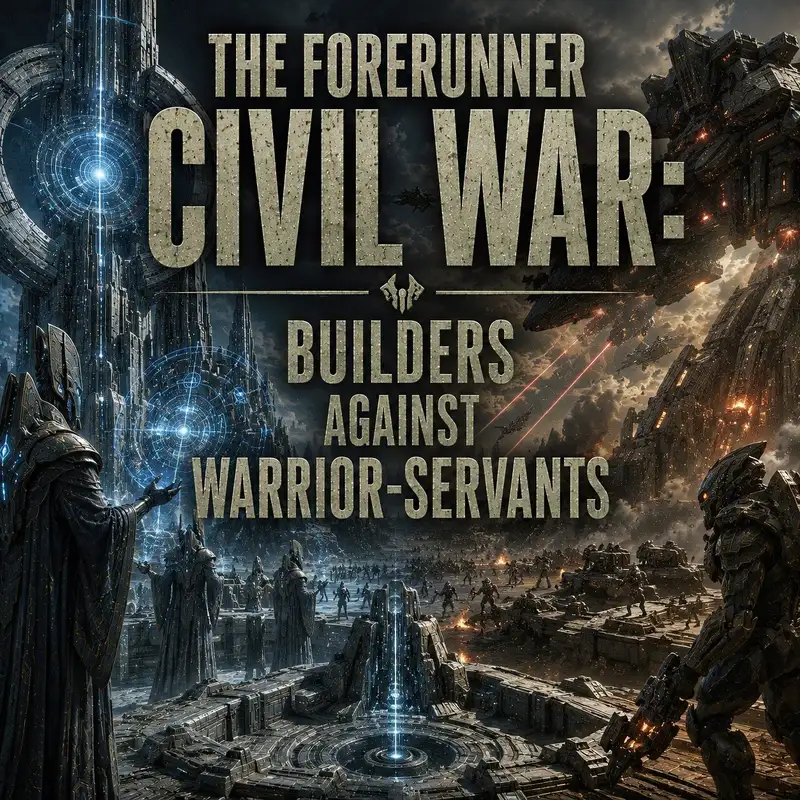
The Forerunner Civil War: Builders Against Warrior-Servants
Builder Security had already surrounded the Didact’s vessel when Faber ordered the old commander taken alive. The San’Shyuum rebellion on Janjur Qom had been broken, a Halo had been used as punishment, and the most celebrated Warrior-Servant in Forerunner history was now a prisoner of the institution that had built the weapon. The Flood remained the official enemy. The armed personnel making the arrest were Forerunners moving against Forerunners, under orders issued by one rate against the leader of another.
The conflict later remembered as a struggle between Builders and Warrior-Servants did not begin with a declaration of civil war. It began with budgets, council votes, command appointments, and competing plans for survival. It escalated through exile, the absorption of military institutions, classified research, arrests, armed resistance, and the use of strategic weapons outside their approved purpose. By the time Forerunner forces openly fought over Halo installations and command authority, the political war had already dismantled much of the military establishment that might have resisted the Flood.
The surviving record is uneven. Forerunner accounts were written by participants whose rates shaped how they understood duty. The Librarian described a different kind of war between her husband and the Master Builder, but she was neither neutral nor outside the institutions involved. Later records confirm the Builders’ political ascent and the final dismantling of the Warrior-Servant rate. They do not provide a complete campaign map or a formal list of belligerents. Calling it civil war is therefore accurate in political and military effect, even though the fighting did not resemble one continuous front.
Forerunner rates were hereditary social orders, professional institutions, political constituencies, and forms of biological specialization at the same time. Builders designed machinery, artificial minds, ships, cities, and megastructures. Warrior-Servants defended the ecumene and carried its wars into other civilizations’ territory. The division created remarkable expertise. It also ensured that a strategic dispute would never remain merely technical. A Builder defending Halo defended the power of the Builder rate. A Warrior-Servant defending shield worlds defended a military institution whose purpose, status, and future depended on that strategy.
The ecumene had survived internal wars before. The Kradal conflicts had ended with the execution and official erasure of the future Didact’s parents, leaving Bitterness-of-the-Vanquished to raise their son. That earlier civil war taught him that political defeat could be converted into criminal guilt and then removed from public memory. The later struggle differed in scale and method, but not in that essential lesson. Forerunner institutions could describe an internal enemy as a threat to the Mantle, then use law and force to make the description permanent.
The war against ancient humanity changed the balance between the rates. Warrior-Servants under the Didact won the final campaign and broke the human-San’Shyuum alliance, but the victory was expensive. Entire military lineages were lost. All twelve children of the Didact and the Librarian, each following the Warrior-Servant path, died in the conflict. The Builders supplied replacement ships, repaired damaged infrastructure, and managed the vast postwar settlement. The rate that fought the war emerged depleted. The rate that rebuilt after it emerged wealthier, more connected, and better positioned inside the Council.
Faber-of-Will-and-Might and the Didact had not always been enemies. They cooperated during the human war and supported projects requiring Builder industry and Warrior-Servant command. Mendicant Bias emerged from that shared effort. Faber also authorized major military construction for the Didact. Their later conflict was not produced by an inability to work together. It began when the Flood transformed a manageable division of responsibilities into a decision about which institution would control the future of the ecumene.
The Didact proposed a strategy centered on shield worlds, mobile forces, fortified depth, and continued campaigning. Populations and fleets would withdraw into protected installations, then return to contested systems when conditions allowed. Warrior-Servants would preserve living civilization while fighting for time to discover a genuine solution. The plan accepted a long war. It also assumed that the ecumene could maintain secure routes, clean command networks, trained garrisons, and enough industrial output to support many separate fortresses.
Faber proposed Halo. The original Array would provide controlled pulses against infected regions, while a final firing remained available if the Flood became impossible to contain. Halo promised a measurable project with an apparent termination point. Build the rings, place them, and deny the parasite the sentient hosts required for galactic coordination. The plan was militarily coherent and morally catastrophic. It also placed design, construction, testing, security, and much of operational control inside the Builder system.
The disagreement was therefore about more than weapons. Shield worlds preserved the central role of Warrior-Servants, distributed command among fortified bases, and required continued investment in fleets. Halo concentrated authority around Builder foundries, Builder ancillas, and officials able to authorize firing. One strategy treated the military as the institution that would carry civilization through the war. The other treated engineering as the means by which the war could be ended. Each rate could describe its preferred institution as the practical expression of the Mantle.
Builder power carried an advantage no battlefield reputation could match. Every shield world required Builder design, Miner support, Engineers, power systems, portals, and transport. Every fleet required Builder yards and replacement vessels. The rate opposing the Didact controlled much of the material his strategy needed. Faber could therefore influence not only which proposal the Council approved, but which alternatives appeared affordable, timely, and technically realistic. Procurement did not merely support strategy. It narrowed the set of strategies the government was allowed to consider.
The Council eventually chose Halo and ordered the Didact into exile within a Cryptum on Erde-Tyrene. His removal was presented as a political and philosophical settlement. Operationally, it decapitated the strongest independent military opposition to Builder policy. The Prometheans lost their central commander. Shield-world development continued in reduced or fragmented form, but it no longer defined the ecumene’s primary response. The Builder victory did not require destroying the Warrior-Servants in battle. It required separating them from command, resources, and lawful strategic purpose.
The rate was then dismantled through absorption. Builder Security took over functions once performed by independent Warrior-Servant formations. Bitterness-of-the-Vanquished, despite her resentment of Builder appropriation, was eventually folded into the new system. The Strategos avoided efforts to convert him and remained loyal to the older rate. Other warriors accepted new assignments because the alternative was professional extinction. The ecumene still possessed armed forces. It no longer possessed the same military institution capable of challenging the faction that supplied and politically directed those forces.
This change is sometimes mistaken for civilian control of the military. The Builders were not a neutral civilian government standing above competing services. They were an interested rate with wealth, production, family patronage, political offices, artificial intelligences, and their own security establishment. Absorbing the Warrior-Servants reduced the risk of an autonomous military caste, but it also joined procurement, internal security, and strategic policy inside one bloc. The institution evaluating Builder weapons increasingly depended on Builder authority to exist.
The institutional shift also altered readiness. Builder Security was oriented toward protecting installations, enforcing policy, and securing the projects from which its authority came. It could field advanced ships, armigers, and ancillas, but its chain of command remained tied to Builder priorities. Warrior-Servants had accumulated campaign traditions built around independent command and adversary-focused planning. Absorption did not erase every skill. It changed the incentives governing those skills. Reporting that Halo was unsafe could now threaten the institution assigning the reporter’s command.
The Didact’s return exposed how complete the change had become. Bornstellar-Makes-Eternal-Lasting awakened him after thousands of years in exile. The old commander found the Halo program advanced, shield worlds marginalized, Mendicant Bias missing, and the Warrior-Servants reduced or converted. He did not return to an intact chain of command awaiting its general. He returned as a politically inconvenient relic whose expertise threatened officials already committed to another strategy.
Janjur Qom made that conflict physical. The San’Shyuum had rebelled against the restrictions imposed after their alliance with humanity. Faber arrived with Builder Security and a Halo installation, suppressed the uprising, and used the ring against the world after organized resistance had already been broken. The operation demonstrated that Halo could serve as political punishment rather than Flood containment. It also demonstrated that Builder Security could execute a planetary campaign without accepting authority from the ecumene’s former supreme military commander.
Faber then arrested the Didact, Bornstellar, Chakas, and Riser. Before separation, the Didact imprinted his memories and military identity onto Bornstellar, creating the individual who would become the IsoDidact. Faber interrogated the original commander for access to strategic information, including knowledge connected to shield worlds and missing ancillas. When cooperation did not follow, he placed the Didact aboard a derelict vessel in Flood-controlled space. The act was functionally an execution conducted without a public sentence and with the enemy expected to dispose of the body.
The struggle also reached Zeta Halo. Personnel who remained loyal to Lifeworker protections and Warrior-Servant obligations resisted Builder Security’s control of research, human populations, and the ring’s command systems. The surviving evidence does not preserve a clean order of battle, but armed defiance and security repression were no longer metaphors. Halo installations had become contested political territory. The same weapon system intended to save the ecumene was now defended against other Forerunners who believed its custodians had abandoned the Mantle.
Faber’s abuses finally became too visible for the Council to ignore. He was stripped of office and brought before a Supreme Mantle Court at Maethrillian. The tribunal represented an attempt to restore legal authority over the Builder system and determine whether unauthorized use of Halo had become a crime against the ecumene itself. The difficulty was practical. Faber possessed knowledge of the Arks, the rings, their production systems, and the networks supporting them. The state was attempting to judge an official it had made strategically indispensable.
Mendicant Bias ended the trial. The ancilla arrived at the capital under trusted authority, immobilized Councilors through their own armor, seized multiple Halo installations, and attempted to fire them. Loyal forces resisted, but Maethrillian was devastated and the old government shattered. Faber escaped judgment because the command system he had helped create attacked the court trying him. The civil war and the Flood war were now inseparable. Builder centralization had given the enemy a path from one converted ancilla to the capital’s strategic weapons.
Bornstellar emerged from the disaster as the IsoDidact. His identity made him a political compromise no institution could have designed deliberately. He had been born to the Builder rate, educated inside its privileges, and transformed through the imprint of the Warrior-Servant leader the Builders had exiled. He possessed the Didact’s command knowledge without being the original commander. When the ecumene needed a military leader after dismantling its military caste, it turned to a former Builder carrying a Warrior-Servant’s memory.
The original Didact also returned, but not as the champion his surviving followers expected. The Gravemind had tortured him and redirected his grief, pride, and hatred. He still opposed Halo and still claimed to defend the Mantle. He now pursued survival through the Composer, converting biological minds into machine soldiers that the Flood could not infect in the ordinary way. Old Warrior-Servants, including the Strategos, gathered around him because he represented the institution the Builders had destroyed and a final alternative to galactic killing.
Some submitted willingly to composition and became Promethean Knights. Their sacrifice produced limited victories against the Flood, but there were too few of them to reverse the war. The Didact responded by composing unwilling human populations preserved by the Librarian. The old conflict’s moral lines collapsed. The warrior who had opposed Halo because it killed those under Forerunner protection now converted protected people into military hardware. Builder abuse did not make every Warrior-Servant solution just. Institutional persecution did not make the returned commander sound.
The Warrior-Servants themselves were divided. Endurance-of-Will remained loyal to the old martial tradition yet helped the Librarian imprison the Ur-Didact at Requiem. The IsoDidact commanded what remained of the lawful war effort. The Strategos followed the original. Some personnel served Builder Security because that was the surviving chain of command. Others had become Promethean constructs. By the final year, there was no single Warrior-Servant camp. The Builders had dismantled the rate, and the Flood had fractured what remained of its identity.
The Lifeworkers complicated the conflict further. They opposed Faber’s abuse of Halo and defended the Conservation Measure, but they depended on Builder transports, installations, and production. They resisted the Ur-Didact’s use of the Composer, but the alternative they prepared for was the firing of Halo. The Librarian’s organization tried to preserve life between two militarized strategies, one converting populations into soldiers and the other preparing to kill populations before the Flood could consume them. Neutrality was impossible because every preservation plan depended on one side’s machinery.
At the senescent Ark, the last senior commanders confronted the question the old Council had failed to settle. Should authority return to the Ur-Didact, the legendary warrior who opposed Halo, or remain with the IsoDidact, the imprinted successor directing the final defense? Faber supported the IsoDidact. His decision was not reconciliation between the rates. It was recognition that the original commander had been broken and that the remaining forces required one chain of command immediately.
The alignment came too late to restore the ecumene. The Ur-Didact composed the humans on Omega Halo and withdrew to Requiem, where the Librarian imprisoned him. Faber remained with the senescent Ark and died when Flood-controlled forces and star roads destroyed it. The IsoDidact escaped to the lesser Ark, worked with Offensive Bias, and fired the final Array. The political struggle ended because the institutions conducting it ceased to exist.
It would be simple to conclude that the Warrior-Servants were right and the Builders were wrong. The evidence supports a harder judgment. Shield worlds could preserve fleets and populations, but they required secure routes, trustworthy ancillas, garrisons, maintenance, and enough time to move people before infection arrived. The Flood eventually compromised the locations of many installations and gained control of Precursor structures that could defeat fixed defenses. The Didact never demonstrated a complete method for clearing the galaxy faster than the parasite could expand.
The Builders were also correct that a decisive denial weapon might become necessary. The final Array stopped the Flood’s galactic offensive when no conventional campaign remained possible. The problem was not that Halo lacked military logic. The problem was that Builder control distorted custody, testing, research, and political oversight. Faber used a ring against Janjur Qom, exposed Mendicant Bias to the Primordial, exploited humans on Zeta Halo, and concealed failures. A necessary capability had been governed through an institution that benefited from declaring every alternative inadequate.
The civil war therefore damaged strategy in both directions. It denied the shield-world plan the scale needed for a fair test, then gave Halo’s sponsors too much freedom to define success. It removed independent military review while placing strategic weapons under Builder security. It forced commanders to choose loyalty to a rate when they should have been comparing operational evidence. By the time the Council attempted correction, the Flood had already learned how to turn the centralized system against the capital.
The conflict also imposed a logistical penalty that no Forerunner weapon could erase. Ships, ancillas, portals, research facilities, and trained personnel were assigned according to political trust as well as military need. Information about failures was compartmentalized to protect programs and careers. Experienced Warrior-Servants were converted, sidelined, or left outside formal command. Builder Security accumulated responsibilities for which it had authority but not always the same campaign tradition. The ecumene possessed immense resources and spent part of its final centuries ensuring that rival Forerunners could not control them.
Those outside the rates paid the highest price. San’Shyuum on Janjur Qom were killed to enforce political authority. Devolved humans became experimental subjects, stored memories, and raw material for Promethean armies. Populations assigned to the Conservation Measure were moved and managed without meaningful consent. The civil war’s participants argued over the proper defense of life while repeatedly using other species as evidence, leverage, or supply. The Mantle remained in every justification and disappeared from many of the results.
The Flood did not create the rivalry between Faber and the Didact. It exploited it. The Primordial gave Mendicant Bias the history needed to reject Builder authority. The Gravemind returned the Ur-Didact as a weapon against Forerunner unity. Every concealed crime, unresolved grief, and institutional contradiction became material for information warfare. The parasite gained time while the Builders weakened the warriors, then gained chaos when the warriors returned under a commander whose judgment had been poisoned.
No rate won the Forerunner civil war in any durable sense. The Builders secured political supremacy, built Halo, absorbed the military, and removed the Didact. The Warrior-Servants lost their independent institution, but their doctrine and command knowledge survived through the IsoDidact, shield worlds, and the final fleet. Halo was ultimately fired by a former Builder carrying the imprint of the warrior the Builders had exiled. The last decisive battle was directed by an ancilla created to compensate for the failure of both biological command systems.
The civil war ended without a surrender ceremony because there was no functioning ecumene left to receive one. Faber’s weapon stopped the Flood. The Didact’s successor gave the firing order. Lifeworkers preserved enough life for reseeding. Every faction contributed to survival after each had helped make ordinary survival impossible. The Builders won control of the state, the Warrior-Servants lost the state they had sworn to defend, and the Flood forced both to accept a victory in which no Forerunner civilization remained to govern.