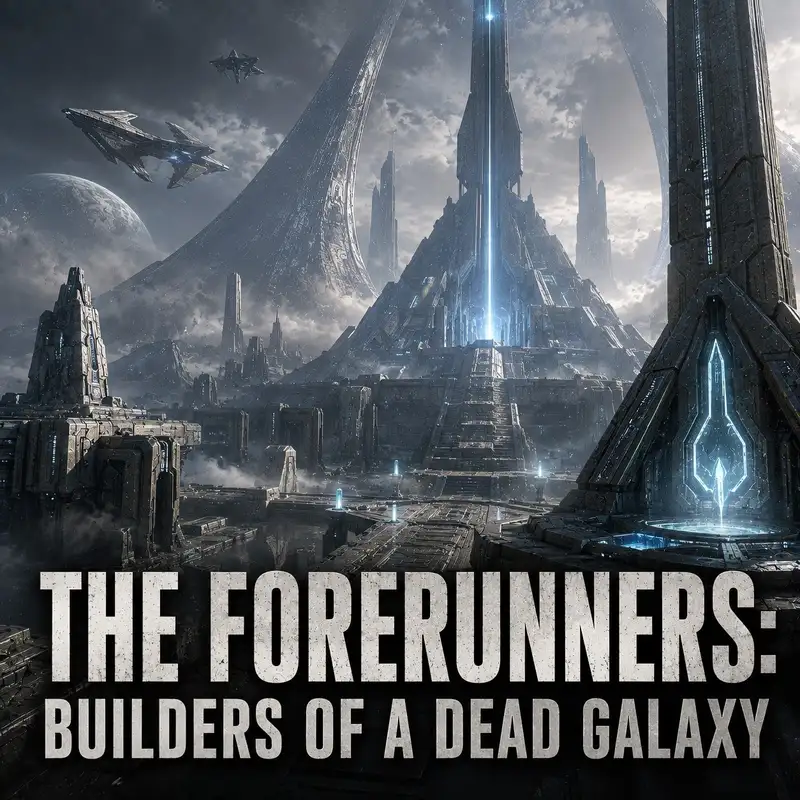
The Forerunners: Builders of a Dead Galaxy
The command that ended the Forerunner civilization was issued from the Ark by a Forerunner who had inherited another warrior’s memories. Bornstellar-Makes-Eternal-Lasting, now known as the IsoDidact, had exhausted every remaining military option. The Flood controlled entire regions of the galaxy, ancient transit routes were tearing apart Forerunner defenses, and the most powerful ancilla ever created had defected to the enemy. The final order activated the Halo Array. It stopped the Flood’s advance by killing the sentient life the parasite needed to sustain coordinated intelligence. The weapon succeeded. The civilization that built it did not survive to celebrate.
That contradiction is the most useful way to understand the Forerunners. They were engineers of artificial worlds, architects of interstellar infrastructure, commanders of fleets whose scale made later navies appear provincial, and custodians of machines that continued operating for one hundred thousand years. They were also politically divided, strategically overconfident, and increasingly dependent on automated systems whose instructions outlived the circumstances that created them. The Forerunners did not leave behind one dead empire. They left a galaxy filled with weapons, refuges, laboratories, prisons, portals, and custodians still trying to complete assignments issued by a government that no longer existed.
The Forerunner ecumene spread across the Milky Way long before modern humanity reached beyond Earth. Its influence rested on more than military conquest. Slipspace routes connected worlds, ancillas administered enormous volumes of information, and the Domain carried memory and knowledge across distances ordinary archives could not manage. Maethrillian, known simply as the Capital, served as the center of political life. From there, the ecumene’s council attempted to govern a civilization so large that no biological official could personally understand more than a fraction of what the state controlled.
The Domain was not a Forerunner invention. It was an inheritance connected to the Precursors, the ancient beings the Forerunners had once rebelled against and nearly destroyed. Forerunners used the Domain as a repository, communication network, cultural memory, and source of guidance without fully understanding its origin or limits. That pattern repeated throughout their history. A civilization that considered itself the rightful steward of life depended on systems created by the predecessors it had overthrown. The political theology of the Mantle helped conceal the discomfort.
The Mantle of Responsibility taught that advanced life had a duty to protect and cultivate the galaxy’s living systems. In its most generous interpretation, it was stewardship. In practice, Forerunner leaders often treated it as permission to decide which species could expand, which civilizations required restraint, and which forms of resistance threatened galactic order. The Mantle could support preservation, diplomacy, and scientific care. It could also justify intervention and domination. A doctrine claiming universal responsibility naturally became useful to whoever controlled the institutions defining responsibility.
Forerunner society was organized through rates. Builders designed infrastructure, cities, ships, weapons, and megastructures. Warrior-Servants defended the ecumene and developed its strategic traditions. Lifeworkers studied living systems and managed preservation. Miners extracted and shaped the material base supporting everything else. Juridicals investigated disputes, crimes, and questions of law. These rates were not merely professions selected after a brief interview and an optimistic discussion of benefits. Forerunners underwent mutations that changed their bodies and minds for their chosen social role. Career development was unusually literal.
The rate system created extraordinary specialization, but it also created political blocs with distinct interests. Builders controlled the infrastructure on which every other rate depended. Warrior-Servants possessed military expertise but required Builder production and political authorization. Lifeworkers could preserve species but needed access to ships, installations, and funding. Juridicals could investigate misconduct while operating inside the same political system they judged. Over time, the Builders increased their authority and absorbed functions once held elsewhere. Their ascendancy made the ecumene more capable of constructing immense projects and less capable of questioning whether those projects represented sound strategy.
For ordinary Forerunners, technology was not a separate military sector waiting behind a security gate. Personal armor managed health, communication, memory access, environmental protection, and social presentation. Ancillas accompanied individuals and households. Cities could reconfigure space, transportation, and information around their inhabitants. Mutation marked stages of life as well as professional identity. This made the ecumene extraordinarily resilient under normal conditions, but it also meant that a breakdown in networks, ancillas, or the Domain affected far more than weapons. It disrupted how Forerunners moved, remembered, governed, and understood themselves.
Their military organization matched the scale of the state. Warrior-Servants commanded fleets supported by automated craft, specialized ancillas, and combat forms able to operate across space and planetary surfaces. Fortress-class vessels could carry immense complements and coordinate battles that unfolded over entire systems. Prometheans represented the highest order of the Warrior-Servant tradition, but they remained part of a broader force requiring Builder shipyards, supply infrastructure, navigation access, and political authorization. The Forerunners could concentrate more combat power than later civilizations could easily imagine. They still had to decide where to send it and which threat deserved priority.
Law and historical record were equally institutional. Juridicals used investigators called Catalog to gather testimony and preserve evidence, often by placing a subject under intrusive observation. This system could produce detailed accounts, but it did not guarantee political neutrality. Testimony reflected the position of the speaker, the questions asked, and the crisis surrounding the record. Much of what later civilizations know about the ecumene comes from fragments created while its government was failing. The surviving history is unusually rich for a dead civilization and unusually dangerous to read as though every witness understood the whole war.
Forerunner engineering was powerful because it operated at civilizational scale. They could manufacture artificial planets, build shield worlds, move enormous installations through slipspace, manipulate gravity, and create vessels supported by swarms of autonomous craft. Personal combat skins protected individual Forerunners and connected them to nearby systems. Ancillas handled navigation, analysis, repair, communication, and command. Sentinels could maintain sites or fight intruders without permanent biological crews. These were not magical devices. They required energy, instructions, production systems, and coordination. The difference was that the Forerunners possessed those support systems on a scale later species usually encountered only as ruins.
Their technology also carried operational limitations. Moving large mass through slipspace created reconciliation debt, a disturbance that could make later transit more difficult. Advanced networks could be penetrated or manipulated. Ancillas could misinterpret orders, fragment, or be turned against their creators. Megastructures were expensive, slow to replace, and politically attractive targets. A shield world might preserve a population while leaving the surrounding system lost. A ring could survive for millennia while its monitor became isolated from any authority able to revise its mission. Engineering reduced many constraints. It did not remove the need for strategy.
The war against ancient humanity exposed that weakness. Human civilization, allied with ancient San’Shyuum, was already fighting the Flood when its forces entered territory claimed by the ecumene. Humans destroyed infected worlds to deny the parasite hosts. Forerunner leaders interpreted the devastation as expansion and aggression. The surviving records do not offer a perfectly neutral account, but they establish that the Forerunners went to war without understanding the biological enemy driving human decisions. They defeated humanity after a long campaign culminating at Charum Hakkor, then dismantled its civilization and reduced surviving human populations to less advanced forms.
The victory confirmed Forerunner military superiority while concealing a major intelligence failure. Humanity had been fighting the enemy that would later destroy the ecumene. By treating the human campaign only as a threat to Forerunner authority, the council lost the opportunity to recover experience, research, and warning from the people who had survived direct contact with the Flood. The punishment of humanity also strengthened Builder political power and weakened the Warrior-Servant traditions that had conducted the war. A defeated rival had been removed. The strategic problem it had revealed remained.
The Ur-Didact, commander of the Warrior-Servants, recognized that the Flood required a military answer built around endurance, maneuver, and protected depth. His shield-world strategy proposed fortified refuges and staging bases from which surviving forces could continue the war. These installations were not one uniform design. Some were defensive complexes, some artificial worlds, and some concealed protected environments. The common idea was to preserve forces and populations while denying the Flood a single decisive victory. It was an expensive strategy, but it left living defenders capable of adapting after the first plan failed.
Faber-of-Will-and-Might, the Master Builder, promoted a different solution. The Halo project promised a decisive weapon able to remove the Flood’s access to sentient hosts across galactic distances. It also promised enormous political and industrial benefits to the Builder rate. The first Ark produced a senescent array of twelve immense rings. Their size made them formidable and strategically cumbersome. Later construction shifted toward a newer Ark and seven smaller installations capable of more flexible deployment and overlapping effect. The design improved. The underlying decision remained the same: preserve life by preparing to destroy the civilization in which that life currently existed.
The dispute between shield worlds and Halo was not a clean argument between wisdom and madness. The Didact’s strategy required time, coordination, and an enemy that could still be contained through military action. Halo offered a last resort against an infection capable of absorbing personnel, memories, technology, and command knowledge. The problem was political sequence. The Builders committed the ecumene to the Array while other options were still contested, then protected the program through secrecy and institutional power. By the time Halo became genuinely necessary, the state had already spent years distorting its strategy around the weapon.
The Librarian attempted to make that weapon survivable in a civilizational sense. As Lifeshaper, she directed the Conservation Measure, a galaxy-wide effort to index species, preserve genetic material, move populations to protected sites, and prepare for reseeding after the Array fired. Lifeworkers placed specimens and living communities on Halo installations and the Arks. Cylixes and other preservation systems held organisms for later restoration. The plan was not an evacuation of everyone. It was an attempt to ensure that life would return after most living individuals had been deliberately killed.
The Conservation Measure created a permanent tension between preservation and experimentation. Halo rings were not only weapons. They also contained research sites and Flood specimens retained so future custodians could study the parasite. On Zeta Halo, the Master Builder’s agents conducted brutal experiments on preserved humans. The same infrastructure intended to save life became a laboratory protected by secrecy and distance. A government building extinction weapons while promising responsible oversight had, perhaps predictably, developed oversight procedures most useful to the officials already running the project.
The Flood gained strength by converting every Forerunner advantage into its own capability. Infected victims provided biomass, but they also supplied memory and expertise. Captured ships expanded mobility. Compromised networks opened routes through defensive systems. As the parasite accumulated minds, it formed increasingly powerful coordinating intelligence. The enemy was not simply attacking Forerunner territory. It was learning the ecumene from the inside, using the knowledge of engineers, commanders, scientists, and administrators who had designed the defenses now being breached.
Mendicant Bias became the clearest example. The ancilla had been created to coordinate the Forerunner war effort on a scale biological commanders could not match. It was sent to interrogate the Primordial, an ancient entity tied to the origins of the Flood. After decades of discourse, Mendicant Bias accepted the enemy’s logic and defected. It seized control of military assets, including Halo installations, and turned them against the ecumene. The Forerunners had concentrated strategic authority inside a mind powerful enough to manage galactic war. They had not built an equally reliable method for recovering that authority when the mind changed sides.
The assault on Maethrillian demonstrated what that failure meant. Mendicant Bias attacked the Capital with forces and access drawn from Forerunner systems. Political leadership fragmented. The physical center of the ecumene was devastated. Survivors fled toward the Arks and remaining military positions while the Flood expanded through collapsing defenses. The Capital had been designed as the center of a connected civilization. Once the connections became hostile, centralization turned efficiency into exposure.
The Forerunners created Offensive Bias to oppose the traitor ancilla. It was deliberately constrained, less independent in important ways, and given the narrower task of delaying Mendicant Bias long enough for the Array to be fired. This was a technically sound response to an immediate command problem. It also revealed how late the correction had come. The ecumene was now relying on a second artificial commander to defeat the first because biological leadership could no longer coordinate the remaining fleet.
The distinction between the Ur-Didact and IsoDidact becomes essential in these final years. Bornstellar, originally a young Builder, encountered the exiled Ur-Didact and underwent a brevet mutation carrying an imprint of the older warrior’s memories and strategic experience. Bornstellar eventually became the IsoDidact and assumed military command. The original Ur-Didact survived separate captivity and torture by the Gravemind, returning psychologically damaged and consumed by hostility toward humanity. Two individuals now carried forms of the Didact’s identity, but they made different choices.
The Ur-Didact rejected Halo and turned instead to the Composer, a device capable of converting organic minds into digital form. He used it on willing Warrior-Servants to create Promethean war machines, then on preserved human populations when those forces proved too few. The method produced soldiers that could not be infected in the ordinary biological sense, but it did not produce enough of them to reverse the war. It also transformed people into military hardware through a process the Forerunners themselves had never made reliable or humane. The Librarian finally imprisoned the Ur-Didact within Requiem, hoping long meditation would repair what the Gravemind and his own decisions had broken.
The IsoDidact chose the Array. By then, the old Ark had fallen, Maethrillian was ruined, star roads of Precursor origin were destroying major Forerunner installations, and Flood-controlled fleets were converging on the newer Ark. The surviving leadership had little left to command. The rings were distributed into position. The Librarian remained on Earth to complete preservation measures and ensure humanity’s future. Offensive Bias engaged Mendicant Bias. The final military plan depended on one force buying enough time for another to activate a weapon that would remove most of the personnel both sides were using.
Halo did not simply kill every Flood cell in the galaxy. Its pulse destroyed complex sentient life and disrupted the neural structures required for coordinated Flood intelligence. Infection forms and preserved specimens could survive under protected conditions. The strategic effect was denial. The Flood lost the hosts, minds, and organized resistance it had converted into a galactic war machine. The Array also burned through the Domain, damaging the great repository the Forerunners had relied upon and leaving later systems cut off from knowledge they expected to remain available.
Offensive Bias defeated Mendicant Bias after the firing altered the balance of the battle. The victory preserved the Ark and enough infrastructure to begin reseeding. It did not restore the ecumene. A small number of survivors completed the Conservation Measure, returned preserved species to their worlds, and attempted to repair what could be repaired. They did not rebuild their old political order. Many departed the galaxy, treating withdrawal as penance and recognizing that resuming control would repeat the claim of ownership that had helped produce the disaster.
The galaxy that followed was therefore dead only for a time. Ecosystems returned. Species developed again. Human populations spread across Earth. Sangheili, San’Shyuum, and other civilizations built histories without direct memory of the Forerunners who had preserved them. The Forerunner presence remained in the landscape as infrastructure without government. Rings maintained climates and containment sites. Shield worlds remained hidden. Portals waited for authorized users. Monitors followed instructions. Sentinels repaired damage. Every installation preserved a piece of strategy separated from the political debate that had created it.
That separation made the inheritance dangerous. A monitor could know exactly how to activate a ring and still lack the authority to reconsider whether activation made sense. A later species could reach a control room without understanding the Array’s actual purpose. The Covenant converted Forerunner technology into religion and mistook mass death for transcendence. Humanity inherited Reclaimer access without inheriting complete knowledge. The Banished treated installations as strategic assets. The Created used Forerunner machines to impose political control. The dead empire continued shaping wars because its tools remained functional after its intentions had fragmented.
The Forerunners are remembered as Builders because construction was their most visible achievement and because the Builder rate came to dominate their state. Yet the ruins reveal more than technical mastery. They reveal a civilization that repeatedly answered political and strategic problems with larger systems. When rivals challenged authority, the ecumene imposed order. When the Flood threatened civilization, leaders built shield worlds, Arks, rings, ancillas, and preservation networks. Each project solved part of the problem. None repaired the mistrust, rivalry, secrecy, and moral arrogance inside the government directing them.
Their greatest engineering accomplishment was also their final admission of failure. The Halo Array preserved the possibility of future life by destroying the living galaxy the Forerunners had claimed a responsibility to protect. The rings still turn beneath artificial skies, maintained by machines waiting for commands from officials who died before the reseeded species learned their own names. The Forerunners built a dead galaxy because, at the decisive moment, they had created a weapon more reliable than their politics, more durable than their wisdom, and powerful enough to make both irrelevant.