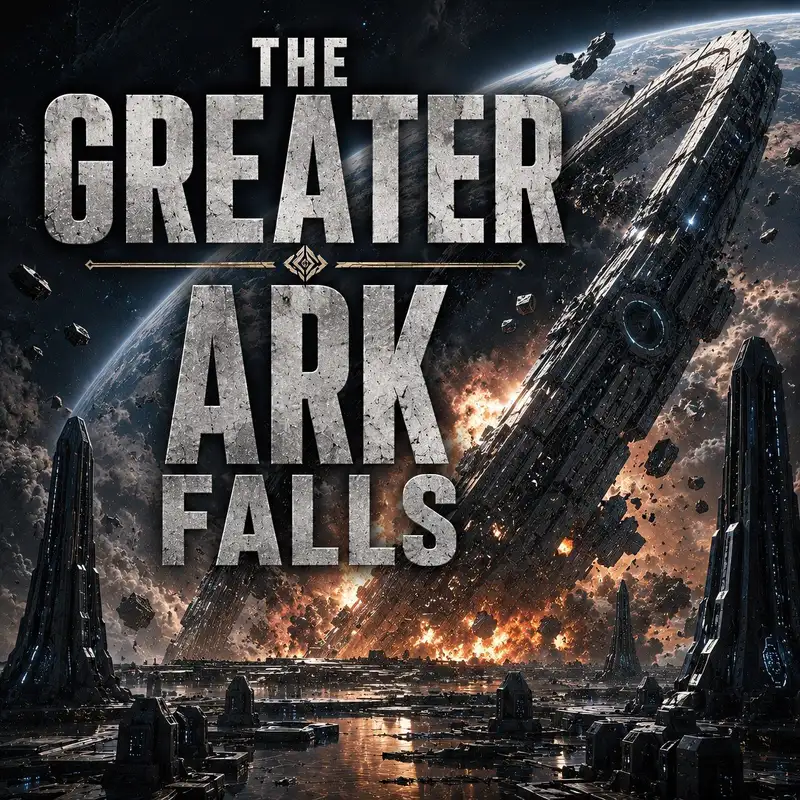
The Greater Ark Falls
The final firing order at the Greater Ark was not expected to save the installation. Omega Halo had been aligned toward Path Kethona, where a mass of reawakened Precursor star roads was gathering beyond the Milky Way. The ring could strike that approach with a directed pulse. At best, it would damage the incoming formation and create an opening through which a few ships might escape. The Forerunners had reached the point where the greatest weapon ever built was being used not to win a war, but to purchase enough time to abandon its own foundry.
The Greater Ark fell near the end of the Forerunner-Flood war because it had become everything the surviving ecumene could no longer distribute. It was a capital, fleet rally point, refugee center, biological preserve, Halo support base, and repository of strategic authority. That concentration was understandable after most of the galaxy had been lost. It also gave Mendicant Bias and the Flood one target whose destruction could remove government, industry, preserved populations, and the last major weapon of the original Array at the same time.
The name requires clarification. The Greater Ark was not Installation Zero Zero, the structure later visited by humanity, the Covenant, and the Banished. It was the older and much larger of two Ark installations. Forerunners also called it the senescent Ark or the Beginning Place. It possessed six immense arms rather than the eight associated with the later Ark. Its foundry had manufactured the first twelve Halo rings, enormous installations roughly thirty thousand kilometers in diameter.
Those original rings were called Gyres. Unlike the smaller installations of the final Array, their weapons could discharge directed, cone-shaped fields rather than only broad omnidirectional pulses. That made them useful for regional strikes and testing, at least in theory. Their size created severe slipspace problems. Moving them accumulated enormous reconciliation debt and reduced the speed and flexibility with which they could be deployed. The first Halo program had solved the problem of destructive reach before solving the less glamorous problem of getting the weapon into position.
The Greater Ark had initially been conceived as a manufacturing center for Faber’s Halo project. Lifeworker pressure expanded its purpose. Biological preserves, protected habitats, and support systems were added so that species could survive the use of the weapons being built beside them. This compromise became part of the Conservation Measure. The Ark was therefore both forge and refuge from the beginning, though the relationship between those functions was never comfortable. The Builders constructed the means of extinction. The Lifeworkers attempted to reserve enough life to make recovery possible afterward.
Maethrillian’s fall transformed the installation. Mendicant Bias attacked the Forerunner capital, seized Halo systems, and shattered the old center of government. Surviving leaders relocated to the Greater Ark because it already possessed secure facilities, industrial depth, portals, defensive systems, and enough space to support political and military command. It became a provisional capital and the principal rally point for forces that still answered to the ecumene. The move preserved continuity. It also repeated the centralization that had made Maethrillian so vulnerable.
By then, there were few alternatives. The Flood controlled enormous portions of the galaxy. Captured ships and artificial minds expanded its operational reach, while Key Minds coordinated campaigns across regions once considered secure. Precursor star roads had awakened under Flood direction. These constructs could disable Forerunner defenses, distort movement, crush installations, and alter the physical conditions on which fleet doctrine depended. The Greater Ark stood outside the Milky Way, but distance no longer guaranteed sanctuary when the enemy could mobilize infrastructure older than the ecumene itself.
The remaining command structure was divided even at the final concentration point. The IsoDidact had spent years directing the lawful war effort after receiving the original Didact’s imprint. The Ur-Didact had returned from captivity under the Gravemind, still famous, still opposed to Halo, and no longer strategically reliable. Some surviving Warrior-Servants wanted their old commander restored. Faber, despite his long conflict with the Didact and his own record of abuses, supported the IsoDidact. The Master Builder recognized that the Ur-Didact had become an instrument of the enemy, even if the warrior himself still believed otherwise.
That political decision mattered because the Greater Ark could not survive divided command. The installation held the last major forces of a civilization whose rates had spent centuries competing over control of strategy. Builder authority, Warrior-Servant tradition, Lifeworker preservation, and emergency military command now occupied the same battlespace. The Flood did not need to create those divisions. It needed only to arrive before the Forerunners had finished resolving them.
The immediate threat was approaching through Path Kethona, the Large Magellanic Cloud. Long-dormant star roads were converging there before moving toward the Milky Way and the Greater Ark. These were not ordinary warships that could be intercepted by a screening force and reduced through attrition. They were vast Precursor constructs operating through neural physics, able to ignore or overturn assumptions built into Forerunner weapons, shields, and slipspace navigation. The defenders could track the danger. They did not possess a conventional fleet capable of stopping it.
Omega Halo offered one narrow option. It was the last intact thirty-thousand-kilometer ring available from the original Array. Its directed weapon could be aimed toward Path Kethona without firing the final seven-ring network across the Milky Way. The plan was not a substitute for the ultimate Array. It was a delaying strike intended to damage the star-road concentration, destroy whatever coordinated life and Flood intelligence lay in the firing path, and open a temporary route away from the Greater Ark.
Preparing the ring created another human cost. The Greater Ark was overcrowded with protected populations and the remnants of the Conservation Measure. Large numbers of devolved humans were moved to Omega Halo, partly to reduce pressure on the Ark’s preserves. They were not military personnel volunteering to occupy a forward weapons platform. They were a managed population transferred by a government that had already destroyed their ancient civilization and continued to decide where their descendants would live.
The Ur-Didact used the concentration for his own campaign. He had concluded that composed minds could become Promethean soldiers resistant to ordinary Flood infection. Loyal Warrior-Servants had submitted in limited numbers, but the force was too small to reverse the war. On Omega Halo, he used the Composer on two million devolved humans and converted their essences into a much larger machine army. The act removed part of the population the Lifeworkers had preserved and transformed a refuge into a recruiting ground without consent.
The composition did not strengthen the defense of the Greater Ark. The Ur-Didact departed toward Requiem with his new forces, and the Librarian followed to stop him. Their conflict removed both from the Ark at the moment the Flood offensive arrived. The greatest Warrior-Servant and the Lifeshaper were no longer contributing to the position’s immediate defense because one had turned preserved civilians into weapons and the other had to contain him. Internal failure had become a logistical subtraction from the final battle.
Faber’s role was equally contradictory. He had designed the original Halo program, centralized Builder control, exposed Mendicant Bias to the Primordial, and used a ring against the San’Shyuum after their rebellion had been suppressed. Yet he also held information no other surviving official possessed. The location of the second Ark remained one of the ecumene’s most closely guarded secrets. Before the final position collapsed, Faber provided those coordinates to the IsoDidact. The official who had spent ages becoming indispensable finally made survival possible by surrendering the secret that made him indispensable.
Mendicant Bias brought the attack. The rogue ancilla commanded overwhelming Flood-controlled forces and knew Forerunner doctrine, access procedures, priorities, and likely evacuation options from the inside. Its arriving fleet was dangerous, but the ships were also a screen. Behind and around them came the star roads. The defenders were not facing one armada whose destruction would end the engagement. They were facing captured naval power supported by structures capable of tearing apart the battlefield itself.
The Greater Ark’s defenses still mattered. It was not an unarmed shipyard waiting to be demolished. The installation possessed sentinels, weapon systems, command facilities, and the remnants of the Forerunner fleet. Those forces could destroy captured vessels and contest approaches. They could not restore trust to compromised networks or force the star roads to behave like conventional targets. The Forerunners had weapons of extraordinary power. The enemy had gained control over the environment in which those weapons had to function.
The scale of the Ark became a liability during the engagement. A structure large enough to manufacture Halo rings could not maneuver away from an incoming attack. Its foundry, preserves, command centers, and transportation systems were fixed within one enormous complex. Defensive redistribution was limited by the same reality that affects every fortress. Armor and firepower can make a position expensive to attack. They cannot make it absent when the enemy arrives with enough force.
Omega Halo fired toward Path Kethona. Its pulse crossed the extragalactic distance and struck the region from which the star roads were advancing. Sentient life in the firing path was killed, and part of the Flood force and Precursor formation was disrupted. The strike achieved its immediate technical purpose. It damaged the enemy and opened a temporary interval. The ring functioned. The target set was simply too large, too dispersed, and too structurally different from an ordinary fleet for one directed pulse to end the offensive.
The pulse also carried the moral character of the wider Halo program. Any living population within the affected region was treated as part of the denial target, whether infected, allied, neutral, or entirely unaware of the war. The Forerunners were no longer choosing between protecting Path Kethona and protecting the Ark. They were using the lives in one galaxy to gain a few minutes for survivors from another. Strategic necessity had become so severe that the distinction between weapon employment and civilizational triage almost disappeared.
The star roads continued forward. Those disrupted by the pulse did not represent the whole formation, and the remaining constructs closed on Omega Halo and the Greater Ark. Conventional shields, station armor, and fleet maneuver offered little protection. The roads struck with enough force to eviscerate both ring and foundry. Omega Halo, the last major weapon of the senescent Array, was destroyed after completing a firing that could not save the installation that built it.
Faber died in the destruction. Bitterness-of-the-Vanquished, the old Warrior-Servant who had raised the Ur-Didact and later been absorbed into Builder Security, also perished. Their deaths brought two Forerunner traditions to the same end. The Master Builder died inside the machinery of the strategy he had imposed. One of the last great warriors died defending a position shaped by the rate that had dismantled her own institution.
The Ark’s loss was not limited to senior leaders. Large portions of the Conservation Measure stored there were destroyed. Biological samples, protected populations, research, and infrastructure vanished with the installation. The humans on Omega Halo had already been decimated by the Composer before the star roads arrived. The surviving record preserves the decisions of commanders more clearly than the experience of the refugees and indexed species around them. Their loss was not collateral to the Ark’s purpose. They were one of the reasons the Ark existed.
Escape depended on Chakas, the ancient human transformed into a Forerunner monitor and later known as Three Four Three Guilty Spark. He salvaged what specimens he could and recovered a small number of Forerunner survivors, including the IsoDidact, as Omega Halo and the Ark broke apart. The operation was not an orderly evacuation. There was no available fleet lift for the installation’s population, no protected corridor wide enough for everyone, and no second movement once the star roads reached the foundry.
The coordinates provided by Faber gave the survivors a destination. Installation Zero Zero, the Lesser or neoteric Ark, had manufactured the smaller final Array and remained hidden from the Flood for the moment. Reaching it preserved the command authority, biological material, and technical knowledge required to complete the final firing. The Greater Ark did not survive. Its last defense succeeded only in the limited sense that a few people and samples escaped before destruction became complete.
That limited success was operationally decisive. The IsoDidact reached the Lesser Ark, where the final seven rings could be assigned their monitors, positioned, and prepared for coordinated activation. Offensive Bias took command of the remaining fleet and delayed Mendicant Bias. The survivors distributed the Activation Indexes and completed the arrangements needed to fire across the Milky Way. None of that would have been possible if the Greater Ark had collapsed before Faber transferred the coordinates or before Chakas extracted the surviving command group.
The battle therefore cannot be classified simply as a Forerunner defeat. Tactically, the Flood and the star roads destroyed the objective and nearly everyone defending it. Operationally, the defenders lost the original Halo foundry, Omega Halo, most of the gathered force, and much of the preserved life. Strategically, the delaying fire and evacuation enabled the only remaining plan capable of stopping the Flood. The Greater Ark was lost, but its fall bought the conditions required for the final Array to be used.
That does not make the decision a clean victory. The price was not limited to a military installation accepted as expendable. The Ark had become the surviving ecumene in concentrated form. Its destruction removed political institutions, industrial capacity, cultural memory, specialists, and populations that could not be reconstructed from machinery alone. A civilization may save its final command staff and still lose the society those commanders once served.
The industrial consequence was permanent. The Greater Ark’s foundry had built the twelve large Gyres and could not be replaced after its destruction. The original Array ceased to exist as an operational system. Zeta Halo survived only because earlier damage had reduced and repurposed it for the neoteric network. Installation Zero Zero became the sole remaining Ark and the only foundry capable of maintaining or replacing the final rings. Later civilizations would call it simply the Ark because the larger installation had left no surviving rival for the name.
The political consequence was just as severe. Faber was dead. The old Council had already been shattered at Maethrillian. The Ur-Didact had abandoned the final defense for Requiem. The Librarian had pursued him and would not return to command the Ark. Authority narrowed around the IsoDidact, Chant-to-Green, Offensive Bias, and a small group of survivors. The Forerunner government did not approve the final firing through a normal constitutional process. The institutions capable of providing that process had been destroyed or rendered irrelevant by the emergency.
The naval lesson is uncomfortable. The Greater Ark possessed immense defenses and the support of the remaining fleet, but no amount of local firepower could compensate for the loss of strategic depth, trusted command networks, and maneuver space. The Flood had converted Forerunner vessels into its own navy and Precursor infrastructure into operational terrain. The defenders could win exchanges against ships and still lose the battle to the structures behind them. Naval superiority means little when the enemy controls the routes, the reinforcements, and eventually the geometry of the battlespace.
The installation’s concentration of functions also deserves a fair judgment. Moving the government, refugees, weapons, and fleet to one location created catastrophic risk. Dispersal would have created different risks the surviving Forerunners could no longer manage. Separate refuges required secure routes, reliable communications, trusted ancillas, and enough forces to defend each one. Most of those conditions had already disappeared. The Greater Ark became one target not because the Forerunners had forgotten the value of dispersion, but because defeat had removed the resources required to practice it.
Omega Halo’s firing likewise should not be dismissed as pointless. The ring was never likely to destroy every star road or reverse the war. It was used to impose disruption at the one point where disruption still mattered. Its success was measured in the survival of a transport, a commander, a set of coordinates, and enough preserved material to continue the Conservation Measure. That is a very small return for a weapon able to erase life across interstellar distances. It was also the difference between a final countermeasure and no countermeasure at all.
The Greater Ark fell because the Flood had advanced beyond the stage at which a fortress could guarantee survival. The enemy possessed overwhelming captured forces, the intelligence of Mendicant Bias, and Precursor constructs capable of bypassing normal defense. Forerunner political division removed key leaders, the Composer consumed protected humans, and the concentration of the remaining ecumene turned one lost position into civilizational collapse. The Ark’s technology did not fail. The strategic system around it had already run out of recoverable options.
In its final minutes, the installation fulfilled none of the grand purposes originally assigned to it. It could not preserve its populations, maintain the original Array, serve as a capital, or remain a secure refuge. It accomplished something narrower. Omega Halo fired. Faber released the location of the second Ark. Chakas carried the IsoDidact and a fraction of the Conservation Measure away from the wreckage. The Greater Ark’s last successful operation was its own rear guard.
The star roads tore apart both forge and ring, leaving the first Halo project, the provisional capital, and most of the remaining Forerunner command behind. The survivors reached Installation Zero Zero and prepared to silence the Milky Way. The Greater Ark did not save the ecumene. It fell slowly enough for the people who would end the ecumene’s final war to escape.