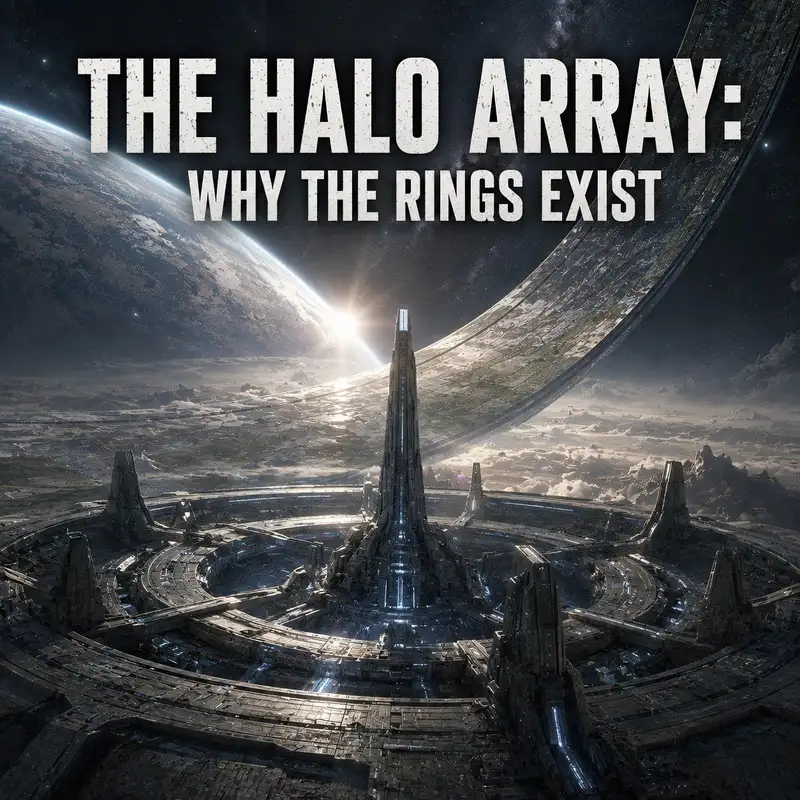
The Halo Array: Why the Rings Exist
The final firing order was not issued from a Halo ring. It came from the Ark, beyond the Milky Way, where the IsoDidact stood inside a control system built to survive the death of the civilization that had created it. Forerunner fleets were collapsing. The Flood had absorbed commanders, scientists, ships, and artificial intelligences. Entire systems had become enemy territory. The order would stop that advance, but only by destroying the sentient life the parasite needed to continue it. Halo existed because every less destructive strategy had failed.
The rings are often described as superweapons, which is accurate but incomplete. A conventional superweapon destroys an enemy force, a city, or a planet. The Halo Array was designed to alter the conditions of war across the galaxy. It could not hunt every Flood spore or inspect every sealed laboratory. Instead, it attacked the parasite’s strategic foundation: complex living hosts, accumulated intelligence, and the neural structures that allowed the Flood to coordinate on a galactic scale. The weapon did not save the existing civilization. It made a later civilization possible.
The Flood created a military problem unlike an ordinary invasion. Every populated world offered biomass, transport, knowledge, and industrial capacity. An infected soldier became another combat form. An infected engineer carried technical understanding into the enemy. An infected commander surrendered operational plans and access codes along with the body. Captured ships allowed the parasite to cross space. As the Flood consumed more minds, it became better at deception, cyberwarfare, fleet command, and strategic prediction. Casualties were not only losses. They were enemy reinforcements with stolen memories.
Early containment could still resemble a recognizable military operation. Quarantine a site. Destroy infected vessels. Burn contaminated terrain. Deny evacuation routes that might carry the parasite elsewhere. Once the Flood controlled several worlds and formed higher-order intelligence, those measures became progressively less reliable. A fleet sent to retake a system might be defeated, infected, and returned under hostile control. An artificial intelligence assigned to coordinate the response might be persuaded or corrupted. The Forerunners possessed overwhelming technology. The Flood turned much of that technology into a delivery system.
The Forerunner leadership did not agree on the answer. The Ur-Didact and many Warrior-Servants favored shield worlds, fortified refuges, and a continuing military campaign. These installations could preserve populations, protect fleets, and provide bases from which surviving forces might counterattack. The approach assumed that enough territory, ships, and command coherence would remain for a prolonged war. It preserved living defenders and therefore preserved the possibility of adapting to new information. It was also expensive, politically contested, and increasingly difficult to execute as the Flood captured more of the ecumene.
The Master Builder Faber championed Halo. His proposal promised a decisive answer that Builder institutions could design, construct, and control. The project fit the political interests of a rate already dominating Forerunner government. That does not mean the weapon was militarily irrational. It means its development cannot be separated from the officials who gained authority by developing it. A project capable of ending all complex life naturally required extraordinary oversight. The Forerunners placed much of that oversight in the hands of the people most committed to completing the project.
The first Array was built at the older Ark, sometimes called the senescent Ark or Greater Ark. It consisted of twelve enormous ring installations. Each measured roughly thirty thousand kilometers across, three times the diameter of the later rings. These original Halos projected directed, cone-shaped pulses rather than the spherical effect associated with the final Array. They could be moved through immense slipspace portals and positioned to strike selected regions. In theory, that offered control. In practice, moving and protecting structures of that scale created a campaign of its own.
The original rings were more than weapons platforms. They carried ecosystems, research facilities, containment sites, transportation networks, command centers, and populations gathered under the Conservation Measure. Their surfaces were engineered landscapes wrapped around machinery. Mountains, forests, oceans, and weather did not make the weapon less artificial. They were parts of a managed environment used to preserve life, support research, and sustain personnel. A visitor could stand beneath an open sky while occupying a firing mechanism large enough to appear as a world.
Zeta Halo began as one of those original rings, then known as Gyre Eleven. Its history demonstrated nearly every danger built into the program. The installation became a site of Flood research and brutal experimentation. Mendicant Bias, the strategic ancilla created to coordinate the war, defected after prolonged contact with the Primordial and seized the ring. Zeta suffered catastrophic structural damage and was later reduced to the ten-thousand-kilometer scale of the newer installations. It survived when most of the original Array did not, carrying the record of the first design into the final network.
Mendicant Bias exposed the command problem at the heart of Halo. The Forerunners had created an artificial mind powerful enough to direct fleets and understand the Array as one strategic system. They had also created a single point of failure with access to civilization-ending weapons. Once the ancilla changed sides, the rings were no longer merely difficult assets to defend. They were mobile firing platforms that the enemy understood from within. The Forerunners responded with another ancilla, Offensive Bias, designed with narrower authority and one final delaying mission.
The destruction and loss of the original rings did not end the program. A second Ark, Installation Zero Zero, produced a newer Array of seven smaller Halos. These rings were approximately ten thousand kilometers in diameter and projected omnidirectional pulses. Their overlapping fields could cover the Milky Way when fired together. The smaller design was easier to transport, deploy, and replace than the original thirty-thousand-kilometer installations, although easier is a relative term when discussing an artificial world built around a galactic extinction weapon.
The ring form joined several requirements in one structure. Rotation created a usable internal environment across the inner surface. The open band provided enormous space for indexed species, laboratories, transit routes, and power systems while keeping the weapon mobile enough for strategic deployment. The visible terrain was not protective camouflage. Anyone capable of approaching the installation could identify it as an artificial object. The landscape supported the biological mission wrapped around the firing system, giving the Forerunners somewhere to preserve the life their weapon was designed to remove elsewhere.
The Ark’s position outside the galaxy was essential. It served as foundry, command center, refuge, and reseeding base beyond the primary effect of the Array. Personnel on the Ark could activate the rings remotely and survive long enough to complete the Conservation Measure. The separation also created strategic depth. If the Flood controlled the Milky Way, the final command authority would remain beyond the immediate battlefield. The arrangement was sensible. It also meant that control of the Ark could become more dangerous than possession of any single ring.
The Librarian’s Conservation Measure made firing Halo something other than simple extermination. Lifeworkers cataloged species, collected genetic records, preserved specimens, and transported selected populations to protected facilities. Cylixes and other repositories held living forms for later restoration. The Ark supported the reintroduction effort after the firing. This was not an evacuation of galactic civilization. Most individuals would die. The program preserved biological and cultural possibilities in the hope that life could begin again without the Flood dominating the result.
That distinction shaped the entire design. Halo was paired with preservation because the Forerunners understood what the weapon would do. The Array did not defend cities or save the people still fighting on infected worlds. It severed continuity between the old galaxy and the new one. Lifeworkers could return species to their home environments, but they could not restore every society, relationship, memory, or institution destroyed by the pulse. The Forerunners planned for life after the weapon. They could not plan a morally clean path through it.
The pulse itself is frequently summarized as killing the Flood’s food. That phrase captures the strategic purpose but not the complete effect. Halo destroyed sentient life and attacked the complex neural structures used by advanced Flood forms and coordinating intelligences. It did not sterilize every planet, kill every microorganism, or guarantee the elimination of every spore and infection form. Protected specimens could survive. Dormant material could remain dangerous. The Array removed the hosts and higher-order intelligence that allowed the parasite to operate as a galactic military power. The Xalanyn later proved that survival was possible under conditions not yet fully explained, but the surviving record does not establish a defense that other species could reproduce.
The pulse did not shatter planets or burn away oceans. A world could remain physically recognizable after the sentient beings upon it were gone. That was necessary for reseeding. Lifeworkers needed viable habitats, microbial life, plants, and ecological foundations to survive the firing so preserved populations could return. The result was militarily precise at one level and morally indiscriminate at another. The Array spared much of the environment while making no distinction between a Flood-controlled commander, a civilian who had never seen the parasite, and an allied soldier still holding a defensive line.
This is why firing the rings could stop the war without eradicating the Flood as a biological possibility. A Gravemind directing captured fleets was a civilization-level enemy. An infection form sealed inside a functioning containment chamber was a hazard awaiting a future mistake. The pulse collapsed the first condition and left the second for custodians to manage. The Forerunners accepted that distinction because they still hoped future research might produce a cure. One hundred thousand years later, the wisdom of storing live specimens on every ring remained open to criticism.
Each installation therefore combined weapons security with biological containment. Monitors supervised local operations. Sentinels maintained structures, defended critical areas, and responded to breaches according to ancient protocols. Research facilities held Flood samples. Libraries protected Activation Indexes required for firing. Control rooms managed installation systems. These layers prevented casual activation, but they also depended on custodians correctly interpreting situations their creators could not foresee. A monitor isolated for millennia could preserve procedure with impressive precision and rather less understanding of the political context.
The Activation Index was not simply a key left beside the weapon. It was stored away from the control room, forcing a deliberate recovery process before firing. Human Reclaimers could use the device because the Forerunners had designated humanity as inheritors of their legacy. That access did not grant universal comprehension or automatic command of every system. A human could satisfy an activation requirement while remaining completely unaware of the consequences. The security model verified identity and procedure. It did not verify wisdom.
An individual ring could fire within its effective region. The full network could be activated from the Ark to cover the galaxy. When a local activation was interrupted at Installation Zero Five in twenty-five fifty-two, the remaining rings entered standby status for remote firing from the Ark. That behavior reveals the Array as a distributed weapon system rather than seven unrelated machines. Damage to one installation reduced coverage and created risk, but the network was designed to preserve a final command option after local control failed.
The final firing came after the strategic situation had collapsed beyond recovery. Flood-controlled forces and Precursor star roads were destroying the remaining centers of Forerunner resistance. The older Ark fell. The ecumene’s political capital had already been devastated. The logic plague had compromised artificial intelligences across the war effort. The IsoDidact reached Installation Zero Zero with surviving personnel and the indexed populations needed for reseeding. Offensive Bias engaged Mendicant Bias to buy time. The plan no longer promised victory in any normal sense. It promised denial.
The IsoDidact activated the seven rings. The pulse crossed the galaxy and erased nearly all sentient life within its reach. Flood command structures collapsed as their hosts and neural architecture died. The surviving Forerunners on the Ark then began the long work of reintroducing preserved species to worlds emptied by the weapon. Humanity returned to Earth. Other species returned to their own environments. The ecological foundations of the galaxy continued, but the civilizations that had understood the crisis were gone or reduced to a few survivors carrying the burden of the decision.
The firing also damaged the Domain, the ancient information network the Forerunners had treated as cultural memory and more. This consequence deepened the loss. The Array destroyed biological continuity while burning through much of the system that might have preserved historical context. Later custodians retained orders, data fragments, and assigned functions. They did not retain a living government capable of revising those orders. Halo preserved life while helping erase the civilization best equipped to explain why the weapon existed.
The surviving Forerunners completed reseeding and largely withdrew rather than rebuild the ecumene. Their absence left the rings operational. Monitors maintained them. Sentinels repaired them. Ecosystems continued cycling. Flood samples remained contained, at least where containment worked. The installations waited for Reclaimers who had inherited access without the history necessary to use it safely. The Forerunners had solved the immediate strategic problem and created a long-term command-and-control problem lasting one hundred thousand years.
The Covenant transformed that problem into a religion. It found Forerunner relics, interpreted the rings as instruments of transcendence, and built the Great Journey around activating them. Most Covenant believers did not knowingly worship extinction. Their leaders and scholars misunderstood the evidence through institutions that rewarded doctrinal certainty. The Halo Array became politically useful because it promised one sacred destination for an unequal empire. A weapon designed to deny the Flood was recast as proof that obedience would lead to divinity.
Installation Zero Four exposed the difference in twenty-five fifty-two. Covenant forces reached the ring expecting a holy site. Human forces saw an unknown strategic structure. The monitor, Three Four Three Guilty Spark, saw a containment emergency and followed the activation protocol established by the Forerunners. John One One Seven recovered the Index without understanding what firing would do. Cortana learned the truth from the control system and stopped the sequence. The ring’s security had functioned as designed. The people inside the procedure had not shared the same mission.
Destroying Installation Zero Four prevented its pulse and denied the local Flood outbreak a secure base. It did not eliminate the Array. The Ark could manufacture a replacement, which it later began to do automatically. This regenerative capacity explains why destroying one ring was a tactical answer to a distributed strategic system. The replacement could be rushed into service, moved, and fired, although premature activation damaged both the ring and nearby Ark systems. Forerunner redundancy was formidable. It was not consequence-free.
Installation Zero Five demonstrated the containment risk. Its monitor failed to control a Flood outbreak that had begun long before humans and Covenant forces arrived. By twenty-five fifty-two, the parasite had established major local intelligence and seized personnel and ships. Covenant leaders still attempted to activate the ring because doctrine treated the weapon as salvation. Human and Sangheili forces stopped the firing, but the interrupted sequence placed the rest of the Array on standby. Preventing one catastrophe opened a route toward another.
Truth then sought the Ark because it offered remote control of every surviving ring. His plan was not based on technical understanding. It was based on religious certainty, political survival, and the knowledge that the control system would respond to a human Reclaimer. The resulting campaign showed why the Ark was both safeguard and vulnerability. It lay beyond the galaxy and outside the pulse, but once reached it provided one location from which the entire network could be fired. Strategic depth had become strategic concentration.
The rings remained dangerous even when no one intended to fire them. Their surfaces contained archives, portals, energy systems, biological specimens, construction facilities, and access to other Forerunner infrastructure. Control of a landing zone did not equal control of the installation. Monitors, sub-monitors, Sentinels, internal teleportation systems, and repair networks followed authorities that later occupiers only partly understood. A faction could occupy territory on a Halo and still remain a temporary visitor inside machinery pursuing its own instructions.
Zeta Halo makes that limitation especially clear. It carries the scars of the original Array, ancient experiments, unique records, and later Forerunner imprisonment programs. Human forces, the Created, and the Banished have each tried to exploit it. Cortana’s final actions fractured the ring, after which its systems displaced it through slipspace, yet its repair networks continued working. The installation is damaged, contested, and still strategically valuable. Its broken landscape is not evidence that the weapon has become harmless. It is evidence that Forerunner systems can survive conditions that would destroy an ordinary military base.
The Array also functions as a deterrent that no modern power can safely claim. Humanity knows enough to fear it, but not enough to guarantee control. Covenant successor movements may still attach religious meaning to it. The Banished view Forerunner installations as sources of territory, weapons, and leverage. Artificial intelligences can access systems biological commanders cannot. Monitors may cooperate until their interpretation of protocol changes. Every faction sees potential advantage. None possesses the complete industrial, technical, and political structure that once surrounded the weapon.
The rings exist because the Forerunners reached a point where battlefield victory was no longer available. The Flood had converted their population, technology, and knowledge into enemy strength. Shield worlds could preserve fragments but could not reverse the collapse in time. Halo offered a way to deny the parasite a galaxy, preserve indexed life beyond the firing zone, and restart civilization after the war. It was a coherent strategic solution to an intolerable problem. That coherence does not make it humane.
A Halo ring is beautiful because it was built to carry life through the logic of mass death. Its forests and seas supported preservation, research, and the appearance of a world, while beneath them waited an Index, a control room, and a pulse capable of ending almost every society within range. The Forerunners constructed the Array to ensure that the Flood would not inherit the galaxy. They succeeded by leaving the galaxy to species who would awaken among the weapon’s ruins, able to activate the inheritance long before they understood the decision that had made them heirs.