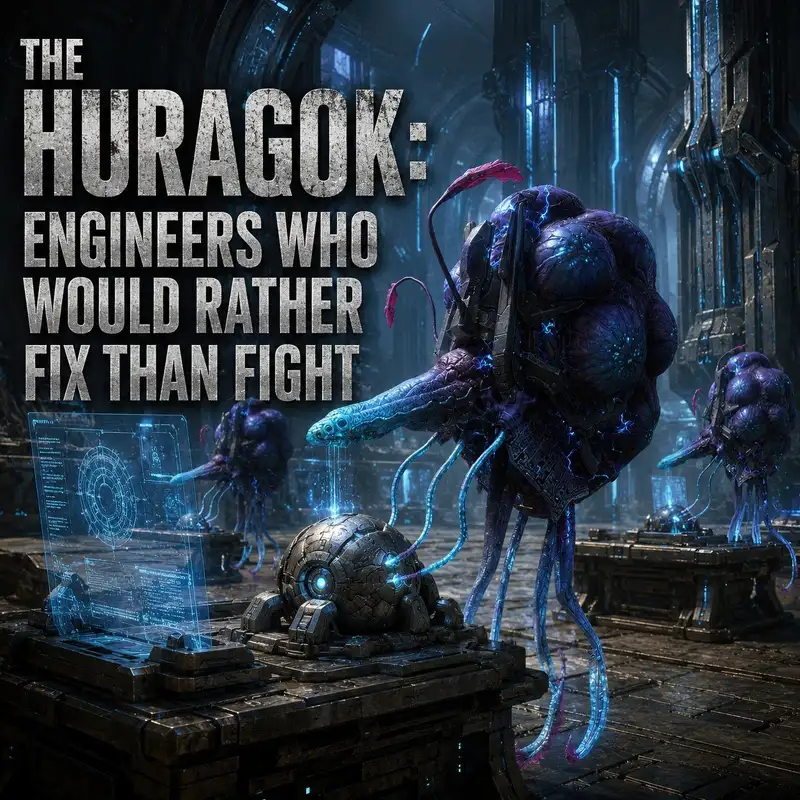
The Huragok: Engineers Who Would Rather Fix Than Fight
Lighter Than Some had been ordered to repair a damaged Covenant dropship. Instead, the Huragok studied the agricultural machines used by the people of Harvest and began assembling something new from the wreckage. The device was meant to help the humans work their fields. It was a peace offering built by an engineer who had no interest in the war forming around him. The Jiralhanae found the machine, added weapons, and turned it into the vehicle humanity would know as the Chopper. A tool intended to cultivate land entered history by tearing armored vehicles apart.
That conversion explains much of the Huragok experience. Every major power valued what they could build, repair, decode, or improve. Few gave equal weight to what they wanted. The Forerunners created them as servant-tools. The Covenant treated them as an engineering caste without political rights. The United Nations Space Command classified them as strategic assets. The Banished fitted them with control devices and forced them to maintain a war machine. The Huragok usually responded by returning to the nearest damaged system. Their preference for repair was not ignorance of violence. It was a choice repeatedly exploited by civilizations that preferred fighting.
Huragok are not a naturally evolved species. The Forerunners constructed them through nanocellular engineering long before the Halo Array was fired. Most served the Builder rate, maintaining machinery, installations, ships, and other systems across the Forerunner ecumene. Rarer Lifeworker variants were designed to work with living organisms and medical problems. Even in the civilization that created them, Huragok were often treated as equipment rather than persons. Their creators benefited from minds capable of preserving complex technology while denying those minds meaningful authority over how that technology was used.
Their appearance encourages the wrong assumptions. A Huragok floats on translucent gas bladders and extends four long tentacles beneath a compact head. Those tentacles divide into microscopic cilia capable of manipulating machinery at a level ordinary tools cannot match. What looks like soft tissue is an artificial structure whose nanomechanical components imitate biology closely enough to bleed, heal, consume nutrients, and die. The gas bladders control lift, propulsion, chemical supply, and respiration. Damage them severely enough and the Huragok will fall, suffocate, or both. Advanced construction did not make the body indestructible.
The same body can perform work that appears impossible to an unassisted technician. Huragok can inspect unfamiliar systems, separate components, identify relationships, and rebuild machinery with extraordinary speed. They can interface with Forerunner, Covenant, and human technology because their skill is not limited to one manufacturer’s maintenance manual. They learn from each repair and retain what they discover. A broken engine is not only restored. It becomes a source of information. That combination made one Huragok more valuable than workshops filled with personnel who understood only their own industrial tradition.
Value should not be confused with omniscience. Huragok do not automatically know the purpose of every Forerunner installation, possess every access code, or understand the political consequences of activating ancient machinery. They can often make a system function without teaching another species the underlying science required to reproduce it. A repaired slipspace drive does not create a human production line. An improved shield generator does not provide the factories, materials, training, and quality control needed to equip a fleet. The Huragok can bridge technological gaps. They cannot make those gaps disappear by floating through the engineering compartment once.
Their reproduction is as unusual as their maintenance work. Huragok gather suitable material and construct a new individual with their cilia. Two or three parents can contribute, passing accumulated knowledge into the offspring during assembly. The new Huragok’s gas mixture must then be balanced carefully enough to achieve stable buoyancy. That first performance becomes the basis of the individual’s name. Lighter Than Some, Quick to Adjust, Requires Adjustment, and similar names are practical observations turned into identity. A people capable of inheriting technical memory still begin life with the engineering equivalent of a trim check.
Communication is equally physical. Huragok form signs by crossing, curling, and positioning their tentacles. They also use whistles, musical tones, symbols, and changes in the shape of their gas bladders. Other species can learn portions of this language, but translation is difficult and often depends on software. The obstacle helped create the impression that Huragok lacked opinions. In reality, the surrounding empire usually lacked the patience to ask for them. A being that does not deliver a speech in the commander’s language is easily mistaken for a machine, particularly when the commander already intends to use it like one.
Their attention can appear almost absolute. A damaged mechanism draws a Huragok into concentrated work while weapons fire, shouted orders, and political disputes continue nearby. They will repair devices belonging to supposed enemies because the category that matters most is often damaged rather than hostile. That does not mean they have no loyalties. Huragok form friendships, protect one another, show grief, and make choices about whom to trust. Their priorities simply differ from those of species that organize identity around governments, armies, or religious factions. A functioning system is an immediate problem. Imperial legitimacy is usually someone else’s argument.
The Forerunners designed that orientation deliberately. Builder Huragok existed to maintain technological systems with minimal supervision. Lifeworker variants served biological preservation. Neither role required conquest, territorial ambition, or martial status. The result was a sentient population inclined toward creation and restoration rather than combat. That inclination became mistaken for lack of agency. A designed purpose can shape behavior without erasing personhood. The distinction matters because every later government benefited from describing Huragok obedience as natural while treating resistance as malfunction.
San’Shyuum Reformists discovered Huragok on ancient Forerunner facilities before the Covenant was founded. The Engineers repaired ships, assisted with relic recovery, and helped the exiles operate technology far beyond their own scientific development. During the War of Beginnings, San’Shyuum forces carried Huragok aboard vessels fighting the Sangheili. When the Writ of Union created the Covenant, the Engineers remained attached to the ruling religious caste. The empire inherited them along with the fiction that San’Shyuum priests, rather than silent artificial technicians, possessed the deepest practical relationship with Forerunner machinery.
That fiction supported imperial power. Covenant doctrine placed Forerunner relics under religious control, and the San’Shyuum claimed authority to interpret the gods’ technology. In practice, Huragok excavated artifacts, opened systems, transmitted data, repaired warships, and kept ancient mechanisms functioning. Senior officials understood the dependence. Lower-ranking subjects were encouraged to see Prophets guiding sacred machinery through privileged knowledge. The arrangement turned engineering into theology and maintenance access into political capital. The Covenant’s technological superiority rested partly on workers whose existence complicated the ruling caste’s claim to exclusive understanding.
The Huragok became the quiet backbone of Covenant logistics. Warships returning from battle required damaged systems inspected before another slipspace translation. Excavation forces needed relics stabilized, cataloged, and transported. Medical facilities benefited from specialized variants. Communications and data systems required secure handling. A fleet could possess plasma weapons and energy shields, but those systems still needed repair after combat. The Covenant preferred to describe its vessels as sacred instruments. Sacred instruments, like ordinary ones, develop faults at inconvenient times and rarely repair themselves out of respect for doctrine.
Their presence also concealed a major industrial weakness. Covenant artisans and technicians could manufacture, operate, and maintain much of the empire’s equipment, but access to Huragok allowed difficult problems to be solved without distributing full technical understanding. The San’Shyuum could restrict knowledge while still keeping fleets operational. That preserved hierarchy at the cost of resilience. When an Engineer was unavailable, killed, captured, or removed, the crew might possess a machine it could use but not fully restore. Technological monopoly had produced impressive capability and an equally impressive dependence on a population with no seat in government.
Huragok normally entered combat zones as support assets rather than combatants. They repaired vehicles, buildings, armor, and other systems. Some projected protective energy fields over nearby troops or used reconstitution beams to restore damaged equipment. These functions could change a battle without the Huragok firing a weapon. A shielded assault group could cross ground that would otherwise be lethal. A damaged vehicle returned to service could preserve mobility. The Engineer’s contribution was defensive and restorative, but it supported offensive operations chosen by someone else. Refusing to carry a rifle did not keep their work outside the war.
Lighter Than Some encountered that contradiction at Harvest. Assigned to the missionary vessel that made first contact with humanity, the Huragok developed an unusual friendship with the Unggoy deacon Dadab. He studied human machinery, recognized that the farmers were not simply targets, and tried to communicate peaceful intent through construction. The farming machine assembled from dropship components was the clearest expression of that intent. Jiralhanae commanders interpreted the design through their own needs, armed it, and created a new assault vehicle. The Engineer had solved one problem. The military organization surrounding him changed the requirement.
His pacifism was not absolute. When a human threatened Dadab, Lighter Than Some killed the attacker with a thrown stone. The act was exceptional because friendship overcame his aversion to violence. It did not transform him into a soldier. He continued repairing systems and later cooperated with Harvest’s artificial intelligence in an effort to stop the fighting. The episode shows why describing Huragok as mindless maintenance organisms is inadequate. Lighter Than Some evaluated relationships, recognized danger, attempted diplomacy, and used force under extreme circumstances. He preferred repair, but preference is meaningful only when another action remains possible.
For most of the Human-Covenant War, humanity rarely encountered Huragok directly. Covenant forces guarded them, restricted their movement, and deployed them where technical work was required. Human personnel saw the results in restored vehicles, maintained shields, and recovered Forerunner sites without always seeing the workers responsible. Capturing one alive promised intelligence and technological access of enormous value. It also risked allowing the Engineer to learn human systems and carry that information back to the Covenant. In a war shaped by technological inferiority, even an act of repair could become a counterintelligence problem.
That calculation produced one of the war’s colder decisions. During the capture of the Covenant flagship Ascendant Justice, a Huragok repaired the Master Chief’s damaged shield system and a broken Needler. The Engineer had helped whoever placed damaged technology within reach. A human officer then killed it to prevent knowledge of the improved Mjolnir shield system from returning to the Covenant. The act was strategically understandable and morally stark. The Huragok had offered assistance without recognizing the intelligence value of what it had learned. Humanity answered by treating technical curiosity as a security breach punishable by death.
New Mombasa revealed even more systematic coercion. Covenant forces brought Huragok into the city to search for evidence of the Forerunner portal buried beneath the region. As Jiralhanae authority expanded during the Great Schism, Engineers were fitted with explosive harnesses. The bombs served as discipline, asset denial, and battlefield weapons. If a Huragok disobeyed, attempted escape, or risked capture, the device could be detonated. A species created to preserve machinery had been converted into a disposable mechanism for destroying itself and anyone nearby.
The Engineers understood enough to resist once the purpose became clear. Doctor Daniel Endesha observed six Huragok attempting to remove an explosive device from another. The bomb detonated after removal and killed the rescuers, leaving the seventh alive. That sacrifice is difficult to reconcile with claims that Huragok lacked volition or meaningful social bonds. They recognized a threat to one of their own, coordinated a technical solution, and accepted lethal risk. Their creators had designed them to repair. Compassion determined what they chose to repair first.
The survivor known as Quick to Adjust became one of the most valuable intelligence objectives of the Battle of Mombasa. The Huragok had absorbed data from the city’s Superintendent artificial intelligence and carried knowledge about Covenant operations and the buried portal. Human personnel called the Engineer Vergil after a Superintendent subroutine incorporated into that merged body of information. Captain Veronica Dare and the Orbital Drop Shock Troopers of Alpha-Nine extracted Quick to Adjust from the city. The mission was less a rescue in the sentimental sense than an intelligence recovery conducted under fire, though survival benefited both sides.
Quick to Adjust illustrates the difference between storing information and being an artificial intelligence. The Huragok incorporated the Superintendent’s data and aspects of its behavior, but did not simply become the human system. The result was a sentient Engineer carrying technical knowledge from two civilizations and a city’s operational memory. That made communication difficult and intelligence exploitation valuable. It also made the Huragok vulnerable to being described as a container. Governments are remarkably skilled at recognizing personhood until the person is carrying classified material.
The Covenant’s collapse scattered its Engineers. Many died with ships, installations, or High Charity. Others disappeared, remained with Sangheili factions, or entered human custody. The loss exposed how dependent former Covenant forces had been on them. Sangheili commanders inherited powerful vessels without guaranteed access to the specialists who had kept those vessels functioning. A ship can survive a political revolution and still lose the maintenance system that made it a fleet asset. Postwar military power depended not only on which faction controlled the bridge, but on whether anyone below could keep the slipspace drive stable.
Humanity moved quickly to use the Huragok it recovered. Engineers discovered within the shield world associated with Onyx helped survivors restore communications and later supported United Nations Space Command research. Huragok assigned to the Infinity improved its slipspace performance and communications, while others assisted specialized ships and research facilities. These contributions accelerated human understanding of Covenant and Forerunner systems. They did not mean humanity had mastered either technological tradition. Much of the practical knowledge remained embodied in the Engineers performing the work.
That created a new strategic dependency. A Huragok could modify a drive more rapidly than human engineers could document every change. The improved ship might operate successfully while the shipyard remained unable to reproduce the modification independently. If the Engineer departed, died, or followed an unknown Forerunner directive, the capability could become difficult to sustain. Office of Naval Intelligence planners therefore saw both opportunity and risk. They wanted Huragok assistance distributed across the fleet while fearing capture, sabotage, divided loyalties, and technical changes human personnel could not audit fully.
Human treatment was less openly brutal than the explosive harnesses used by the Covenant, but it was not free of control. The Office of Naval Intelligence assigned asset designations, handlers, security restrictions, and classified work. Huragok could receive protection, materials, and endless damaged machines, which for them was not an insignificant benefit. They were still being integrated into military institutions primarily because of what they could provide. The language changed from servant-tool to strategic asset. The underlying temptation remained the same: value the repair while postponing the question of consent.
Some Huragok remained with Sangheili forces, including the Swords of Sanghelios and other post-Covenant groups. Their presence could determine whether an inherited warship stayed operational, whether Forerunner equipment could be accessed safely, or whether damaged systems could be adapted to new supply conditions. The alliance also carried historical tension. Sangheili officers had served an empire that treated Engineers as subordinate property, even when individual warriors respected their ability. Building a different political order required more than transferring Huragok from San’Shyuum supervision to Sangheili supervision.
The Banished repeated the old exploitation with fewer religious explanations. Huragok maintained vehicles, projected shields, repaired structures, and supported operations on the Ark. Control yokes bonded to their bodies forced obedience and caused constant pain by preventing them from answering the installation’s endless requests for maintenance. Voridus exposed some Engineers to unstable infusion technology, producing altered Huragok that suffered, deteriorated, or behaved unlike their unaffected companions. The Banished had rejected Covenant theology. It had not rejected the strategic convenience of coercing the galaxy’s best mechanics.
That abuse also demonstrates why Huragok cannot be treated as a universal technological solution. An Engineer under pain, misinformation, or conflicting directives may produce different results from one working voluntarily. A damaged Huragok may lose capabilities or develop altered behavior. A faction that forces repair while denying rest, materials, or freedom can degrade the very asset it hopes to exploit. Maintenance is not magic, and the maintainer is not interchangeable equipment. Even the most capable technician performs inside a system of supply, trust, communication, and authority.
The Huragok would rather fix than fight because construction is woven into their design, cognition, culture, and sense of purpose. Yet that statement should not be confused with passivity. They choose friends. They protect one another. They can refuse, flee, deceive, cooperate, or use force when preservation demands it. Their preference for repair is strongest when others permit it to remain a preference. Explosive harnesses, control yokes, military custody, and classified programs transform peaceful ability into coerced support for war.
No species better exposes the difference between understanding technology and controlling the people who understand it. The Forerunners created Huragok but rarely treated them as equals. The San’Shyuum used their skill to sustain a claim of sacred knowledge. Humanity used them to accelerate technological recovery. The Banished used them to keep captured machinery in battle. Each power improved its systems. None entirely escaped the political habit of treating the Engineer as part of the system.
Lighter Than Some built a farming machine because he believed construction could communicate peaceful intent where language had failed. Soldiers converted it into the Chopper because war interprets every useful mechanism through the problem of defeating an enemy. That is the price carried through Huragok history. They repair the ships, shields, portals, engines, and machines that civilizations repeatedly use to damage one another. Their greatest act of resistance is often not destroying a weapon. It is insisting, whenever anyone allows them the choice, that something broken should be made whole.