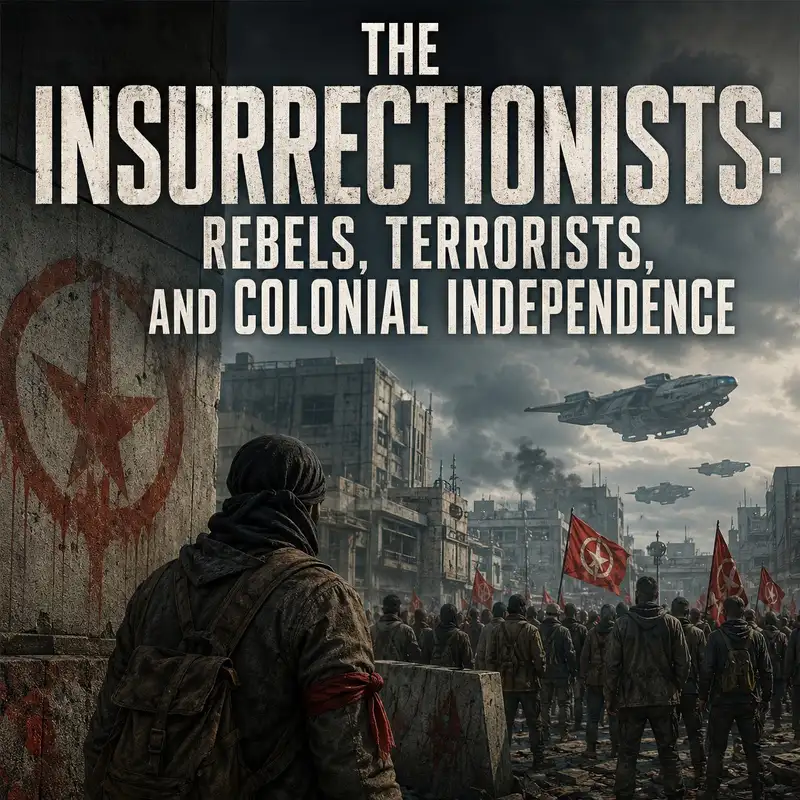
The Insurrectionists: Rebels, Terrorists, and Colonial Independence
The search found no contraband. It still left thirty people dead. In early twenty-four ninety-four, the United Nations Space Command corvette Callisto stopped a merchant vessel in the Twenty Six Draconis system and sent a boarding party across. The crew had heard rumors that similar inspections ended in impressment. Nervous people reached for weapons, trained personnel answered, and the cargo hold became a killing ground. Three naval officers and twenty-seven merchant crew members died. The ship carried none of the material the patrol sought. For the government, the deaths showed how quickly colonial suspicion could turn lethal. For the surrounding colonies, they showed what happened when Earth enforced authority through armed searches.
Thirty-seven days later, another merchant ship accepted a Callisto inspection. Its cargo bay was empty. The boarding team was expelled into space, armed men seized the corvette, and the remaining crew was killed. The captured ship became a rebel warship, its computer system gutted and replaced, then turned against the force that had operated it. A dispute over trade controls had become piracy, murder, and naval combat. The Callisto Incident is often treated as the beginning of the Insurrection because it compressed the entire conflict into one sequence: a legitimate security concern, a coercive government response, civilian fear, an atrocity by insurgents, and an escalation neither side could easily reverse.
The word Insurrection suggests one rebellion directed by one leadership. Halo’s historical record describes something far less convenient. The Insurrection was an undeclared civil war between the Unified Earth Government and numerous separatist, revolutionary, terrorist, and criminal organizations operating across human space. Some groups sought constitutional independence. Some wanted local control over taxes, resources, policing, or trade. Some organized armed resistance against military occupation. Others deliberately attacked civilians. Many existed only on one planet or inside one labor movement, while larger alliances tried to connect them. Calling all of them Insurrectionists simplified military reporting. It did not create common ideology, discipline, or command.
Their grievances grew from the design of human expansion. Many Outer Colonies produced food, minerals, and other resources for Earth and the wealthier Inner Colonies. Their economies depended on shipping networks, imported machinery, and decisions made far beyond local political reach. Slipspace allowed interstellar travel, but it did not make administration immediate or representation equal. Colonists watched officials invoke the survival of the whole human system while local workers carried the risks of mining, agriculture, and frontier transport. Independence became attractive because distance made centralized authority feel less like common government and more like external management.
The earliest organized separatists did not begin by detonating bombs. In twenty-four eighty-seven, the Secessionist Union and the People’s Occupation submitted sovereignty demands on behalf of a dozen worlds. The Unified Earth Government refused. That strengthened those who argued Earth would never permit lawful separation. Peaceful activists now had to explain what negotiation had achieved. Armed organizers could present sabotage or revolt as the only practical route. A government may believe granting one colony independence will trigger many more departures. Colonies may interpret the same refusal as proof that membership is compulsory. Both positions can be strategically rational and politically incompatible.
Earth’s interests were more substantial than wounded pride. Outer Colony agriculture fed major populations. Colonial mines supplied industry. Shipping lanes connected settlements that could not sustain advanced economies alone. Materials used in slipspace technology could not circulate without control once armed groups began seeking ships and strategic weapons. A breakaway system might shelter raiders, interrupt commerce, or encourage neighboring worlds to leave. From the government’s perspective, fragmentation threatened the interstellar economy. From the frontier’s perspective, that argument meant their resources were indispensable while their consent was optional. The conflict was about who could decide the terms of an interdependent civilization.
The government’s worst answer arrived before the Callisto was captured. In twenty-four ninety-two, rebellion on Far Isle resisted conventional suppression. The United Nations Space Command used nuclear weapons and razed the colony, leaving no known survivors. The available record does not provide a complete public account of the uprising, the target process, or the alternatives considered. It does establish the result. A human government annihilated one of its own communities in order to end resistance. Far Isle became an enduring source of anger because it transformed separatist warnings into demonstrated possibility. Rebel propagandists did not have to invent a massacre. They only had to tell people that the government had classified one.
Far Isle does not excuse what insurgent organizations did afterward. It explains part of the environment in which recruitment became easier. A population can possess legitimate grievances without making every act committed in its name legitimate. The Freedom and Liberation Party demonstrated that in twenty-five eleven, when an affiliated terrorist detonated a commercial nuclear explosive inside the Haven arcology on Mamore. Two million people were killed and more than eight million were injured. The group demanded the withdrawal of colonial military forces from the Eridanus sector. Whatever political objective the attackers claimed, the method treated civilians as instruments. That was terrorism in the clearest military and moral sense.
Between Far Isle and Mamore stood a wide range of organizations. The Secessionist Union combined political demands with guerrilla cells and efforts to seize colonial governments. The United Rebel Front eventually linked multiple rebel networks across several systems. The Sundered Legion fought a prolonged local struggle on Meridian. Other movements remained planetary, ideological, commercial, or criminal. Defectors brought military experience. Smugglers brought routes and false manifests. Workers provided information on ports and factories. Merchants moved weapons beside legitimate cargo. Opportunists joined because rebellion offered profit or protection. A cell might be deeply rooted in its community, while another group using the same language had no meaningful civilian mandate at all.
Colonel Robert Watts illustrates why the Insurrection could not be dismissed as amateur unrest. Watts had served as a respected officer in the United Nations Space Command Marine Corps before becoming disillusioned and defecting. On Eridanus Two, he helped turn separatism into organized armed revolt. His forces used bombings, assassinations, kidnappings, sympathetic officials, and an improvised fleet to seize effective control of the colony in the mid twenty-four nineties. The struggle was not only rebels against Earth. It also placed separatists against the recognized Eridanus government, local loyalists, and colonists who did not want their world made into a revolutionary base. Colonial independence movements could reproduce the same coercion they accused Earth of using.
Operation Charlemagne retook Eridanus Two in twenty-four ninety-six, but victory cost four destroyers and failed to eliminate the movement. Surviving rebels withdrew into the system’s asteroid belt, where hidden facilities and civilian traffic made them difficult to locate. That geography favored insurgency. A hollowed asteroid did not need to defeat the fleet in open battle. It needed concealment, repair capacity, sympathetic shipping, and enough warning to scatter before a stronger force arrived. The government could hold the planet and still fail to control the system. Orbit contained freighters, habitats, rocks, debris, and more hiding places than any inspection force could search.
The Callisto engagement showed what even a small rebel naval force could achieve. Three destroyers were sent to recover or destroy the captured corvette. The insurgents used an asteroid and a prepositioned nuclear weapon to break the incoming missile attack, destroying one government ship and badly damaging the others. Preston Cole eventually disabled the Callisto through deception and close-range action, but the cost was severe. Insurgent fleets were usually improvised and outmatched in sustained combat. They could still exploit local terrain, civilian hulls, surprise, and rules the regular Navy was expected to obey. A weaker force did not need command of space. It needed to make routine patrol, inspection, and reinforcement expensive enough to change political behavior.
Rebel penetration of the Colonial Military Authority made the problem worse. Sympathizers supplied weapons, ships, and information, while agents occupied positions inside the organization responsible for frontier security. When the network was exposed, the central government accelerated the transfer of authority from colonial military institutions to the United Nations Space Command. The reform improved centralized control and reduced confidence in local forces considered compromised. It also removed a layer of colonial identity from security operations. Frontier populations increasingly encountered a military associated with Earth rather than an institution staffed and shaped by the colonies themselves. The government solved a counterintelligence problem and deepened a legitimacy problem at the same time.
Intelligence planners came to believe that the conflict could expand into a civil war capable of destroying human civilization. Doctor Elias Carver’s projections encouraged rapid military intervention and leadership decapitation. Critics argued that diplomacy and political reform still offered alternatives. The armed forces adopted the more dangerous forecast as a planning baseline. This was understandable. Commanders are not rewarded for assuming a crisis will remain manageable until it does not. Yet the model created its own pressure. Once large-scale rebellion was treated as inevitable, every strike, protest, or separatist demand became evidence that the forecast was correct. Carver later believed his findings had helped produce the disaster they predicted.
The Office of Naval Intelligence and the military responded by expanding covert action. The revived ORION project produced augmented operators for missions against rebel leaders and facilities. In twenty-five oh two, Avery Johnson assassinated Secessionist Union leader Jerald Ander on Harvest. The operation removed an organizer, disrupted his movement, and created a martyr. That pattern appeared repeatedly. Leadership strikes could produce immediate operational advantage, especially when a faction depended on one experienced commander. They rarely settled the political dispute that had supplied recruits. Remove one leader and a network might collapse, fragment into less disciplined cells, or elevate someone more willing to attack civilians. Counterterrorism success and counterinsurgency success were not automatically the same.
By twenty-five oh nine, surviving cells had consolidated under Watts into the United Rebel Front. The name implied unity, but the organization functioned as an alliance of networks spread across different systems and local causes. That structure provided resilience. Captured members often knew only their immediate task and contacts. Weapons could be manufactured in dispersed bomb shops. Civilian freighters could carry components without resembling a battle fleet. Stolen military craft could be renamed, modified, or hidden among legitimate traffic. The same decentralization limited political control. A central leader could negotiate, but could not always guarantee that every cell would honor an agreement. The movement could survive decapitation more easily than it could produce a single peace settlement.
Operation Trebuchet began in twenty-five thirteen as the government’s broad military answer. It involved naval forces, Marines, intelligence units, raids, blockades, ship searches, ground assaults, and campaigns across multiple systems. The immediate Eridanus fighting pitted a government fleet of carriers, cruisers, and destroyers against roughly one hundred smaller rebel craft while combat continued on the planet below. The regular fleet prevailed, as a regular fleet should have. Watts withdrew surviving forces into the asteroid belt and continued the struggle. Trebuchet could destroy ships and retake installations. It could not inspect every cargo hold, protect every official, or make distant authority legitimate by order.
The campaign became a contest over intelligence and access. Rebels needed safe houses, sympathetic dockworkers, false identities, supply routes, explosives, and warning of approaching patrols. Government forces needed sources who could distinguish militants from political organizers and both from civilians. A warehouse might contain machine parts on Monday and bomb components on Tuesday. A labor leader might oppose Earth, reject terrorism, and still refuse to inform for the military. A family might shelter a fighter from conviction, fear, or obligation. A raid based on incomplete information could kill civilians, alienate a community, and make the next intelligence report worse.
A twenty-five twenty-four strike against bomb makers on Tribute captured the dilemma in miniature. Marines entered to stop attacks. The action ended with rebels and military personnel dead, along with thirty-eight civilians. The objective did not disappear because civilians were present, and the deaths did not become less important because the target was real. Insurgents benefited when military force appeared indiscriminate. Government officials cited the use of civilian infrastructure to justify harder measures. Both sides understood the information effect. Neither controlled it. The population was the political objective, the intelligence network, the recruitment pool, and the group paying for every failed distinction.
The Insurrection reshaped military procurement and doctrine. Patrol craft, carriers, armored vehicles, boarding equipment, artificial-intelligence security protocols, and naval tactics were developed or adapted for war against human opponents who understood human systems. Ships had to inspect commerce without becoming vulnerable to ambush. Boarding parties needed protection in pressurized civilian spaces. Artificial intelligences required safeguards against hostile access methods created by people trained on similar networks. Large carriers were expected to sustain distant interdiction campaigns. The military that later fought the Covenant did not begin that war as a blank institution. Its force structure, secrecy, and operational culture had been sharpened against its own citizens.
No consequence was more important than the Spartan Two program. It was commissioned to defeat the Insurrection, not the Covenant. The children taken in twenty-five seventeen were selected, abducted, replaced with short-lived flash clones, trained, augmented, and equipped to conduct operations that conventional forces could not perform quietly or reliably. The strategic justification was the prediction of catastrophic civil war. The method converted children into instruments of state survival before the alien war began. Their later defense of humanity does not erase their origin. It reveals the central contradiction of the program: a weapon created through profound abuse became indispensable against an enemy its designers had not anticipated.
The Spartans’ first operation in twenty-five twenty-five demonstrated the concept. Blue Team infiltrated Eridanus Secundus and captured Robert Watts alive. Tactically, the mission was extraordinarily effective. It penetrated a hidden stronghold, removed a major commander, and gave the Office of Naval Intelligence access to a valuable prisoner. It also required violence inside a mixed military and civilian settlement. John later remained troubled by the unarmed dockworkers and others killed during the escape. The mission proved that elite forces could solve a problem a fleet had failed to solve for years. It did not prove that capturing one man could settle the sovereignty of dozens of worlds.
By the time Blue Team captured Watts, the strategic world around the Insurrection had already changed. The Covenant had attacked Harvest months earlier, although the scale and meaning of the new war were still becoming clear across human space. As the United Nations Space Command redirected forces toward species survival, Operation Trebuchet was suspended and government representatives sought truces with rebel leaders. Many insurgents suspected deception because deception was already a normal instrument of the civil war. The doubt was not irrational. It was also disastrously timed. Some rebel groups cooperated with the military or fought beside Spartans. Others continued attacking government forces. The Insurrection did not end through reconciliation. A larger enemy interrupted it.
The colonial geography made the interruption especially bitter. The communities most alienated from Earth were among the first exposed to Covenant attack. The government’s claim that interstellar unity provided collective defense became more compelling at precisely the moment that defense repeatedly failed. Fleets could not protect every world. Outer Colonies were destroyed, evacuated, or cut off while military resources concentrated around strategic industry and the Inner Colonies. Separatists could now say Earth had demanded loyalty without delivering protection. The military could answer that it had lost ships and personnel defending colonies against overwhelming force. Both statements were true, and neither repaired the political relationship.
Insurrectionist behavior during the Covenant War remained uneven. At Alpha Corvi Two, local rebels and Blue Team fought a common enemy. Elsewhere, insurgents continued ambushes, sabotage, or attempts to exploit the crisis. Hidden communities such as Eridanus Secundus survived for years by remaining quiet while the Covenant destroyed nearby worlds. Some factions treated alien invasion as proof that humanity had to unite. Others believed the government would use the emergency to make temporary military authority permanent. The war made cooperation necessary without producing trust. It also destroyed many of the populations, supply networks, and political organizations that had sustained the original rebellion.
When the Covenant War ended in twenty-five fifty-two, colonial independence returned because the dispute had never been resolved. Some surviving worlds refused renewed alignment with Earth, believing they had been abandoned. The United Rebel Front remained active. The New Colonial Alliance attempted to seize the United Nations Space Command Infinity in twenty-five fifty-three and later tried to ignite a broader war. The Office of Naval Intelligence answered with raids and political manipulation intended to redirect colonial anger toward economic organizing. By twenty-five fifty-nine, Ilsa Zane had seized the New Colonial Alliance and pledged it to the Banished, turning one strand of human separatism into part of a larger multi-species military power.
That later history does not mean colonial independence was merely a path toward terrorism or foreign alliance. It shows what happens when a political category outlives the organizations placed inside it. Some colonists wanted self-government and peaceful separation. Some rebels fought military targets. Some protected their communities when the central government could not. Some murdered civilians by the millions. Some leaders defected from the armed forces out of conviction. Others used independence as a banner for profit, vengeance, or personal power. The term Insurrectionist described all of them because the government cared first about whether they accepted its authority. Historical analysis has to make finer distinctions than an operations order.
The Insurrectionists were rebels when they resisted a political order they considered illegitimate. They were independence fighters when they sought the right of colonies to govern themselves. They were terrorists when they used violence against civilians to compel political change. They could be all three across the same movement’s history, and sometimes within the same week. The government was likewise capable of lawful defense, necessary security, covert manipulation, and mass atrocity. This was not moral equivalence. It was a civil war in which specific actions must be judged specifically.
The conflict endured because neither side could convert strength into legitimacy. The Unified Earth Government could retake planets, destroy improvised fleets, and remove leaders. It could not prove that distant colonies had freely consented to remain. Insurgents could make occupation costly, hide among the shipping network, and survive repeated defeats. They could not demonstrate that they represented every colonist or control every faction acting in the name of freedom. The Covenant changed the strategic map, but it did not answer the political question. That question was already present in the Callisto’s empty cargo hold: how much coercion can a government use to preserve unity before the effort to keep one humanity creates enemies among its own people?