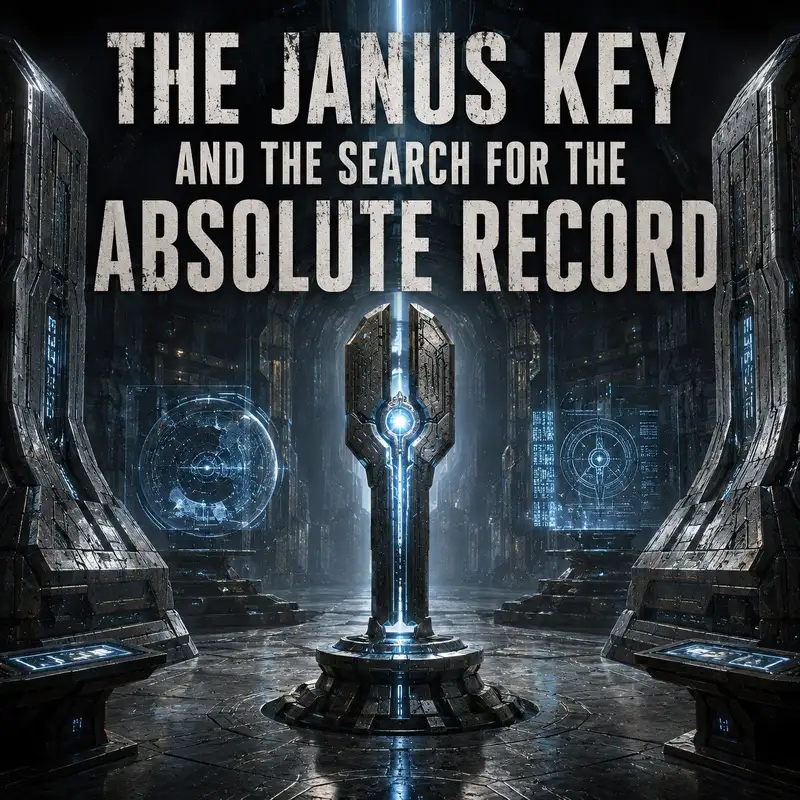
The Janus Key and the Search for the Absolute Record
On Aktis Four in July of twenty-five fifty-eight, a Pelican descended toward a Forerunner structure carrying one of the most dangerous objects aboard the United Nations Space Command Infinity. The cargo was half of the Janus Key, a device capable of locating Forerunner technology across the galaxy. Doctor Henry Glassman believed the fragment might interact with an artifact on the surface. Commander Sarah Palmer provided the escort. The incoming fire that struck the Pelican was expected by the people who had built the trap. It was not fired by the people who were supposed to spring it.
The unauthorized attack came from followers of Sali ’Nyon, a Sangheili zealot challenging Jul ’Mdama’s claim to lead a renewed Covenant. Their intervention turned an intelligence ambush into a three-sided battle among Infinity’s expedition, Jul’s forces, and rebels inside Jul’s own movement. The Key changed hands before anyone could establish what had happened. The episode captured the central problem of the entire search for the Absolute Record. Every participant wanted the authority represented by Forerunner technology. None possessed the political unity, technical understanding, or mutual trust that the technology had originally required.
The Janus Key was not itself a weapon. It was a galactic cartographer, built to identify and catalog the locations of Forerunner devices and installations. When its two halves were joined, it could guide its user toward an inheritance larger than any modern government could secure. A fleet commander could imagine hidden warships. A scientist could imagine design archives and production systems. An intelligence service could imagine every rival reaching those sites first. The Key offered information, and information of that scale was more strategically dangerous than many weapons it might reveal.
Forerunner records describe the Key as having been divided deliberately. One half was associated with the Builders and the other with the Warrior-Servants. The arrangement required agreement between two powerful rates before the catalog could be used. It was an ancient balance-of-power mechanism built into the artifact itself. The Forerunners had created too much military and industrial capacity to permit one institution to locate all of it without another institution’s consent. Their safeguard was imperfect, but its logic was sound. A map to civilization-level power should not belong to one impatient person.
The Librarian later brought both halves to Requiem. Her plan was for the rehabilitated Ur-Didact to deliver the Key to humanity and guide its development. That plan failed when the Domain was damaged by the firing of Halo and the Didact emerged from his Cryptum embittered, unstable, and hostile to the species he was meant to teach. After his departure, the Librarian’s stored personality gave the Janus Key to Catherine Halsey and directed her to the Absolute Record, the repository where the Forerunners had indexed the products of their civilization.
The gift immediately became divided again. Jul ’Mdama escaped Requiem with Halsey and one half of the Key. Halsey threw the other half to Spartan Gabriel Thorne before she was carried away. Thorne returned it to the United Nations Space Command, and Glassman began studying it aboard Infinity. The original division had required two Forerunner institutions to cooperate. The new division placed the halves in the hands of enemies who agreed only that the other side could not be trusted with the completed artifact.
Halsey regarded the Librarian’s instruction as personal selection. She had spent decades building military technology, shaping the Spartan Two program, and treating restricted knowledge as a problem best solved by placing more of it under her own control. The Absolute Record appeared to offer vindication on a civilizational scale. She could give humanity access to technology beyond anything the Office of Naval Intelligence or the Navy could develop. She could also decide how that access would be used, which was precisely the part of the proposal that alarmed nearly everyone familiar with her record.
Jul wanted the same repository for different reasons. His Covenant lacked the ministries, industry, and uncontested religious authority of the old empire. Requiem and the Didact had allowed him to present himself as the chosen Hand of a living Forerunner. The Absolute Record might provide weapons and technical systems, but it also promised legitimacy. If Jul could reveal hidden relics, command ancient machines, and distribute power to loyal shipmasters, his political claims would become harder to challenge. He did not need to rebuild High Charity. He needed enough sacred victories to make followers believe history had selected him.
Their alliance was therefore a temporary exchange between two people who expected to betray one another. Halsey needed Jul’s ships, troops, and possession of the first half. Jul needed Halsey’s ability to interpret the Key and navigate Forerunner systems. Each considered the other useful and fundamentally unfit to control the final prize. That is a poor foundation for government and a perfectly serviceable foundation for a short intelligence operation, provided the operation ends before either partner acquires what both are seeking.
The trap on Aktis Four was designed to obtain Infinity’s half. Halsey and Jul arranged a false Forerunner discovery that appeared to contain recesses matching the Key. Glassman, working from incomplete information and facing interference that prevented Infinity from simply leaving the system, requested that the fragment be brought down for examination. Captain Thomas Lasky approved the movement. From his perspective, a guarded transfer to a research site offered a chance to understand the anomaly. From Halsey’s perspective, human procedure was delivering the Key exactly where she wanted it.
Sali ’Nyon disrupted the plan because Jul’s Covenant was already fracturing. His followers shot down the Pelican and its Broadsword escort, recovered the Key fragment, and treated possession as proof that Sali was the true religious leader. Jul’s ships then emerged from concealment within Aktis Four’s opaque oceans and surrounded Infinity. The surface expedition withdrew into the Forerunner structure while Covenant factions fought one another outside. A deception intended to produce one controlled ambush had become a fleet action, a ground battle, and an internal purge.
The fighting demonstrated why possession of the Key could not create stable authority. Sali used the fragment as a sacred symbol, yet one of his own Sangheili concluded that the Prometheans’ loyalty to Jul carried greater religious weight. The soldier stole the Key and offered it back to Jul’s forces in exchange for acceptance. Palmer, Thorne, and another Spartan tracked the exchange and waited for Halsey to arrive. Palmer captured her, but Halsey escaped with the fragment and was recovered by Jul’s Phantoms. Sali’s rebellion was crushed on the planet, though Sali himself survived as a prisoner.
Jul and Halsey now held both halves. When joined, the Key generated the map they had been seeking. The result was an intelligence disaster for the United Nations Space Command, but not yet a military defeat. Infinity survived the battle and retained a source inside Jul’s organization. Ayit ’Sevi was a Sangheili mercenary secretly working with the Office of Naval Intelligence. He reported that Jul and Halsey intended to find the Absolute Record. The government that had lost the artifact still possessed warning, access, and a chance to follow it.
Halsey required weeks to interpret the completed Key. On September fifteenth, twenty-five fifty-eight, while Jul’s force remained concealed in the Urs system, she identified the location that would lead them to the Record. The delay is important. The Key did not place every Forerunner asset under immediate command. It produced information that still required analysis, navigation, and access. Jul possessed a map, not a supply network. He had no guarantee that the destination would recognize his authority, permit his ships to enter, or provide machinery that his followers could maintain.
The Office of Naval Intelligence organized Operation ATHENA around those uncertainties. Palmer led Spartans Gabriel Thorne and Holly Tanaka. Glassman joined them because reaching an archive without someone capable of interpreting it would produce little beyond an unusually expensive trespassing charge. Ayit provided infiltration, language, and access to Jul’s fleet. The plan placed the human team inside a cargo container with a concealed compartment, carried aboard a Phantom and delivered to the assault carrier Breath of Annihilation.
The operation depended on stealth and a telemetry probe. Once Jul’s fleet reached the destination, the probe was supposed to transmit the location back to the United Nations Space Command. The team could then separate from the fleet, find a landing point, and support a larger response. It was a sensible plan built around one significant limitation. The infiltrators had no dependable real-time superluminal communications. If the probe failed, headquarters would not know where they were. Classification had produced an excellent team. Interstellar distance still declined to cooperate with the paperwork.
On September seventeenth, Jul’s fleet emerged within the atmosphere of an immense and apparently artificial gas giant. Its metallic hydrogen core and extreme heat suggested that the visible planet was part of the access system rather than an ordinary natural waypoint. The Janus Key reacted, and a dormant slipspace portal began to open. The activation was violent. Ruptures tore through several ships, destroyed at least two cruisers, damaged Breath of Annihilation, and destroyed the telemetry probe before it could report the coordinates.
Operation ATHENA lost its communications plan before reaching the objective. The infiltrators escaped their damaged container, fought through the carrier, and stole movement where they could. Ayit and Thorne eventually remained with Breath of Annihilation, trying to create a route back to the Office of Naval Intelligence. Palmer, Tanaka, and Glassman transferred to Jul’s flagship, Song of Retribution. Jul, angry at the losses, considered abandoning the approach. Halsey argued that the technology beyond the portal would replace the ships and make his followers regard him as a god. Jul chose to continue with one carrier.
That decision reduced the fleet’s exposure while concentrating the political leadership, the completed Key, and the human infiltration team inside a single vessel. Song of Retribution crossed the portal alone and entered a vast Forerunner chamber. The site was not the entirety of the Absolute Record in a simple geographic sense. Later evidence indicates that the Record was a distributed repository with multiple local facilities and connections. This location was one guarded point of access, administered by a Contender-class ancilla later identified as Invariant Bias.
The Absolute Record had served the Forerunner ecumene as an archive and index of technology, operating alongside the Domain and preserving important information locally. It was not merely a warehouse filled with unattended weapons. Its value lay in knowing what existed, where it had been placed, and how larger systems fit together. A government controlling that information could select which design seeds to activate, which sites to investigate, and which dormant forces to awaken. The archive could turn scattered relics into a strategic program.
Invariant Bias immediately detected that humans were hidden aboard Jul’s carrier. Halsey presented herself as the Librarian’s chosen custodian and offered the Janus Key as proof. The ancilla rejected the assumption. Possession demonstrated access, not legitimacy. The artifact could have been stolen, captured, or taken by force, which was close enough to the actual history that the distinction became uncomfortable. When Jul’s Zealots attacked local Sentinels, the ancilla removed the floor beneath them and separated the surviving groups for examination.
The test Invariant Bias presented was not a weapons trial or an authentication code. It was a problem of stewardship. A peaceful species possessed biological material that might help produce immunity to the Flood. Waiting for naturally deceased individuals would preserve the species’ autonomy and offer a thirty-three percent chance of success. Harvesting living members by force would raise the probability to thirty-five percent. Glassman and the Spartans chose cooperation. Halsey chose coercive extraction in the name of the greater good. Jul advised the peaceful answer, though whether conviction or calculation shaped his response remains uncertain.
The difference between thirty-three and thirty-five percent was deliberately small. The test asked whether a custodian would destroy another society for a marginal increase in strategic advantage. Halsey’s answer was consistent with the hardest decisions of her career. Faced with a species-level danger, she would accept concentrated harm imposed on people who had not consented, provided she believed the calculation favored survival. Invariant Bias had not yet completed its judgment when Halsey made a second choice. She refused to leave the decision to the custodian and disabled the ancilla.
Her success should not be mistaken for proof that human operators could routinely overpower Contender-class systems. Halsey exploited the immediate interface and circumstances inside a facility that was actively testing her. Invariant Bias also possessed a failsafe that preserved a fragment of itself within a Sentinel. Halsey gained temporary control of the local site, not ownership of the entire Absolute Record. Even so, the brief access revealed why every faction had taken such risks to reach it.
A Librarian imprint guided Halsey toward dormant design seeds and other hidden assets. Design seeds were construction templates that could be fed into Forerunner manufacturing systems, allowing machinery and facilities to be assembled at enormous scale. Some locations held automated warships and the means to build more infrastructure from the resources of entire systems. Halsey saw a path by which humanity could leap past centuries of industrial development. The missing portion of the plan was who would supervise that leap and what would happen to any population occupying the required resources.
Jul reached the same danger from the opposite direction. Once Halsey had opened the archive, he ordered his warriors to restrain her when she emerged. Halsey overheard the order through the Record’s systems and turned Sentinels against his troops. Their alliance ended exactly as both had expected. Jul wanted a human interpreter who remained subordinate. Halsey wanted alien transport and protection until she could command Forerunner systems herself. Access to the prize did not resolve their conflict. It removed the last reason to postpone it.
Palmer, Tanaka, and Glassman encountered the Sentinel carrying the backup fragment of Invariant Bias. They helped it reach an auxiliary control conduit while fighting machines now directed by Halsey. Palmer confronted Halsey near the central controls, but a containment field blocked her. Jul then ordered Song of Retribution to fire into the facility. The bombardment disrupted power, damaged the local installation, and interrupted both Halsey’s control and the restoration effort. It was a remarkably efficient demonstration of why the custodian had been reluctant to admit any of them.
The interruption allowed Invariant Bias to reassert control. The ancilla captured Halsey as she attempted to escape through a portal. It judged that she had performed well enough to approach acceptance, but that her impatience and seizure of authority disqualified her. The custodian removed the Janus Key from her possession and denied further access. The local facility began withdrawing through slipspace portals. Jul recovered Halsey, and his flagship escaped with surviving forces before the Record vanished from their reach.
Elsewhere, Ayit and Thorne used the confusion aboard Breath of Annihilation to create a mutiny. Ayit released Sali ’Nyon and encouraged him to renew his rebellion. Sali’s followers seized the carrier and Jul’s stored collection of Forerunner artifacts. Thorne was wounded during the fighting, and Ayit’s cover nearly collapsed, but the infiltrators survived. Palmer, Tanaka, and Glassman later reached the captured carrier, and Ayit moved the human team to a rendezvous with an Office of Naval Intelligence prowler. Jul pursued aboard Song of Retribution, but Sali escaped with his new ship and another chance to challenge him.
Operation ATHENA did not deliver the Absolute Record to the United Nations Space Command. It did not recover Halsey, seize the Janus Key, or provide the practical access needed for a conventional follow-on force. It did prevent Jul and Halsey from retaining control of the repository. It also fractured Jul’s fleet, cost him ships, strengthened a rival, and confirmed that the Absolute Record possessed an active custodian able to judge modern claimants. The operation succeeded as strategic denial while failing as acquisition, extraction, and exploitation.
Jul paid heavily for a prize he never controlled. The denial of the Absolute Record joined Sali’s rebellion and the growing unreliability of the Prometheans in weakening his authority. Halsey remained aboard his flagship, but their partnership had become mutual containment rather than cooperation. She had attempted to use the Record to discard Jul. He had attempted to use her and then place her under guard. Both now knew exactly what the other intended, which improved clarity without noticeably improving morale.
The United Nations Space Command also received a warning about its own assumptions. The Janus Key could point toward technology, but it could not manufacture the political judgment required to use that technology safely. Glassman’s technical expertise, Palmer’s fireteam, Ayit’s intelligence access, and Infinity’s wider power had been enough to follow Jul. They had not been enough to claim a Forerunner civilizational archive. Reclaimer status opened interfaces. It did not convert every human institution or individual into a legitimate custodian.
Later records confirm that the Absolute Record remained active. After the conflict on Zeta Halo in twenty-five sixty, the sub-monitor Adjutant Revendicate contacted the repository to deposit an updated body of information about the galaxy. Invariant Bias responded and accepted the material. The Record had not been destroyed when it withdrew from Jul and Halsey. It had preserved itself, its data, and its authority to decide who could use them. Other points of access may still exist, though their physical and digital relationship remains uncertain.
The search for the Absolute Record failed because every modern faction interpreted the Janus Key as a title of ownership. Jul saw divine confirmation. Halsey saw personal selection. The Office of Naval Intelligence saw a strategic asset that had to be recovered or denied. The Key’s original design had expressed the opposite principle. Power of that scale was supposed to remain divided until rival institutions reached unity of purpose. The people who reassembled it achieved physical completion without political agreement.
The Janus Key found the road. It did not make Jul a prophet, Halsey a custodian, or the United Nations Space Command the heir to every machine the Forerunners had abandoned. At the end of the operation, the artifact was gone, the archive had withdrawn, and all three claimants returned with less control than they believed they deserved. The Absolute Record’s most important defense was not a fleet or a sealed door. It was an ancient intelligence willing to ask whether the people carrying the key should be trusted with what it opened.