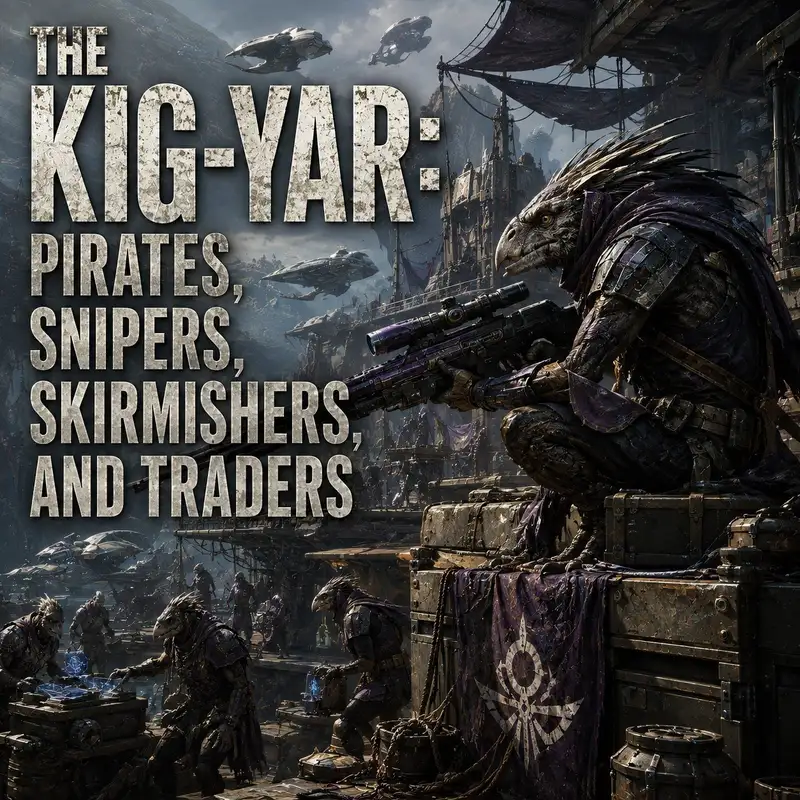
The Kig-Yar: Pirates, Snipers, Skirmishers, and Traders
The freighter had no crew, no weapons and no reason to expect attack. When the human vessel Horn of Plenty emerged from slipspace near the Kig-Yar missionary ship Minor Transgression, Shipmistress Chur'R-Yar did not see the beginning of a holy war. She saw cargo, navigational data, and a chance to make a private profit before reporting anything to Covenant authorities. Her raiders disabled the freighter, boarded it, and traced its route back to Harvest. The first Covenant ship to encounter humanity therefore acted less like an imperial battle group than a licensed privateer examining an unfamiliar merchantman. That was not an accident. It was the Kig-Yar method.
The Covenant classified the Kig-Yar as a client species and assigned them low status, but never fully converted them into a conventional subject population. Kig-Yar loyalty usually ran first to clan, nest, ship, and matriarch, then to whichever employer offered protection or profit. Their military roles reflected that independence. Shield bearers defended a narrow piece of ground. Snipers chose distance and timing. Skirmishers exploited gaps before heavier formations could respond. Traders and pirates moved between political systems that preferred clear borders. Why did an empire built on obedience tolerate a people whose relationship with authority remained so transactional?
The answer begins in the Y'Deio system. Eayn, the Kig-Yar homeworld, is not a planet but the principal moon of the gas giant Chu'ot. The wider system contains a dense asteroid belt, along with planetoids, minor moons, settlements, redoubts, and commercial stations. Many Kig-Yar lived away from Eayn long before Covenant rule. Distance from the homeworld encouraged local autonomy, while the asteroid environment rewarded smaller ships, careful navigation, concealed bases, and crews able to operate without continuous support from a central government. Geography did not create Kig-Yar culture by itself, but it gave independent clans somewhere to remain independent.
Early Kig-Yar history was organized around clans, maritime raiding, competition for territory, and trade across Eayn's seas. Those traditions did not disappear when the species reached space. The ocean became an asteroid belt, the sailing vessel became a raider or merchant ship, and the rival settlement became an isolated station with cargo worth taking. Gray markets sustained communities that had little reason to obey distant authorities on Eayn. Some clans became traders. Some became pirates. Many moved between both activities depending on opportunity, legality, and which official was asking. In practical terms, commerce and raiding were not opposite professions. They were different methods of acquiring the same cargo.
Kig-Yar society remained strongly matriarchal. Females traditionally controlled major assets, territory, family organization, and breeding rights, while powerful matriarchs and shipmistresses directed clans and vessels. A ship was therefore more than transportation. It could be a household, business, military command, and political constituency under one leader. Crew loyalty often depended on personal relationships and shared profit rather than an abstract national institution. This made Kig-Yar organizations flexible but difficult to unify. A matriarch might cooperate with another clan for one expedition, compete with it over a market, then hire its specialists for a raid several months later. Coalition management required constant attention and, preferably, accurate accounting.
The species was never culturally uniform. Ruuhtians, Ibie'shans, and T'vaoans developed in different regions and environments, and Covenant service emphasized those differences. T'vaoans arose on an asteroid within the Y'Deio system and became closely associated with the skirmisher tradition. Ibie'shans developed in relative isolation on Eayn. Ruuhtians formed much of the population encountered in conventional formations. Human troops reduced them to two battlefield labels, Jackals and Skirmishers. That was useful for a fire-control call and poor political analysis.
When Covenant fleets entered the Y'Deio system in the year thirteen forty-two, the Kig-Yar did not submit immediately. Pirates, militias, and mercenary crews combined against the intruders. Larger Covenant vessels possessed superior weapons and protection, but the asteroid belt limited maneuver and created countless hiding places for smaller local craft. Kig-Yar captains knew the routes, hazards, and concealed stations. They could raid, scatter, resupply, and return. The Covenant could destroy positions once it found them, but finding every armed ship and every hidden redoubt was a much larger task. A force built to overawe planets discovered that an asteroid belt contains very few convenient capitals to capture.
The Kig-Yar still could not win a prolonged war against the full resources of the Covenant. Their leaders accepted letters of marque through the Ministry of Tranquility and entered imperial service. The arrangement resembled a negotiated surrender, a commercial concession, and legalized piracy at the same time. The Covenant gained scouts, privateers, crews, and access to local networks. Kig-Yar captains gained protected markets, advanced technology, and permission to prey on the empire's enemies. Religious conversion followed for many individuals, and some became sincere believers in the Great Journey. The basic relationship nevertheless remained closer to contract than absorption.
That arrangement protected more Kig-Yar culture than the Covenant preserved for many subject species. They lacked representation on the High Council, but retained ships, clans, trade networks, and substantial control over daily affairs. Covenant ministries regulated slipspace drives and restricted strategic technology. They did not eliminate gray markets or the diversion of imperial goods into private hands. Officials knew some of this occurred. Complete suppression would have required policing the same crews the Covenant needed for trade, scouting, and privateering. The empire tolerated leakage because the alternative was expensive.
Kig-Yar service was therefore never simply mercenary in the sense of having no beliefs or loyalties. Family obligations were real. Clan identity was real. Religious faith could be real. So could hatred, ambition, friendship, and professional pride. Economic calculation did not erase culture. It was part of culture. A Kig-Yar captain who changed employers might still remain loyal to the same crew and matriarch. From the captain's perspective, the contract had changed while the important institution had not. Covenant commanders often mistook this for dishonor because they expected loyalty to move upward through the caste system. Kig-Yar loyalty usually moved sideways through relationships.
The darker side of that autonomy appeared in the conflict with the Unggoy. Both species occupied low positions in the Covenant hierarchy, but competition over housing, resources, and status became vicious. In twenty-four sixty-two, radical Kig-Yar shipmasters poisoned recreational infusions used by the Unggoy, leaving many males sterile. Covenant authorities discovered evidence and imposed little more than financial penalties. The resulting outrage helped ignite the Unggoy Rebellion. This was not harmless commercial rivalry. It was an organized attack on a population's ability to reproduce, protected by an imperial government more concerned with stability than justice.
On the battlefield, the most familiar Kig-Yar carried point-defense gauntlets that projected broad energy shields. These were not miniature versions of a warship's defensive field. They were directional barriers, effective when the carrier faced the threat and maintained the proper angle. Used well, they created mobile cover for a lance, protected a corridor, screened an advance, or forced an opponent to waste time and ammunition finding an exposed edge. The shield bearer could fire a plasma pistol or Needler around the barrier while supporting troops maneuvered behind. In confined terrain, one disciplined Kig-Yar could obstruct movement out of proportion to the weapon carried.
The shield also imposed limitations. It protected one direction, occupied an arm, drew power, and encouraged the bearer to fight from a predictable orientation. Explosives, flanking fire, elevated positions, and concentrated attacks could defeat the system or bypass it. A shielded Kig-Yar was not an armored assault soldier. The equipment compensated for a lighter body and made the user valuable as screening infantry. Covenant commanders sometimes treated that value as expendability, placing shield bearers at the front of formations where they absorbed the opening fire. The gauntlet improved survival. It did not improve the commander's opinion of the soldier behind it.
Kig-Yar snipers accepted the opposite bargain. Precision weapons required both hands, so the sniper generally abandoned the large point-defense shield and relied on concealment, range, optics, and early detection. Their sensory acuity made them well suited to reconnaissance and long-range fire, but natural ability was only the beginning. Effective sniping required patience, terrain selection, target discrimination, fire discipline, and an extraction plan. Covenant units placed Kig-Yar marksmen over approaches, around command posts, in urban high points, and along routes where human troops would be forced to expose themselves. The best were not merely accurate. They understood how to make one firing position shape an entire movement plan.
The Jha'kaar represented the elite edge of that role. This specialized order served the Prophet of Regret and appeared outwardly similar to ordinary Kig-Yar sniper units. Their members carried standard equipment and no obvious markings of a separate formation. Their reputation came from performance, not ornament. During operations on Earth and Installation Zero Five, such snipers occupied tactically valuable positions and delivered fire that human personnel could not ignore. The lack of distinctive equipment was itself useful. A defender could not know whether the marksman ahead was a routine shooter or part of a highly selected order until the first shot provided an answer.
Skirmishers solved a different problem. Within the Covenant, the role was held almost exclusively by T'vaoans. They used speed, armor, coordination, and aggressive maneuver to flank positions, overrun isolated personnel, or hold tight choke points where mobility mattered more than a large shield. The term described an operational function as much as a body type. Skirmishers could act ahead of heavier units, pursue retreating troops, and exploit vertical terrain that slowed less agile formations. Their effectiveness depended on discretion. A commander who tried to use them as ordinary line infantry discarded the reason for assigning them in the first place.
The Covenant placed these roles inside a hierarchy that rarely trusted Kig-Yar with high command. Sangheili or Jiralhanae officers usually directed mixed formations. Experienced Kig-Yar might lead lances or specialist teams, but remained subordinate to species above them. The arrangement preserved local initiative while keeping strategic authority elsewhere. It also created a weakness. A unit might follow orders while conditions remained profitable, survivable, or personally binding. Once the commander died, the contract failed, or another patron offered better terms, cohesion could change quickly. The empire called that unreliability. The Kig-Yar might call it a review of current obligations.
Their naval contribution mattered just as much as the infantry visible to human troops. Kig-Yar crewed missionary ships, privateers, raiders, patrol craft, and commercial vessels. They conducted reconnaissance, interdiction, smuggling, boarding, and trade. Because many served on vessels tied to their own clans, they preserved maritime expertise that did not depend entirely on Covenant academies. The Ministry of Tranquility used them to patrol distant regions and locate targets. Their ability to move between official service and private enterprise gave Covenant intelligence access to routes and rumors that formal fleets might never encounter. It also ensured that sensitive cargo occasionally developed an independent travel schedule.
Humanity's first contact demonstrated both sides of that arrangement. Minor Transgression was operating as a Covenant missionary vessel when Chur'R-Yar raided human shipping. Her crew recovered the route to Harvest and discovered what Covenant instruments identified as a world filled with Forerunner relics. Chur'R-Yar intended to conceal part of the find for personal benefit. Her private scheme failed, and the encounter expanded into open conflict. The immediate cause of the Human-Covenant War was a San'Shyuum decision to conceal the truth about humanity. The path to that decision began with Kig-Yar piracy, commercial curiosity, and stolen navigational data.
Once the war began, Kig-Yar scouts helped locate human colonies and report them to Covenant fleets. Their ships and patrols extended the empire's search network beyond major naval formations. On the ground, shield bearers, marksmen, and skirmishers supported invasions, occupations, boarding actions, and the defense of Covenant installations. They participated in a genocidal campaign even when personal motives were less theological than those of the Prophets. A paid contract does not reduce responsibility for the work performed under it. Kig-Yar pragmatism made cooperation possible across political lines. It also made cooperation with extermination possible when the employer controlled the larger market.
The Rubble showed how far that pragmatism could reach. In twenty-five thirty-five, Kig-Yar forces encountered a human asteroid settlement populated by Insurrectionists and survivors from Madrigal. Trade developed despite the official war between their civilizations. Covenant weapons moved toward human buyers, while human slipspace technology moved toward Kig-Yar hands. The human partners believed they were dealing with alien rebels willing to ignore the Covenant. In reality, the operation had the approval of the High Prophet of Truth and was intended to gather navigational knowledge that could expose human worlds. Commerce created trust. Intelligence services used the trust for targeting.
That episode also demonstrates why traders should not be confused with neutral merchants. Kig-Yar economic networks could connect enemies, move scarce technology, and sustain communities ignored by larger governments. They could also traffic weapons, deceive customers, support invasion planning, raid civilian shipping, and seize territory for nesting grounds. Profit was not a moral system. It was an incentive structure. The same captain who sold supplies to refugees might provide their location to a stronger patron if the reward changed. Reliable trade required reputation, enforcement, or personal bonds. Where those were absent, every transaction included an intelligence risk.
The Great Schism broke the Covenant's central authority but did not shatter Kig-Yar society to the same degree experienced by populations whose institutions depended on High Charity. Clans, ships, pirate flotillas, and trading relationships already existed outside the imperial chain of command. Some Kig-Yar followed Jiralhanae loyalists. Some served Sangheili factions. Some protested the Prophets. Many simply resumed independent piracy, trade, salvage, and mercenary work. The collapse removed restrictions and opened former Covenant installations to looting. It also removed the common legal system that had made contracts enforceable across imperial space. Opportunity increased at roughly the same rate as risk.
Postwar Eayn stabilized under an alliance of arch-matriarchs, but that did not create a unified species-wide state. Remote colonies and asteroid communities retained substantial independence. Shipmistress Chol Von attempted to build a stronger combined naval force capable of defending Kig-Yar interests, yet few clans accepted the need to surrender enough autonomy for the project to succeed. The failure was revealing. Kig-Yar leaders understood external threats. They disagreed over whether defense required centralization or whether centralization was simply another external threat wearing local plumage.
Independent markets became increasingly important after the war. On Venezia, Kig-Yar lived and worked beside humans, Sangheili, Jiralhanae, and other former Covenant subjects. Transport businesses, clearing houses, arms dealers, smugglers, engineers, and intelligence brokers helped sustain a city whose political order was hostile to the United Nations Space Command but economically connected to nearly everyone. Kig-Yar specialists even cooperated with human engineers on communications equipment able to access several different networks. The old empire had tried to regulate information through ministries. Postwar traders discovered that incompatible systems are merely a market waiting for the correct adapter.
The Banished offered another version of the old bargain. Kig-Yar joined as freebooters, raiders, snipers, skirmishers, ship commanders, and specialists. Wealth and advancement replaced the Covenant's religious promise, while local leaders often granted capable personnel more discretion than the old caste system allowed. The Banished also expanded the skirmisher tradition beyond T'vaoans. Ruuhtians adopted the armor, methods, and aggressive role, demonstrating that the practice belonged to a broader Kig-Yar military inheritance. Competence could earn autonomy, although refusal, failure, or weakness still carried consequences in an organization built around coercive power.
On Zeta Halo, Banished Kig-Yar served as marksmen, scouts, high-value commanders, archaeologists' companions, and guardians of occupied terrain. Their roles again connected battlefield skill with information. A sniper observed movement. A skirmisher controlled a route. A trader knew who could acquire a component. A shipmistress understood how to move personnel and loot before another faction arrived. Banished commanders benefited when they treated Kig-Yar as decision-makers rather than disposable light infantry. They also had to accept that capable decision-makers evaluate their employers, especially when the promised rewards stop arriving.
The Kig-Yar were pirates, but piracy was not their entire civilization. They were traders, but trade did not make them peaceful. They were snipers because sensory ability and training made them effective at range, not because every member preferred a beam rifle. They were skirmishers because particular communities preserved a tradition of mobile independent combat. Covenant records compressed these distinctions into useful labels. Human battlefield slang compressed them further. Neither vocabulary adequately described the political economy that placed those soldiers on the battlefield.
The Covenant tolerated the Kig-Yar because it needed what it could not easily manufacture through conquest: local navigation, flexible shipping, informal markets, private initiative, and personnel willing to operate where regular fleets were inefficient. The Kig-Yar accepted the Covenant because imperial service opened routes, technology, and targets beyond the Y'Deio system. Neither side fully trusted the other. Trust was not required while the exchange remained profitable. The arrangement lasted for more than a thousand years because both participants understood the transaction, even while publicly describing it as religious unity.
Their military equipment expressed that bargain with unusual clarity. The shield protected the space immediately in front of one soldier. The sniper rifle allowed the user to influence a battlefield without standing inside another species' formation. The skirmisher's armor rewarded speed, initiative, and the ability to exploit a moment before permission arrived. The privateer ship carried its own crew, cargo, and chain of loyalty. Each system gave the Kig-Yar a measure of independence while still making their service valuable to a larger power.
That is why the empire never completely owned them. Covenant ministries could issue drives, commissions, weapons, and orders. They could not eliminate the clans, asteroid settlements, shipboard loyalties, and markets that existed beneath official authority. After High Charity fell, those networks kept functioning because they had never depended entirely on High Charity. The Kig-Yar paid for that resilience with political fragmentation, violent competition, and an inability to unite even when unity might have protected them. Their freedom was real, but it was unevenly distributed and often guarded by whoever controlled the ship.
A Kig-Yar marksman watching a road, a skirmisher waiting above a choke point, and a shipmistress calculating the value of unfamiliar cargo appear to be performing different tasks. They are applying the same strategic habit. Observe first. Preserve options. Commit only when the advantage is clear. The Covenant saw a lesser caste that could be hired, armed, and aimed. The Kig-Yar saw an empire large enough to provide markets and foolish enough to mistake a contract for ownership. When the empire disappeared, the traders changed routes, the pirates changed targets, and the snipers kept watching.