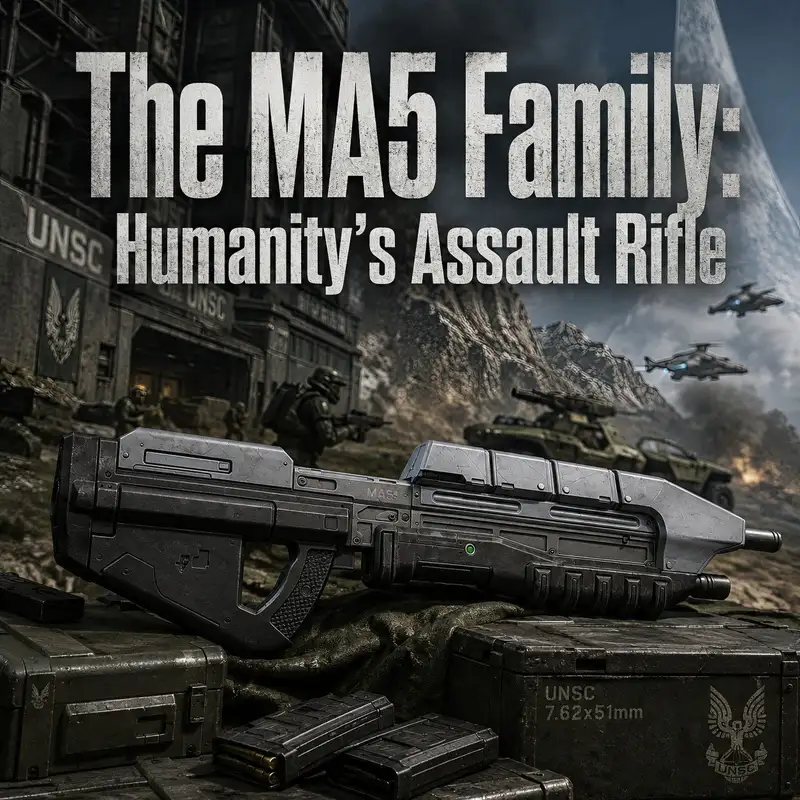
The MA5 Family: Humanity’s Assault Rifle
Aboard the Pillar of Autumn, the armory problem was immediate. Covenant boarding parties were cutting into the ship, compartments were filling with smoke, and the defenders had no time to debate procurement. The weapon placed into many hands was the M A five B. It was not exotic, and it was not designed for an enemy protected by energy shields. It was available, familiar, and already supported by the ship’s ammunition stores. In a boarding action, those qualities can matter more than elegance.
That moment captures the central question behind the M A five family. Why did a conventional ballistic rifle remain one of humanity’s defining infantry weapons through decades of colonial unrest, the Human-Covenant War, and the unstable conflicts that followed? Humanity encountered plasma weapons, hard light, advanced shielding, and machines built by civilizations older than the human species. Yet Marines, soldiers, naval security teams, Orbital Drop Shock Troopers, and Spartans continued to carry rifles whose basic operating principles would have been recognizable centuries earlier.
The answer begins with Misriah Armory and the idea of a weapon family rather than a single perfect rifle. The M A line was built to be revised, adapted, and produced in related forms for different services and missions. By twenty-five sixty, versions of the platform had served for more than half a century. Some were full-size service rifles. Others were compact carbines. Some emphasized magazine capacity and close-range fire. Later models improved accuracy, durability, electronic integration, and compatibility with modern combat systems. The common thread was continuity.
Most major M A five variants were air-cooled, gas-operated, magazine-fed rifles arranged in a bullpup configuration. The magazine sat behind the firing grip, allowing the weapon to retain a useful barrel length without becoming excessively long. That mattered in vehicles, urban terrain, defensive works, and shipboard passages where a rifle had to move through hatches and around equipment. The layout was not perfect. Rearward magazine placement could complicate reloads for an unfamiliar user. The United Nations Space Command accepted that trade because troops could be trained around it and the compact package suited expeditionary warfare.
The rifle was also more than a barrel attached to a trigger. Its electronics suite could display ammunition remaining, provide directional information, and communicate with helmet systems and smart-linked fire controls. To a soldier fighting in darkness, smoke, or a pressurized suit, knowing how many rounds remained without removing the magazine was not a decorative feature. The electronics looked vulnerable, especially on a weapon expected to survive mud, vacuum exposure, impacts, and indifferent maintenance. In practice, the family earned a reputation for remaining functional under conditions that were not kind to precision equipment.
That reliability reflected the world for which the rifle had originally been built. The M A five was not conceived as an answer to the Covenant. Its early users expected to fight other humans during colonial security operations, counterinsurgency missions, shipboard actions, and conventional combat. Those missions demanded a rifle capable of automatic fire, rapid handling, and useful performance across short and medium ranges. The enemy might wear body armor, use cover, or attack from a crowded settlement. No one designing the platform needed to imagine a Sangheili warrior crossing the room behind a personal energy shield.
This origin matters because military procurement rarely starts over when the enemy changes. A service rifle is tied to training programs, ammunition factories, magazines, spare parts, armor interfaces, transport plans, and thousands of personnel who already know how to use it. Replacing all of that during a war of extinction would have created a second emergency inside the first. The United Nations Space Command therefore adapted the M A family rather than discarding it. The weapon remained useful, even when it was no longer technologically impressive.
The M A five B became the best-known wartime expression of that decision. It fed from a sixty-round magazine and delivered sustained automatic fire from a compact frame. In close terrain, aboard ships, and against massed infantry, that capacity gave a squad time to suppress, maneuver, or break contact before reloading. It also suited a military confronting opponents who could not always be stopped by a short burst. A shielded target might require repeated hits before conventional rounds could reach armor and flesh beneath the energy barrier.
Sixty rounds did not make the rifle free of logistical cost. Full-power seven point six two by fifty-one millimeter ammunition was heavy. A large magazine added weight beneath the weapon and placed more cartridges in every reload. Soldiers could consume ammunition at an alarming rate when firing automatically, particularly under stress. The ammunition counter could tell a Marine that the magazine was nearly empty. It could not make another magazine appear. Every burst still depended on a factory, a transport ship, an orbital transfer, a ground convoy, and someone carrying the load the final distance.
The Covenant made this burden more severe. Human bullets could wear down personal energy shields, but they generally did so less efficiently than plasma stripped shielding. The M A five B could overwhelm a shield through volume, concentrated fire, or accurate bursts, yet a lone rifleman faced a poor exchange against a well-protected Sangheili at the wrong distance. The rifle’s value came from the fire team. Several weapons firing together could collapse a shield, after which precision fire, grenades, heavier weapons, or another burst could finish the engagement.
That was not merely an improvisation by frightened troops. It reflected the United Nations Space Command’s wider dependence on combined arms. Assault rifles worked beside machine guns, marksman weapons, shotguns, rockets, grenades, vehicles, aircraft, and orbital support. Captured plasma weapons were sometimes used to exploit the enemy’s own technology, but scavenging did not create a reliable supply chain. The M A five remained the weapon commanders could plan around. Its effectiveness was predictable, its ammunition was standardized, and armorers understood how to keep it running.
The rifle also had clear limits. It was not a precision weapon for every range. Sustained automatic fire reduced practical accuracy and spent ammunition quickly. Its cartridge offered power, but power did not guarantee penetration of every alien armor system or immediate defeat of a shielded opponent. The large M A five B magazine could become cumbersome, and the weapon’s integrated electronics did not turn every user into a marksman. Battle rifles and designated marksman rifles existed because infantry combat repeatedly demanded more controlled fire at distance.
The M A five C represented an effort to correct some of those weaknesses without abandoning the platform. It used a thirty-two-round magazine and incorporated changes intended to improve accuracy, range, handling, and reliability. The smaller magazine looked like a retreat from the M A five B’s famous capacity, especially to anyone who believed more ammunition inside the weapon must always be better. Procurement officers were forced to consider a less dramatic question: how many rounds could be carried, fed, controlled, and placed effectively before the weapon’s weight and magazine wear became liabilities?
The reduced capacity reflected a different balance. A stronger and more refined rifle with improved practical accuracy could make each burst more useful. A lighter magazine could improve handling and reduce strain on the feed system. The user reloaded more often, but the weapon was less committed to the idea that the answer to every close-range problem was another long burst. The M A five C became prominent during the final battles of twenty-five fifty-two, including fighting on Earth and the Ark, where Marines and Orbital Drop Shock Troopers needed a general-purpose rifle rather than a specialized answer to one enemy.
The naming of the family can make its history appear cleaner than it was. It was not a simple march from M A five B to M A five C to M A five D, with every older rifle disappearing when a new letter entered service. The Army fielded the related M A thirty-seven, while the Navy and Marine Corps commonly used M A five designations. Different branches maintained different stocks, procurement priorities, and operational needs. Weapons remained in armories long after a newer model existed because militaries replace rifles by unit, contract, theater, and available budget rather than by historical convenience.
The M A thirty-seven seen in Army service on Reach illustrates that point. It belonged to the same broad Misriah individual combat weapon lineage, used the same general ammunition class, and filled the same basic role. Its presence did not mean the Army had been issued an inferior museum piece while Marines received the future. It meant the Army had its own long-established procurement path and a rifle suited to planetary defense, garrison duty, and large conventional formations. During the fall of Reach, the distinction mattered less than whether ammunition, replacement magazines, and trained users were available.
Special operations created another requirement. The M A five K was a shortened carbine intended for users who valued speed, compactness, and close-range volume of fire. Spartan Three personnel and other special operators could carry it through confined spaces, dense terrain, and missions where a full-length rifle interfered with movement. The K designation reflected its carbine role. The weapon was not simply a smaller rifle with every advantage preserved. A shortened platform traded effective reach and stability for quicker handling and easier carriage.
That trade made sense for reconnaissance, infiltration, and assault teams expecting sudden engagements at short distance. A compact weapon could clear a hatch, move through vegetation, or remain manageable while the operator carried demolition charges, sensors, or other mission equipment. It could also serve personnel whose primary task was not prolonged rifle combat. The M A five K did not replace the standard service rifle because most infantry units still needed a weapon capable of broader employment. Special operations equipment becomes special precisely because the rest of the force cannot organize every mission around the same assumptions.
The M A five D carried the family into the postwar era. It saw limited service during the Human-Covenant War and became far more common after the conflict, including among forces attached to the United Nations Space Command Infinity. The rifle retained the familiar ballistic core while improving modularity, ergonomics, and integration with contemporary combat systems. Its users included Spartan Fours, but the weapon was not designed only for augmented personnel. It remained a service rifle that ordinary troops could operate, even when a Spartan’s armor and strength allowed more aggressive employment.
That continuity was strategically important. Humanity emerged from the war with devastated colonies, depleted fleets, damaged industry, and access to technologies it only partly understood. It could not rebuild every infantry arsenal around captured plasma systems or Forerunner devices. A recovered energy weapon was useful. A weapon that could be manufactured, inspected, repaired, and supplied across human space was useful in a different and often more important way. The M A five D represented modernization without pretending that technological discovery had erased industrial reality.
By twenty-five sixty, the M A forty had become the most prominent heavy assault rifle in many Army and Marine formations. The M A forty was not labeled as an M A five variant, but it grew from the related M A thirty-seven branch and incorporated improvements developed across the wider production line. It emphasized mechanical reliability and durability in extreme conditions while preserving the high rate of fire and heavy cartridge expected from the family. On Zeta Halo, scattered United Nations Space Command survivors depended on exactly those characteristics.
The M A forty’s role against shielded enemies remained familiar. Its rapid fire and substantial cartridge could strip protection through repeated hits, especially at close and medium distance. It was not renowned for exceptional precision or economical ammunition use. That was an honest description of the design. The rifle solved the problem of giving assault troops a rugged weapon that could deliver immediate volume against dangerous targets. It did not solve the problem of carrying unlimited ammunition through a broken campaign with no secure depot behind the firing line.
The coexistence of the M A five D and M A forty also shows why model numbers should not be mistaken for a universal quality ranking. A Spartan or Orbital Drop Shock Trooper choosing between them would care about condition, ammunition, smart-link compatibility, mission range, and available support more than the letter or number stamped on the receiver. Official assessments have treated the granular tactical differences among such rifles as relatively small for elite operators. The better weapon is often the one that connects to the user’s combat system and still has magazines available.
Training reinforced that interchangeability. A soldier familiar with one member of the family could understand the controls, balance, reloading logic, and recoil behavior of another more quickly than if issued an entirely foreign system. That reduced transition time and allowed mixed stocks to remain useful. During the Covenant War, units were rebuilt from survivors, replacements, and personnel diverted from other assignments. A rifle family with recognizable handling characteristics helped commanders create functional formations from people and equipment that had not begun the campaign together.
Maintenance mattered for the same reason. Armorers needed gauges, replacement components, cleaning procedures, and diagnostic equipment that could support weapons across multiple deployments. Common design principles reduced the number of entirely separate systems they had to master. Misriah Armory’s broad manufacturing presence also made the platform more than a single factory’s product. A distributed human war effort could continue producing related weapons and parts even as colonies were isolated or destroyed. Standardization did not make the supply network invulnerable, but it gave the network something consistent to move.
Ammunition remained the family’s greatest strength and most persistent burden. The seven point six two millimeter cartridge provided useful power against body armor, light cover, and unshielded targets. Common ammunition simplified planning across related rifles and machine guns, depending on the specific weapon and loading. Yet every improvement in rate of fire increased consumption. Every larger magazine increased carried weight. Every isolated garrison eventually had to count remaining rounds. The M A five family made human firepower dependable, but never independent of transport.
The electronic suite added another layer of dependence without making the rifle helpless. Smart-link systems allowed aiming information to pass between weapon and helmet. Visual intelligence systems could identify targets, display ammunition, and help a trained operator fire from positions that would be awkward with conventional sights alone. Spartans benefited greatly because Mjolnir armor integrated weapon data into a far richer sensor environment. Ordinary personnel gained useful assistance as well. If the network failed, the rifle remained a mechanical firearm. That separation between enhanced capability and basic function was one of the platform’s quiet strengths.
The Master Chief’s association with the assault rifle sometimes hides the scale of its real history. A Spartan could use the weapon with exceptional control, absorb recoil easily, carry more ammunition, and combine it with armor sensors unavailable to most troops. The family’s success cannot be measured by what one augmented operator achieved. Its importance came from the millions of less celebrated moments when a Marine guarded a hatch, an Army squad held a street, an Orbital Drop Shock Trooper cleared a landing zone, or a naval technician defended a compartment long enough for someone else to restore power.
The rifle’s competitors were often better at a specific task. Battle rifles delivered controlled bursts and superior precision at range. Marksman rifles supported observation and deliberate fire. Submachine guns were easier to handle in tight spaces. Shotguns dominated certain close engagements. Plasma weapons attacked shields efficiently. Forerunner arms offered effects human industry could not duplicate. None of those facts made the M A five unnecessary. A general-purpose rifle survives by being adequate across many situations, not supreme in one.
Enemy countermeasures reinforced this need for balance. Sangheili shields punished inaccurate individual fire. Kig-Yar shields forced soldiers to change angles, target exposed areas, or use grenades and supporting weapons. Jiralhanae armor and physical resilience demanded disciplined shot placement and concentrated fire. Flood combat forms made ammunition control and immediate stopping effect matters of survival. The M A five could contribute against all of them, but it required different tactics. The rifle did not determine doctrine by itself. It gave trained units a dependable tool around which doctrine could be built.
Its long service therefore says something uncomfortable and important about human warfare. The United Nations Space Command did not defeat technological inferiority by discovering one superior rifle. It survived by maintaining a system that could absorb losses, teach replacements, distribute ammunition, and improve equipment without breaking continuity. The M A five family was conservative because humanity needed conservative systems. A rifle that demanded an entirely new industrial base, power infrastructure, or alien technical cadre would have been impressive in a laboratory and largely irrelevant to a platoon waiting for resupply.
The familiar silhouette, illuminated ammunition counter, and heavy report became symbols because the weapon appeared wherever human forces were forced to hold ground with what remained. The M A five B reflected wartime volume and close-range necessity. The M A five C traded some capacity for refinement. The M A five K compressed the design for specialized missions. The M A five D modernized the platform for a networked postwar force. The M A thirty-seven and M A forty showed how the same lineage could diverge across service branches and return with lessons shared across decades.
The M A five family endured because it was never the answer to only one battle. It linked the soldier to factories on Mars, ammunition plants across the colonies, shipboard armories, training ranges, helmet displays, and the people responsible for moving magazines through a war zone. Its limitations were real, and its replacements were always being discussed. That is normal for a service rifle. What made the family exceptional was that humanity could keep building it, keep teaching it, keep repairing it, and keep placing it into the hands of the next unit ordered to hold.