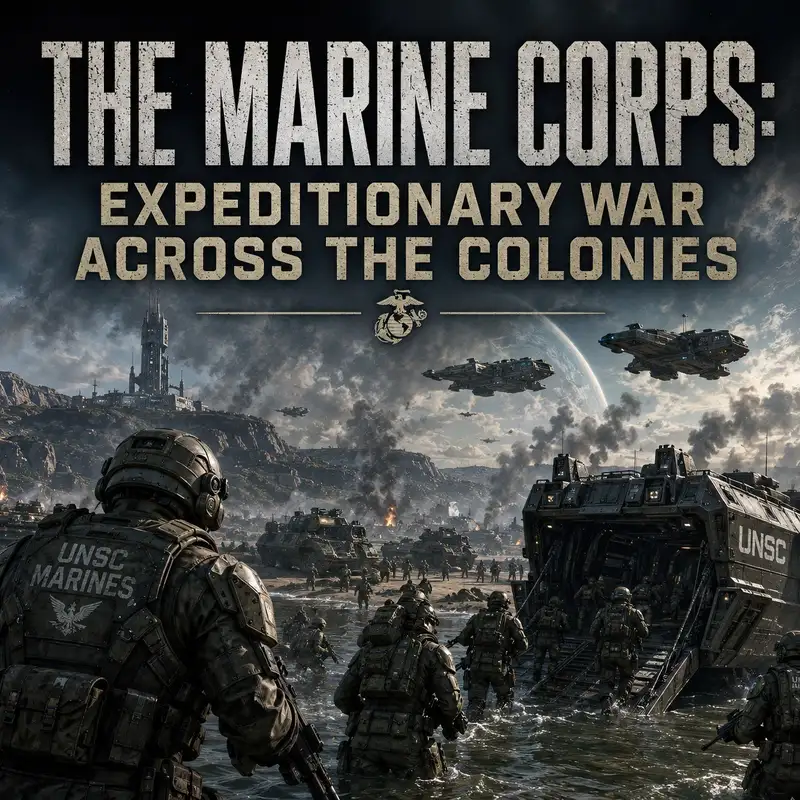
The Marine Corps: Expeditionary War Across the Colonies
At Pirth City on Arcadia, the Marines moved toward the Covenant while the civilian population moved toward the spaceport. Their mission was not to defeat the invasion in one battle. It was to hold roads, landing zones, and evacuation corridors long enough for transports to lift. Every minute gained on the ground had value only if aircraft arrived, ships remained in orbit, and the route out of the system stayed open. The Marine Corps could place combat power on a colony quickly. It could not promise that the colony would exist when the last transport departed.
The United Nations Space Command Marine Corps was built for the space between naval arrival and sustained planetary war. The Navy could carry troops across interstellar distances and fight for access to orbit. The Army could defend major worlds, maintain garrisons, and conduct long campaigns on the surface. Marines were organized to leave the ship, seize the immediate objective, protect the fleet’s interests ashore, and create enough local control for a larger operation to begin. They were the force expected to be ready when a captain received an order that ended with a planet’s name and did not include much time.
That role began in twenty-one sixty-three during the Interplanetary War. The United Nations combined naval and spaceborne expeditionary formations from several national militaries into a common force. The new Marine Corps made its first extraterrestrial deployment during the Mars Campaign, striking Koslovic positions near the Argyre Planitia shipbuilding facilities. The operation demonstrated that warships carrying trained landing forces could move rapidly from strategic transport to direct action. The lesson endured. Human naval power would not be limited to firing from orbit. It would bring its own ground force.
The Corps’ formal purpose was to provide combined-arms expeditionary forces and security detachments. Those words covered a remarkable range of duties. Marines guarded ships, nuclear weapons, command spaces, and high-value personnel. They formed boarding parties, protected installations, enforced emergency military authority in crisis areas, and developed methods for rapidly deploying combat power between worlds. When a Navy vessel reached an isolated system, its Marine detachment could become a security force, assault element, reconnaissance unit, or emergency garrison before any purpose-built ground formation arrived.
That flexibility placed the Marine Corps in an unusual command relationship. Its commandant organized and trained the service, while operational control could pass through Naval Command or Unified Ground Command. Fleet Marine Forces served aboard ships, stations, landing parties, and aerospace elements. Units assigned to long-term planetary security or garrison reinforcement could fall under ground command. The arrangement reflected a force working on both sides of the atmosphere. It also gave headquarters several opportunities to argue over who owned the same battalion, a familiar military capability requiring no new technology.
Marine units were organized so they could be matched to the ships and missions available. A frigate might carry a platoon-sized detachment. A cruiser could support a company. A carrier could embark a battalion or more, while a Marine Expeditionary Force combined larger ground, aviation, command, and support elements for major operations. These were not rigid packages that arrived untouched from a manual. Commanders attached engineers, armor, reconnaissance, medical personnel, logistics teams, and aircraft according to the objective. Expeditionary organization meant carrying enough capability to fight immediately without pretending that the landing force could remain independent forever.
The ship was more than transportation. It was the Marine unit’s warehouse, hospital, communications hub, repair facility, artillery platform, and route home. Pelicans moved personnel and vehicles from orbit to the surface. Warthogs gave squads speed and flexible weapons once ashore. Scorpion tanks added protected firepower when a vessel could carry them and a landing zone could accept them. Every capability consumed cargo space, fuel, ammunition, spare parts, and maintenance time. A commander could land more riflemen by leaving support behind. The result was usually more riflemen discovering why the support had been included.
Marines trained as a combined-arms force because no single weapon solved an expeditionary mission. Infantry secured terrain and cleared confined spaces. Armor broke defended positions and protected movement. Engineers opened routes, repaired infrastructure, breached obstacles, and made landing zones usable. Communications teams linked dispersed units to ships and aircraft. Medical personnel stabilized casualties for evacuation. Aviation moved the force faster than roads or terrain allowed. The Corps’ real weapon was not the assault rifle. It was the ability to combine these functions under one command soon after arrival.
The enlisted ranks carried much of that system. Corporals and sergeants led fireteams and squads. Staff noncommissioned officers translated officers’ plans into movement, security, fields of fire, maintenance, and discipline. They also preserved experience as units absorbed replacements during a war that did not permit long recovery cycles. A young officer might understand the objective and possess lawful authority. A veteran gunnery sergeant often knew how many Pelican loads the objective required, which vehicle would fail first, and how long the ammunition would last once the Covenant began firing. Successful commanders treated that knowledge as intelligence rather than commentary.
The Corps’ first centuries were not spent defending humanity from aliens. Marines were used to enforce central authority across increasingly restless colonies. During the Insurrection, they conducted raids, protected government facilities, trained local forces, guarded shipping, and fought separatist organizations under Operation TREBUCHET. They also became the visible face of policies created far from the communities where those policies were enforced. A Marine platoon arriving from orbit could suppress an armed cell. It could not resolve unequal representation, resource disputes, corporate power, or resentment toward Earth.
Counterinsurgency gave the Corps practical experience in rapid deployment, urban fighting, intelligence support, and joint operations. It also produced institutional habits that were dangerous when force replaced political judgment. At Eridanus Two and other contested colonies, Marines were sent to capture rebel leaders and pacify populations whose support could not be separated neatly from fear, grievance, and coercion. On Tribute, a hostage crisis near Casbah ended with Marines, rebels, and dozens of civilians dead. The tactical problem lasted minutes. The political consequences outlived the unit that responded.
First contact with the Covenant changed the enemy without changing the Corps’ basic problem. At Harvest in twenty-five twenty-five, only a handful of Marine officers were present to train the colonial militia when the attack began. Captain Ponder became the Corps’ first casualty of the new war. The Marines had spent decades preparing to reinforce human authorities and fight human insurgents. They now faced an interstellar empire whose infantry carried energy weapons, whose aircraft could dominate local airspace, and whose warships could remove the naval support on which expeditionary doctrine depended.
The long Harvest campaign showed both the usefulness and limits of Marine flexibility. Forces deployed from the Spirit of Fire established bases, conducted reconnaissance, moved armor, and attacked Covenant positions across difficult terrain. They could create a functioning ground force far from an established garrison because their support structure traveled with the fleet. Yet every success remained tied to control of transport and orbit. A firebase could be built quickly. It could also become an isolated collection of troops and equipment if dropships were destroyed or the supporting ship was forced to leave.
At Alpha Corvi Two, Marines defended the capital while a Spartan team pursued a separate high-value objective involving a Forerunner artifact. The conventional force drew and fixed the enemy, creating the conditions for the special operation. The Marines suffered severe casualties and eventually withdrew when the wider defense became unsustainable. That pattern appeared throughout the Covenant War. Spartans could strike command nodes, recover intelligence, or destroy a critical target. Marines held landing zones, secured routes, fought the enemy’s main body, and absorbed the pressure that made the specialized mission possible.
Arcadia made the relationship between expeditionary warfare and civilian survival even clearer. Marines from the Spirit of Fire defended population centers and kept evacuation routes open as Covenant forces attacked in twenty-five thirty-one. Their objective was measured in transports launched and civilians moved, not merely enemy casualties. The Corps could establish defensive lines and counterattack local positions, but it could not reverse the naval balance above the planet by infantry action. When the strategic situation demanded withdrawal, the ground force’s task became protecting movement rather than possessing terrain.
Across the Outer Colonies, that became the normal form of defeat. Marines landed because they were available, mobile, and trained to fight immediately. They faced Covenant infantry, armor, aircraft, and eventually orbital bombardment with limited reinforcement. If the Navy lost control of the system, ammunition stopped arriving, damaged vehicles remained damaged, and medical evacuation became uncertain. Units could continue resistance, but their operational choices narrowed with every hour. The Corps was first to fight partly because it was also the force most likely to be placed where the fleet might soon be unable to return.
This dependence did not make ground action pointless after orbital defeat. Marines could delay enemy access to population centers, destroy navigation data, evacuate specialists, sabotage facilities, recover intelligence, and keep a spaceport functioning long enough for one more flight. They could deny the Covenant an artifact or prevent a captured ship from revealing another human world. These were limited objectives, but limited objectives were often all that remained. A battalion did not need to save the planet to change how many people escaped it or how much the enemy learned from its ruins.
Reach exposed the Corps at every level. Marines defended Fleet Command facilities, orbital-defense generators, ships, and evacuation sites while Army and Air Force formations fought the wider planetary campaign. When Covenant forces bypassed portions of the orbital defense network and landed near critical infrastructure, Marine units were pulled into ground battles whose outcome determined whether the fleet’s largest weapons could continue firing. The Corps existed to connect naval and terrestrial warfare. At Reach, that connection became a target, and the enemy attacked it from both directions.
The fall of Reach also scattered Marines onto missions for which no normal expeditionary plan could account. Personnel aboard the Pillar of Autumn had been assembled for Operation RED FLAG, a high-risk attempt to capture a Covenant leader. Instead, they escaped to Installation Zero Four with a damaged ship, incomplete information, and no support network. When the Autumn was abandoned, its Marines and Orbital Drop Shock Troopers landed on an unknown ring and reconstructed a ground force from survivors, lifeboats, Pelicans, vehicles, and whatever supplies could be recovered.
Alpha Base became an improvised expeditionary headquarters. Marines secured the Autumn’s crash site, rescued prisoners, raided Covenant positions, guarded captured equipment, and supported operations across the ring. They performed the familiar tasks of a landing force without a secure fleet overhead or a reliable route home. Their situation worsened when the Flood emerged. The threat turned every casualty into a potential enemy and made evacuation, quarantine, and information control inseparable from combat. The Marines remained organized longer than circumstances reasonably allowed. Organization did not create a safe extraction that no longer existed.
Orbital Drop Shock Troopers represented the Corps’ most specialized answer to difficult access. They were elite, all-volunteer Marines trained for high-risk operations, often entering from orbit in individual drop pods. A pod could place a trooper behind enemy lines or onto a contested surface without waiting for a large landing zone. It could not carry a tank, establish a hospital, or guarantee recovery. Shock troops seized opportunities and disrupted the enemy. Conventional Marine elements still had to reinforce, resupply, exploit, or extract them.
The distinction matters because Halo’s most visible Marines are often Orbital Drop Shock Troopers. They are part of the Marine Corps, not the definition of it. Most Marine work involved ordinary squads and crews moving by Pelican, guarding ships, operating vehicles, holding defensive positions, and maintaining enough local security for the larger force to function. The drop trooper’s arrival was dramatic because the pod compressed an entire insertion into seconds. The follow-on operation still required communications, ammunition, intelligence, and someone willing to fly into the same airspace to bring the trooper back.
Earth brought Marine expeditionary doctrine home. Boarding parties and security detachments fought aboard orbital stations. Ground units defended New Mombasa, Voi, and other population centers. Marines cleared anti-aircraft positions so reinforcements could land, escorted vehicles through contested corridors, and helped retake infrastructure required for the wider defense. The Corps was no longer projecting force to a distant colony. It was applying the same methods inside humanity’s political center, moving from ships to cities and from landing zones to objectives under a collapsing strategic picture.
At Voi, ground forces had to open the route toward the Covenant position around the portal while the Navy and allied Sangheili fought above and around Earth. Marines and Spartans attacked anti-aircraft systems, strongpoints, and armored forces so aircraft and follow-on units could operate. The importance of the mission did not make the landing force independent of support. Every advance depended on vehicles, airlift, naval coordination, and the ability to replace losses. The battlefield may have included humanity’s most famous Spartan. The route was still opened and held by conventional forces.
The deployment through the portal to the Ark was the Corps’ expeditionary mission taken to its logical extreme. Marines traveled with a joint human and Sangheili force to an installation beyond the galaxy, assaulted Covenant positions, operated heavy vehicles, and helped disable defenses protecting the Citadel. They did so from a naval task force with no nearby human base and no ordinary reinforcement route. The operation succeeded because ships, landing craft, allied forces, and ground units acted as one expeditionary system. Remove any major part of that system and the Marines on the surface would have become stranded troops on an incomprehensibly large machine.
The Covenant War gave the Marine Corps a heroic public identity, but it did not erase the Corps’ earlier use in colonial coercion. The same institution that evacuated civilians from Arcadia had enforced emergency authority during the Insurrection. The same mobility that brought protection to a threatened settlement allowed the central government to land troops against colonial resistance. For people on the frontier, the sound of Pelican engines could mean relief, arrest, reinforcement, or occupation. The mission determined the meaning, and the Marines often had less influence over that mission than the civilians who saw them arriving.
Postwar operations expanded the range of enemies without reducing the demand for Marines. The Infinity carried a substantial Marine force alongside Spartans, aircraft, vehicles, and support personnel. On Requiem, Marines secured bases, operated heavy equipment, protected scientific and command elements, and reinforced Spartan missions against Covenant remnants and Promethean machines. The ship could place a combined-arms force onto the shield world quickly. It could not make the terrain understood, the Forerunner systems predictable, or every Covenant position visible before the landing.
The growing Spartan Four program changed the relationship between elite and conventional forces, but it did not make Marines obsolete. Veteran Orbital Drop Shock Troopers were among the candidates selected for augmentation, carrying Marine experience into the new branch. Those who remained continued to perform missions that did not require, or could not obtain, a Spartan. A super-soldier could break a defended point or lead a reconnaissance strike. Marines still guarded the ship, crewed the vehicles, secured the base, processed prisoners, moved casualties, and held the ground after the exceptional action ended.
The Created uprising again severed expeditionary forces from the networks that sustained them. Artificial-intelligence defections and Guardian attacks disrupted command, power, communications, and transportation across human space. Marines stationed aboard ships and installations found themselves operating under local authority with incomplete information. Their training made them useful in precisely that kind of disorder. Their dependence on naval logistics remained. Readiness could preserve a unit through the first crisis. It could not manufacture replacement missiles, reactor parts, medical supplies, or aircraft.
At Zeta Halo, the Banished ambush on the Infinity reduced a vast expeditionary force to scattered survivors. Marines and Orbital Drop Shock Troopers reached the ring in lifeboats, dropships, or damaged craft and gathered around positions such as the wreck of the Mortal Reverie. They built local defenses, conducted patrols, rescued isolated personnel, and tried to restore communications. Without the Infinity’s command systems, aviation, hospitals, stores, and repair capacity, separate groups could not easily become one force. The Marines still knew how to fight. The expeditionary system that had carried them there had been broken.
That difference explains both the strength and weakness of the Corps. Marines were designed to arrive with little warning, establish combat power, and operate before a full theater infrastructure existed. They were not designed to sustain an interstellar campaign without ships, depots, replacement personnel, or secure communications. Their adaptability sometimes concealed that limit from higher command. A unit that survived one week on field expedients could be ordered to survive another. Eventually improvisation became a supply policy, which is normally the moment the people writing the policy were farthest from the landing zone.
The Marine Corps mattered across the colonies because it gave the United Nations Space Command a force that could move with the fleet and fight immediately on arrival. It boarded ships, protected installations, trained local troops, enforced authority, opened landing zones, defended evacuations, and carried combined-arms warfare onto worlds where no permanent garrison could respond in time. It also brought the central government’s coercive power to communities that did not always welcome it. Expeditionary capability was politically neutral only on the loading manifest.
Marines did not hold human space together by winning every ground battle. They held it together by creating time and access. Time for civilians to board transports. Time for a fleet to charge its slipspace drives. Time for engineers to destroy sensitive data. Access for Spartans to reach a high-value target. Access for diplomats, relief teams, and follow-on forces to enter a system. When those minutes or corridors were enough, the operation could look decisive. When they were not, the official report often recorded a withdrawal and left the surviving Marines to remember exactly what had been abandoned.
The Corps’ defining contradiction was visible at every colony where a Pelican touched down under fire. The aircraft delivered a small, organized piece of interstellar military power: infantry, weapons, communications, medical skill, and a chain of command. That force could change the local battle almost immediately. Its future still depended on the ship above, the route behind it, and the political decision that had sent it there. The Marine Corps crossed humanity’s scattered worlds because it was built to be first ashore. Too often, it was also built around the assumption that someone would still be able to come back for it.