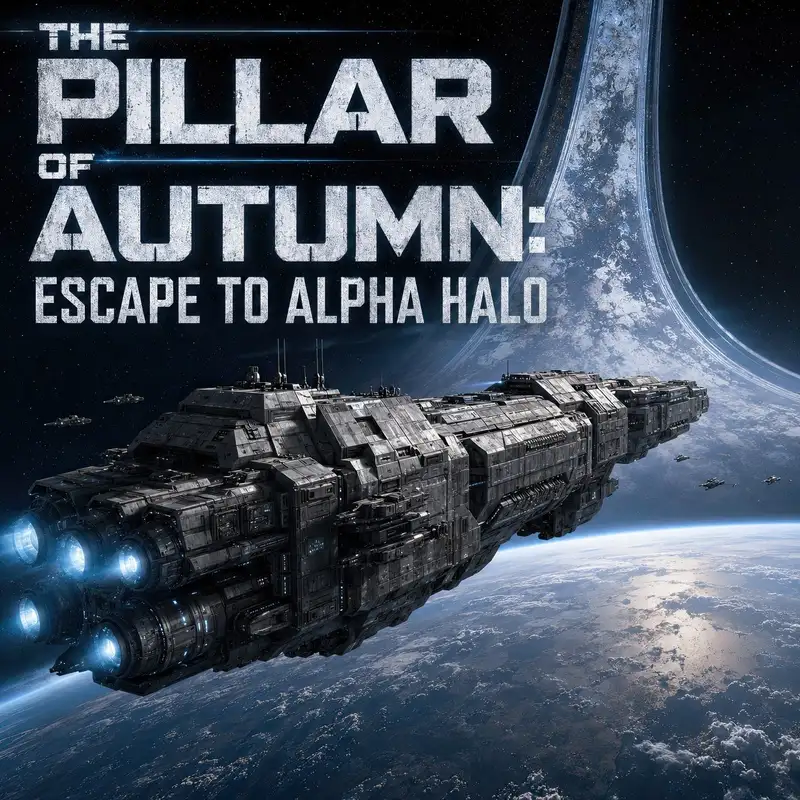
The Pillar of Autumn: Escape to Alpha Halo
At the Asźod ship-breaking yards, Captain Jacob Keyes faced a decision that would have been irrational on almost any other day. The Pillar of Autumn was damaged, Reach’s orbital defenses were collapsing, and Covenant ships were closing over the continent. The cruiser could attempt to leave immediately, but the intelligence package carried by Noble Team had not reached the ship. Keyes remained in place. He came down in a Pelican to collect it personally while Marines held the drydock and an approaching Covenant battlecruiser moved into firing position. The last ship capable of carrying the package away from Reach waited beneath enemy guns because leaving without it might have made survival meaningless.
The Pillar of Autumn’s escape is often remembered as a clean transition between two catastrophes. Reach falls behind the ship. Alpha Halo appears ahead. The actual operation was less orderly. The Autumn had begun the day as the transport and command platform for Operation RED FLAG, a mission intended to capture a Covenant leader and force negotiations. By the end of August thirtieth, twenty-five fifty-two, the mission was dead, most of its Spartan assault force had been scattered or lost, and the ship had become an improvised evacuation vessel. It carried no plan for victory. It carried the people, intelligence, and weapons that had survived long enough to leave.
That role suited the Autumn for reasons its designers had not intended. The ship was a Halcyon-class light cruiser more than four decades old. The class had been judged inefficient, overbuilt, and expensive for the combat power it originally delivered. Its internal structure used extensive cross-bracing and armored honeycomb compartments that added mass without improving speed or economy. In peacetime procurement language, this was a defect. In a losing war, it meant the cruiser could absorb damage that would break a more elegant hull. The Navy had retired ships like it because they were obsolete. The Covenant War brought them back because an obsolete ship that still held atmosphere remained useful.
The Autumn had received an extensive refit for RED FLAG. Its power plant, weapons, command systems, troop spaces, and deployment facilities were upgraded, while its bridge gained a data core able to support Cortana. The ship was not transformed into a vessel equal to a Covenant carrier. It became a durable special-operations platform able to approach a larger enemy, take punishment, and keep functioning long enough for embarked forces to act. When RED FLAG collapsed, those qualities made it unusually suited to escape with survivors aboard.
Captain Keyes and Cortana formed the command partnership around which the ship operated. Keyes had earned his reputation at Sigma Octanus Four by defeating stronger Covenant forces through timing, geometry, and controlled risk. Cortana brought fire-control calculation, electronic warfare, navigation analysis, and access to information no human staff could process quickly enough during a battle. Neither replaced the crew. Damage-control teams, engineers, weapons officers, pilots, medical personnel, and deck crews kept the cruiser operational while systems failed. A captain and an artificial intelligence could choose the maneuver. The ship still needed people to make it happen.
During the orbital battle over Reach, the Autumn fought far beyond what its original mission anticipated. It destroyed a Covenant carrier early in the engagement and later defeated a specialized long-range warship that had been killing major human vessels from outside the normal defensive envelope. The victory badly damaged the cruiser and left its main reactor compromised. At the same time, John-One One Seven led a team to Reach Station Gamma to destroy navigation data aboard the prowler Circumference. The mission enforced the Cole Protocol and prevented the Covenant from obtaining routes to other human worlds. John returned to the Autumn. James-Zero Zero Five was lost, and Linda-Zero Five Eight came back critically wounded.
The Spartan force intended for RED FLAG no longer existed as a concentrated unit. Most had been sent to defend the surface generators powering Reach’s orbital magnetic accelerator platforms. Others were dead, missing, or cut off. John remained combat capable. Linda was placed in cryogenic suspension because ordinary medical treatment could not stabilize her. The Autumn carried one functioning Spartan Two from a mission built around an entire assault force. Officially, the ship still possessed its principal special operator. Operationally, it had lost the mass and redundancy that made RED FLAG imaginable.
After fighting in orbit, the Autumn conducted a rapid surface docking at the Asźod ship-breaking yards. It arrived damaged, with surviving personnel aboard and little time for repair. The yards offered a place to receive the package, recover people, and restore enough function to depart. They were not a secure naval base. They were an industrial graveyard becoming an extraction point because almost every better facility had been lost.
The package was a fragment of Cortana carrying analysis derived from Forerunner data beneath Sword Base. That work connected with information recovered from the artifact at Sigma Octanus Four. Noble Team had been ordered to deliver it to Keyes because the Autumn was the remaining platform capable of carrying the intelligence beyond Reach. Carter-A Two Five Nine died clearing the route. Emile-A Two Three Nine reached the yards with Noble Six and took control of an Onager mass driver protecting the launch area. Jun-A Two Six Six had separated from the team to escort Doctor Catherine Halsey. The package arrived because Noble Team had been reduced one mission at a time until delivery depended on two Spartans beside a departing ship.
Keyes did not delegate the final transfer. He brought a Pelican to the landing platform, received the data module from Noble Six, and offered the Spartan a place aboard. Before the extraction could be completed, Sangheili Zealots attacked the mass driver and killed Emile. A Covenant battlecruiser descended toward the yards and prepared to prevent the Autumn’s launch. Noble Six remained behind, retook the weapon, and fired on the approaching ship at close range. The shot destroyed the immediate threat and opened a corridor into the sky. The Autumn lifted. Noble Six did not.
That moment defines the real economy of the escape. The cruiser’s engines carried the survivors, but its departure was purchased by personnel who stayed outside the hull. Soldiers held the drydock. Pilots entered airspace dominated by the Covenant. Noble Team moved the package across a continent whose cities and routes were being destroyed. Emile defended the mass driver. Noble Six used it after Emile died. The Autumn escaped because several units spent their remaining combat power creating one departure window. The ship’s name appears in the history because it left. Many who made that possible remained on Reach.
Once clear of the surface, Keyes still had to pass through a blockade. The Covenant had placed ships around the system to prevent surviving human vessels from escaping with intelligence. The Autumn’s armor could absorb damage, but durability was not invisibility. Cortana managed weapons, sensors, and navigation while Keyes used the confusion of a collapsing battle to reach a viable translation point. Other human ships were fighting, withdrawing, or dying across the system. Their resistance prevented every enemy vessel from concentrating on the cruiser. Escape was not one ship outrunning an armada. It was one ship finding an opening created by the unfinished destruction of everyone else.
The Cole Protocol governed what happened next. Human ships were forbidden from leading the Covenant toward Earth or another major population center. If pursued, they were expected to choose a random slipspace vector rather than a known human route. Navigation records and artificial intelligences containing sensitive information were to be destroyed rather than captured. The Autumn had enforced that policy at Gamma Station at severe cost. Keyes now needed to leave Reach without turning the cruiser into a beacon pointing toward the worlds humanity still possessed.
Cortana did not choose a truly random destination. She used coordinates derived from the Forerunner artifact recovered at Sigma Octanus Four and the data delivered from beneath Sword Base. The resulting course led toward the Soell system. The coordinates did not point toward Earth, satisfying the immediate purpose of avoiding a human colony. They also represented a deliberate interpretation of ancient information that no command authority had fully evaluated. Cortana converted an archaeological clue into a navigation decision while the ship was escaping a blockade. It was precisely the initiative a smart artificial intelligence was designed to provide, and exactly the kind that could place a crew somewhere no existing order had anticipated.
The choice carried an intelligence logic beyond curiosity. The Covenant had risked troops and ships to recover Forerunner artifacts at Sigma Octanus and Reach. A coordinate embedded in related material could identify a place valuable to the enemy. Reaching it might reveal why the Covenant fought for those objects or create leverage for a war humanity was losing. A random jump promised distance. The Forerunner route offered information. Cortana chose the course with potential strategic value, though neither she nor Keyes understood the destination. It led to the most dangerous military installation humanity had encountered.
The slipspace transit lasted until September nineteenth. That interval is easy to compress because little conventional combat occurred aboard the cruiser, but it mattered operationally. Wounded personnel required treatment. Survivors entered cryogenic storage where appropriate. Engineers worked within the limits of a damaged ship that no longer had access to Reach’s repair yards. Ammunition, aircraft, medical supplies, and troop strength could not be replaced in transit. The crew had escaped the battle, not its consequences. Every system lost at Reach remained lost when the ship emerged.
Slipspace did not guarantee separation from the enemy. Covenant drives were faster and more precise than human systems, and the Fleet of Particular Justice followed the Autumn’s departure vector. Supreme Commander Thel 'Vadamee had helped destroy Reach and had no reason to allow a surviving human cruiser to disappear. The ship might carry navigation data, intelligence, Spartans, or evidence of Covenant operations. Pursuit was militarily sound before the destination was known. Once the Covenant calculated the route and recognized where it led, the chase acquired religious importance as well.
The Covenant ships arrived in the Soell system before the Autumn. By the time the human cruiser emerged near the gas giant Threshold, enemy warships were already positioned around an artificial ring. The structure was Installation Zero Four, later called Alpha Halo by human forces. To the Covenant, it was a sacred object associated with the promised Great Journey. To the Autumn’s bridge crew, it was an unknown megastructure occupying a system that should have offered empty space. Cortana could identify that it was artificial. She could not yet explain its purpose.
The immediate military situation was worse than the view suggested. The Autumn had completed a long transit with battle damage, reduced Spartan strength, and no friendly fleet nearby. The Covenant held the surrounding space and had enough ships to destroy the cruiser conventionally. Keyes could not call Reach for reinforcement. Reach was the place from which he had escaped. Another jump required time, a functioning ship, and freedom from the enemy formation closing around him. The Autumn had reached its destination and discovered that the pursuit had arrived first.
Keyes ordered the ship to combat alert and brought John out of cryogenic suspension. This was not a ceremonial decision to place humanity’s greatest warrior at the center of events. It was a damage-control decision. Covenant boarding craft were approaching, the ship’s internal security would soon become a ground battle, and John was the only combat-effective Spartan available. Linda remained suspended because she could not fight. Marines and Orbital Drop Shock Troopers prepared to repel boarders and evacuate. The special-operations platform built for an offensive mission was now defending its corridors long enough for its crew to abandon it.
Covenant politics created the first opening. The Prophet of Stewardship, present with the fleet, feared that unrestricted plasma fire might damage the ring. He ordered the human cruiser captured rather than destroyed near the installation. Thel 'Vadamee viewed the Autumn as an enemy warship that had to be eliminated and did not always accept the Prophet’s restraint. Their disagreement divided authority at the moment unified action would have ended the battle quickly. Religious doctrine did not make the Covenant weak. It changed what counted as an acceptable victory. Preserving the holy object mattered more than using the fleet’s full destructive power immediately.
Cortana exploited that hesitation. The Autumn used its magnetic accelerator cannon, Archer missiles, point defenses, and coordinated fire to destroy several Covenant warships and damage others, including the cruiser Truth and Reconciliation. The performance was extraordinary for a damaged Halcyon-class cruiser facing a superior force. It did not mean the ship was winning. The Covenant could replace local losses with the vessels that remained. The Autumn could not replace a missile magazine, armor section, or crew station. Its firepower bought evacuation time rather than control of the system.
Boarding parties entered through damaged sections and access points while Covenant fighters attacked outside. Human defenders fought compartment by compartment to keep the bridge, engineering spaces, hangars, and escape routes usable. A Covenant antimatter charge disabled the Autumn’s main magnetic accelerator weapon, removing the system that had inflicted the greatest naval damage. Once the gun was lost and boarders continued spreading through the hull, Keyes faced the same type of decision he had faced at Asźod. He could remain with the ship and allow the enemy to close around it, or use the time purchased by the crew to move survivors somewhere the Covenant did not yet fully control.
He ordered abandon ship. John received Cortana’s data core because she contained navigation information, military intelligence, and knowledge that could not be allowed into Covenant hands. Lifepods, Pelicans, drop pods, and other available craft launched toward the ring. Some were destroyed before landing. Others came down far from one another across terrain no human survey had mapped. Evacuation preserved personnel by dispersing them, but dispersion also broke the command network. Pilots and pod crews made independent decisions based on damaged sensors, local threats, and whatever landing area appeared survivable.
The Autumn’s embarked forces gave those scattered survivors a chance to reorganize. Major Antonio Silva commanded the Orbital Drop Shock Trooper battalion. Marines, pilots, naval personnel, and technicians carried weapons and equipment intended for RED FLAG and shipboard operations. The artificial intelligence Wellsley supported battlefield coordination for Silva’s troops. Pelican pilot Carol Rawley, known by the callsign Foe Hammer, provided transport between isolated groups after reaching the surface. These capabilities did not form a prepared planetary campaign force. They formed the components of one, separated by emergency landings and pursued by an enemy fleet.
Keyes placed the Autumn on a controlled descent toward Installation Zero Four before leaving the ship. The cruiser struck the ring and came to rest badly damaged but largely intact. Its heavy internal bracing again justified decades of criticism from procurement officers who had preferred lighter and more efficient structures. The hull survived a landing no warship was designed to perform. That preserved weapons, vehicles, supplies, data, and machinery that human forces could later recover. It also left the ship as a fixed objective visible to Covenant reconnaissance.
The landing completed the escape from Reach in the narrowest possible sense. The Autumn was no longer at Reach, and the people who had departed in its lifepods were alive on another world. They had not escaped the Covenant. They had transported a reduced human force into a system controlled by the same fleet that had pursued them. No human slipspace-capable ship remained ready to carry them away. The cruiser was grounded. The survivors were surrounded by an enemy that considered the ring sacred and possessed the orbital advantage to reinforce almost any point on its surface.
The discovery of Alpha Halo revealed why the coordinate decision mattered more than the ship’s survival alone. The Autumn had carried Cortana, John, Keyes, and a joint force to a Forerunner installation capable of affecting life across the galaxy. The Covenant believed the ring promised transcendence. The humans initially regarded it as terrain, technology, and possibly a weapon. Neither side yet understood that it had been constructed as part of a system intended to stop the Flood by destroying the sentient life on which the parasite depended. The Autumn’s escape had not found sanctuary. It had delivered two warring forces to an extinction mechanism.
Remaining at Reach would almost certainly have destroyed the ship, killed its passengers, and buried the Forerunner data with Noble Team. Reaching Alpha Halo created catastrophic risk, but it also placed people capable of stopping that risk at the installation. Cortana’s decision was neither pure strategic genius nor random accident. It was an informed gamble made with partial evidence when every available choice carried danger.
The ship escaped because several advantages converged for one brief interval. Its overbuilt hull survived damage that would have disabled other cruisers. Its RED FLAG refit gave it weapons, power, troop capacity, and artificial-intelligence support beyond the normal capability of its class. Keyes and Cortana used those systems intelligently. Human forces across Reach occupied the Covenant long enough for the cruiser to move. Noble Team delivered the navigation intelligence and destroyed the warship blocking the launch. The Cole Protocol prevented the escape route from leading toward Earth. None of those factors alone was sufficient.
The price remained visible in what did not arrive. Noble Six stayed on Reach. Most of Noble Team was dead, and the majority of the Spartan force intended for RED FLAG never boarded. The Autumn reached Alpha Halo only to be abandoned under attack. Many lifepods were destroyed, and the cruiser itself would never leave the installation. Escape preserved a force, not its future.
The Pillar of Autumn reached Alpha Halo through a chain of tactical successes no one had planned as a campaign. A damaged cruiser survived the fall of a fortress, waited for intelligence beneath an approaching battlecruiser, crossed a blockade, followed ancient coordinates, and fought long enough to land its people on a ring built to kill civilizations. It was not the fastest or most advanced vessel at Reach. It was the ship whose structure, crew, passengers, and accumulated sacrifices remained connected long enough to complete one more movement. Reach vanished behind it. The war’s most dangerous objective appeared ahead, chosen from clues carried aboard by soldiers who never saw where those clues led.