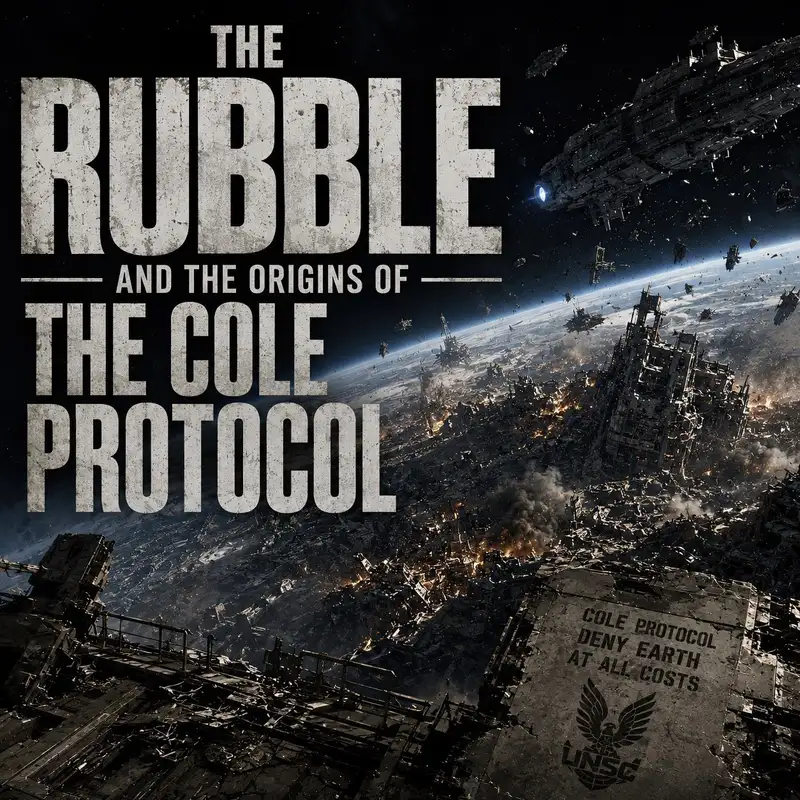
The Rubble and the Origins of the Cole Protocol
Ignatio Delgado was carrying the most dangerous object in the Rubble, and it had no warhead. The data chip in his keeping contained navigation routes leading to Earth and other human population centers. In twenty-five thirty-five, the Covenant had not yet found humanity’s homeworld. A person who sold that chip could decide where the next extermination campaign began. Gray Team had orders to erase it. Kig-Yar merchants intended to steal it. The Rubble’s leaders needed it to evacuate. The same information was simultaneously a lifeline, a bargaining instrument, and an extinction risk.
The Rubble explains why the Cole Protocol became more than another classified naval order. It recognized that location itself had become a weapon. Humanity could eventually replace a cruiser. It could continue after losing a colony, though the people there received little comfort from the distinction. If the Covenant captured a reliable route to Earth, Reach, or another major population center, tactical victory could become mass extermination. Navigation security therefore became strategic defense, enforced aboard ships, stations, artificial intelligences, and eventually among civilians who had never accepted military control.
The protocol began several years before the Rubble crisis. On December twenty-fourth, twenty-five thirty, Admiral Preston Cole led seventeen warships against three Covenant vessels at Groombridge Eighteen Thirty. Humanity won and lost eleven destroyers doing it. Human forces then recovered a living Sangheili from a crashed assault carrier. The prisoner confirmed that the Covenant intended to find and destroy every human world. Its hatred was important. The gaps in its knowledge were more useful. The Covenant possessed overwhelming firepower without a complete map of human space.
Cole understood that ignorance was one of humanity’s few remaining advantages. His first draft, designated Hypodermic F X T J, ordered ships exposed to Covenant contact to erase or destroy navigation computers and artificial intelligences if necessary. Retreating vessels were to use randomized slipspace vectors away from core worlds. Office of Naval Intelligence broadcasts would scatter old carrier signals to complicate attempts to triangulate Earth. Political approval could wait. Within Cole’s battle group, the draft became law.
The final directive became Emergency Priority Order Zero Nine Eight Eight Three One A One, better known as the Cole Protocol. Navigation databases and backups had to be purged. Retreating ships could not jump directly toward Earth, the Inner Colonies, or another populated system. If Covenant capture became unavoidable, a ship was expected to destroy itself. Shipboard artificial intelligences had to be extracted or purged. A commander might save a crew and expose a world, or sacrifice the ship to keep that world hidden. The protocol sharply limited discretion.
The Rubble revealed why a naval order could not remain confined to the Navy. After the Covenant glassed Madrigal, Insurrectionists and civilian crews rescued survivors and carried them to an asteroid cluster near the gas giant Hesiod in the Twenty-three Librae system. Refugees hollowed out hundreds of rocks, connected them with docking tubes, installed propulsion, and created a settlement of roughly one million people. Many trusted the Insurrectionists because those were the people who had arrived while Madrigal was burning.
The resulting community was not a temporary camp. Its asteroids contained housing, docks, workshops, gardens, civic spaces, and defensive positions. Rotating sections provided artificial gravity. Mass drivers and a small fighter force protected the settlement. An elected Security Council governed an independent society technically sophisticated enough to keep a million people alive inside moving stone. It was also dependent on shipping routes recorded in civilian navigation systems.
Keeping the asteroids aligned required Juliana, a smart artificial intelligence operating beyond the normal service life expected for her kind. She controlled propulsion, traffic, infrastructure, and the calculations preventing hundreds of separate collisions. Her age placed her near or within rampancy, but maintaining the Rubble gave her purpose and helped preserve coherence. The colony’s independence therefore rested on an intelligence that was difficult to replace and becoming less predictable. This was less a flaw than a concise description of wartime infrastructure.
The Rubble’s ships retained navigation data leading to Earth and other colonies. Under the Cole Protocol, every copy was a breach. The same data allowed refugees to trade, find supplies, and escape if the Covenant returned. Erasing it made the wider population safer by isolating the Rubble. Preserving it improved the Rubble’s survival prospects by endangering everyone else. The protocol had been written for military crews inside a chain of command. The Rubble placed the problem inside an independent society with sound reasons to distrust the order’s authors.
That distrust shaped the colony’s contact with the Kig-Yar. The smuggler and Security Council member Peter Bonifacio hailed an alien ship rather than attack or flee. He negotiated with a Kig-Yar leader named Reth, offering human goods and slipspace technology in exchange for Covenant weapons. Some residents believed the arrangement might demonstrate that the war was the United Nations Space Command’s fault rather than an unavoidable conflict between species. If the Rubble dealt with the Covenant separately, perhaps its people could survive as clients, trading partners, or simply a population not worth exterminating.
Reth encouraged that belief while working under secret instructions from the Prophet of Truth. The Kig-Yar were to acquire navigation records that could lead the Covenant to new colonies and Earth. Weapons sold into human networks helped Reth trace where the buyers traveled, while requests for coordinates turned commerce into intelligence collection. The bargain was asymmetric from the beginning. The humans were offering mobility and information. The Kig-Yar were offering weapons supplied by an empire whose senior leadership had already ordered humanity’s destruction.
Most Security Council members eventually understood the danger. Once the Kig-Yar possessed the coordinates, the Rubble would lose its value and become another target. Bonifacio still pressed for the sale and bribed other officials. The council quietly created the Exodus Project in case either the Covenant or the United Nations Space Command found the settlement. The largest asteroid became a mobile habitat with life support and multiple slipspace drives intended to carry the entire population beyond both powers. In a participatory democracy, evacuation became one of the few secrets kept from nearly everyone.
Covenant politics made the situation less stable. Truth did not share his operation with the Prophet of Regret. When Regret discovered modified Covenant weapons in human hands, he treated the trade as heresy and sent Sangheili Zealots under Thel ‘Vadamee to destroy those responsible. Two Hierarchs were fighting the same war through conflicting classified operations. This was not yet the Great Schism. It was an early example of an empire able to build first-rate warships while losing track of which secret belonged to which Prophet.
The United Nations Space Command followed another trail toward the Rubble. Modified Covenant weapons appeared during unrest on Charybdis Nine. The stealth-equipped light frigate Midsummer Night, under Commander Dmitri Zheng with Lieutenant Jacob Keyes as executive officer, supported an Office of Naval Intelligence investigation. When a Covenant fleet entered the system, Zheng and Keyes wanted to join the defense. Intelligence officers ordered them to follow the freighter Kestrel instead. Charybdis Nine faced the attack while the frigate pursued a supply chain that might expose a larger threat.
That decision captured the logic of the Cole Protocol. Defending one colony mattered. Discovering how Covenant weapons moved through human space might protect many more. Midsummer Night followed Kestrel into the Twenty-three Librae system and found an independent metropolis hidden among asteroids, where humans traded openly with Kig-Yar. The intelligence mission had succeeded. The frigate was now inside a settlement whose defenses were aimed partly at the government it represented.
Gray Team was already there. Jai Zero Zero Six, Adriana One One One, and Michael One Two Zero were Spartan Twos trained for prolonged missions with little supervision. Their orders were to locate and destroy navigation data throughout the Rubble, not to restore Unified Earth Government authority or arrest every Insurrectionist. They operated from the stolen freighter Petya and moved undercover through the habitats. The assignment suited their independence. It also required three soldiers to search a million-person settlement for information that could be copied, hidden, or moved in an object smaller than a sidearm.
By the time Gray Team closed in, the Rubble had destroyed most of the dangerous records. One set survived. The Security Council gave it to Ignatio Delgado, a Madrigal survivor in the Rubble Defense Force. Delgado understood the risk but rejected the United Nations Space Command’s claim to the data. When rogue Kig-Yar attacked him and killed his copilot, Adriana intervened and treated his wounds. She requested the chip. Delgado refused. Rescue by a Spartan did not erase colonial history or guarantee protection after his people surrendered their only route out.
Juliana forced a compromise. She penetrated Petya’s systems and disabled the ship, proving that Gray Team’s stealth did not conceal it from the intelligence coordinating the colony. She offered the remaining data if the Spartans helped defend the Rubble from the Kig-Yar. Gray Team accepted. Data destruction became a coalition operation with an Insurrectionist artificial intelligence, refugee security forces, and civilians who regarded the Spartans as agents of occupation. The Cole Protocol demanded obedience. Achieving its purpose required negotiation.
Midsummer Night’s arrival nearly destroyed that coalition. Lieutenant Badia Campbell, a navigation officer sympathetic to the rebellion, sabotaged the frigate’s coolant system and mortally wounded Commander Zheng. Rubble defenses struck the crippled ship with a mass-driver round and missiles. Zheng ordered its Shiva nuclear weapons ejected so they could not be seized or used against the settlement. As he died, Keyes assumed command and surrendered to save the crew. The Rubble imprisoned loyal personnel and offered some of them citizenship.
Keyes’s surrender did not reject the Cole Protocol. The captors were human, and destroying the frigate would have killed his crew without eliminating the navigation threat. He preserved the force because the mission could continue. That judgment mattered within hours. Kig-Yar and Sangheili factions were already turning on one another, Thel ‘Vadamee’s Zealots had been captured after betrayal, and Reth was preparing to seize the Rubble with an army assembled on Hesiod’s moon Metisette.
The crisis tightened around Delgado’s chip. Bonifacio took Delgado and Council member Diego Esquival to the freighter Distancia, supposedly so the data could be moved into Habitat Exodus. He instead drew a weapon, shot Diego, stole the chip, and attempted to deliver it to Reth. Gray Team recovered Delgado, disabled Distancia, and forced Bonifacio to reveal where he had hidden the data. The navigation record had now moved from civil-defense asset to private bargaining currency to Spartan objective in a matter of minutes. No database purge could solve a security problem carried by individual ambition.
Juliana next needed proof of the Kig-Yar plan. Jai freed Keyes and the imprisoned crew of Midsummer Night. Keyes, Orbital Drop Shock Troopers, Delgado, and Gray Team mounted a boarding action against the Kig-Yar raider Infinite Spoils so Juliana could enter its network. The operation encountered Thel ‘Vadamee and his surviving Zealots, who were attempting to seize the same ship for their own purposes. Jai and Thel fought briefly, years before either understood how completely the war would reorder their loyalties. The engagement produced no lasting alliance. It did reveal Reth’s preparations on Metisette.
Reth had established the Redoubt on the moon and assembled hundreds of thousands of Unggoy as an invasion force. The Kig-Yar planned to seize the Rubble, obtain the coordinates, and use the settlement’s people and infrastructure for their own campaign. The Rubble’s belief in a separate peace collapsed. Even then, the Security Council hesitated to fight beside the United Nations Space Command. Residents had survived by treating central authority as a threat. They now had to accept that the alien merchants they had trusted intended to make the entire argument academic.
Fighting inside a space habitat made atmosphere part of the weapon system. Keyes’s personnel and the Spartans sealed their suits before Juliana vented a contested dock. Most Kig-Yar there were unprepared for vacuum and died before the remaining defenders were cleared. Bulkheads, airlocks, pressure zones, traffic control, and artificial gravity were not background systems. They were terrain. Juliana could shape that terrain faster than a biological commander, provided the people inside trusted her enough to survive the change.
The evacuation and counterattack became one operation. Habitat Exodus, a six-mile mobile asteroid designed to carry the Rubble’s population, began loading civilians. Its intended long-range escape capability was incomplete because not enough slipspace drives had been installed. Juliana nonetheless had no other transport capable of moving roughly one million people. While the population entered Exodus, Keyes retook command of the partially repaired Midsummer Night. Rubble ships and mass drivers held off the Kig-Yar fleet, and empty habitats were maneuvered away from the evacuation route.
Midsummer Night made a high-speed descent toward Metisette and deployed Gray Team with Orbital Drop Shock Troopers against the Redoubt. Their objectives were the anti-aircraft batteries and sensor facilities that could detect or stop Juliana’s larger attack. The landing force suffered heavily. One sixteen-person Orbital Drop Shock Trooper element was reduced to six survivors before completing its task. Jai’s force placed the frigate’s last Shiva warhead at the sensor hub. The nuclear detonation damaged the Redoubt and blinded the defenders long enough for the ground teams to withdraw.
Juliana then converted the Rubble from a home into ammunition. She fractured the emptied settlement, drove its asteroids toward Metisette, and bombarded the Redoubt with the same rocks she had spent years keeping safely aligned. The impact destroyed Reth’s army and killed him during his attempted escape. It also destroyed Juliana. The artificial intelligence chose to end her life with the settlement whose continued operation had held her mind together. A colony built from mobile stone survived by becoming kinetic bombardment against the force preparing to capture it.
Exodus escaped under Midsummer Night’s protection, carrying the Rubble’s population and the navigation record Gray Team had been sent to destroy. The original plan called for a long jump beyond both the Covenant and the Unified Earth Government. Its incomplete drive array could not make it, while shorter jumps would take generations. The civilians had escaped the battle and remained trapped by propulsion, life support, and interstellar distance. Security doctrine had encountered the unhelpful habit of refugees needing somewhere real to go.
Keyes persuaded the Security Council to use the data and travel to Falaknuma in the Eighteen Scorpii system. The decision appears paradoxical only if the Cole Protocol is reduced to deleting coordinates. Its purpose was to deny them to the enemy. The data remained under human control, the Kig-Yar force had been destroyed, and Midsummer Night could escort the refugees. Erasing the route then would have protected a principle by condemning the people that principle existed to protect.
The migration succeeded, narrowly. Exodus reached Falaknuma, where its inhabitants transferred to the colony. The asteroid then began breaking apart from the stresses of moving so large a body through slipspace. Its fragments formed a debris ring and complicated local navigation for years. The Rubble’s people arrived alive, but their habitats, infrastructure, political independence, and shared home had been consumed by the escape. An evacuation can preserve people without preserving the society they built.
Admiral Cole debriefed Keyes and promoted him to commander. Delgado joined the Navy. Gray Team returned to operations behind enemy lines. Rubble survivors entered a government system many had spent years rejecting. This did not prove that the United Nations Space Command had been correct in every colonial dispute. It showed that Covenant extermination could force cooperation without resolving the grievances that had made cooperation unlikely.
The Rubble exposed the many ways the Covenant might locate human worlds. Navigation data could be captured from military computers, carried by civilian freighters, copied into artificial intelligences, sold by officials, exchanged by smugglers, traced through modified weapons, or revealed by a retreat vector. Security could not be achieved through one locked room at Fleet Command. Captains, station managers, pilots, technicians, and artificial intelligences had to treat ordinary geographic information as controlled war matériel.
That requirement saved lives and imposed brutal costs. Ships jumped away from friendly systems before turning home. Crews erased computers they might need for survival. Artificial intelligences faced destruction rather than capture. Disabled vessels were scuttled when safe rescue proved impossible. Refugee ships became security liabilities if their databases remained intact. The protocol worked by making local survival subordinate to the concealment of populations the local unit might never see.
The policy was imperfect. The Covenant found colonies through Forerunner Luminaries, tracking devices, accidents, captured personnel, and betrayal. Earth was eventually discovered in twenty-five fifty-two. For most of the war, however, the enemy lacked a dependable map of humanity’s core worlds. The protocol forced it to search and follow incomplete leads rather than move directly between major population centers. In a war humanity could not win ship for ship, enemy ignorance became strategic depth.
The Cole Protocol was born at Groombridge, where Preston Cole learned that the Covenant intended to destroy every human world but did not know where those worlds were. It matured at the Rubble, where almost every weakness in the policy appeared at once. Civilian need competed with military secrecy. Insurrectionists held information the government could not simply seize. Covenant factions ran overlapping operations. One corrupt official nearly sold Earth, while an aging rebel artificial intelligence became one of the protocol’s most effective defenders.
The defining image is Habitat Exodus emerging above Falaknuma and beginning to break apart while the Rubble’s former homes fell onto Metisette. The navigation data at the center of the crisis had been dangerous enough to justify destroying ships and valuable enough to guide a million refugees to safety. That contradiction was the Cole Protocol in its most honest form. Information did not become dangerous because it existed. It became dangerous when the wrong force controlled where it led.