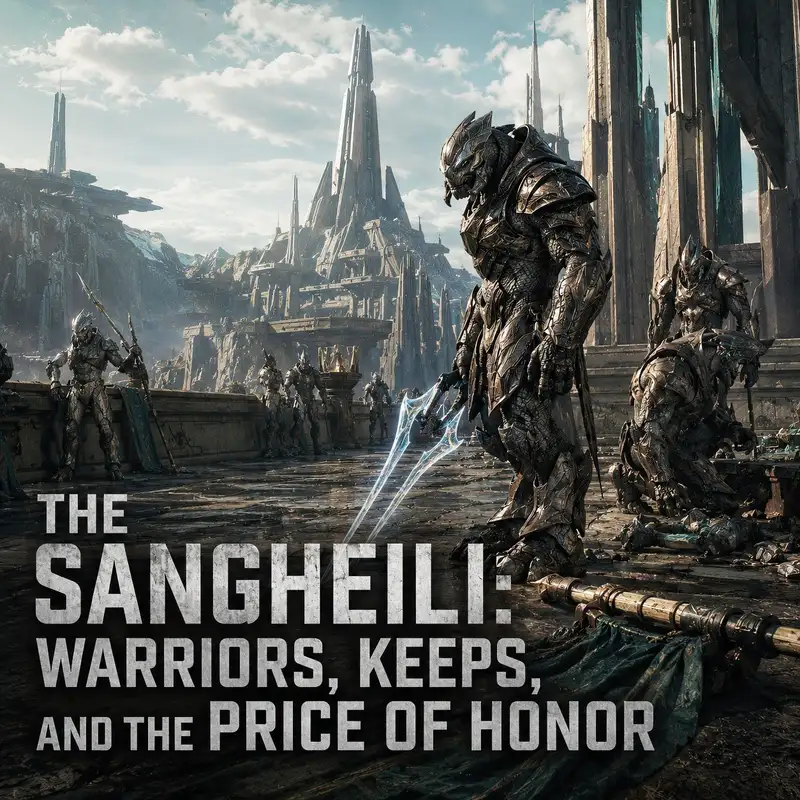
The Sangheili: Warriors, Keeps, and the Price of Honor
Across High Charity and the fleets gathered around Installation Zero Five, Sangheili officers received an order that broke the political logic of their entire civilization. The Jiralhanae were replacing them as the Prophets’ chosen protectors. Honor Guards were dismissed. Commands were transferred. Councilors were isolated. Then the transfers became executions. A warrior who had spent his life proving loyalty to the Covenant now had to decide whether obedience meant surrendering his weapons, resisting the government he had sworn to defend, or attacking members of another species who had fought beside him. The Great Schism was a military purge, but its deepest weapon was Sangheili honor turned against itself.
The Sangheili are often described as honorable warriors, which is accurate in the same way that calling a fleet a collection of ships is accurate. It identifies the visible part and leaves the operating system unexplained. Their military strength came from keeps, clans, lifelong training, ritualized competition, and a belief that reputation had to be demonstrated through action. Those same institutions could punish caution, discourage medical care, reward politically useful sacrifice, and divide commanders whose interests were attached to different lineages. The central question is not whether Sangheili honor was real. It is what that honor produced, who learned to control it, and what the Sangheili paid when duty became indistinguishable from obedience.
Long before humans called them Elites, the Sangheili had built an interstellar civilization centered on Sanghelios and its colonies. Their society was not one nation with one bureaucracy. Political life grew from territorial states, ancestral households, military lineages, and the fortified communities known as keeps. These institutions survived Covenant rule because the empire needed them. The keep remained where a Sangheili learned identity, obligation, and the names of those whose achievements he or she was expected to equal.
A keep was more than a fortress. It was an ancestral home, a training ground, an economic center, a political assembly, and a repository of collective memory. Smaller client keeps could owe allegiance to the ruling keep of a state. Elders represented important lineages and advised the kaidon, the leader responsible for the territory. Land, family, military obligation, and political authority therefore reinforced one another. A defeat in distant space could damage a household’s influence at home. A dispute between commanders could become a dispute between keeps. Sangheili politics traveled with every fleet.
The kaidon was expected to rule because he had proved capable of defending the state and himself. Councils of elders selected leaders, but selection did not end the test. Rivals could challenge or attempt to assassinate a new kaidon. If the challenger failed, the consequences could extend to the conspirator’s family. If the kaidon died, the death itself demonstrated unworthiness. The arrangement encouraged alert, formidable leaders who understood that political authority required personal competence. It also institutionalized violence as a form of review. Human governments produce audits, hearings, and votes of no confidence. Sangheili elders occasionally produced assassins, which did reduce the paperwork.
The system was not simply male warriors commanding passive households. Women traditionally exercised substantial authority over keeps, bloodlines, property, education, and local administration, especially while male relatives served on distant campaigns. Scions could preserve a keep after the death of a kaidon, and women trained to defend their communities even when formal military service remained restricted. This division of labor was unequal, but it was not powerless. The Covenant depended on generations of male warriors leaving home because others maintained the institutions to which they intended to return. When postwar reform opened wider military roles to women, it changed tradition while also recognizing skills the keeps had required for centuries.
Sangheili military preparation began early. Adolescence was spent learning weapons, physical discipline, fieldcraft, history, and the expectations of the clan. Only capable candidates were chosen to represent their kaidon in Covenant service. A newly encountered Sangheili Minor was therefore not an untrained recruit receiving his first weapon. He had already survived years of selection inside a culture that treated martial competence as a qualification for adult status. This produced highly motivated soldiers with strong small-unit instincts and confidence in personal combat. It also meant that the empire could draw trained personnel from the keeps without building every part of their identity itself.
Honor bound those personnel together, but honor was never one written regulation applied identically by every Sangheili. It included courage, loyalty, repayment of debts, defense of the keep, obedience to legitimate authority, mastery of arms, and willingness to accept responsibility for failure. Different clans and warrior orders emphasized different obligations. Zealot chapters preserved ancient codes. Ascetic traditions survived beneath Covenant institutions. Fleet commanders interpreted honor through service and victory. Kaidons interpreted it through protection of land and lineage. A warrior could therefore act honorably according to one duty while betraying another. The Great Schism became possible because loyalty to the Prophets and loyalty to the Sangheili had been allowed to appear identical until they suddenly were not.
Armor made status visible. Harness color, ornament, and pattern could identify rank, office, specialization, religious distinction, or personal achievement. The energy sword carried an even heavier meaning. It was a close-combat weapon, but also a symbol of lineage, command, and the right to settle disputes personally. A kaidon who expected others to fight while refusing danger himself contradicted the ideal of leadership. Yet ceremonial prestige could distort military judgment. Closing with an enemy might demonstrate courage when a firing line, air strike, or withdrawal would better serve the mission. Professional warriors still had to learn that valor and efficiency were not synonyms.
The Sangheili possessed fleets and colonies before meeting the San’Shyuum. Their conflict with the Prophets began over the use of Forerunner relics and ended with the Writ of Union. The settlement created a durable exchange. San’Shyuum leaders interpreted sacred history and directed imperial purpose. Sangheili warriors provided fleets, officers, and coercive power. This was not immediate enslavement. The Sangheili entered as a founding people whose military strength the Prophets could not simply ignore. They retained seats on the High Council, command of major forces, and control of many local institutions. The danger lay in allowing another species to define which wars were sacred and which sacrifices counted as honorable.
Under the Covenant, Sangheili service became both military career and religious obligation. A commander did not merely protect territory. He defended the Great Journey, recovered relics, punished heresy, and proved his worth before the gods. That fusion gave the empire extraordinary mobilizing power. Orders carried operational authority, political authority, and spiritual consequence at once. Refusal could be cowardice, treason, and heresy in the same moment. The San’Shyuum did not need to defeat Sangheili honor. They placed themselves at the top of it, presenting the Prophets as the legitimate source of missions through which warriors earned status.
The results on the battlefield were formidable. Sangheili officers commanded warships, task forces, occupation forces, special operations, and combined-species ground units. Their training favored initiative, aggression, and the personal presence of leaders near danger. They could maneuver with discipline, exploit technological superiority, and recover from local setbacks without waiting for every detail to be approved by High Charity. Human personnel often encountered them as fast, shielded opponents able to think independently rather than as automatons following a fixed pattern. Their effectiveness came from preparation and institutions, not from biology alone. A strong body helped. A lifetime spent being evaluated by armed relatives helped considerably more.
Covenant command also gave Sangheili leaders access to the abilities of other species. Unggoy supplied infantry and technical labor. Kig-Yar served as scouts, marksmen, privateers, and ship crews. Yanme’e added mobility and engineering support. Mgalekgolo provided concentrated heavy combat power. Huragok maintained systems few warriors fully understood. A capable Sangheili commander could combine these strengths into a flexible force. An incapable one could treat subordinates as expendable, ignore their knowledge, and discover that fear is a poor substitute for coordination. Species hierarchy made Sangheili command easier politically and less reliable operationally, especially when lower-ranking personnel possessed information their superiors were culturally unwilling to hear.
Naval service brought the highest form of Sangheili power. Shipmasters and fleetmasters controlled vessels whose weapons could decide the fate of colonies. Command at that scale required more than swordsmanship. It demanded navigation, intelligence, formation control, logistics, damage assessment, and an understanding of ministry politics. Covenant fleets were not one standardized navy, and Sangheili commanders varied from patient professionals to ambitious zealots. Their culture encouraged decisive action, but the most successful officers knew when not to attack. Rtas ‘Vadum’s later record showed that a warrior could value honor while practicing quarantine, fleet coordination, and strategic restraint. Survival occasionally requires the courage to refuse a glorious mistake.
One of the clearest costs of the warrior ideal appeared in attitudes toward injury. Blood carried meaning, and visible wounds could be treated as evidence of courage. Seeking medical care might be viewed by traditionalists as weakness or an attempt to avoid an honorable death. These beliefs were never universal, and practical commanders used healers when they could. The culture still lost experienced personnel who might have survived with treatment. Postwar reformers who protected medical specialists were not merely changing bedside manners. They were challenging a system in which avoidable death had been turned into proof of virtue. No military can indefinitely replace veterans for the sake of maintaining a dramatic casualty report.
The willingness to die gave Sangheili formations resilience under fire. It also gave political leaders a renewable resource of sacrifice. A mission framed as sacred could consume ships and warriors without requiring the same explanation that a secular government might owe its population. Families expected sons and brothers to return with honor or not return at all. Commanders who questioned an objective risked appearing fearful. The empire could therefore continue operations whose religious value exceeded their military value. Tactical bravery concealed strategic waste. The dead had proved devotion. The ministry that selected the target usually remained at High Charity.
Shame was the other side of the system. A public failure could destroy status even when the circumstances exceeded any commander’s control. The title of Arbiter had once represented great authority, but the Prophets transformed it into a mechanism for reclaiming disgraced warriors. A condemned commander received sacred armor, an impossible mission, and an opportunity to die usefully. The office converted humiliation into obedience. It also removed politically dangerous figures without wasting their skills. The arrangement was efficient, provided one overlooks the fact that a religious government was using ritual suicide assignments as personnel management.
Thel ‘Vadamee experienced that machinery after the destruction of Installation Zero Four. He had commanded the Fleet of Particular Justice and defeated the human defenders of Reach, yet the loss of the ring overshadowed the campaign. The Prophets stripped his rank, marked him publicly, and appointed him Arbiter. His earlier victories did not protect him because honor was not a private moral possession. It was a status distributed by institutions. The same leaders who defined his disgrace then defined the path by which he could redeem it. His eventual rebellion mattered because he recognized that the authority judging him had manipulated both the evidence and the standard.
Honor also failed to restrain the war against humanity. Sangheili commanders destroyed fleets, invaded colonies, and participated in the glassing of inhabited worlds as part of a campaign intended to exterminate the human species. Individual warriors could respect human courage while continuing the killing. Some regarded worthy opponents as admirable and still denied those opponents any right to survive. A code centered on loyalty, courage, and martial reputation is not automatically a humanitarian law. The Prophets framed genocide as sacred duty, and Sangheili honor supplied disciplined execution. Respect for an enemy meant little to the civilians beneath an energy projector.
This contradiction did not make every Sangheili identical. Some commanders were cruel. Some were restrained within the limits of their orders. Some questioned the war’s purpose. Others embraced it. The human label Elite concealed those differences because soldiers under fire rarely conduct political anthropology before returning fire. The distinction became strategically important in twenty-five fifty-two. Once the Prophets moved against the Sangheili as a species, commanders responded according to competing duties. Some defended the old Covenant. Some joined the rebellion. Some protected only their fleets or keeps. Honor did not provide one answer because the obligations had finally separated.
The Great Schism was therefore not an instant moral awakening. It was a civil war triggered by political replacement, religious betrayal, and fear of annihilation. The Jiralhanae received commands formerly held by Sangheili. Sangheili councilors and officers were attacked. Fleets divided. Old rivalry became organized slaughter. The Arbiter’s alliance with humanity emerged from necessity and shared enemies, not sudden forgiveness. Sangheili forces helped stop the Prophet of Truth and the Halo activation because their survival required it. Many still hated humanity. Many humans had equally sound reasons to hate them. Cooperation was a battlefield solution to a common strategic problem, not a completed peace.
When the Covenant collapsed, the keeps became more important because the imperial institutions above them had disappeared. Sangheili officers returned with ships, followers, weapons, and competing claims about the future. Some joined the Swords of Sanghelios. Some embraced religious restoration. Some became regional warlords or aligned with Covenant successor groups. Others entered the Banished. The result was the Blooding Years, a series of conflicts in which local allegiance could matter more than any species-wide identity. The Covenant had provided a common command structure. Its fall revealed that the Sangheili possessed many governments, many armies, and no universally accepted method for combining them.
The Swords of Sanghelios under Thel ‘Vadam became the most important unifying force, but not a government automatically obeyed by every keep. The alliance depended on kaidons, fleet commanders, and local leaders who retained their own interests. Thel sought a broader union capable of defending Sangheili worlds and negotiating with other species. Rival leaders saw centralization as a threat to their autonomy or a betrayal of tradition. Assassination remained a recognized answer to political disagreement. A leader could liberate Sanghelios and still need decoys while traveling through his own capital. Victory over the Prophets had not removed the political habits the Prophets had exploited.
Human intelligence services understood that fragmentation. Elements within the Office of Naval Intelligence armed Sangheili dissidents and attempted to prolong the civil war so humanity could recover without facing a unified former enemy. It treated keeps as pressure points in a system that could be manipulated from outside. Sangheili leaders knew some humans sought alliance while others sought permanent weakness. The discovery reinforced every traditional warning about foreign influence. Thel’s diplomacy therefore required him to cooperate with humanity without pretending humanity had one policy or that the war’s victims had forgotten who burned their worlds.
Reform reached into the keeps themselves. Thel elevated the role of scions, supported healers, expanded military opportunities for women, and accepted service from species the Covenant had ranked beneath the Sangheili. Tul ‘Juran’s combat service helped open formal military roles that tradition had restricted. These changes were operational as well as ethical. A modern force needed talent wherever it could be found. Traditionalists interpreted the same measures as an attack on identity. Reformers argued that a culture unable to change after discovering its sacred empire was built on lies had learned very little from the experience.
The collapse also exposed technological and industrial dependence. Sangheili artisans had maintained deep weapons knowledge, and some had quietly resisted San’Shyuum restrictions even before the Schism. Yet Covenant production had linked ministries, Huragok, specialized worlds, supply systems, and species-specific labor across the empire. A keep that inherited a cruiser did not automatically inherit the network required to repair it. Postwar manufactories began new work, restored older designs, and developed vessels for Sangheili requirements rather than Prophet policy. This was a genuine renaissance, but it proceeded unevenly. A warship can symbolize sovereignty while waiting for parts manufactured by someone whose politics are less inspiring.
Cooperation with humanity became one answer to that weakness. The Anvil Initiative brought human and Sangheili personnel together to test equipment, exchange technical knowledge, and build habits of joint service. This required more than combining armor components. Veterans had to work beside former enemies whose species had killed their families. Sangheili participants had to accept that honor could include patience, technical collaboration, and adherence to agreements with humans. It created a setting where younger personnel might develop professional trust before another crisis forced them to improvise it under fire.
Later crises proved that the political problem remained. Created occupation used overwhelming machine power to impose order on Sanghelios. After that grip weakened, the Banished exploited local divisions and resource competition, including fighting around the valuable mines of Suban. Some keeps supported Thel. Others sought different arrangements or accepted Banished influence. Sangheili commanders again faced the problem that had defined their history: whether loyalty belonged first to a leader, a keep, a species, an alliance, or a personal code. Superior courage could not substitute for unified strategy. A gate left open by a sympathetic local faction could defeat defenses that no attacking army had been able to breach.
The Sangheili were warriors because their society trained them to connect military competence with adulthood, political authority, family reputation, and spiritual worth. Their keeps produced resilient communities and leaders who understood personal responsibility. Their honor encouraged courage, loyalty, and a willingness to stand against impossible odds. The price was paid when those virtues became rigid. Warriors died rather than accept treatment. Commanders pursued sacred objectives instead of strategic ones. Rivals turned political disagreement into blood feud. Prophets transformed shame into control and obedience into genocide. The code did not fail because honor was meaningless. It failed because powerful institutions were allowed to define honor for everyone else.
The post-Covenant struggle is therefore not a choice between tradition and dishonor. It is a contest over which traditions deserve to survive. The Sangheili can preserve courage without worshiping unnecessary death, defend keeps without accepting permanent fragmentation, and respect martial skill without making violence the final test of every political claim. Their most difficult campaign is not against humanity, the Jiralhanae, the Created, or the Banished. It is against the belief that a warrior proves loyalty by surrendering judgment. The Great Schism began when Sangheili officers learned that obedience could require their own destruction. Their future depends on never confusing that obedience with honor again.