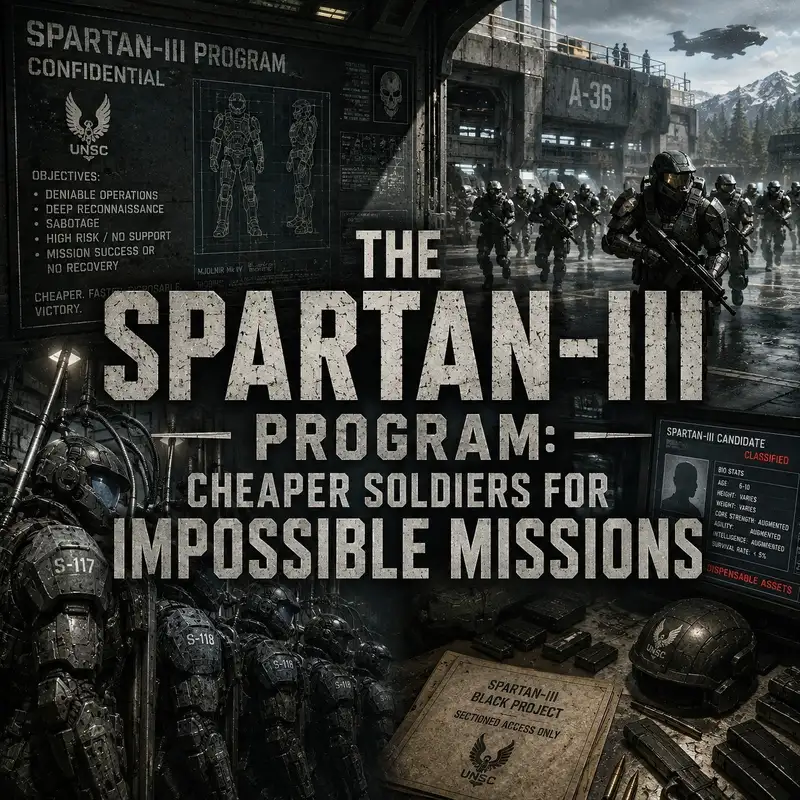
The Spartan-III Program: Cheaper Soldiers for Impossible Missions
On July third, twenty-five forty-five, three hundred Spartan Threes of Beta Company descended toward Pegasi Delta in long-range stealth pods. Their objective was a Covenant fuel refinery that nuclear strikes had failed to reach and conventional commanders considered too heavily defended for a normal assault. The Spartans reached the target, destroyed it, and forced the Covenant to rebuild a supply route far deeper inside its own territory. Two members of the company returned. The official result was a strategic success.
That arithmetic defined the Spartan Three program. The soldiers were not designed to be inferior copies of the Spartan Twos. They were designed to be more numerous, less expensive to equip, easier to conceal, and available for operations in which the United Nations Space Command expected catastrophic losses. The central question was not whether they could fight. They could. The question was whether humanity could create enough of them, quickly enough, to exchange small formations of exceptional soldiers for time the wider war effort desperately needed.
By twenty-five thirty-one, the Covenant had exposed the weakness of the existing Spartan system. The Spartan Twos were extraordinarily effective, but there were too few of them to influence every threatened colony or fleet engagement. Their selection standards had been narrow, their training lengthy, and their Mjolnir armor so expensive that each suit represented a major strategic investment. A Spartan Two team could destroy an objective that defeated conventional troops. It could not be present across hundreds of systems while the Covenant selected the next colony to burn.
Colonel James Ackerson of the Office of Naval Intelligence proposed a different model. His Spartan Three program was approved in October of twenty-five thirty-one under the deeply classified Beta Five Division. The new project would widen the candidate pool, use safer augmentation procedures, train companies rather than one small class, and replace standard Mjolnir issue with Semi-Powered Infiltration armor. Ackerson was not promising a better version of Catherine Halsey’s program. He was promising a force that could be produced in batches and committed where ships, aircraft, and ordinary special operations units could not achieve the required effect.
Vice Admiral Margaret Parangosky understood the proposal as strategic economy. Humanity was losing warships, colonies, trained crews, and industrial capacity faster than it could replace them. A company of Spartans might cost less than the battle group required to achieve the same objective, assuming a battle group could reach the objective at all. The program therefore treated trained personnel as an alternative form of precision weapon. That conclusion was militarily coherent. It was also possible only because the people being converted into those weapons had very little political power.
The candidates were children orphaned by Covenant attacks. Many had seen their families, homes, and entire communities destroyed. Recruiters offered them a direct path toward revenge. This differed from the Spartan Two abductions and flash-clone replacements. The Spartan Three candidates were presented with a choice. A traumatized child choosing between helplessness and becoming a weapon is not exercising the kind of consent a military institution normally claims to value. The program did not steal them from living parents. It recruited them from the wreckage of a war the government had been unable to stop.
Their grief solved a motivational problem. Their biology still had to solve a medical one. The Spartan Three selection standards were broader than Halsey’s requirements, but they were not open to every orphan who volunteered. Genetic compatibility remained important, and the Office of Naval Intelligence could find only a limited number of viable candidates for each company. Ackerson wanted scale. Human physiology, funding, and the number of children who fit the profile kept reducing his preferred totals to several hundred at a time.
The training site was Camp Currahee on Onyx, a world whose official isolation protected the program from public scrutiny. The Office of Naval Intelligence removed Spartan Two Kurt Zero Five One from active service and gave him the surname Ambrose, placing him in command of the project. Senior Chief Petty Officer Franklin Mendez, who had trained the Spartan Twos, joined him. Ackerson supplied the institutional design. Kurt and Mendez had to turn angry, frightened children into coherent military formations.
Their training was compressed, severe, and focused on immediate military usefulness. The candidates learned fieldcraft, marksmanship, demolition, infiltration, survival, small-unit tactics, and the academic subjects needed to understand those tasks. They were repeatedly placed against superior numbers, inadequate equipment, and objectives whose apparent solution was deliberately wrong. The purpose was not merely physical conditioning. It was to produce soldiers who expected plans to fail and could continue without waiting for a headquarters to explain what the enemy had changed.
Team cohesion became essential. Alpha Company’s candidates arrived with high aggression and a strong desire for personal revenge. Kurt and Mendez redirected that aggression toward collective performance. Later companies received even greater emphasis on unit cohesion because experience showed that once a company fragmented, individual excellence could not compensate for enemy airpower, orbital reinforcement, and a lost extraction route. A Spartan could outrun ordinary infantry. No Spartan could outrun a cruiser descending through the atmosphere.
Project Chrysanthemum provided the biological transformation. Advances since the Spartan Two augmentations allowed most enhancements to be delivered through chemical and less invasive procedures. The candidates received reinforced skeletal structures, increased muscular density, improved vision, and faster physical response. The accepted Spartan Three candidates survived augmentation at rates that would have seemed impossible during Halsey’s first class. The safer procedure did not make the results weak. It made the process more repeatable.
The principal economy came from equipment. Most Spartan Threes received Semi-Powered Infiltration armor, usually called S P I armor. It offered environmental protection, communications, limited ballistic and energy protection, and active camouflage intended to reduce the wearer’s visual signature. It was substantially less protective than Mjolnir and did not amplify strength on the same scale. It was also cheaper, easier to manufacture, and suitable for covert movement by entire companies. The armor matched the mission. These Spartans were meant to penetrate, sabotage, and disappear, not stand in open ground trading fire with Covenant armor.
Calling S P I merely cheap understates its value. Its camouflage made it excellent for reconnaissance and infiltration. The platform could accept specialized attachments and later became useful as a development testbed because losing one suit did not destroy an investment comparable to Mjolnir. Its weakness appeared when stealth failed. Plasma fire, heavy weapons, and sustained close combat could overwhelm it rapidly. The program reduced procurement cost by transferring more risk to the person inside the armor.
Alpha Company was the first full demonstration. Hundreds of candidates trained on Onyx, and the company entered active service in twenty-five thirty-six. They performed well in several early operations, giving the Office of Naval Intelligence evidence that the concept worked outside controlled exercises. Kurt and Mendez also identified exceptional individuals whose talents were better suited to long-term special operations. Some were reassigned before the company’s largest mission, eventually serving in units such as Noble Team or in two-person Headhunter elements dedicated to reconnaissance, sabotage, and assassination.
Those reassignments are important because they correct the simplest version of the Spartan Three story. The program did not send every graduate into one formation and wait for the casualty report. It maintained at least two employment models. Mainline companies delivered massed special-operations power against strategic targets. Selected Spartans were removed for sustained service in smaller teams, sometimes issued Mjolnir armor, and placed under other commands. The institution saw expendability at the company level while still recognizing exceptional individuals as assets worth preserving.
On July twenty-seventh, twenty-five thirty-seven, the three hundred Spartans assigned to Alpha Company began Operation Prometheus against a Covenant shipyard on asteroid K Seven Forty-Nine. The facility supported multiple vessels under construction and contained plasma reactors spread across its surface. Destroying it promised more than a local victory. Every ship delayed or prevented from launching was one less hull available to attack human colonies.
Alpha Company landed with surprise and spent days disabling reactor sites. The Covenant eventually concentrated reinforcements, cut off the Spartans from extraction, and turned the operation into a battle of attrition. Alpha continued destroying the shipyard until the formation was overwhelmed. Every Spartan deployed on Prometheus was killed. The target was crippled, and the Office of Naval Intelligence counted the mission as successful because the industrial damage exceeded the value assigned to the attacking force.
From a campaign perspective, the decision was not irrational. Shipyards create fleets, and fleets were destroying worlds. A force of three hundred soldiers had imposed losses that might otherwise have required a major naval engagement. The operational failure was extraction. Once Covenant reinforcements closed the route out, Alpha’s stealth, augmentation, and tactical skill could only extend the fight. The program had created soldiers capable of reaching an impossible objective. It had not created a logistics system capable of guaranteeing their return.
Kurt received the loss as a commander rather than an accountant. Beta Company was approved soon afterward, with more candidates entering a training regime revised around the lessons of Prometheus. Kurt emphasized cohesion, initiative, and the need to continue toward the objective when communications failed. He also continued removing exceptional Spartans for other assignments. The Office of Naval Intelligence wanted another company. Kurt wanted soldiers who might live long enough to become something beyond one mission.
Beta Company entered service in the middle of a war that had grown worse. Its defining operation came at the Covenant refinery on Pegasi Delta in twenty-five forty-five. The installation processed deuterium and tritium used by Covenant vessels and sat close enough to human space to support continued attacks. Destroying it would force enemy ships to travel farther for fuel and lengthen their resupply cycle. Long-range nuclear attacks had been intercepted. A conventional invasion was judged too costly. Beta Company became the available answer.
The Spartans descended in stealth pods, but the insertion did not remain covert. Some were killed during landing. Covenant Seraphs began strafing and bombing the formation, forcing the Spartans to abandon concealment and move rapidly toward the refinery. Sangheili and Kig-Yar defenders reinforced the perimeter. The Spartans remained tactically dominant at close range, but every minute brought more aircraft and more troops. Then seven Covenant cruisers arrived and began delivering additional forces directly onto the battlefield.
Beta Company continued toward the objective because withdrawal would have produced the same casualties without the strategic result. Team Foxtrot reached the refinery core. Adam B Zero Zero Four remained behind after being mortally wounded. Min B One Seven Four died while setting charges. Tom B Two Nine Two and Lucy B Zero Nine One completed the destruction and escaped the blast by entering the nearby ocean. They were the only two members of the deployed company known to return.
The explosion destroyed the refinery, enemy ground forces, and Covenant ships caught within the effect. The supply base was gone. So were two hundred ninety-eight Spartan Threes. Lucy’s final words during the operation were followed by years of silence caused by post-traumatic vocal disarticulation. The medical description was precise. It could not improve the underlying fact that a twelve-year-old had watched nearly everyone she knew die while completing a mission senior officers had judged too dangerous for other forces.
Operation Torpedo demonstrated both the effectiveness and the cruelty of the program. Beta Company accomplished the assigned strategic task. Its soldiers were not killed because they lacked ability or discipline. They were killed because the enemy achieved air and orbital superiority over a force whose plan depended on speed and concealment. Special operations can bypass strong defenses. They cannot remain special once several cruisers begin delivering thousands of reinforcements onto the objective.
Tom and Lucy returned to Onyx and helped train Gamma Company. Kurt used their experience to improve the next generation, but he also made a decision outside lawful medical authority. Gamma Company received additional frontal-lobe modifications intended to increase aggression, strength, endurance, and tolerance to severe injury under stress. The changes could keep a wounded Spartan fighting after an ordinary soldier had become incapable of organized action. They also created a dependency on counteracting medications known informally as smoothers.
Without regular smoothers, Gamma Spartans risked losing emotional control, rational judgment, and eventually their grip on reality. Kurt had responded to the deaths of Alpha and Beta by making the next company harder to stop. He also made them medically dependent on a classified supply chain that might fail during precisely the kind of isolated mission they were trained to conduct. The modification improved last-stand performance and made the definition of last stand uncomfortably literal.
Gamma Company began training in twenty-five forty-five. Kurt secured approval to augment all three hundred thirty candidates who completed selection, and every one survived the procedure. He regarded them as the finest Spartans the program had produced. Most of the company deployed in late twenty-five fifty-two, but the war ended before Gamma could be committed to another company-scale operation like Prometheus or Torpedo. Fifteen remained on Onyx for top-honors competition when the planet’s Forerunner systems activated and the conflict there began.
The Onyx fighting revealed what Gamma Spartans could do outside the expendable-company model. Small teams adapted to enemies they initially misidentified, used terrain and low-velocity objects to defeat Sentinel targeting behavior, and fought beside Spartan Twos during the effort to reach the shield world inside Onyx. Some died. Others survived and continued into postwar service. Ash G Zero Nine Nine, Olivia G Two Nine One, and Mark G Three One Three later operated as members of a covert Ferret team, applying Spartan Three training to infiltration and intelligence work rather than a single mass assault.
Noble Team offered the most visible proof that Spartan Threes were never inherently lesser soldiers. Its Alpha and Beta Company veterans received Mjolnir armor and served under Army operational authority in sustained special warfare. Carter, Kat, Noble Six, Jun, Emile, Thom, and Rosenda came from the same program that produced the companies lost at K Seven Forty-Nine and Pegasi Delta. Their different careers resulted from assignment, equipment, and mission structure, not from a separate biological class.
Headhunter teams demonstrated the same point in another form. Usually operating in pairs, they conducted deep reconnaissance, sabotage, targeted killing, and disruption behind Covenant lines. S P I armor’s camouflage suited that work better than a massed frontal engagement. Their missions remained dangerous, and some teams were lost. The employment model gave them a chance to exploit stealth without requiring hundreds of Spartans to converge on one target and create a signature the enemy could eventually surround.
The phrase cheaper soldiers therefore requires care. Spartan Threes were cheaper to equip than Mjolnir-armored Spartan Twos. Their augmentations were safer and more scalable. Their training emphasized military utility over the broader education Halsey had provided. The Office of Naval Intelligence could recruit from a growing population of war orphans rather than search for a tiny class of genetically ideal children with living families. None of those efficiencies made the candidates inexpensive in any human sense. Each one required years of training, medical work, instructors, transport, armor, intelligence, and secrecy.
The program saved resources by changing what losses the institution was willing to accept. A destroyed Mjolnir suit represented a procurement crisis. A destroyed S P I suit could be replaced. A lost Spartan Two was one of a few irreplaceable operators. A lost Spartan Three company could be followed by authorization for another company. That was the strategic design, though Kurt, Mendez, Tom, Lucy, and the Spartans themselves continually resisted being reduced to that design.
The missions called impossible were not random suicide attacks. Prometheus targeted ship production. Torpedo targeted fleet logistics. Headhunters attacked command, reconnaissance, and infrastructure. Noble Team conducted high-risk special warfare in support of larger campaigns. The common feature was disproportionate effect. The Spartan Threes were sent where a small force might destroy something far more valuable than itself. Their tragedy was that the planners sometimes measured disproportionate effect only after assuming the attacking force would not return.
Did the program work? Tactically and operationally, often yes. It destroyed facilities the Covenant depended upon, disrupted campaigns, produced exceptional reconnaissance and strike personnel, and fielded hundreds of augmented soldiers during a war that consumed conventional units at an industrial rate. Strategically, it bought time. It did not reverse Covenant technological superiority, replace the ships lost over human colonies, or create enough soldiers to defend every threatened system.
Its most important limitation was the one no augmentation could solve. Spartans still required intelligence, transport, orbital access, ammunition, medical support, and extraction. Alpha Company died after its route out was cut. Beta Company died beneath enemy aircraft and cruisers. Their combat performance was extraordinary. Their support situation became impossible. The program’s public mythology would later emphasize what Spartans could survive. Its classified history was equally concerned with how much they could accomplish before survival ceased to be part of the plan.
The ethical distinction from the Spartan Two program is real but incomplete. The Spartan Threes were not abducted from intact homes and replaced with dying clones. They were orphans who accepted an offer to strike back at the force that had destroyed their families. They were also children shaped by grief, trained for years in secret, biologically altered, and committed to operations adults had decided were too costly for ordinary troops. Volunteering for revenge did not make them responsible for the institution’s choice to spend their lives.
The Spartan Three program created cheaper soldiers for impossible missions by reducing armor cost, expanding selection, improving augmentation safety, accelerating training, and accepting casualties on a scale the Spartan Two system could never sustain. Its soldiers were not cheap because they were less capable. They were cheap because the Office of Naval Intelligence calculated their value differently.
The defining image is Beta Company crossing Pegasi Delta while Covenant cruisers descend behind them. The Spartans are still moving toward the refinery because reaching it will damage the enemy more than turning back can save them. They complete the mission. Two return. Humanity receives the time their victory purchased, while the names of the children who paid for it remain inside classified files. The program made impossible missions achievable by separating mission success from the survival of the people sent to achieve it.