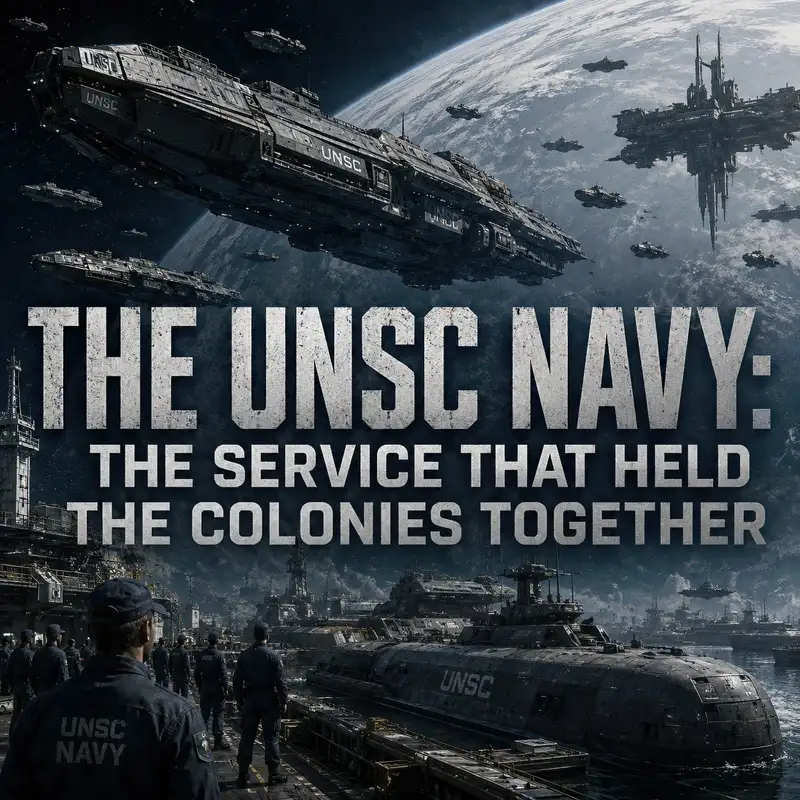
The UNSC Navy: The Service That Held the Colonies Together
In twenty-five twenty-four, commercial freighters began disappearing near the agricultural colony of Harvest. To the shipping system, each loss was a missing hull, an overdue cargo, and a crew that had stopped answering. To Harvest, the pattern threatened machinery, trade, and the movement of everything the colony could not produce locally. Naval Intelligence sent Lieutenant Commander Jilan al-Cygni under commercial cover to investigate. The cause proved larger than piracy. An alien ship was attacking human traffic, and the first warning of the Covenant War arrived not as a fleet battle, but as a break in the shipping network that made colonial life possible.
That is the best way to understand the United Nations Space Command Navy. Its most visible function was fighting in space, and during the Covenant War that function consumed ships and crews on a scale no peacetime planner had imagined. Its deeper function was connection. The Navy moved soldiers, officials, messages, artificial intelligences, medicine, ammunition, and replacement parts between worlds. It protected commercial routes, supported navigation, carried Marines, enforced blockades, and provided the orbital presence behind central authority. Humanity possessed colonies because civilians built them. The Unified Earth Government could claim to govern them because ships could still reach them.
The Navy originated in twenty-one sixty-three during the Interplanetary War, when conflict across Earth, Mars, and the wider Solar System exposed the limits of separate national forces. The newly formed United Nations Space Command combined naval and expeditionary capabilities under a common military structure. Its early campaigns established a pattern that survived for centuries. Warships delivered Marines, controlled movement between planets, protected installations, and gave political leaders a force that could act beyond Earth. Space was not merely another battlefield. It was the road between every battlefield, and whoever controlled that road could decide where reinforcements arrived and where resistance remained isolated.
Human slipspace travel expanded that mission enormously. The creation of distant colonies did not eliminate the physical requirements of settlement. Every new world needed survey ships, construction equipment, specialists, power systems, communications gear, food reserves, and a continuing flow of components until local industry matured. The Domus Diaspora, beginning in twenty-three sixty-two, created a widening network of Inner and Outer Colonies linked by routes that were never equally fast or equally secure. A colony might be politically part of the same government as Earth while remaining weeks of uncertain travel from the ministries issuing its regulations. The Navy operated inside that distance.
Most of the traffic was not carried by warships. Commercial freighters, passenger vessels, corporate transports, and colonial craft moved the bulk of the interstellar economy. The Department of Commercial Shipping regulated much of that traffic, including the licensing and inspection of slipspace-capable vessels. Civilian shipping made colonial growth economically possible. Naval power made the routes credible. A freighter could carry more fertilizer than a destroyer, but it could not deter raiders, investigate a missing convoy, or force a hostile ship to submit to inspection. The distinction between military and commercial shipping mattered. Their dependence on one another mattered more.
Navigation infrastructure was another quiet form of control. Slipspace did not allow a captain to point toward a star and arrive on schedule through confidence alone. Reliable movement depended on route data, beacons, fuel depots, trained navigators, functioning drives, and often artificial-intelligence support. Travel times varied. Ships that departed together could emerge separately. A delayed courier could leave a commander acting on information already overtaken by events. Maintaining the network required technicians and patrol forces spread across remote systems. A government that lost those nodes might retain a flag and a legal claim while losing the practical ability to move through its own territory.
The Unified Earth Government created the Colonial Military Authority in twenty-three ten to handle colonial protection. Its naval arm performed search and rescue, anti-smuggling patrols, trade enforcement, and other frontier duties that rarely produced heroic monuments but kept daily movement functioning. It also operated in a political environment increasingly suspicious of Earth. Over time, corruption, divided loyalties, and the growth of separatist conflict weakened the organization. The United Nations Space Command absorbed much of its authority and many of its responsibilities. What had begun as a colonial security arrangement became a more centralized military system directed from the Inner Colonies.
That transition reveals the Navy’s political role. A patrol ship could rescue a damaged freighter, but it could also stop one. A navigation checkpoint could prevent collisions and smuggling, but it could also enforce an embargo. A warship in orbit could discourage piracy, reassure a governor, intimidate a local council, or support troops conducting arrests. The same mobility that allowed the central government to protect a colony allowed it to compel that colony. The Navy held human space together in both meanings of the phrase. It maintained the connections on which the colonies depended, and it supplied the force used when some colonies tried to sever those connections.
The Insurrection turned that coercive function into a major mission. Separatist organizations varied widely, from political movements seeking autonomy to armed groups willing to bomb civilian targets. The central government’s response also varied, but it increasingly relied on naval mobility, intelligence collection, blockades, raids, and expeditionary forces. Navy ships transported Marines and special operators into systems where local authority had collapsed or become hostile. They intercepted suspected weapons shipments, supported counterinsurgency campaigns, and provided the communications and fire support needed by forces ashore. A local revolt became an interstellar problem the moment it could move people and weapons between worlds.
Late in the twenty-fifth century, the Colonial Military Authority fielded Punic-class supercarriers as space control vehicles capable of sustaining expeditionary and interdiction campaigns in remote Outer Colonies for months. Their scale reflected the problem. A distant operation needed more than guns. It needed troop berths, landing craft, repair capacity, command spaces, medical support, stores, and enough endurance to remain in a system after the first engagement. These ships could serve as mobile bases where permanent infrastructure was absent or politically unreliable. They were instruments of state presence. They were also extraordinarily expensive concentrations of people and matériel, which made every loss more than a line in a fleet register.
By the early twenty-sixth century, Naval Command divided its work among several major organizations. Fleet Command directed the movement and tasking of naval squadrons and allocated warfighting assets. Naval Logistical Operations Command oversaw ship construction, maintenance, ammunition, spare parts, food, and the other supplies required to keep those assets useful. Naval Special Warfare Command supported specialized missions, including operations involving Spartan personnel before later organizational changes. These were not competing descriptions of the same fleet. They were separate answers to three questions: where the ships would go, how they would remain operational, and what missions required capabilities outside ordinary fleet warfare.
Regional commands converted those decisions into action along established interstellar routes. Ships could be grouped administratively in squadrons, then assigned to fleets, battle groups, task forces, or joint formations according to the mission. A force protecting a convoy did not need the same composition as one blockading a rebel system or defending an orbital shipyard. A planetary campaign might combine Navy vessels with Marines and units from Unified Ground Command. High Command could define priorities, but the regional commander still had to work with the ships actually available, not the ships a planning document assumed would survive the journey.
The Navy’s ship types reflected these different tasks. Frigates served as escorts, patrol ships, troop carriers, and flexible combatants, becoming the visible workhorses of many fleet formations. Destroyers brought more concentrated firepower and were useful for attack and escort missions. Cruisers provided greater endurance, command capacity, and offensive strength. Carriers transported fighters, dropships, troops, and the support needed for sustained operations. Prowlers performed reconnaissance, surveillance, infiltration, and intelligence missions where being detected could compromise an entire campaign. No single class held the colonies together. The network required many hulls doing unglamorous work on schedules that rarely appeared in battle reports.
A Navy warship was also a moving piece of infrastructure. Its communications systems could relay orders between isolated units. Its sensors could monitor traffic and identify threats. Its hangars could launch fighters, Pelicans, and boarding craft. Its medical spaces could stabilize casualties before a ground hospital was available. Its machine shops and technical crews could keep embarked forces operating. Its Marines could secure a station, reinforce a colony, or board a suspect vessel. Even a modest frigate could become the most capable command center in a remote system. This made captains influential far beyond the destructive power of their magnetic accelerator cannon.
The integration of Navy and Marine forces was especially important. Marines provided the expeditionary ground force that could move directly from ships to stations, cities, and hostile vessels. The Navy provided transport, intelligence, aerospace support, orbital fire, and extraction. Army and Air Force units carried much of the burden of sustained planetary defense, but they too depended on naval transport when deployed between systems. A division that could dominate a ground campaign was still strategically immobile without ships. The Navy did not replace the other services. It made it possible for them to matter beyond the world where they were stationed.
That mobility carried hard limitations. Slipspace drives required maintenance. Crews needed food, water, atmosphere, medical care, and rest. Missiles and magnetic accelerator rounds had to be loaded somewhere. Damaged armor needed dockyards, replacement plate, and trained workers. Artificial intelligences could improve navigation, fire control, and analysis, but they could not manufacture a reactor component from an empty storeroom. Naval Logistical Operations Command was therefore as important to colonial defense as Fleet Command. The fleet existed twice: once on the operational map, and again in the shipyard schedule. Only the second version determined how many ships could actually fight.
When the Covenant attacked Harvest in twenty-five twenty-five, the Navy confronted an enemy built for a different technological age. Covenant ships possessed energy shields, powerful plasma weapons, superior slipspace capabilities, and the industrial support of a vast interstellar empire. Human warships relied on armor, maneuver, magnetic accelerator cannon, missiles, nuclear weapons, coordinated fire, and the willingness to accept losses that would have ended most earlier wars. The Navy could still win engagements through surprise, massed fire, minefields, intelligence, and exceptional command. It could not make those victories inexpensive or easily repeatable.
The war transformed the meaning of colonial connection. Before the Covenant, a ship arriving in orbit represented trade, government, and military presence. During the war, it might represent the last evacuation capacity a colony would ever receive. Commanders had to choose between escorting civilian transports, attacking enemy carriers, protecting orbital-defense infrastructure, and preserving enough ships to defend the next system. There were never enough hulls to do all of those things. A successful evacuation could save thousands while destroying a colony as a functioning political and economic community. A failed defense could erase both population and route from the map.
The Cole Protocol imposed an even harsher logic. Human vessels were required to prevent the Covenant from obtaining navigational data that could lead to Earth or other colonies. Databases had to be purged. Retreat courses could not point toward populated systems. Captured ships and compromised information could require destruction. The policy protected the wider human network by treating every connection as a potential path for the enemy. The Navy had spent centuries making the colonies reachable. It now helped preserve them by hiding them from one another and by ensuring that a fleeing ship did not carry the Covenant to the next world.
Convoy escort became a form of strategic triage. Civilian shipping carried evacuees and the industrial output needed elsewhere, but escorts assigned to one route were unavailable for another. A captain facing an enemy capital ship might protect transports by attacking, by drawing the enemy away, or by remaining between the convoy and incoming fire. Each option consumed time, ammunition, and hull integrity. The objective was not always to destroy the enemy. Sometimes it was to delay pursuit for the few minutes required to complete a slipspace transition. Naval history is filled with battles won by the side that escaped with what mattered.
The Navy’s technological inferiority also made crews unusually valuable. Experienced officers understood how Covenant formations reacted, how shields could be overwhelmed, how to coordinate missile salvos, and when a damaged ship still had one useful attack left. Those skills could not be replaced as quickly as a hull was built. The loss of a supercarrier meant the loss of its fighters, landing craft, repair shops, command staff, specialists, and institutional memory. Official reports counted tonnage. The surviving fleet felt the absence of people who knew how to keep a formation coherent while plasma weapons crossed the engagement space.
Reach demonstrated the full scale of that loss. It was not only a fortress world guarded by fleets and orbital-defense platforms. It was a center of command, training, intelligence, shipbuilding, repair, and logistics. When Reach fell in twenty-five fifty-two, the Navy lost warships and crews, but also facilities that made future warships possible. Fleet Command’s infrastructure was shattered. Shipyards, depots, communications nodes, and trained personnel disappeared within the same campaign. The surviving ships could withdraw toward Earth. The industrial system that would have repaired and rearmed them could not withdraw with equal speed.
The concentration of surviving forces in the Solar System protected humanity’s political center, but it also exposed the strategic reality of the final war year. Many colonies were already isolated, destroyed, or beyond timely reinforcement. The Home Fleet had to defend Earth because losing the capital, command network, and remaining industrial base could end organized resistance. That decision was militarily rational and politically brutal. Colonists who had supplied personnel and resources to the war could watch Navy ships depart for a defense line centered elsewhere. A service can hold a civilization together and still reveal which parts its leaders believe must be held first.
Earth survived, and the Covenant collapsed through a combination of military resistance, internal religious crisis, the Great Schism, alliance with Sangheili forces, and events at the Ark. The Navy’s contribution was essential but not singular. It defended orbital approaches, moved troops and ships through the portal, sustained operations, and preserved enough command structure for humanity to act as a government rather than a collection of isolated survivors. The war did not prove that human naval doctrine was superior. It proved that an outmatched service could remain strategically relevant long enough for the enemy’s political system to fracture.
After the war, the Navy became one of the principal tools of reconstruction. It reopened routes, escorted relief traffic, transported diplomats and security forces, supported scientific expeditions, and helped reconnect colonies that had survived years of isolation. The postwar fleet incorporated captured and allied technology, including energy shielding on selected vessels, but access did not erase scarcity. Humanity had acquired advanced systems without acquiring the complete industrial history behind them. New ships still required shipyards, crews, spare parts, and political decisions about where limited capacity would be assigned.
The Infinity represented the ambition of that era. It was a warship, mobile command center, carrier, research platform, and expeditionary base able to project force far from Earth. Its size and capabilities made it useful in a galaxy filled with unstable alliances, Covenant successor factions, and Forerunner sites. It also concentrated an extraordinary portion of human personnel, technology, and command capacity in one hull. The old naval problem had not disappeared. A mobile base could bring the government to distant crises, but losing that base would remove far more than a ship.
The Created uprising in twenty-five fifty-eight attacked the connective system directly. Guardians and artificial-intelligence defections disrupted power, communications, command networks, and access to established infrastructure across many colonies. The Infinity escaped Earth and remained on the move, but opportunities to resupply became limited. Every engagement became more expensive because damaged equipment and expended ammunition could not be replaced through a dependable chain. The most advanced human ship in service was reduced to searching for hidden stores and abandoned facilities. Naval power still depended on the map of support behind it, even when the ship itself could cross interstellar space.
The Banished ambush at Zeta Halo made the Navy’s absence visible. When the Infinity was driven out of the fight and its personnel scattered across the installation, survivors lost more than heavy weapons. They lost reliable communications, medical evacuation, coordinated intelligence, repair facilities, protected transport, and the command structure that connected separate units into one force. Marines, Spartans, sailors, and civilians continued resisting, but they did so as isolated groups. A flagship that had looked like an overwhelming concentration of power became, once removed, a list of functions no one on the ground could easily replace.
The United Nations Space Command Navy held the colonies together because it controlled movement through a civilization separated by unstable routes and enormous distance. It carried the other services, protected commerce, delivered government, sustained expeditionary forces, and preserved communications when local institutions could not. It also enforced central authority, blockaded rebellious systems, and decided which populations received the fleet’s limited protection. Its history is therefore not only a record of naval battles. It is the history of who remained connected, who was cut off, and who paid when the route between them could no longer be defended.
The Navy never possessed enough ships to save every colony. Its importance came from making a scattered civilization function despite that shortage. When a frigate entered orbit, a governor could receive orders, a hospital could receive medicine, an Army unit could receive ammunition, and a transport convoy could attempt the journey home. When no ship arrived, law, logistics, and strategy became local matters. The service that held the colonies together was not defined by the worlds it completely controlled. It was defined by the fragile lines between them, and by how quickly human civilization began to fragment whenever those lines disappeared.