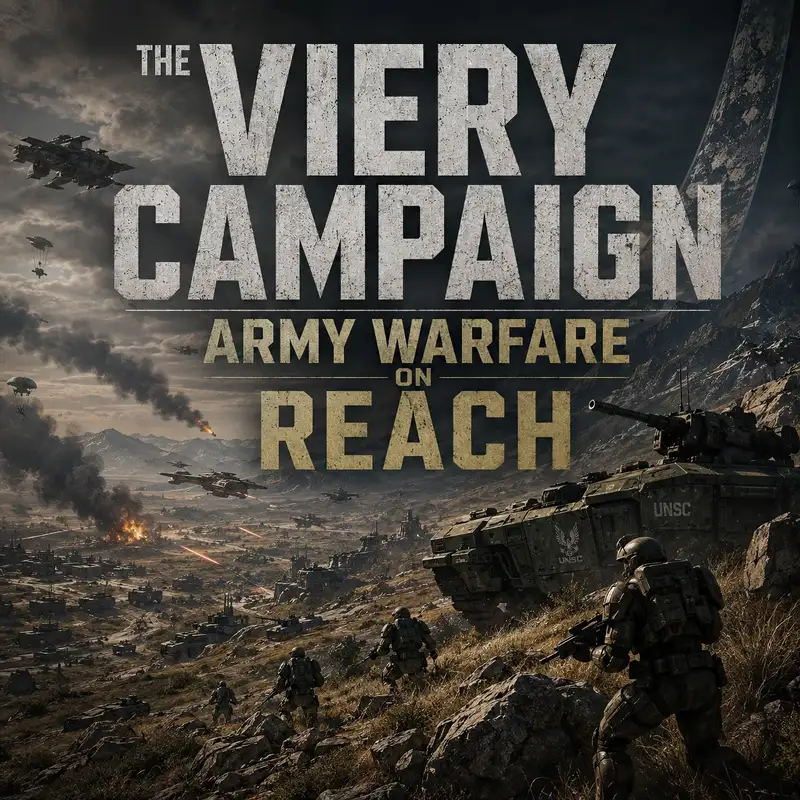
The Viery Campaign: Army Warfare on Reach
At eight hundred hours on August twelfth, twenty-five fifty-two, an Army column crossed the open ground below Szurdok Ridge and entered a prepared Covenant engagement zone. Warthogs and Scorpion tanks advanced under Falcon and Pelican cover while Banshees dropped toward the formation and Wraith mortars walked plasma across its route. Vehicles vanished in explosions. A bridge ahead of the lead elements was destroyed before they could cross. The attack had barely begun, and the force was already divided by terrain, enemy fires, and damaged communications. Reach still possessed armor, aircraft, and warships in the region. The immediate problem was connecting those weapons to targets before the Covenant separated every part of the force from the others.
The Viery Campaign is often remembered through Noble Team and the assault later called the tip of the spear. That perspective is useful, but incomplete. Viery was the first large conventional ground campaign of Reach’s fall, fought across a territory rather than inside one base. Army brigades, mechanized units, armor, Marine battalions, Orbital Drop Shock Troopers, Air Force transports, Navy aircraft, and supporting frigates all entered the fight. Spartans attacked the points where the wider offensive had stalled. The campaign itself belonged to the conventional force around them. Its central question was whether Reach’s ground-defense system could recover from strategic surprise quickly enough to break a concealed Covenant army.
The United Nations Space Command Army was built primarily for warfare inside a gravity well. On Reach it defended fixed installations, transport routes, power systems, cities, and terrain that could not be secured from orbit alone. The Viery battle map showed three major Army formations spread through the territory: the Eighth Armored Brigade, the Thirty-fourth Infantry Brigade, and the One Hundred Twenty-fourth Mechanized Infantry Brigade. Marine and shock-trooper battalions reinforced them. Air Force units provided mobility, while Navy aircraft and frigates supplied fires when the air-defense situation allowed. The display does not provide a perfect strength report, but it establishes the scale. This was a brigade-level joint campaign, not a patrol enlarged by the presence of Spartans.
The Army’s role differed from the more familiar expeditionary work of the Marine Corps. Marines deployed from ships and could seize a landing area quickly. Army formations were intended to remain on a world, sustain armored and mechanized operations, protect infrastructure, and fight across sectors that might stay active for weeks. Reach required exactly that kind of force. Its military value was distributed among fleet bases, orbital-defense generators, communications sites, shipyards, research facilities, and cities separated by great distances. Viery was therefore not one objective. It was a regional system. The defenders had to reopen roads, find hidden enemy positions, defend installations, and prevent the Covenant foothold from becoming a permanent theater.
The offensive was built on intelligence collected only hours earlier. On the night of August eleventh, Jun-A Two Six Six and Spartan-B Three One Two entered a Covenant-held dark zone that human surveillance could not penetrate reliably. They found a stealth pylon, occupied settlements, enemy patrols, and a large deployment area containing corvettes and substantial ground forces. The discovery changed the command assessment. Earlier fighting around Visegrád and Sword Base had looked like a limited intrusion that might still be isolated. Viery revealed an army already established behind electronic concealment. Reconnaissance had found the landing zone. It had not yet identified the full source of the deployment or the concealed naval force supporting it.
The Covenant concealment system was more than camouflage. Hiding canopies and stealth equipment obscured formations. Electronic interference degraded command awareness. Corvettes and dropships moved troops into protected areas, while tall deployment spires created shielded terminals for additional forces. A normal landing zone reveals itself through transport traffic, maintenance, ammunition handling, and communications. Viery’s signatures were fragmented and masked. Human commanders knew they were facing enemy troops but did not know those troops were connected to a cloaked supercarrier above the battlefield. The Covenant had hidden the logistical center of its surface campaign inside the same network protecting the soldiers below. The Army was attacking a force whose supply route appeared only at its lowest and most heavily defended end.
Supreme Commander Rho ‘Barutamee also pursued objectives that complicated human analysis. His Fleet of Valiant Prudence was heavily armed, but its commander was especially interested in Forerunner relics on Reach. The Devoted Sentries searched scientific and archaeological records instead of destroying every site they entered. At the B X R Mining Corporation facility near Szurdok Ridge, the Zealot Alsu ‘Ahcuree sought seismic and survey data about the Eposz region. That made civilian industry part of the campaign. Mining records could reveal what lay beneath the ground. Human commanders saw a commercial facility inside an invasion zone. Covenant artifact specialists saw sacred intelligence. The same buildings therefore controlled movement, sheltered troops, and contained information worth fighting over.
Winter Contingency called for a full counteroffensive against the Priority One landing zone. Army armor and mechanized forces would pressure the Covenant across Viery while air and naval elements attacked from above. Noble Team would strike the nodes preventing those larger forces from operating. This was an appropriate use of Spartans. They were too few to clear and hold the territory, but they could destroy a pylon, penetrate an anti-aircraft position, or disable a shield that had immobilized much greater firepower. The plan depended on sequence. Reconnaissance identified the network. Conventional formations fixed the enemy. Spartans attacked critical systems. Aircraft and frigates exploited the openings. If one link failed, the campaign became several isolated battles fought by units unable to support one another.
The opening advance at Szurdok Ridge looked like a direct armored charge because speed mattered. The Covenant had enjoyed weeks of concealment and another night after its large deployment was discovered. Delay allowed more troops, vehicles, aircraft, and defensive weapons to arrive. The Army could attack with an incomplete picture or wait while the enemy strengthened the position being studied. It chose tempo. That exposed the lead column to Wraith mortars and Banshees, but delay carried its own cost. The visible convoy was also only one part of the regional offensive. Other brigades and battalions were fighting across Viery. The Covenant answered the breach force by using indirect plasma fire and terrain to break its momentum before human mass could reach the landing zone.
Terrain became a weapon immediately. Viery’s ridges, ravines, waterways, bridges, and mining roads restricted heavy movement. A Scorpion could defeat Covenant armor under favorable conditions, but it could not ignore a destroyed crossing. Warthogs offered speed, yet remained exposed to plasma mortars, fuel-rod fire, and aircraft. Falcons bypassed broken ground until anti-aircraft batteries denied the route. The campaign became a contest over corridors. The Army needed roads for armor, landing zones for air mobility, and clear firing areas for support weapons. The Covenant needed to close only selected passages long enough to prevent concentration. Destroying one bridge did not stop the entire offensive. It forced an attacking element to improvise while the defender reinforced the next obstacle.
Human combined arms were visible in the systems surrounding Noble Team. Scorpions engaged heavy targets. Warthogs carried reconnaissance and direct-fire teams through gaps. Infantry secured structures, protected vehicles, and held positions after mobile elements passed. Falcons provided armed lift. Pelicans delivered heavier equipment. Longswords attacked targets ground weapons could not reach efficiently. Frigates brought sensors, point defense, and magnetic accelerator fire into the atmosphere. No platform was sufficient alone. Tanks without infantry could be ambushed. Aircraft without suppression could be destroyed. Frigates without targeting risked friendly forces or hardened shields. Infantry without transport arrived too slowly. The Army’s strength came from combining capabilities. The Covenant’s first success was preventing that combination from occurring on human terms.
The Covenant used its own combined-arms system. Wraiths supplied indirect plasma fires from behind the forward line. Ghosts scouted and harassed mobile elements. Banshees attacked vehicles and aircraft. Phantoms and Spirits moved infantry between positions. Scarabs threatened fortified areas and concentrated armor. Tyrant batteries created zones in which human aircraft and low-flying warships could not operate safely. Sangheili leaders directed mixed formations of Unggoy, Kig-Yar, Yanme’e, and heavier assets according to the task. Species hierarchy created weaknesses, but the force was not a collection of isolated targets. Its weapons covered one another. Wraiths disrupted approaches to the anti-aircraft guns. The guns denied air support. The spires reinforced the troops protecting both.
The first decisive problem was suppression of enemy air defenses. Covenant Tyrant batteries were firing plasma through the air corridor and keeping friendly aircraft at range. The frigate Grafton could not simply descend and erase the landing zone while those weapons remained active. A warship in atmosphere loses much of the safety provided by distance and maneuver. It becomes a large target close to ground weapons and inhabited terrain. Noble Six and Kat-B Three Two Zero were directed against the batteries because the wider force was already paying for their continued operation. They reached the first position, fought through its defenders, and destroyed the weapon’s power core. That local action restored access to part of the sky. Its value lay in everything friendly forces could do afterward.
Once the battery was neutralized, Longswords and the frigates Grafton and Saratoga moved over the sector with greater freedom. Aircraft struck Covenant positions, and warship weapons eliminated targets that would have required costly ground assaults. This was the operation working as intended. The Spartans did not destroy every enemy in the valley. They removed the system preventing larger weapons from entering the fight. The Army resumed movement through a battlefield still containing Wraiths, infantry, and aircraft. Clearing one corridor did not clear Viery, but it allowed the joint force to act jointly again. The campaign advanced whenever ground troops opened a window for air or naval support and stalled whenever the Covenant closed that window with another gun, shield, or concealed formation.
The route through the mining complex changed the fight from mobile warfare to infantry combat among industrial structures. Vehicles useful in the open could not solve every problem inside a facility of narrow access points, machinery, and records the enemy wanted. Covenant troops held the complex because it controlled movement toward the spire and because its survey data had value of its own. Noble Team and supporting soldiers cleared resistance while keeping the larger mission moving. This was not merely a diversion. It showed what planetary warfare does to civilian infrastructure. Mines, power stations, farms, communications relays, and transport hubs become terrain, supply, shelter, intelligence, and obstacles at the same time. Their military value often appears only after civilians have already lost access to them.
After the second anti-aircraft battery was disabled, Noble Six joined Jorge-Zero Five Two in a Falcon moving toward Spire One. The aircraft crossed the spire’s shield and was struck by an electromagnetic pulse. It crashed, killing the crew and reducing an air-mobile assault to a ground infiltration within seconds. The surviving Spartans continued on foot because the tower’s controls still had to be reached. Their armor protected them through the crash and fight. It did not restore the aircraft, replace the dead crew, or create another extraction route. The incident captured an uncomfortable truth about special operations. Exceptional personnel can survive failures that destroy ordinary teams, but the machines and supporting people lost around them remain lost.
Inside the spire, the defenders discovered a teleportation terminal linked to an unknown source. The finding changed the interpretation of the battlefield. The Army had assumed it was attacking a landing zone supplied by ships and dropships that could be observed or forced away. The spire allowed troops to arrive through a protected terminal whose origin remained hidden. Destroying visible transports would not stop a force whose main source was concealed. It also explained why Covenant strength had grown inside a dark zone without producing all the traffic expected from a conventional landing. The ground campaign was fighting the lower end of a deployment system connected to a capital ship that human sensors had failed to detect.
Noble Six reached the controls and lowered the spire’s shield. Carter-A Two Five Nine extracted Six and Jorge by Falcon, and Grafton received authorization to fire its magnetic accelerator cannon in atmosphere. The shot shattered the tower. Combined arms had been compressed into one sequence. Reconnaissance found the objective. The Army offensive reached its perimeter. Spartans disabled the defenses. Aviation recovered the assault force. A Navy frigate delivered the destructive effect. The action also carried risk. A magnetic accelerator round fired toward the surface was not routine support near friendly troops and inhabited terrain. It was authorized because the shield was down, the Spartans were clear, and destroying the terminal promised to break the Covenant deployment network.
The spire fell. Grafton survived only moments longer. Its shot disrupted the concealment surrounding the supercarrier Long Night of Solace, which had been holding position above the battlefield. An energy-projector beam struck the frigate and destroyed it before the human force could respond. The tactical objective had been achieved, but success revealed that the operational estimate was disastrously incomplete. The Army had not been fighting a bridgehead supported by a few corvettes. It had been fighting the surface component of a supercarrier’s deployment system. Grafton’s loss also removed fire support, sensors, communications capacity, aircraft support, and a trained crew. The Army had opened the sky and discovered that its most dangerous occupant had been waiting under camouflage.
The counteroffensive had destroyed batteries, penetrated the landing zone, eliminated a spire, and exposed the enemy’s main naval asset. Those were real successes. They did not secure Viery because the supercarrier could continue deploying forces and destroy supporting ships. The Army could defeat Covenant units on the ground and still lose the operational contest while enemy space power remained intact. The Navy, in turn, could not attack the hidden carrier until ground operations revealed it. Viery demonstrated the vertical nature of war on Reach. The battle ran from underground survey records to infantry positions, armored corridors, air-defense envelopes, atmospheric frigates, and a cloaked capital ship. Control at one level did not guarantee control at the next.
The response became Operation Upper Cut, a joint plan to destroy Long Night of Solace with a slipspace drive used as an improvised bomb. Army forces and Noble Team helped retake the Sabre launch facility. Air Force and Navy personnel supported the launch and orbital engagement. Sabre fighters defended Anchor Nine and escorted the force toward the Covenant corvette Ardent Prayer. The frigate Savannah helped disable the corvette so the boarding force could seize it as the bomb’s delivery vehicle. Upper Cut grew directly from Viery’s intelligence breakthrough. The ground campaign had identified the true source of the deployment. Conventional attack remained inadequate, so the services assembled a solution from assets never designed to work together in quite that manner.
Long Night of Solace was destroyed on August fourteenth. Jorge manually activated the weapon when its trigger failed, sacrificing himself and any chance of extraction. From Viery’s perspective, the result was an extraordinary operational success. The hidden supercarrier supporting the Covenant army was gone. A much larger Covenant fleet then arrived. The Army had fought for corridors, destroyed anti-aircraft systems, exposed the carrier, and enabled the operation that killed it. None of that altered the enemy’s ability to commit additional fleets from beyond the theater. The offensive solved the problem it had discovered and revealed that the strategic problem was larger. Reach’s defenders had hit the target and learned that the target was not the invasion.
The Army kept fighting because the ground war did not disappear when the fleet situation worsened. Units defended orbital-generator sites, bases, evacuation routes, cities, and temporary positions across Reach. Damaged formations absorbed survivors and lost vehicles faster than depots could replace them. Aircraft diverted to evacuation were unavailable for assault. Civilian traffic complicated military movement. Every plasma strike that destroyed a bridge or power system created an engineering problem under fire. Viery’s exact losses remain difficult to reconstruct, and later glassing erased records along with terrain. The conventional soldiers outside the remembered Spartan actions held sectors, recovered crews, guarded ammunition, moved wounded personnel, and kept headquarters connected while the strategic situation above them collapsed.
Viery also corrects the idea that Spartans operated apart from conventional war. Noble Team was an Army special-warfare asset inside a larger ground campaign. Its members relied on Army intelligence, soldiers, vehicles, routes, airfields, and command networks. Their attacks on the Tyrant batteries mattered because aircraft and frigates were waiting to exploit them. Destroying the spire mattered because commanders could turn the discovery into Upper Cut. The brigades fighting across Viery fixed Covenant formations that might otherwise have concentrated against the Spartans. Noble Team was the point applied to the hardest part of the target. The shaft behind that point was made of ordinary units performing tasks no armor suit could replace.
The Viery Campaign was Army warfare on Reach in its clearest form: brigade-scale maneuver under electronic interference, contested airspace, broken infrastructure, and constant danger from orbit. It required armor, infantry, aviation, engineers, special operations, naval fires, and civilian routes to function as one system. The Army did not fail because its soldiers lacked courage or because one column crossed open ground. It failed to save Viery because the Covenant had concealed the level of war that controlled every level below it. The counteroffensive broke the enemy’s surface network, exposed Long Night of Solace, and enabled its destruction. Its reward was a clear view of the larger fleet arriving behind it. At Szurdok Ridge, Reach’s Army proved it could tear open a hidden invasion. What it could not do was close the sky afterward.