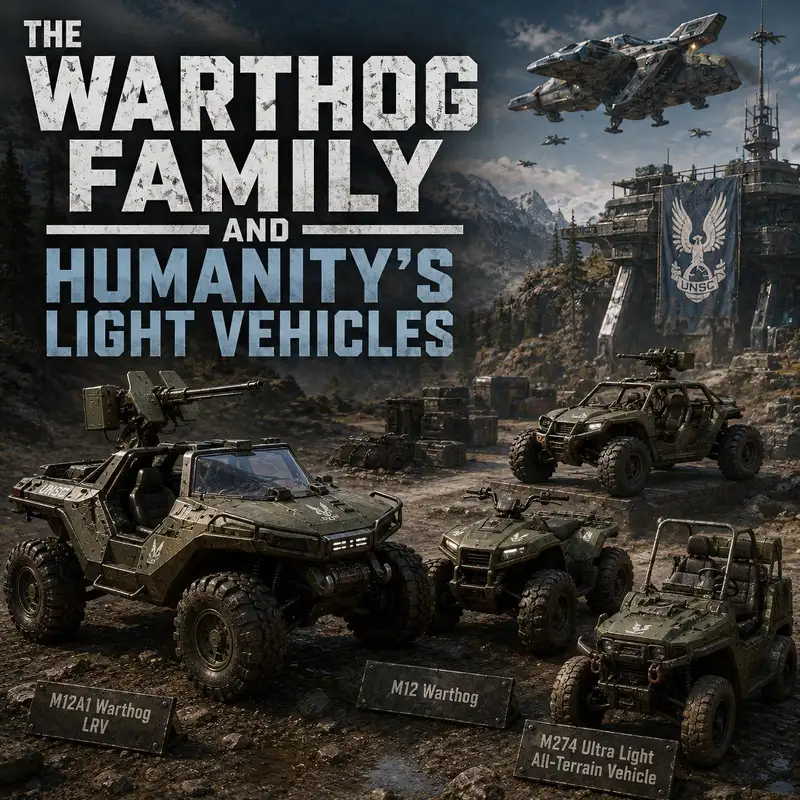
The Warthog Family and Humanity’s Light Vehicles
On September nineteenth, twenty-five fifty-two, Pelican Echo Four-One-Nine descended toward a group of survivors scattered across Installation Zero Four. The Pillar of Autumn had crashed. Lifeboats had landed kilometers apart. The Marines had no road network, no secure depot, and no guarantee that another ship would arrive. The Pelican lowered an M twelve Warthog to the surface. What followed was not merely the issue of a gun truck. It was the creation of mobility for a force whose original transportation plan had fallen out of orbit.
The Warthog could connect isolated survivors, carry ammunition, move wounded personnel, scout unfamiliar terrain, and place a heavy weapon where infantry needed it. Those roles explain why the vehicle remained in service for more than two centuries. It was not the best armored vehicle humanity could build, nor the most heavily armed. It endured because it could be transported, repaired, reconfigured, and driven almost anywhere human forces were expected to fight.
AMG Transport Dynamics developed the first Warthog prototype on Luna in twenty-three nineteen. The Z twelve was advertised as a vehicle able to go almost anywhere and perform almost any task. Demonstrations across remote territory on Luna and Mars attracted civilian attention and, more importantly, contracts from the Colonial Military Authority. By twenty-three twenty-one, the company had secured a major agreement to meet the authority’s ground transportation requirements, and the prototype entered military service as the M twelve Force Application Vehicle.
The sequence matters. The Warthog was born from colonial transportation before it became an icon of interstellar war. Early colonies needed vehicles that could cross unfinished roads, mining districts, agricultural zones, landing sites, and terrain that had never been surveyed for civilian traffic. A vehicle dependent on ideal infrastructure would have been useful near the capital and burdensome everywhere else. The M twelve was designed for the everywhere else.
By twenty-three twenty-nine, it had become the most common military all-terrain vehicle in human service. Colonial Military Authority personnel supplied the nickname Warthog, and the name proved more durable than the organization’s original monopoly over it. The United Nations Space Command eventually adopted the platform across its armed forces. Army units, Marines, naval security personnel, special operators, colonial forces, and local garrisons all found uses for the same basic chassis.
The mechanical design supported that spread. Warthogs used all-wheel drive, active steering, a broad suspension, and large resilient tires designed for terrain that would immobilize less specialized vehicles. A hydrogen-injected internal-combustion power plant gave the vehicle substantial range, while onboard systems could produce fuel from suitable water supplies. That did not make fuel free. Crews still needed water, maintenance, lubricants, coolant, replacement filters, and a power train that had not been damaged by enemy fire.
The ability to draw fuel from local water was especially valuable on distant colonies and expeditionary deployments. A unit did not always need a dedicated tanker following every patrol. It could extend operations by using available sources, assuming those sources were accessible and the conversion system remained functional. On an airless installation, a poisoned landscape, or a battlefield where every reservoir was under observation, the feature became less impressive. Logistics had been made flexible, not abolished.
The tires reflected the same philosophy. Their reinforced internal structure reduced the vulnerability associated with conventional pneumatic designs. A Warthog could cross rubble, sharp rock, industrial debris, and damaged roads without treating every puncture as the end of the mission. Suspension and traction gave it exceptional off-road mobility. The vehicle could also roll when cornered badly, struck at speed, or driven by someone who had learned the controls during the previous thirty seconds. Rugged did not mean forgiving.
Shared parts and familiar handling were equally important. The Warthog belonged to a wider family of frontier vehicles, including civilian and industrial trucks used across human colonies. Many recruits reached military training with some experience maintaining or driving related machines. The United Nations Space Command eventually required personnel across specialties to understand basic Warthog operation and maintenance. A communications technician might not be a cavalry scout, but after a crash landing that distinction could become administratively interesting and tactically irrelevant.
Standardization gave commanders options. A common chassis could support reconnaissance, troop movement, communications, medical evacuation, cargo transport, recovery, and several kinds of fire support. Changing the rear mount or bed was much easier than designing a completely new vehicle for every task. The result was a family whose members shared major components even when their battlefield purposes differed. A mechanic trained on one Warthog was not beginning from nothing when another variant entered the workshop.
That modularity also suited naval deployment. Pelican dropships could carry Warthogs beneath their tail booms and place them directly near a landing force. A light vehicle could leave a ship, enter atmosphere, and begin moving troops within minutes of reaching the ground. Heavy armor remained essential, but it demanded more lift, more maintenance, and more suitable terrain. A commander could often deploy Warthogs earlier and in greater tactical variety, then use them to secure the routes heavier vehicles would need.
The standard light reconnaissance configuration placed a chaingun on the rear mount. The driver controlled mobility, the gunner controlled the main weapon, and a passenger could provide navigation, security, or additional fire. The arrangement was simple enough to be deceptive. The Warthog was not an armored personnel carrier and not a miniature tank. Its crew sat exposed. The gunner stood behind a shield that protected only part of the body. Speed and terrain were the vehicle’s primary defenses.
Used correctly, the chaingun Warthog could screen a column, suppress infantry, escort a convoy, protect a landing zone, and attack light vehicles. Its mobility allowed the crew to fire from one position, relocate, and engage again before the enemy established an effective response. Used incorrectly, it drove directly into the strongest part of the enemy line and presented three casualties in one convenient package. The vehicle rewarded judgment because armor could not compensate for its absence.
Crew coordination mattered as much as mechanical performance. The driver watched terrain and escape routes. The gunner watched the target and the vehicle’s flanks. The passenger navigated, communicated, or protected the exposed crew during stops. A good team moved before the enemy completed a firing solution and stopped only long enough to make its own fire count. A poor team discovered that a fast vehicle can reach a bad decision more quickly than infantry on foot.
Covenant weapons made that limitation severe. Plasma could burn through the vehicle’s protection, disable exposed systems, or kill the crew without destroying the chassis. Ghosts combined speed with energy weapons. Wraiths attacked from beyond the range at which a chaingun was comfortable. Banshees could strike from angles the rear gunner could not always follow. The Warthog survived by using cover, dispersal, ambush, supporting infantry, and friendly aircraft rather than by exchanging fire as though it were a main battle tank.
The Human-Covenant War nevertheless increased demand for the platform. Humanity was losing colonies and factories faster than it could redesign every ground force. The Warthog already existed in large numbers, its production system was mature, and its crews understood it. Misriah facilities supplemented AMG manufacturing during the final year of the war. A vehicle that could be built in several locations and repaired from familiar parts was strategically more valuable than a superior prototype awaiting a peaceful procurement cycle.
The Gauss Warthog turned the chassis into a light anti-armor platform. Its magnetic cannon launched a dense projectile at extreme velocity, giving a fast wheeled vehicle the ability to threaten Ghosts, Choppers, Wraiths, and exposed aircraft. The combination was effective because the gun and chassis solved different parts of the same problem. The cannon provided penetration. The Warthog placed it on a flank before the enemy’s heavier armor could respond.
That capability remained dependent on the crew. The driver needed to find a firing position and leave it quickly. The gunner needed to identify a vulnerable target and avoid wasting shots on armor the weapon could not defeat efficiently. Ammunition and electrical systems had to be maintained. A Gauss Warthog that remained stationary after revealing itself became a light vehicle carrying an expensive weapon and a very clear request for return fire.
Rocket variants offered another solution. Some were designed primarily for anti-armor work. Others mounted missile systems able to engage both vehicles and aircraft. Rockets provided explosive effect and, in certain configurations, guidance. They also created bulky ammunition, visible launch signatures, and reload intervals during which the vehicle was unusually vulnerable. The same chassis could therefore become anti-aircraft or anti-armor support, but the mission depended on the exact launcher and ammunition loaded, not on the crew calling every version a Rocket Hog.
More specialized Warthogs carried flamethrowers, incendiary systems, or environment-specific equipment. Arctic models used enclosed cabins, heating, modified suspension, or tracks for snow and ice. Tropical versions received additional protection against corrosion and hostile vegetation. Recovery models carried towing and repair equipment. These designs were not all common and should not be imagined in every motor pool. They demonstrate the platform’s adaptability, not unlimited production.
Unarmed variants were often more important to a campaign than the famous gun trucks. Scout Warthogs removed the turret to gain cargo space and reduce weight. The M eight thirty-one troop transport carried several personnel beneath a protective roll cage. Other configurations supported ambulances, communications shelters, command posts, and supply work. None produced the visual authority of a spinning chaingun. All helped determine whether the people using the chaingun received ammunition, treatment, orders, and replacements.
The recovery vehicle deserves particular attention because light forces still become immobilized. A damaged suspension, overturned chassis, flooded engine compartment, or destroyed wheel could remove a Warthog without killing its crew. Recovery variants used stronger drive systems, winches, and repair equipment to extract damaged vehicles. Leaving a disabled vehicle behind surrendered parts, intelligence, and sometimes a complete weapon system to the enemy. Recovery was not an administrative task performed after the battle. It was part of preserving combat power for the next one.
The Warthog’s long service also linked it to humanity’s internal wars. Before the Covenant arrived, the vehicle patrolled colonies, supported counterinsurgency operations, carried security forces, and moved through communities where the dispute concerned political authority rather than species survival. Insurrectionists captured, purchased, or maintained Warthogs of their own. The same characteristics that made the vehicle useful to the government made it useful to people fighting the government.
This dual use came from the platform’s civilian roots and broad industrial presence. Related vehicles, parts, tools, and technical knowledge existed beyond military depots. A colonial mechanic did not need Office of Naval Intelligence clearance to understand a suspension component. That familiarity improved readiness and complicated control. A light tactical vehicle distributed across many worlds would inevitably appear in militia compounds, corporate fleets, private garages, and rebel motor pools.
During the Covenant War, the Warthog became a symbol of human resistance because it appeared wherever the ground campaign had not yet ended. On Reach, Army and Marine formations used it across military bases, cities, farmland, and evacuation routes. On Earth, it moved through the wreckage of New Mombasa and supported operations around Voi. On the Ark, Warthogs traveled beyond the normal reach of human supply lines. The settings changed. The requirement for mobile firepower and transport did not.
Installation Zero Four showed the vehicle at its most basic. Survivors from the Pillar of Autumn needed to connect scattered landing sites and establish Alpha Base while Covenant forces searched the ring. A Warthog could move a small group faster than infantry, carry a weapon through unfamiliar terrain, and be redeployed by Pelican when the operational focus changed. It did not create the campaign plan. It allowed the surviving force to have one.
The Spirit of Fire demonstrated the industrial side of the family. Its factory systems carried design records for many Warthog configurations and could manufacture vehicles as resources allowed. After the ship arrived at the Ark in twenty-five fifty-nine, Isabel adapted additional variants using intelligence and technology gained during the fight against the Banished. An isolated ship could therefore continue evolving the platform rather than depend entirely on deliveries from a human world it could not contact.
That capability was impressive and finite. Factory modules still consumed feedstock, power, machine time, and skilled supervision. Producing a rocket Warthog meant not producing something else from the same material. A ship could retain a design library without possessing unlimited ammunition or replacement crews. The Warthog’s advantage was that a familiar chassis reduced the number of entirely separate vehicle lines the ship had to support.
The M twelve B chassis entered limited service by the final months of the Human-Covenant War and became more prominent afterward. It changed the body, storage, protection, and arrangement while preserving the platform’s basic role. This was evolution rather than replacement through revolution. Drivers, armorers, and commanders could recognize the same vehicle family while receiving a chassis better suited to postwar equipment and operating experience.
Postwar designers also reconsidered the troop carrier. The M fifteen Razorback grew from the Warthog family but emphasized armor and payload rather than a mounted weapon. It offered increased capacity for personnel, support weapons, power equipment, and mission cargo. The design eventually replaced the older M eight thirty-one transport in many roles. Removing the turret did not make the vehicle useless in combat. It made the vehicle responsible for delivering the people and equipment that produced combat power elsewhere.
That trade became especially important on Zeta Halo. United Nations Space Command survivors had lost the Infinity, its organized logistics, and much of their heavy equipment. A Razorback could move a group of Marines, carry recovered weapons, transport power devices, or evacuate casualties across broken terrain. It was not protected like a tank. Its value came from moving more of the surviving force in each trip and giving that force a better chance of arriving together.
The Mongoose occupied an even lighter category. AMG’s M two seventy, followed by the M two seventy-four and M two ninety families, provided a fast quadbike for reconnaissance, courier work, forward observers, sniper teams, and light cargo. It was cheap, compact, and easier to transport than a Warthog. It was also unarmored, noisy, and exposed. Speed was not merely its protection. Speed was almost all of its protection.
A Mongoose could carry a passenger, move a message when networks failed, or place a specialist where a larger vehicle would be too conspicuous. That made it valuable to dispersed units and colonial garrisons. It also made the rider vulnerable to small-arms fire, mines, rough handling, and every enemy who understood that the person arriving quickly might be carrying something important. The vehicle was a mobility tool, not a miniature cavalry fighting vehicle.
Armed Gungoose variants added forward-firing weapons while preserving the basic quadbike form. The modification gave the driver some ability to attack without depending entirely on a passenger. It also encouraged users to fight from a vehicle whose protection had not improved merely because weapons were attached. The best use remained rapid harassment, reconnaissance, and movement. A Gungoose attempting a prolonged duel with armored opposition had confused mobility with durability.
The Warthog, Razorback, and Mongoose therefore occupied different points in the same system. The Mongoose moved one or two people and very light cargo. The Warthog balanced transport with a modular weapon or mission bed. The Razorback increased protection and payload for personnel and equipment. Commanders could select among them according to terrain, threat, lift capacity, and what needed to arrive at the destination.
No selection eliminated maintenance. Light vehicles still required tires, tracks, power plants, steering systems, weapons mounts, batteries, and repair crews. Their open construction made some repairs easier and left components more exposed to weather and damage. A common manufacturer and shared design philosophy reduced the burden, but the growing number of variants increased the catalog of parts, ammunition, and training packages. Modularity is efficient until every unit requests a unique module.
Their greatest strategic advantage remained deployability. A Pelican could place a Warthog beside infantry without waiting for engineers to build a road. Ships could carry several light vehicles and support packages within space that heavier formations would consume quickly. Once ashore, the vehicles could disperse, scout, escort, and sustain small units across a wide area. They allowed human ground forces to turn limited lift into wider presence.
Their greatest tactical weakness remained exposure. A Warthog crew could be killed by weapons that left much of the vehicle recoverable. A Mongoose rider had almost no protection. A Razorback carried more people, which meant one successful ambush could produce more casualties. These were not design oversights hidden for two centuries. They were the price paid for speed, payload, simplicity, and air mobility.
The Warthog family endured because humanity repeatedly fought campaigns in which those qualities mattered more than perfect protection. Colonial patrols, evacuation routes, damaged cities, alien installations, and isolated outposts all demanded vehicles able to move before ideal support arrived. The Warthog could carry a gun, a squad, a radio shelter, a casualty, or the parts needed to recover another Warthog. Humanity kept changing the rear bed because the battlefield kept changing the requirement.
Echo Four-One-Nine’s delivery on Installation Zero Four captured the platform’s purpose. The vehicle did not restore the Pillar of Autumn, replace the lost fleet, or make the scattered survivors secure. It gave them the ability to reach one another and act as a force rather than die as isolated groups. That is what humanity’s light vehicles provided across generations. They did not survive by absorbing every hit. They survived by carrying people, weapons, and decisions to places where heavier systems had not yet arrived.