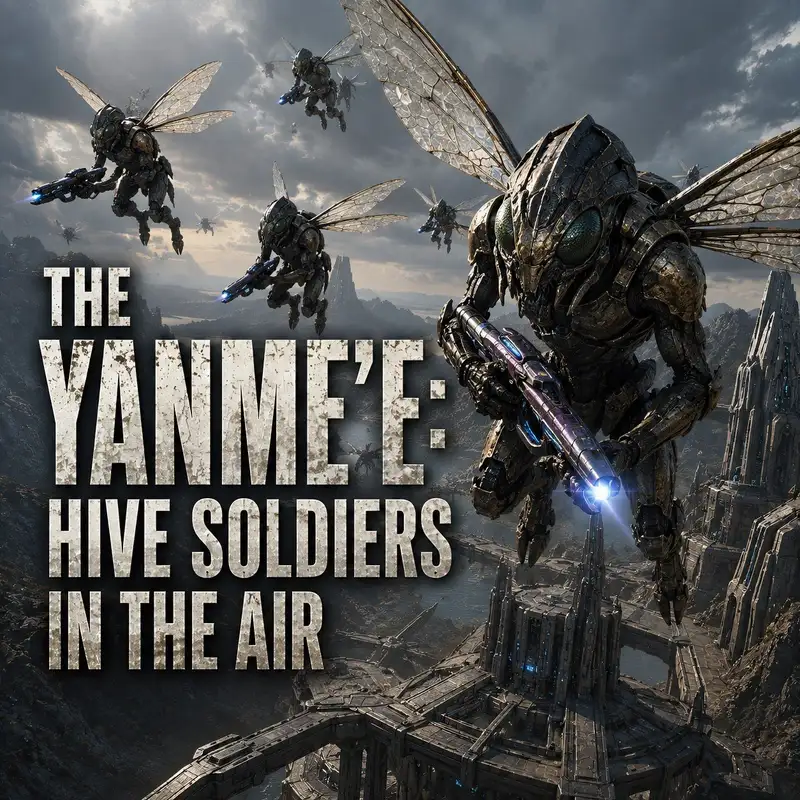
The Yanme’e: Hive Soldiers in the Air
The Covenant force sent to Palamok had been ordered to recover possible Forerunner relics without destroying the sites that might contain them. That restriction removed the empire’s simplest answer to resistance. Sangheili troops could not simply call for glassing when Yanme’e swarms descended through the dense air, struck from several directions, and vanished into jungle hives before a conventional formation could respond. The invaders possessed better warships and more destructive weapons. On the ground, they were fighting a species whose entire society had learned to coordinate movement, labor, and defense as one system.
Human soldiers later called the Yanme’e Drones or Buggers, labels that implied machines or mindless insects. They were neither. They were intelligent arthropods organized into hives, governed by queens, divided into specialized castes, and technologically capable before the Covenant found them. Their military importance came from more than wings. Yanme’e could repair machinery, construct fortified nests, move through vertical terrain, and attack from directions most infantry doctrine treated as inaccessible. The question is why a species so useful to the Covenant remained politically marginal, and how hive organization became both its greatest strength and its most exploitable weakness.
Palamok, in the Napret system, is a high-gravity world with a dense atmosphere and broad regions of jungle. Yanme’e ancestors evolved among trees and developed hard exoskeletons, multiple grasping limbs, and two pairs of wings. On their homeworld, those wings provided limited bursts of movement rather than effortless sustained flight. The combination of gravity and body mass made long aerial maneuver difficult. Their natural environment therefore rewarded short, coordinated leaps between surfaces, rapid climbing, and secure attachment to branches, ceilings, and structures. Long before the Covenant armed them, the Yanme’e already experienced space as something used in three dimensions.
Covenant engineers transformed that limited mobility into true battlefield flight. Gravity-dampening modules reduced the burden on the Yanme’e body, especially on worlds with lower gravity than Palamok. The wings still provided control and maneuver, but the technology extended range and endurance. That distinction matters. Yanme’e soldiers were not biological aircraft capable of operating indefinitely without support. Their mobility depended partly on issued equipment, power, maintenance, and a compatible environment. The Covenant had not merely discovered flying infantry. It had taken a species adapted for short aerial movement and equipped it to remain airborne over a human battlefield.
Their bodies were suited to technical work as well as combat. Dexterous hands, grasping feet, and additional limbs let a Yanme’e stabilize itself while handling tools or weapons. A hard carapace protected against impacts, though not like heavy armor, while compound eyes and sensory antennae supported awareness across a wide field. Before first contact, the species had already developed industry and interplanetary travel within the Napret system. The Covenant did not uplift a primitive population. It acquired a technical civilization whose workers could reach confined machinery, climb structures, and divide complex tasks among coordinated teams.
The central institution of Yanme’e society was the hive queen. A queen was responsible for reproduction, but her role extended beyond egg production. Sonic and pheromonal signals helped organize the hive, align activity, and direct complex collective behavior. The protection of the queen therefore became a biological, political, and military priority at once. A human government can lose an official and appoint a replacement through law. A Yanme’e hive losing its queen faced a crisis affecting reproduction, command, identity, and continuity. Fortifications, labor patterns, and military action all reflected that concentration of importance.
Yanme’e society included domestic, worker, and protector castes. Protectors supplied organized defense, while workers built, repaired, gathered, and maintained. The Covenant blurred those functions when imperial requirements demanded it. Technical personnel could be pressed into combat, and protectors could be assigned to labor far from their queens. Caste did not make every member identical. Age, experience, and task shaped different capabilities. What outsiders saw as a swarm was a structured organization with assigned personnel, leaders responsible for coordination, and serious consequences when individuals were forced into roles for which they had not been prepared.
Communication made that organization difficult for outsiders to understand. Yanme’e used clicks, shrieks, wing-generated sounds, movement, and pheromonal information. Covenant units relied on attachés who learned enough of another species’ language to relay orders, while human translation systems captured only part of the message. The hive system encouraged obedience, but it did not erase individual intelligence. Yanme’e could improvise, display rivalry, and plan independently. Those unable to function within normal hive structures were labeled Unmutuals and often exiled or imprisoned, proof that hive society possessed dissenters as well as discipline.
The Covenant reached Palamok in the year eleven twelve while searching for Forerunner artifacts. First contact became a war because the empire entered as an armed religious power and the Yanme’e resisted. Early fighting produced heavy casualties on both sides, with Covenant forces performing worse than expected against the sheer number and coordination of the defenders. Palamok’s hives dispersed military strength across terrain the invaders did not understand. Destroying one concentration did not end resistance elsewhere. Every tunnel, canopy, and concealed chamber could contain workers, protectors, supplies, or another route into the rear of a Covenant formation.
Orbital destruction remained available, but San’Shyuum leaders believed the hives might conceal sacred relics. Their own doctrine prevented them from burning the world before searching it. Communication eventually offered a less costly solution. Once the Covenant learned how to negotiate with the Yanme’e, the conflict ended through treaty rather than total conquest. Exploration did not produce the treasure the invaders had expected. The empire had preserved Palamok for artifacts that either remained inaccessible or were not present in the form anticipated. It still gained something strategically valuable: an entire species of technicians, laborers, and potential soldiers.
An assembly of hive queens agreed that lower-caste Yanme’e could enter Covenant service. That gave the empire manpower without dismantling every hive government. Queens remained recognized centers of authority, while ministries received personnel through them. The structure converted existing obedience into imperial mobilization. The Prophets did not need to persuade every worker or protector. They needed influence at the level of the queens. The Covenant had found an administrative shortcut. Like most shortcuts involving sovereign populations, it worked best when nobody asked how voluntary the lower ranks considered the arrangement.
Yanme’e reportedly understood San’Shyuum authority through the concept of queens, translating the Covenant’s ruling caste into a hierarchy familiar to hive society. That did not mean the species embraced Covenant theology with the same intensity as Sangheili zealots or San’Shyuum clerics. Their obedience appears to have depended heavily on command structure, hive authority, and assigned function. Religious language still mattered because it organized the empire around them, but the Great Journey was not necessarily the central emotional bond for every Yanme’e. The Covenant could accept that difference as long as the swarms worked, repaired, and fought where they were sent.
Political power did not accompany military service. Yanme’e had no seat on the High Council. Their interests were handled through the Ministry of Concert, the bureaucracy assigned to manage disputes and represent lower-caste species. That was representation at a distance, filtered through San’Shyuum officials and subordinate to imperial priorities. Hive queens could hold influence, attend important ceremonies, and negotiate over their people. They did not possess equal control over the fleets carrying those people into war. The Covenant valued Yanme’e organization as a source of labor while refusing to treat it as a model of legitimate political authority.
Their earliest imperial role was technical. Yanme’e worked as mechanics, maintenance crews, and laborers aboard Covenant ships and installations. Coordinated groups could inspect systems quickly, reach equipment mounted high above deck level, and divide complex jobs among specialized workers. Their understanding of machinery was substantial, even if Huragok remained unmatched in dealing with Forerunner-derived systems. A warship needs far more than bridge officers and gunners. It needs personnel cleaning conduits, replacing components, moving supplies, and finding faults before those faults become vacuum. Yanme’e labor helped keep an empire of sacred vessels operational.
Huragok assignments could create resentment because technical work was not merely employment. It was caste function and hive identity. On the missionary ship Rapid Conversion, Yanme’e workers killed the Huragok Lighter Than Some after the Engineer displaced them from valued tasks. The act was violent and strategically foolish, but it also exposed the cost of treating specialists as interchangeable. Covenant commanders had reassigned status without understanding what the task meant to the workers. The empire possessed extraordinary technology and sometimes managed its maintenance section with the sensitivity of a dropped gravity hammer.
Over time, Covenant authorities expanded Yanme’e combat service. The protector caste offered an obvious military base, while flight-assist systems created a capability other client species could not duplicate easily. Workers and protectors were increasingly folded into imperial formations, sometimes without regard for the distinction between technical competence and combat preparation. A Yanme’e trained to service machinery could become confused or ineffective when abruptly issued a weapon and ordered into battle. A protector accustomed to hive defense could be highly dangerous when deployed according to that experience. The difference was training and role, not species-wide courage.
Yanme’e aerial tactics exploited vertical access. They could rise above conventional cover, cling beneath platforms, enter openings too narrow for larger troops, and attack from several elevations at once. In urban terrain, they used rooftops, shafts, atriums, and damaged structures as approach routes. Inside ships and stations, they could move along walls and ceilings while defenders remained oriented toward decks and corridors. A swarm could force infantry to divide attention between the front, the flanks, and the space overhead. Even when the Yanme’e did not inflict decisive casualties, they created opportunities for heavier Covenant forces to advance.
Most carried light Covenant weapons such as plasma pistols, Needlers, and plasma rifles. These were practical choices for troops whose effectiveness depended on mobility. Heavy equipment would reduce speed, endurance, and maneuver. The tradeoff was limited protection and firepower. Exoskeletons resisted impacts but not concentrated small-arms fire. Wings and flight modules were vulnerable, and an airborne soldier had less cover than one on the ground. Explosives, automatic fire, overlapping fields of fire, and attacks on landing points could break a poorly coordinated swarm. Flying infantry remained infantry, and the air offers remarkably few walls.
Coordination determined whether numbers became combat power. Lesser Yanme’e ranks operated under more experienced leaders who aligned movement and concentrated attacks. Captains directed groups in the field, while hivewards represented the highest observed protector authority. A swarm without effective leadership might disperse, expose itself, or repeat attacks against prepared defenses. A coordinated swarm could use one group to draw fire while another moved behind the position. This was not a mystical group mind. It was a command system optimized for rapid collective response, reinforced by signals that other species could not fully perceive.
Hivewards rarely appeared outside the strongholds they were responsible for defending. Their gold carapaces, improved weapons, and enhanced energy shields reflected both rank and mission. When an enemy penetrated a hive, the hiveward coordinated the defense of the queen, pupae, chambers, and internal routes. The position resembled a fortress commander more than a routine squad leader. Its rarity also mattered. Human troops who met one were no longer dealing with an expendable patrol. They had reached a place the Yanme’e considered essential enough to commit senior protective authority.
A hive was therefore not simply a nest. It was barracks, command post, nursery, workshop, shelter, and territorial claim. Yanme’e could build temporary structures rapidly from available organic and construction material, often placing them underground, in canopies, or along ceilings. The enclosed environment protected developing members and created routes suited to Yanme’e movement. It also altered the local infrastructure. Heat, debris, restricted access, and biological material complicated human operations. Destroying a hive could require fire, engineers, protective equipment, and close fighting in spaces designed for the defenders. Occupation had acquired an architecture.
Yanme’e were among the first Covenant species encountered by humanity on Harvest in twenty-five twenty-five. Their presence during the siege of Gladsheim and later fighting showed that the Covenant had not brought only diplomats or ship crews. Technical workers and protectors were already part of the force establishing control. Humans had no established doctrine for insectoid infantry able to attack from above and move through structures in unfamiliar ways. Early descriptions emphasized appearance because that was what survivors could report immediately. Understanding the hive, command signals, and caste structure took considerably longer.
During the Human-Covenant War, Yanme’e served in planetary invasions, defensive operations, shipboard maintenance, and boarding actions. Their ability to maneuver in confined three-dimensional spaces made them useful against orbital platforms and warships, where corridors, access shafts, and machinery compartments created more routes than a human security plan could cover. They could bypass a barricade without breaching it, then attack personnel operating critical systems. Boarding doctrine usually depends on controlling doors, intersections, and decks. Yanme’e forced defenders to include ceilings, maintenance voids, and open vertical spaces in the same problem.
They also fought during major campaigns such as Reach and Earth, but counting appearances understates their function. A Yanme’e swarm could screen a landing, protect an excavation, chase survivors, secure a shaft, or establish a hive that turned temporary occupation into persistent control. Their speed made them useful for pursuit, and their technical background allowed them to exploit infrastructure after seizure. The same unit could help take a facility and then begin converting it for continued use. That combination reduced the delay between assault and consolidation, a valuable quality for Covenant forces operating far from High Charity.
New Mombasa provided the clearest example. After the Covenant entered the city, Yanme’e established a hive inside the underground data center housing the Superintendent artificial intelligence. Within hours, a human infrastructure site had become a heated, obstructed, vertically layered defensive complex containing workers, protectors, pupae, and senior hive authority. The location offered shelter from surface fighting and access to systems the Office of Naval Intelligence considered vital. To remove the occupation, Orbital Drop Shock Troopers and intelligence personnel had to enter the hive itself. The Yanme’e had turned a data facility into terrain designed around their biology.
Human countermeasures improved through experience. Fire teams learned to maintain overhead observation, avoid concentrating on one axis, and use automatic weapons against fast-moving targets. Grenades and heavy fire could deny clusters or force Yanme’e away from ceilings. Sealing access shafts reduced infiltration routes. None of these measures made the threat simple. A soldier looking upward was not watching the Sangheili advancing ahead. Ammunition spent suppressing a swarm was unavailable for the next assault. The Yanme’e created tactical dilemmas because their value lay partly in forcing defenders to fight several kinds of battle at once.
When the Great Schism divided the Covenant in twenty-five fifty-two, documented Yanme’e formations generally remained with the San’Shyuum and Jiralhanae loyalists. That choice fit the command relationships the empire had built. Queens and imperial authorities had supplied the structure through which military swarms received orders, while the Sangheili revolt threatened the system that had organized service for centuries. It would be a mistake to read one universal political belief into every hive. The species was distributed across many queens and assignments. The surviving battlefield record mainly preserves the groups that continued fighting beside Covenant loyalists.
After the empire collapsed, many Yanme’e returned to Palamok and the wider Napret system. Others remained with successor factions, employers, or isolated hives. Several Covenant remnants used Yanme’e troops, especially where old command networks and anti-Sangheili loyalties survived. The United Nations Space Command generally avoided provoking the home system while larger postwar crises demanded attention. That policy was not friendship. It was an acknowledgment that invading a high-gravity world filled with independent hives would be costly and unnecessary unless the Yanme’e created a direct strategic threat.
Isolated hives still created threats. In the postwar period, a new Spartan fireteam led by Hieu Dinh attacked a fledgling Yanme’e hive inside a derelict Forerunner facility. The mission showed that their military danger did not depend on a restored Covenant. A queen, protected site, growing population, and defensible structure could create a local power center without a fleet or ministry. The United Nations Space Command could destroy one nest. It could not assume that doing so produced control over every hive elsewhere.
The queen-centered command system also invited technological exploitation. The Kig-Yar scientist Sig Raan developed a device that imitated the sonic and pheromonal signals of a Yanme’e queen, allowing her to direct a swarm that was not naturally hers. She attempted to use those troops against the Banished before Atriox intervened and destroyed the scheme. The device did not make the Yanme’e unintelligent. It attacked the authentication system through which collective action was organized. A military network can be sophisticated and still fail when an enemy successfully impersonates the commander.
That vulnerability explains both the strength and the tragedy of Yanme’e service. Hive organization allowed rapid construction, disciplined mass action, technical specialization, and aerial maneuver. It also concentrated authority around signals and leaders that outside powers could bargain with, pressure, capture, or imitate. The Covenant never needed to grant equal citizenship to every worker it sent into battle. It needed access to queens and a hierarchy able to translate imperial orders into hive obligations. The system produced reliable labor and dangerous swarms while keeping the species low in the caste order.
The Yanme’e were never merely flying insects added to Covenant formations for variety. They were a technical civilization whose biology, social organization, and issued equipment created a form of air-mobile infantry unlike any conventional force. Their wings opened the vertical battlefield. Their hives converted captured infrastructure into defensible territory. Their castes sustained both maintenance and war. The Covenant respected those capabilities enough to use them everywhere and feared them enough to keep political control elsewhere.
That is the contradiction defining the hive soldiers in the air. The empire treated collective discipline as proof that the Yanme’e required masters, though the same discipline had nearly defeated Covenant troops on Palamok. It treated queens as recruiting authorities, then built a system in which anyone able to manipulate those authorities could manipulate the swarm. The Yanme’e gave the Covenant reach above the battlefield and labor beneath its decks. They did not give it ownership. When High Charity fell, the hives and queens remained, and the soldiers returned to structures that had existed before the Prophets arrived.