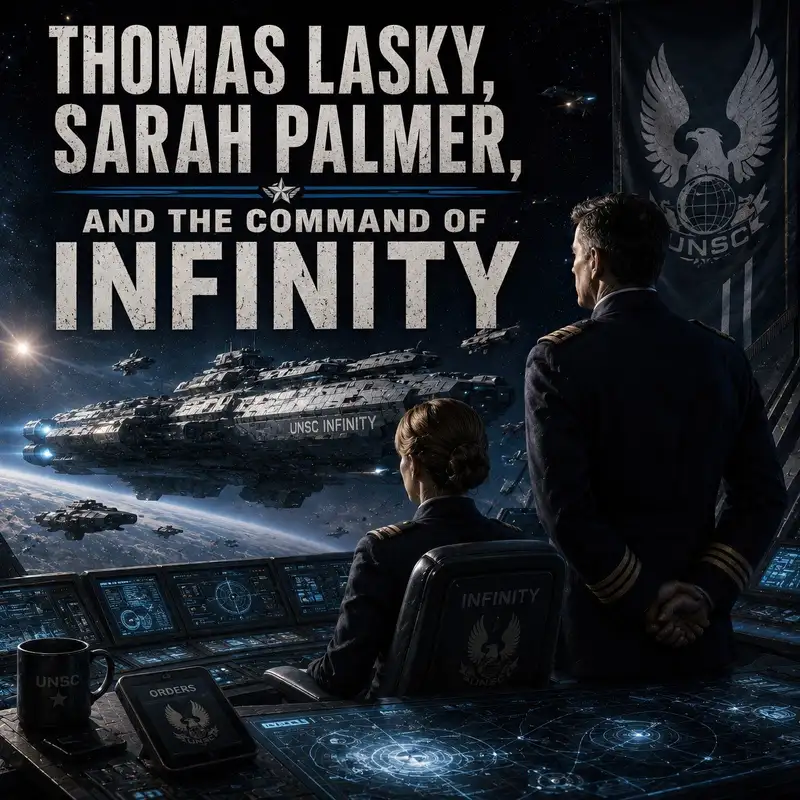
Thomas Lasky, Sarah Palmer, and the Command of Infinity
The United Nations Space Command Infinity arrived at Zeta Halo on December twelfth, twenty-five fifty-nine, expecting to execute a precision operation against Cortana. Instead, Banished dreadnoughts were already in position. Captain Thomas Lasky ordered every station to engage and pressed the ship toward its objective. Spartan Commander Sarah Palmer sent her fireteams against boarding forces while directing lifeboats, drop pods, and scattered personnel toward the ring. Within minutes, the flagship’s carefully layered command system had become an evacuation network under attack from inside and outside the hull.
That collapse revealed what Lasky and Palmer had actually built aboard Infinity. Lasky commanded the ship, its naval operations, and the wider expedition. Palmer commanded the Spartan contingent and translated strategic intent into missions that small teams could execute at machine-supported speed. Neither officer could replace the other. Lasky could move a supercarrier, allocate aircraft, coordinate diplomats, and preserve the chain of command. Palmer could direct augmented operators through the places where ships, political agreements, and orderly plans stopped being useful. Infinity worked best when those two forms of authority remained connected.
Infinity was never merely a large warship. Its design began during the Covenant War as part flagship, technology demonstrator, and survival platform for a civilization that expected Earth might fall. After the war, it carried thousands of military and civilian personnel, aircraft, vehicles, and smaller warships. Its spaces supported research, repair, medicine, planning, and diplomacy. Its captain commanded a mobile base and a politically sensitive concentration of advanced capabilities humanity wished it possessed in greater numbers.
That made the chain of command unusually complicated. The captain held naval authority over the ship and expedition. Palmer represented the Spartan branch and led every Spartan fireteam aboard. Roland, the ship’s smart artificial intelligence, connected sensors, communications, navigation, and mission data. The Office of Naval Intelligence maintained separate compartments and priorities, while senior admirals could intervene with politically sensitive orders. Infinity was powerful because it concentrated authority and information. It was vulnerable for the same reason.
Lasky learned the cost of failed command before he was old enough to hold any. He came from a military family and entered the Corbulo Academy of Military Science on Circinius Four in twenty-five twenty-six. He was an unwilling cadet, physically troubled by cryogenic reactions, uncertain that the service expected by his family was the life he wanted. His older brother had already died in the war against human rebels. The academy prepared students for the conflict humanity understood. The Covenant arrived carrying a war humanity had barely begun to recognize.
The attack destroyed the academy’s assumptions along with most of its personnel. Lasky watched instructors, classmates, and the girl he loved die during an evacuation that never became orderly. John One One Seven and Blue Team guided the surviving cadets through Covenant forces toward extraction. Lasky saw a Spartan not as propaganda, but as a young soldier who still needed others to survive. He also saw what happened when warning failed before the enemy reached the ground. He later became a naval aviator and officer, carrying that lesson through the Human-Covenant War.
Palmer arrived through the enlisted combat force. She served as a Marine and Orbital Drop Shock Trooper through a dozen tours across eight colonies. Her record was built around contested landings and missions where the extraction plan became obsolete early. She developed the aggression expected of a shock trooper, but also understood that direct action had to create space for someone else to move.
After the Covenant War, Palmer joined the first operational generation of adult Spartan volunteers. The Spartan Four program enhanced personnel who already possessed military experience rather than creating soldiers from abducted children. Mjolnir expanded Palmer’s physical and command reach without erasing the former trooper. When the New Colonial Alliance tried to seize Infinity, she helped stop the hijacking and defeated the rogue augmented operative Ilsa Zane, proving she could defend the institution from enemies who understood its systems.
Infinity’s first great postwar crisis began under another captain. In twenty-five fifty-seven, the ship entered the Forerunner shield world Requiem under Captain Andrew Del Rio, with Commander Lasky as executive officer and Palmer commanding the Spartan contingent. Requiem seized the ship through a gravity well, dragged it beneath the surface, and placed its crew inside a battlespace that human doctrine had not anticipated. Covenant remnant forces, Promethean machines, unknown Forerunner systems, and a returning ancient commander all competed around the same trapped vessel.
Lasky served as acting ground commander while Palmer acted as tactical lead. That division made operational sense. Lasky coordinated the ship’s effort to escape, the deployment of heavy vehicles, and contact with John and Cortana. Palmer managed the Spartan and ground response, applying small teams against particle cannons, access routes, and enemy positions. The command structure gave Infinity two connected perspectives. One officer had to understand what the entire expedition required. The other had to understand what the force at the point of contact could actually accomplish.
The arrangement became more important when Del Rio’s judgment failed. Faced with Cortana’s rampancy, John’s refusal to surrender her, and the Didact’s movement toward Earth, Del Rio prioritized withdrawal and formal reporting. His concern for the chain of command was not imaginary. A captain cannot permit every celebrated operator to decide which orders deserve obedience. The problem was that Del Rio treated procedure as a substitute for threat assessment. Lasky provided John and Cortana the means to continue, accepting the professional risk of supporting a disobedient Spartan because the immediate danger exceeded the captain’s plan.
Fleet Command removed Del Rio after Infinity returned, and Lasky assumed command. The ship then joined the defense against the Didact’s vessel, Mantle’s Approach, using its magnetic accelerator weapons to create an opening that John could exploit. Lasky’s first major action as captain therefore joined naval firepower to special operations rather than treating one as a replacement for the other. Infinity could breach the enemy ship. It could not enter the opening, carry Cortana to the critical system, or make the final decision inside.
Lasky and Palmer developed into a complementary command team. Lasky was measured, diplomatic, and willing to hear unwelcome information. Palmer was direct, visibly confident, and comfortable issuing concise orders while the tactical picture changed. He gave the ship institutional patience. She gave its Spartan force momentum. Their differences created useful friction when both officers respected the boundary between debate and execution. They also created risk because each was willing, under the right pressure, to work around a superior or enter a fight personally.
The return to Requiem in twenty-five fifty-eight transformed Infinity from a trapped warship into the headquarters of a large expeditionary research and security effort. Scientists studied Forerunner sites. Marines guarded bases and convoys. Spartan fireteams conducted reconnaissance, raids, recoveries, and counterattacks across a planet-sized artificial environment. Aircraft and ground vehicles moved personnel between locations that could become hostile without warning. Palmer directed multiple Spartan teams through an operations network, while Lasky managed the expedition’s larger priorities and the security of the ship above it.
The campaign demonstrated Palmer’s command style. Spartan teams such as Crimson operated beyond immediate support, with objectives changing as intelligence arrived. Palmer redirected them, coordinated extraction, and committed reinforcements when local discoveries became larger threats. She understood that Spartans required clear intent more than constant supervision, and that completing one task did not secure the site or eliminate the network around it.
Roland made that tempo possible without making human command unnecessary. He combined sensor returns, communications, navigation, and mission reports faster than a biological staff could process them. Yet Requiem’s Forerunner systems repeatedly exceeded his access or presented data without context. An artificial intelligence could identify anomalies and calculate routes. Lasky and Palmer still had to decide which anomaly justified moving a ship, risking a fireteam, or interrupting the expedition’s political purpose. The calculation was rapid. Responsibility remained stubbornly human.
Catherine Halsey exposed the fault lines within that responsibility. Infinity brought her aboard because its crew could not understand a Forerunner artifact affecting the ship. Palmer regarded Halsey through the history of the Spartan program and distrusted both her methods and her ability to manipulate command. Lasky recognized the same danger while still accepting that her knowledge might be indispensable. When Halsey communicated with Jul ‘Mdama and was later abducted, the crisis became an intelligence emergency, a rescue problem, and a test of lawful authority at the same time.
Admiral Osman ordered Halsey killed rather than permit her capture and cooperation with the enemy. Palmer moved to carry out the order. Lasky sent Fireteam Majestic to stop her and preserve her life. Palmer wounded Halsey, but Jul’s forces escaped with the scientist. The important issue was not compassion against ruthlessness. Infinity’s chain of command had split. Palmer obeyed the senior intelligence authority, while Lasky resisted an extrajudicial decision he believed would sacrifice a person and valuable knowledge. Neither gained control. Halsey was captured, Requiem was destroyed, and Jul ‘Mdama emerged stronger.
Post-Requiem operations demanded more than battlefield competence. Infinity supported talks among human, Sangheili, and Jiralhanae representatives at Ealen Four, where assassins attacked and a Spartan traitor proved augmentation had not eliminated political disloyalty. Lasky had to preserve a diplomatic mission among former enemies. Palmer had to defeat the immediate betrayal without turning every participant into another target.
The ship remained vulnerable. New Colonial Alliance forces later used a captured energy projector to inflict severe damage on Infinity. Repairs drew on modules intended for the unfinished sister ship Eternity, demonstrating the industrial cost of maintaining one unique flagship. Humanity had built an extraordinary platform, not a fleet of them or an unlimited supply chain for its hybrid systems.
Palmer’s strength was that she represented the Spartans on the bridge without becoming confined to it. She understood their training, equipment, and limits because she still entered the field. That gave her credibility with fireteams and practical knowledge of what an order required. It also encouraged a dangerous habit. Palmer could treat personal intervention as the fastest way to restore momentum, even when her value as commander exceeded her value as another rifle at the objective.
Lasky’s strength was almost the reverse. He made room for expertise and tolerated initiative that a more insecure captain might interpret as a threat. This allowed Spartans, artificial intelligences, scientists, pilots, and junior officers to influence decisions before rank converted uncertainty into silence. The weakness was that collaborative command depends on trust, communication, and enough time to compare perspectives. Office of Naval Intelligence compartments, corrupted networks, and crises moving at slipspace speed could remove all three.
That tension returned when Blue Team went absent without leave in twenty-five fifty-eight while pursuing Cortana. Lasky supported Fireteam Osiris as it searched for John and his team, but the problem expanded beyond personnel recovery when Guardians began awakening. Infinity became the platform connecting Halsey’s analysis, Roland’s technical planning, Hood’s strategic authority, Palmer’s Spartan force, and diplomatic access to the Arbiter. No single part of that command network possessed enough information to solve the crisis alone.
Lasky arranged a mission to Sanghelios so Palmer, Halsey, and a Spartan team could support the Arbiter and follow the Guardian connected to Blue Team. Hood accepted the need while limiting Infinity’s exposure. Osman demanded deniability and again authorized Palmer to kill Halsey if necessary. Lasky negotiated permission. Palmer carried the force into a civil war. Both served an intelligence authority that considered the scientist useful and disposable in the same briefing.
Cortana’s uprising changed Infinity’s role overnight. When a Guardian appeared at Earth and prepared to disable its power networks, Lasky ordered an emergency slipspace jump. The decision preserved the flagship but separated it from fixed command, shipyards, supply depots, and much of the government it was meant to defend. After recovering Blue Team, Fireteam Osiris, Palmer, and Halsey from Sanghelios, Infinity became a mobile resistance headquarters pursued through a galaxy whose communications and artificial-intelligence infrastructure could no longer be trusted.
For more than a year, Lasky kept the ship moving through unpredictable jumps and temporary safe areas. Palmer maintained Spartan operations while the crew scavenged supplies from abandoned facilities and isolated bases. The normal complement of more than seventeen thousand had fallen to roughly seven thousand one hundred fifty by the approach to Zeta Halo. Some aboard were civilian contractors and support personnel needed to keep the ship, vehicles, weapons, and life-support systems operating. A supercarrier does not become self-maintaining merely because it is large enough to contain several smaller warships.
This period may have been their greatest command achievement. Every transmission risked detection, and every deployment consumed supplies and people who might not be replaced. Lasky had to preserve a major mobile headquarters outside Created control. Palmer had to use Spartans aggressively enough to gather intelligence and support resistance, but carefully enough that the branch did not disappear through a series of individually necessary missions.
Operation Wolfe on Reach showed that the depleted command could still concentrate force. Infinity deployed Spartans and Orbital Drop Shock Troopers while Blue Team recovered material from Halsey’s former laboratory for the creation of the Weapon. The operation combined naval insertion, local allies, compartmentalized intelligence, and extraction from a world occupied by Banished forces. It delivered the asset needed to confront Cortana.
The plan for Zeta Halo depended on precision rather than fleet superiority. The Weapon would enter the ring, contain Cortana, and allow John to retrieve her. Infinity would provide the command platform, deployment force, and recovery capability. The plan assumed the flagship could reach the installation and establish the local conditions needed for the operation. It did not adequately account for a Banished force already positioned to attack the moment the ship emerged.
Lasky responded to the ambush by continuing toward the objective while ordering full engagement. Palmer directed Spartan teams against boarders and toward evacuation routes. Their actions reflected years of shared command. Lasky protected mission purpose at the level of the ship. Palmer converted that purpose into immediate orders for hundreds of separated personnel. When the ship could no longer remain a functioning headquarters, both shifted from defeating the ambush to preserving the force.
Thousands of pods, lifeboats, shuttles, and damaged craft moved toward Zeta Halo while Banished artillery and aircraft attacked the descent. Spartans held corridors, supported launch bays, and escorted personnel who lacked armor. Sailors, Marines, contractors, technicians, and medical staff left a vessel whose internal routes were collapsing around them. The evacuation was not one orderly movement. It was a collection of local decisions linked by Lasky’s authority and Palmer’s tactical network until communications failed.
Infinity fell because command excellence could not erase strategic conditions. The ship had spent more than a year without reliable shipyard support, stable resupply, or a full crew. It approached a known Forerunner objective focused on Cortana and without the screening fleet that would normally protect a flagship. The Banished achieved surprise, committed dreadnoughts, opened boarding actions against the hangars, and attacked the command platform before it could deploy its full strength. Escharum later claimed the victory took four minutes. Whether literal or propaganda, the speed reflected preparation meeting exhaustion.
The final safeguard was Rubicon Protocol, which authorized surviving personnel to act independently when centralized command no longer existed. On the ring, Spartans and conventional troops built resistance cells, protected intelligence, and denied Banished control where possible. The protocol preserved initiative, but its activation was also an admission. The command system centered on Infinity, Lasky, Palmer, and Roland had been broken apart. Survival now depended on subordinates understanding the larger purpose well enough to act without them.
The most recent official account, set in June twenty-five sixty, records John’s belief that Lasky and Palmer survived and were already helping the struggle to retake Zeta Halo. The same account makes clear that he lacked direct confirmation because Banished jamming still prevented a complete command picture. Their precise locations, forces, and authority were not yet established. The uncertainty is appropriate to their history. Both officers spent years creating a command culture able to function when the bridge, network, and formal chain were unavailable.
Lasky and Palmer commanded Infinity by joining different answers to the same problem. Lasky coordinated naval power, intelligence, diplomacy, logistics, and technical expertise. Palmer made the Spartan force act quickly within that wider design. Their partnership did not make Infinity invulnerable. It made the ship adaptable enough to survive Requiem, political betrayal, the Created uprising, and a year of flight before the Banished shattered the platform.
The revealing legacy appeared after the flagship disappeared. Survivors on Zeta Halo did not wait for orders from a bridge they could no longer reach. They formed units, rescued one another, protected the mission, and kept the enemy from turning an ambush into uncontested rule. Infinity had concentrated humanity’s strength in one vessel, making its loss catastrophic. Lasky and Palmer had also distributed enough judgment that the loss was not final. Their greatest command achievement may have begun after the command deck went silent.