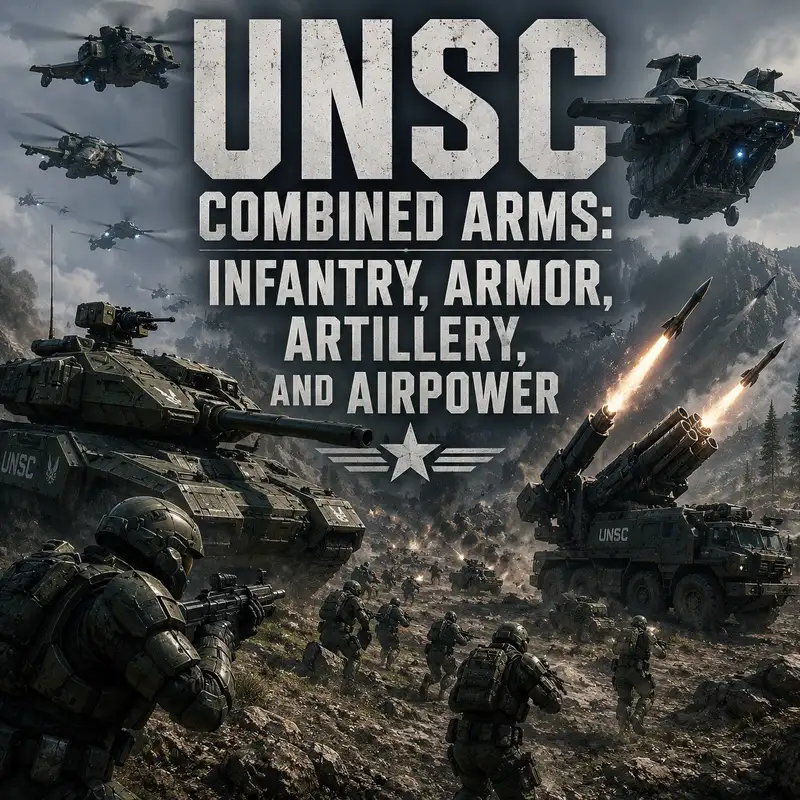
UNSC Combined Arms: Infantry, Armor, Artillery, and Airpower
At Szurdok Ridge on Reach, United Nations Space Command commanders ordered a counterattack against what they believed was a contained Covenant foothold. Infantry moved through broken ground ahead of armored columns. Scorpion tanks advanced toward Wraith positions. Falcons and other aircraft carried troops, watched the flanks, and attacked targets that ground units could not reach quickly. Artillery and orbital fires waited for coordinates. The plan depended on every arm arriving at the right place before the enemy revealed how much larger the invasion really was.
That operation explains both the promise and the limits of human combined arms. The United Nations Space Command did not defeat stronger enemies by finding one perfect tank, aircraft, or supersoldier. It tried to make infantry, armor, artillery, aerospace forces, engineers, intelligence, and logistics support one another so that the enemy could not answer every threat at once. When the system worked, a technologically inferior force could create a temporary advantage. When one link failed, the other arms often became isolated targets.
Combined arms and joint warfare were related, but they were not identical. Combined arms meant using different battlefield capabilities together at the tactical and operational levels. Joint warfare meant coordinating different military services. A Marine platoon moving with Scorpion tanks and supported by aircraft was conducting combined-arms warfare. If those Marines came from Naval Command, the tanks belonged to an Army formation, the aircraft were assigned through the Air Force, and a Navy ship provided orbital fire, the operation was joint as well. Halo's largest human battles usually demanded both.
The doctrine developed before the Covenant War. Human forces moved across continents, protected colonial infrastructure, suppressed armed revolts, and reinforced distant settlements. Those missions taught commanders that infantry could clear a building but not control an entire region alone. Armor dominated open ground but could not search every tunnel. Aircraft reached farther, but only while fuel, maintenance, airfields, and local air defense kept them flying.
Infantry remained the foundation because someone still had to occupy the ground. Soldiers and Marines cleared structures, protected civilians, secured landing zones, guarded artillery, and held positions after the vehicles moved on. They also performed the close reconnaissance that sensors could not replace. A drone might identify movement near a ridge. An infantry patrol could determine whether the contact was an enemy observation team, frightened civilians, or a damaged friendly unit whose transponder had failed.
That information gave infantry a role far beyond rifle fire. Forward observers marked targets for artillery and aircraft. Anti-armor teams forced enemy vehicles to slow, disperse, or turn toward less favorable routes. Engineers moving with infantry opened minefields, repaired crossings, and cut through fortifications. Communications specialists connected small units to the wider battle network. The squad on the ground often became the point where intelligence, fire support, and maneuver met.
Infantry needed protection from threats it could not survive in the open. Covenant plasma, Wraith bombardment, and Banshee attacks could tear apart exposed formations. Terrain, vehicles, suppressive fire, and timing mattered more than body armor alone. A platoon advanced because tanks engaged the strongest positions. The tanks survived because infantry searched close terrain for concealed anti-armor teams.
Armor supplied protected mobility and direct fire. The Scorpion main battle tank was the most recognizable example, but armored warfare included troop carriers, reconnaissance vehicles, tank destroyers, recovery machines, and specialized platforms. Scorpions could break fortified lines, engage enemy armor, and provide mobile fire support. Warthogs moved personnel, ammunition, sensors, and mounted weapons rapidly across terrain that would exhaust infantry. The Warthog was not a small tank. Treating it as one was an efficient way to return it to the maintenance section in several interesting pieces.
Armored vehicles combined movement, protection, and weapons, but every advantage depended on machinery. Tracks, tires, sensors, and engines could fail. Plasma transferred heat into armor and internal systems. Rubble restricted maneuver, soft ground slowed heavy vehicles, and aircraft attacked from angles the main gun could not cover. Armor without infantry, air defense, and recovery support became an expensive roadblock.
Artillery attacked the enemy before direct contact or prevented reinforcements from reaching it. Human ground forces used mortars, rockets, self-propelled guns, and mobile platforms such as the Kodiak. These systems could suppress defensive positions, destroy concentrations, isolate a battlefield, and force Covenant units to move when they would rather remain behind cover. Artillery was most effective when used to shape maneuver rather than merely to produce a large explosion.
That required observers, communications, and ammunition. Someone had to identify the target, confirm friendly positions, and determine what lay nearby. Artificial intelligence accelerated the calculation without making a poor coordinate safe. A delayed report could place rounds on troops or civilians who had already moved into the area. Fire support was powerful because it reached beyond direct sight, which was also why authorization mattered.
Orbital fire extended this idea to a much larger scale. Warships and defense platforms could strike surface targets with magnetic accelerator weapons or missiles, but those fires were never ordinary artillery with a higher altitude. The destructive area, political consequences, and danger to friendly units were far greater. A naval ship might also have only a brief firing window before Covenant vessels forced it to maneuver. Ground commanders treated orbital support as a scarce theater asset, not a reliable substitute for field artillery.
Airpower connected the battlefield vertically. Pelicans delivered infantry, vehicles, ammunition, and medical teams. Falcons and Hornets provided local transport, reconnaissance, and attack capability. Longswords and other strike aircraft could attack larger targets or operate across wider areas. Air Force squadrons defended the atmosphere and close orbit, while Marine and Navy aviation supported expeditionary operations. The branch markings mattered to the command relationship. The troops below mostly cared whether the aircraft arrived with the correct cargo.
Aircraft shifted strength faster than roads permitted. A threatened company could receive ammunition, reinforcements, or evacuation if a route remained open. Reconnaissance found armored columns, attack aircraft engaged targets beyond ground observation, and medical evacuation moved wounded personnel toward treatment. Airpower multiplied the value of every unit able to communicate with it.
It also carried demanding conditions. Aircraft needed fuel, weapons, spare parts, trained crews, maintenance teams, and secure operating locations. Covenant anti-aircraft batteries and fighters could close an air corridor. A Pelican approaching a hot landing zone carried more than passengers. It carried the risk that one enemy shot would remove an entire squad and the aircraft needed for the next mission. Air superiority was therefore local and temporary, especially when the enemy still controlled orbit.
Air defense belonged inside combined arms for the same reason. Mobile systems such as the Wolverine protected armored formations and bases from hostile aircraft. Infantry weapons and fixed guns covered lower approaches. Fighters challenged Banshees, Seraphs, and strikecraft farther out. A tank formation without air defense had to disperse or hide whenever enemy aircraft appeared. An air-defense battery without infantry and armor protection could be overrun on the ground. Each arm created the conditions in which another could operate.
Engineers, logisticians, signals personnel, and medical teams formed the joints of the system. Engineers repaired roads, breached obstacles, and recovered vehicles. Logistics delivered ammunition, fuel, batteries, and parts. Signals teams connected commanders and observers. Medical personnel preserved trained crews. Combined arms looked like tanks and aircraft attacking. Its endurance came from people behind them with cranes, cables, stretchers, and manifests.
Unified Ground Command coordinated Army, Air Force, and assigned Marine units during planetary campaigns, while Naval Command controlled ships and many expeditionary forces. Operational control shifted with the mission. A ground commander could request orbital fire without commanding the cruiser providing it. A Marine unit might land under naval authority and then support an Army-led sector. The flexibility was necessary, though it occasionally allowed several headquarters to assume someone else had arranged the transport.
The battle network turned those organizations into one force. Sensors reported contacts, observers marked targets, command posts assigned fires, and aircraft received routes and warnings. Armored units passed damage and ammunition status. Artificial intelligences fused reports and reduced delay without eliminating misunderstanding. Every damaged relay or classified compartment made the arms less combined.
A successful attack usually followed a sequence. Reconnaissance found the enemy. Artillery and airpower suppressed or disrupted it. Infantry and armor maneuvered toward decisive terrain. Engineers opened the route. Air defense protected the formation. Logistics moved forward before ammunition ran low. Reserves exploited the breach or replaced damaged units. The sequence could change, but the principle remained. Each arm solved the problem preventing the next arm from acting.
The Covenant practiced combined arms as well. Phantoms inserted infantry and vehicles. Banshees attacked exposed troops and pursued aircraft. Ghosts scouted and screened. Wraiths combined armored mobility with indirect plasma bombardment. Mgalekgolo formations provided heavy direct fire and protected critical approaches. Sangheili leaders, Jiralhanae pack commanders, Unggoy units, Kig-Yar specialists, and Yanme'e swarms brought different capabilities to the same fight. Human commanders were not facing a collection of unrelated targets. They were facing another military system.
Covenant technology gave that system advantages in mobility, protection, and firepower. Anti-gravity vehicles crossed terrain that slowed tracked armor. Energy shields allowed selected troops and vehicles to survive attacks that would disable human equivalents. Plasma weapons inflicted severe thermal and structural damage. Dropships could place troops behind a defensive line, while capital ships threatened every fixed position below. Human combined arms had to function under pressure from both the surface and orbit.
The Covenant system still had weaknesses. Species hierarchy complicated trust. Religious objectives redirected military effort toward artifacts or sacred sites. Some formations coordinated with precision, while others treated subordinate species as expendable or pursued prestige at the expense of support. Human forces could exploit those patterns only when intelligence identified the actual formation rather than relying on stereotypes.
The early campaigns around Harvest showed how a mobile human force could carry combined arms into a remote theater. The Spirit of Fire transported Marines, vehicles, aircraft, supplies, and command facilities within one large expeditionary platform. Ground forces could establish bases, deploy Scorpions and Warthogs, move infantry by air, and support operations far from permanent infrastructure. The ship gave the force reach. Its internal stores and workshops did not make the supply problem infinite.
On Arcadia, combined arms served an evacuation rather than a conquest. Ground units defended population centers and movement routes while aircraft carried civilians and troops. Armor counterattacked Covenant forces threatening the corridors. Infantry secured landing zones and held close terrain. The correct measure of success was not how much ground remained under human control at sunset. It was how many transports departed before orbital and surface conditions made further evacuation impossible.
This difference mattered throughout the war. Tanks and artillery might destroy an enemy formation or delay it for twenty minutes. Airpower might attack troops threatening an evacuation route instead of pursuing enemy fighters. Combined arms supplied several tools and forced commanders to decide which outcome mattered most.
Reach became the largest demonstration of the doctrine and its failure under strategic surprise. High Command initially believed the Covenant intrusion could be contained through a decisive ground campaign in the Viery Territory. Army and Marine units, armored formations, aerospace forces, artillery, and special operations personnel were committed against enemy positions. Massive tank engagements developed around Szurdok Ridge as commanders attempted to destroy the foothold before it expanded.
Noble Team supported that wider offensive by attacking critical positions, opening routes, and helping neutralize anti-aircraft threats that restricted human aviation. The Spartans were valuable because they could reach defended systems and survive where an ordinary assault force might fail. They did not replace the armored columns, aircraft, artillery, and thousands of conventional personnel conducting the campaign. Their missions created openings. The larger force had to exploit them.
Local attacks achieved real results. Covenant positions were destroyed, armor advanced, and aircraft regained access to selected areas. Commanders concentrated several forms of fire against targets that had expected to face them separately. Those successes encouraged the belief that the invasion remained manageable. The tactical system worked against the enemy in front of it. The strategic estimate failed against the enemy still arriving.
The Covenant widened the campaign faster than human command could concentrate. New landing zones appeared. Communications failed. Orbital conditions deteriorated. Ground forces protecting generators and airfields were pulled into separate battles. Aircraft lost bases and safe corridors. Artillery lost observers or ammunition routes. Tanks that had advanced with infantry and air cover found themselves fighting without one or both. Combined arms did not vanish in one moment. It broke apart by losing connections.
Urban warfare in New Alexandria showed how terrain changed the balance. Heavy armor had fewer useful routes among damaged buildings and blocked streets. Aircraft became essential for moving personnel between isolated positions, yet Covenant anti-aircraft systems and fighters made every flight dangerous. Infantry defended rooftops, evacuation points, and communications nodes. The city required precise coordination at a time when the network supporting that coordination was collapsing.
Earth offered a more successful sequence around Voi. Ground forces attacked Covenant positions and anti-aircraft defenses so aircraft and naval forces could approach. Armor provided direct fire and protected movement along exposed routes. Infantry cleared terrain vehicles could not secure alone. Once the air-defense threat was reduced, heavier fires could be brought against the Covenant position around the portal. No single arm won that operation. Each removed a barrier facing the next.
Spartans fit into this system as high-capability maneuver elements. They could destroy an anti-aircraft battery, designate a target, seize a control point, rescue a command team, or break a defended position. Their speed and survivability made them excellent at attacking the joints of an enemy formation. They were not artillery batteries, airlift fleets, occupation forces, or logistical networks. A Spartan could open a corridor. Conventional forces still had to move through it and keep it open.
Postwar forces institutionalized these lessons. The Infinity carried Spartans, conventional troops, aircraft, vehicles, workshops, intelligence systems, and medical support. On Requiem, fireteams attacked critical objectives while larger units established bases and controlled wider terrain. Concentrating so much capability aboard one ship improved coordination and placed much of the support structure in one target.
The same lesson appeared in the Spirit of Fire's later war at the Ark. Its forces used infantry, armor, mobile artillery, air defense, and aviation against the Banished. Kodiak batteries could strike from protected positions once deployed, while other units screened them and found targets. Aircraft moved forces across terrain shaped by Forerunner structures rather than human roads. The ship's manufacturing and logistical systems kept the force operating, but every replacement still required material, time, and trained personnel.
The Banished were another combined-arms opponent, not merely raiders. They used dropships, infantry, armor, artillery, fortifications, engineers, and salvage teams under flexible local commanders. Their mixture of Covenant inheritance, captured technology, and modification produced tactical variety and a difficult supply system managed through salvage and ruthless control of resources.
Zeta Halo demonstrated what happened when the United Nations Space Command lost its combined-arms structure before the ground campaign properly began. The Infinity was ambushed, its units scattered, and most survivors reached the ring without organized artillery, reliable aviation, heavy maintenance, or centralized command. They still had trained infantry, Spartans, some vehicles, and local communications. They did not have the complete system that had made those assets mutually supporting.
The Banished could therefore attack isolated positions with local superiority. A human outpost might repel infantry and then face armor without anti-armor ammunition. Survivors could recover a vehicle but lack parts or fuel to keep it operating. A Spartan could destroy a battery or rescue prisoners, yet could not instantly rebuild the air wing and artillery network lost with the flagship. The campaign became a series of local actions because the organization connecting those actions had been removed.
Logistics was always the hidden limit. Infantry ammunition, tank rounds, artillery shells, aircraft weapons, fuel, medical supplies, and replacement parts all traveled through different chains. A combined-arms formation consumed more categories of supply than a light infantry force. That complexity was worthwhile because it produced greater capability. It also meant that losing one convoy could remove only the missiles, track assemblies, or targeting components needed by the arm on which the next phase depended.
Civilian operations made the problem harder. A Pelican carrying ammunition could not carry the same number of evacuees. Tanks defending a road were unavailable for the counterattack. Artillery suppressing an approach could endanger civilians still using it. Combined arms provided choices without freeing commanders from deciding whose movement and survival received priority.
The doctrine worked by creating dilemmas. If Covenant infantry dispersed to avoid artillery, armor and infantry could defeat smaller groups. If Wraiths concentrated to stop the tanks, aircraft or precision fires gained better targets. If anti-aircraft batteries focused on the aircraft, ground teams could approach them. If the enemy withdrew into fortified terrain, engineers and artillery could prepare the breach. The United Nations Space Command did not need every arm to be superior. It needed each arm to make the others harder to counter.
That requirement explains why tactical heroism could not compensate indefinitely for strategic collapse. Combined arms needed time to plan, networks to coordinate, transport to concentrate, and industry to replace losses. Covenant control of orbit threatened every one of those conditions. Once airfields, depots, relays, and ship support were destroyed, the battlefield became simpler in the enemy's favor. Human units continued fighting, but fewer of them could combine their strengths.
United Nations Space Command combined arms was therefore not the spectacle of a Scorpion firing while aircraft crossed overhead. It was the command and logistical system that made those actions part of one purpose. Infantry found and held. Armor moved and struck. Artillery shaped the battlefield. Airpower connected, observed, and attacked. Engineers, signals teams, logisticians, and medical personnel kept the sequence from stopping after its first success.
At Reach, that system created powerful local counterattacks and still failed to save the planet because the strategic picture collapsed around it. At Voi, it opened a route through a layered defense because each arm acted in the correct order. At Zeta Halo, its absence reduced survivors to isolated groups despite their courage and training. Combined arms allowed humanity to fight above the weight of its individual machines. It could turn separate units into an army, but only while the roads, radios, aircraft, ammunition, and people between them remained intact.