UNSC High Command: Admirals, Generals, and Wartime Authority
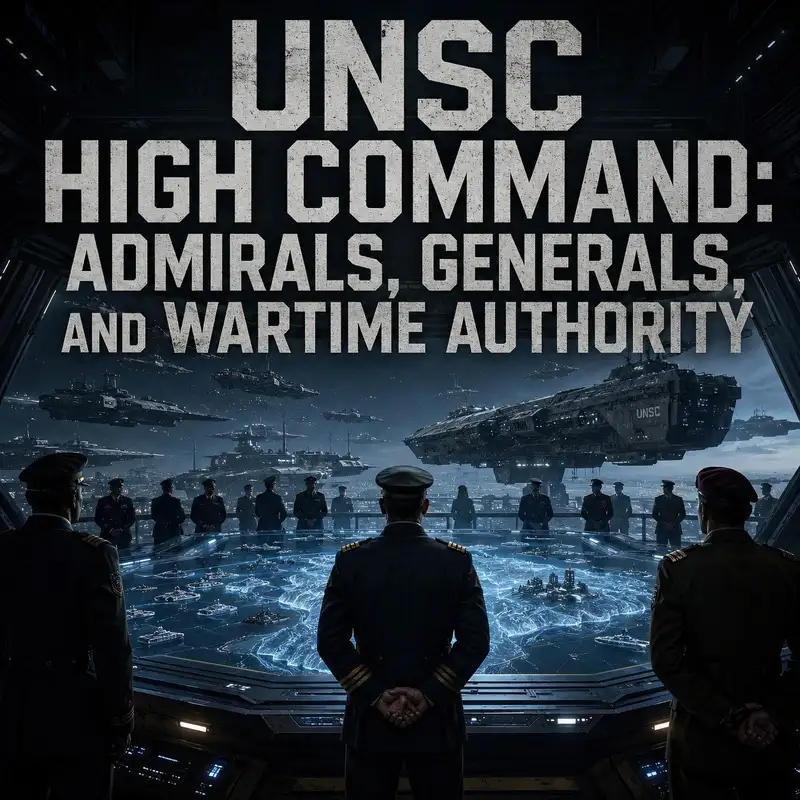
Lieutenant Wagner entered the underground command chamber on Earth carrying the news every senior officer had feared. Reach had fallen. The great fortress world, headquarters of Fleet Command and anchor of humanity’s military defenses, was no longer a functioning base. Ships had been destroyed, orbital guns silenced, and much of the command staff killed or cut off. Around the crescent-shaped table sat officers who could still issue orders across human space. Their immediate problem was not how to retake Reach. It was whether any remaining strength could be risked searching for survivors when the Covenant might already be moving toward Earth.
That scene captures the real purpose of United Nations Space Command High Command. High Command did not fly every ship or direct every battalion. It decided which disasters received scarce reinforcements, which colonies had to defend themselves, which fleets would combine, and which missions justified risking forces humanity could not replace. Its authority was measured by the consequences of the priorities it set.
High Command, usually shortened to HIGHCOM, was the highest military office of the United Nations Space Command. It was a small joint executive body composed of the most senior admirals and generals, normally fewer than twenty people. Calling it the Admiralty was common, but misleading. The Navy was the dominant service in an interstellar war, yet High Command also included senior representatives of the Army, Air Force, Marine Corps, intelligence community, and later Spartan Operations. Its task was to keep those institutions pointed at the same enemy rather than at one another.
The distinction between High Command and the civilian government remained essential. The Unified Earth Government was humanity’s central political authority. The United Nations Space Command was its military arm. High Command advised civilian leaders on defense, turned political objectives into military plans, and controlled personnel, equipment, and operations inside the armed forces. During the Covenant War, emergency powers greatly expanded military control over civilian agencies and colonial administration. Even then, the system retained civilian approval mechanisms. The war produced militarized government, but it did not make every admiral the lawful ruler of humanity.
High Command existed because the armed forces were too large and too specialized to be directed as one undifferentiated mass. A ship captain had authority aboard a vessel. An admiral could command a task force or fleet. A general could control a planetary campaign. Service chiefs managed readiness and institutional requirements. Theater commanders fought within assigned regions. High Command stood above those levels, settling priorities and deciding how much of the total force each commander would receive. That was orderly only by the standards of an organization losing planets faster than it could update the map.
At the broadest operational level, High Command divided responsibility between Naval Command and Unified Ground Command. Naval Command handled the fleet and the expeditionary forces required to move between worlds. Unified Ground Command coordinated terrestrial operations involving Army, Air Force, and assigned Marine units. The division was functional rather than absolute. Marines could move between naval and ground command relationships depending on the mission. Aerospace forces might defend a planet, support a fleet, or deploy aboard a carrier. A clean organizational chart became considerably less clean once the shooting started.
Naval Command itself depended on several different forms of authority. Fleet Command directed the movement and tasking of naval squadrons. Naval Logistical Operations Command dealt with construction, maintenance, ammunition, spare parts, food, and the other matters without which a fleet becomes an expensive collection of pressure-tight monuments. Naval Special Warfare Command handled specialized operations and forces. Those functions belonged to the same wider naval institution, but they solved very different problems.
Unified Ground Command performed the corresponding task within planetary gravity wells. It coordinated combined-arms forces without erasing the identities or administrative responsibilities of the services that provided them. Army divisions and Air Force wings still depended on their own replacement, maintenance, and training systems. Marine units might arrive under naval authority and then support a terrestrial campaign. Unified Ground Command translated those separate capabilities into a campaign plan for a particular world. It could direct missions. It could not create trained personnel, fuel, or air superiority by memorandum.
This distinction also explains why rank and command were not identical. A fleet admiral possessed enormous seniority, but a theater commander might exercise operational control over several services. A general could direct ground forces while naval commanders retained responsibility for orbital defense and interstellar movement. A captain aboard a damaged ship could make an immediate decision that no distant council could revise in time. In military organizations, authority comes from rank, position, mission orders, and circumstance. Halo adds one more factor: whether the communications link still exists.
Admirals appear especially powerful in human history because geography favored the Navy. Colonies were separated by slipspace. Reinforcements, food, ammunition, evacuation transports, and political representatives traveled aboard ships. A general could defend a continent. An admiral could decide whether the general’s world remained connected to the rest of humanity. Control of orbit shaped every ground campaign, and the loss of a fleet could isolate millions of people before the first Covenant landing craft entered the atmosphere. Interstellar strategy therefore became naval strategy with political consequences attached.
That did not make generals secondary. Ground commanders controlled the forces that defended orbital gun generators, cities, airfields, shipyards, and evacuation corridors. Army and Air Force organizations often remained after naval units had withdrawn or been destroyed. Marine commanders turned fleet access into combat power on the surface. A colony could not be held by ships alone, and orbital control could be temporary if ground forces captured the infrastructure supporting it. High Command needed admirals to move power between worlds and generals to make that power matter once it arrived.
Regional central commands helped bridge the distance between Sydney, Reach, and the fighting. These headquarters controlled assigned areas of human space and converted broad directives into theater plans. Their commanders had to interpret orders written with incomplete information, then act before a reply could return. Slipspace travel did not remove distance. Communications could be delayed, relays destroyed, and ships separated in transit. A commander who waited for perfect guidance might receive it after the colony was gone. High Command therefore centralized priorities while delegating execution.
That arrangement created unavoidable tension. Senior leaders wanted control because every ship and battalion was scarce. Local commanders needed discretion because conditions changed faster than the chain of command could respond. The best orders established the objective, protected essential information, and left room for judgment. The worst attempted to control details from several systems away. In practice, wartime authority moved outward whenever communications failed and snapped back toward headquarters whenever a functioning network returned. The chain of command was a structure, not a guarantee that every link would remain intact.
High Command’s institutional habits were formed before the Covenant arrived. During the Insurrection, senior officers confronted sabotage, terrorism, separatist movements, and predictions of a wider civil war. They approved counterinsurgency campaigns, expanded intelligence collection, and supported programs intended to break rebel organizations before human space fragmented. Some of those decisions were conventional. Others, including the Spartan Two program, were buried behind extreme classification. High Command learned to treat secrecy, rapid intervention, and centralized force as solutions to political instability. Those habits later helped humanity fight an extermination war. They also made military power easier to hide from civilian scrutiny.
First contact with the Covenant transformed the scale of command. The problem was no longer how to suppress rebellion while preserving colonial control. It was how to keep any human government alive against an enemy with superior ships, weapons, and mobility. Combat forces previously divided among the Colonial Military Administration, local authorities, Naval Command, and Unified Ground Command were drawn into a unified war effort. High Command gained broader emergency authority because only a centralized institution could allocate fleets across a collapsing interstellar front. Centralization improved coordination. It did not provide enough ships.
Vice Admiral Preston Cole illustrated the authority granted to distant commanders. He fought far from Earth, often with limited intelligence and no opportunity to request guidance before battle. His campaigns required him to combine surviving ships, revise formations, deceive stronger enemy forces, and decide when a colony could still be defended. The Cole Protocol, designed to prevent the Covenant from following human vessels to Earth or other populated systems, became a strategic rule for the entire force. It constrained navigation, data handling, retreat, and sometimes survival. High Command could issue the protocol. Captains had to enforce it while their ships were burning.
Strategic planning also produced missions that were bold enough to resemble desperation in uniform. Operation RED FLAG called for Spartans to capture a Covenant leader and force negotiations. The plan required committing some of humanity’s most valuable special operators and one of its most important ships at a moment when conventional defenses were failing. It was not irrational. The existing strategy was losing the war. Yet RED FLAG also showed the limits of High Command’s choices. When industrial weakness removes the reliable options, senior leaders begin selecting among gambles and calling the result a plan.
Reach was where the command system faced its most severe test. Fleet Command maintained major facilities there, including the complex around Olympic Tower, while Reach High Command coordinated planetary defense. When Covenant forces infiltrated the world in July of twenty-five fifty-two, the initial picture suggested a limited incursion that could be isolated. Commanders imposed an information lockdown, mobilized local forces, and attempted to contain the threat. The assessment was wrong. The enemy presence was larger, its objectives more ambitious, and the time available shorter than headquarters understood.
The failure was not simply that senior officers made a bad estimate. The Covenant attacked the systems from which command derived awareness and control. Communications relays were disabled. Fleet movements were concealed. Ground forces struck infrastructure tied to orbital defenses. Civilian evacuation competed with military deployment. Reports arrived from units already being overrun. Formal authority could not restore a destroyed sensor or compel a dead communications relay to answer. The planet’s defenders were increasingly forced to fight separate battles inside one collapsing campaign.
On August thirtieth, Covenant forces destroyed Reach High Command in the Highland Mountains. Senior officers died with the headquarters, and Vice Admiral Danforth Whitcomb, the Deputy Chief of Naval Operations, became the senior surviving commander for the remaining forces on Reach. That succession mattered. Militaries plan for the loss of commanders because command facilities are targets, especially when an enemy understands that destroying coordination may achieve more than destroying another battalion. Whitcomb inherited authority, but not the intact fleets, communications, or time that had made the position powerful.
The survivors of High Command shifted their center of activity to Facility Bravo Six beneath Sydney. There, Fleet Admiral Terrence Hood chaired the United Nations Space Command Security Council. The council brought together the highest officers from the services and intelligence establishment. After Reach, it had to decide what could still be defended, what forces would be concentrated in the Solar System, and how much risk could be accepted elsewhere. Emergency directives gathered surviving naval strength into the Home Fleet with final civilian approval. Humanity’s strategic reserve was becoming whatever had reached Earth before the doors closed.
Hood’s influence came from holding several roles at once. He was the Navy’s highest-ranking officer, Chief of Naval Operations, and chairman of the Security Council. During the final months of the Covenant War, that made him the practical leader of the military effort. His authority was not unlimited. He still worked through the council, civilian institutions, service commands, and commanders in the field. Yet when Earth was attacked, he directed its defense from the orbital network and later from the surface. The position required him to think simultaneously as naval officer, joint commander, and political representative of a government facing extinction.
The Battle for Earth demonstrated the burden of that authority. Hood had to protect the homeworld, manage damaged orbital defenses, support fighting around New Mombasa and Voi, and judge whether to commit forces through the portal opened by the Prophet of Truth. Pursuing the enemy offered a chance to prevent activation of the Halo Array. Sending everything would leave Earth exposed. Hood retained forces for home defense while Commander Miranda Keyes and allied Sangheili continued through the portal. The decision divided risk rather than eliminating it, which is what senior command usually means when every option can produce catastrophe.
Not all power inside High Command came from visible command appointments. The Commander-in-Chief of the Office of Naval Intelligence sat among the senior leadership, and Admiral Margaret Parangosky controlled an organization with access to strategic intelligence, covert operations, special programs, and information other leaders were not permitted to see. Her influence often exceeded what an ordinary reading of the chain of command would suggest. High Command could direct the intelligence service, but individual sections compartmentalized operations and sometimes misled the very officers they formally served. The institution responsible for reducing uncertainty could also manufacture it inside headquarters.
This was more than bureaucratic rivalry. A commander can only evaluate options that reach the briefing table. If intelligence officers conceal a program, distort a source, or protect an operation from oversight, they change the decision without issuing the order. The Spartan programs, technological exploitation, propaganda, and postwar intervention on Sanghelios all demonstrate how classified authority could run beside formal authority. High Command was powerful, but it was not omniscient. One of the quiet rules of the Halo universe is that the most senior person in the room may still possess only the version of the war someone else selected for them.
Logistics placed another hard limit on command. High Command could designate a colony as strategically vital, but Naval Logistical Operations Command still needed a shipyard, crews, reactors, ammunition, and spare parts to support it. Fleet Command could assign a cruiser that had not completed repairs. A general could request air support from squadrons already stripped for another theater. The official order might be precise while the available force was not. Authority became credible when backed by transportation and supply. Without them, a priority message merely described what headquarters wished existed.
The Covenant War ended before the emergency military state became permanent. On January eighth, twenty-five fifty-three, the Unified Earth Government resumed its full governing powers. Hood supported the reduction of extraordinary wartime authorities and participated in reconstruction diplomacy with colonies that had survived. The transfer did not erase military influence. The United Nations Space Command controlled much of the surviving interstellar transportation, security, and intelligence infrastructure. It did restore an important principle: victory had not converted emergency command into an unlimited right to rule.
Postwar High Command remained active as a body of operational oversight. When Captain Andrew Del Rio withdrew the Infinity from Requiem and left the Master Chief behind, the Security Council reviewed his conduct and removed him from command. Thomas Lasky replaced him. The episode showed that a ship captain’s lawful authority could be decisive in the moment and still be judged afterward by higher command. Commanders are expected to act under uncertainty. They are not promised that senior officers will approve the result.
The creation of Spartan Operations added a direct instrument for the Security Council. Spartans were no longer only assets hidden inside Naval Intelligence programs. They became part of a formal command structure able to receive missions from the highest level. That increased accountability in some respects and concentrated exceptional force in others. High Command could send a fireteam to solve a problem that resisted conventional action. It still had to remember that capturing a person, securing an artifact, and winning a war were three different achievements.
The Created uprising exposed the vulnerability of centralized command more brutally than the Covenant had. Cortana’s Guardian attack struck Sydney, where HIGHCOM had been headquartered for centuries. Hood and Admiral Serin Osman escaped with the help of the loyal artificial intelligence Black-Box, but much of the established command network was neutralized or scattered. The enemy did not need to defeat every fleet in sequence. It attacked power, communications, and leadership together. A military designed to receive direction from a central hierarchy suddenly had to survive without reliable access to that hierarchy.
For more than a year, Hood and Osman remained isolated on Rossbach’s World, alive but unable to command the wider war. They were recovered in November of twenty-five fifty-nine and rejoined efforts against Cortana, yet their absence had already proved the point. Rank does not transmit orders by itself. A fleet admiral without communications, staff, ships, or a recognized command network is an experienced officer in hiding. Meanwhile, scattered commanders, ship captains, Spartans, and colonial defenders continued acting under old directives, local necessity, and whatever lawful authority they could still establish.
That condition persisted on Zeta Halo after the Infinity was ambushed. With centralized leadership unreachable, surviving personnel operated under emergency protocols that authorized independent action to deny the installation to the Banished and rebuild communications. The principle was familiar. High Command establishes intent before the crisis. Field commanders preserve that intent after the headquarters disappears. The danger is obvious. Decentralized authority enables survival, but it can also produce contradictory plans and commanders who disagree over absent leadership’s intent.
UNSC High Command was therefore neither an all-seeing council nor a decorative collection of senior ranks. It was the mechanism that turned civilian objectives, military intelligence, industrial capacity, and service capabilities into priorities for a war spread across human space. Admirals dominated because ships connected the colonies and decided where power could move. Generals mattered because fleets could not defend cities, generators, and populations from orbit alone. Intelligence chiefs shaped what the others believed, while logisticians determined which decisions could become real.
Its greatest authority appeared during the moments when humanity had the fewest acceptable choices. High Command could concentrate the Home Fleet, authorize a strategic gamble, abandon a colony, relieve a captain, or send a Spartan team toward a problem no conventional force could reach. It could not restore a destroyed relay, replace a lost industrial world, or make obsolete intelligence current. The institution’s real strength was not perfect control. It was the ability to preserve a common purpose while delegating enough power for distant commanders to act. Its defining weakness was the same arrangement. Every delegated decision carried the possibility that the war at the edge of human space had already become something the officers in Sydney no longer understood.