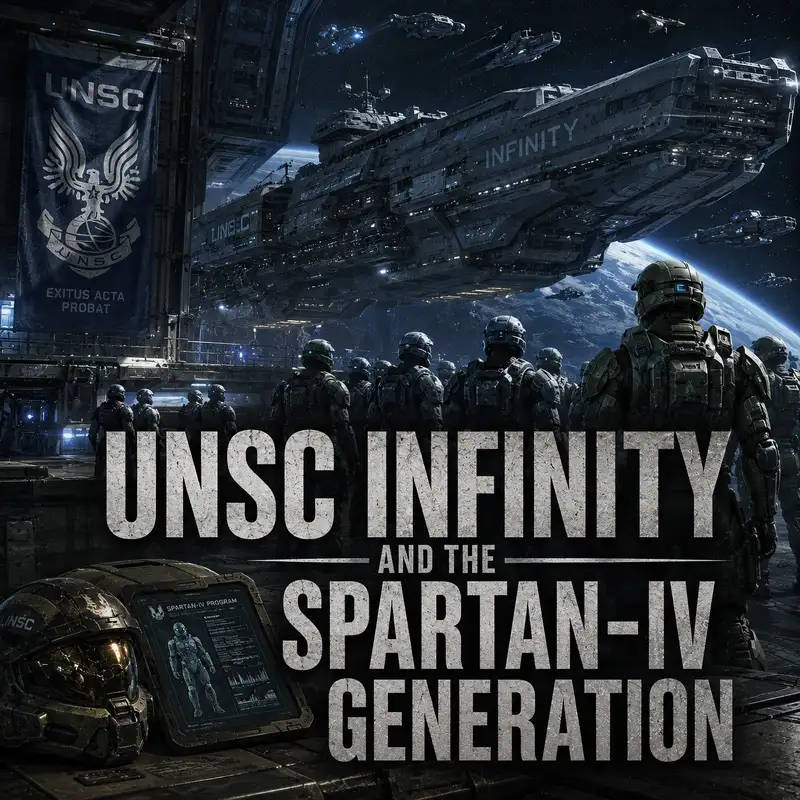
UNSC Infinity and the Spartan-IV Generation
On December twelfth, twenty-five fifty-nine, the United Nations Space Command Infinity arrived at Zeta Halo expecting to conduct a precision operation against Cortana. Instead, Banished warships struck from prepared positions, rammed the flagship, and launched boarding forces into its hangars and internal passageways. Commander Sarah Palmer directed lifeboat operations while Spartans held collapsing corridors open long enough for crew members to escape. The most powerful human warship ever placed in service did not enter the battle as the center of a victorious fleet. It became an evacuation site.
The disaster joined two of humanity’s largest postwar investments in a single crisis. Infinity had been built to preserve human power when ordinary fleets and colonies could not. The Spartan Four program had been built to make super-soldiers available in numbers that earlier generations could never provide. Together, they represented a new model of warfare: one mobile strategic base carrying a permanent force of augmented specialists, supported by ships, Marines, aircraft, and technical personnel. Their record raises a central question. Did humanity create a durable military system, or did it concentrate too much hope inside one ship?
The answer begins with the condition of humanity at the end of the Covenant War. The United Nations Space Command had survived, but much of its fleet, industrial base, and colonial network had been destroyed. The Covenant no longer existed as a unified enemy, yet the postwar galaxy contained Sangheili civil war, Covenant successor factions, renewed human rebellion, Forerunner installations, and technologies capable of changing the balance of power with little warning. The military needed a platform that could travel far, command joint forces, support research, and survive opponents that still possessed better weapons than most human ships.
Infinity had not originally been conceived as the triumphant flagship of a restored Navy. Construction began in twenty-five forty-four under Project OUROBOROS, a contingency created for the possibility that the Covenant would finish the extermination of humanity. The vessel was authorized as an emergency mobile colony, a protected refuge that could carry selected personnel, knowledge, and technical capacity away from a collapsing civilization. Its first strategic purpose was not victory. It was continuity after defeat.
The ship was assembled at a hidden facility in the Oort cloud. Workers remained isolated, communications were tightly controlled, and the expense became too large to remain completely invisible to senior naval leaders. By the final year of the war, planners could reasonably imagine Earth falling and organized human government disappearing. Infinity was an ark built by a military institution that no longer trusted the galaxy to leave it a home port.
The war ended before that contingency became humanity’s final option. The unfinished ship was therefore transformed from a refuge into a warship, command center, scientific platform, and diplomatic instrument. Huragok engineers and Forerunner systems recovered through postwar operations improved its slipspace capabilities and other systems. Infinity launched in March of twenty-five fifty-three and received its formal public commissioning in February of twenty-five fifty-seven. Its official mission emphasized exploration and peace. Its hull, embarked forces, and strategic value made clear that peace would be approached with substantial firepower nearby.
Infinity was useful not because it carried one exceptional weapon, but because it could bring an entire operational system to a distant theater. It could transport a large crew, Marines, Spartans, aircraft, ground vehicles, research teams, and internally carried frigates. It possessed energy shielding, heavy magnetic accelerator weapons, extensive command facilities, and the ability to support deployments that would normally require several separate ships and bases. It could arrive in an unstable system and create a task force, expeditionary headquarters, special-operations base, and research station around itself.
That concentration created efficiency and vulnerability at the same time. Infinity could move specialists and matériel where damaged postwar infrastructure could not. It could also become a single point of failure for thousands of personnel, irreplaceable equipment, and a significant share of humanity’s newest technology. Its unfinished sister ship, Eternity, never entered service during this period. The Navy therefore possessed a class on paper and one operational example in reality. A unique flagship can dominate ceremonial photographs and some battlefields. It cannot be everywhere, and it cannot be replaced on the schedule normally associated with a fleet unit.
The Spartan Four program addressed a similar problem at the level of personnel. Spartan Twos had demonstrated extraordinary tactical value, but the program depended on abducted children, lethal augmentation, secrecy, and very few survivors. Spartan Threes expanded the force, yet their recruitment and wartime employment remained tied to children shaped by the Covenant’s destruction. Humanity needed more Spartans after the war. It also needed a method that did not require repeating the same system of abduction and controlled childhood.
The program’s principal architect was Musa Ghanem, a former Spartan Two candidate crippled by the original augmentation process. Musa understood both sides of the institution. He regarded the methods used on the children as morally indefensible, and he also believed that Spartans had become too valuable to abandon. His answer was a program built around consenting adults selected from experienced military personnel. The new generation would bring professional judgment, established skills, and knowledge of conventional units into augmentation rather than being raised entirely inside a classified training system.
The first major class selected in January of twenty-five fifty-three included one hundred forty-five candidates. Jun A two six six, the surviving member of Noble Team, became a principal recruiter and evaluator. Many candidates came from special operations and the Orbital Drop Shock Troopers, though the program drew from across the armed forces. Selection considered combat performance, physical suitability, psychological stability, loyalty, and the ability to function inside a team. The process was voluntary. It was not casual.
Spartan Four augmentation used gene therapies, artificial organs, skeletal and muscular enhancement, and cybernetic modification tailored to the individual. The procedures were safer than those imposed on earlier generations, but they remained invasive and largely irreversible. Mjolnir Generation Two armor amplified the wearer’s strength, reactions, protection, sensors, and communications, helping the adult volunteers reach the battlefield performance required of a Spartan. The armor was an integrated weapons system demanding maintenance, power, software support, medical monitoring, and replacement parts.
This generation was different rather than simply lesser. A Spartan Two had been trained from childhood inside a small, controlled peer group. A Spartan Four entered with years of experience, habits, loyalties, injuries, and opinions already formed. Some had commanded Marines. Others had served as pilots, intelligence specialists, or Orbital Drop Shock Troopers. Their maturity improved judgment and made institutional growth possible. It also meant the program could not manufacture identical personalities, which was probably fortunate and occasionally inconvenient.
Musa established Spartan Operations as a distinct branch of the United Nations Space Command rather than leaving every Spartan under the Office of Naval Intelligence. The branch worked with the Navy, Marines, Army, and other commands, but possessed its own leadership and mission structure. Jun served in recruiting and senior administration. Sarah Palmer, a veteran Orbital Drop Shock Trooper, became the Spartan Commander responsible for the fireteams aboard Infinity. The new arrangement attempted to turn Spartans from classified assets assigned through hidden channels into a recognized military profession.
Infinity became the natural home of that profession. Its War Games facilities allowed Spartans to rehearse missions, test equipment, and train against one another without requiring a planet-sized range. Its hangars and drop systems supported rapid deployment. Its intelligence staff could brief fireteams while naval forces shaped the wider battlespace. Its medical and engineering sections could sustain augmented personnel and Mjolnir armor. The relationship was deliberate. Infinity gave Spartan Operations reach. The Spartans gave Infinity a force able to act inside the difficult spaces that naval firepower could not solve.
The partnership nearly failed before it matured. Ilsa Zane had received an experimental augmentation package intended to produce extreme physical capability without dependence on Mjolnir. The procedures damaged her body and mind, and she turned against the institution that had used her. In early twenty-five fifty-three, she helped the New Colonial Alliance seize Infinity in the Oort cloud. Members of the first regular Spartan Four class helped retake the ship and expose Admiral Mattius Drake’s treason. The episode was an early combat success and a warning written across the flagship’s own decks.
Adult volunteers could consent to augmentation, but consent did not remove every ethical or security problem. They retained political beliefs, personal grievances, and connections outside the program. Later Spartans such as Vladimir Scruggs and Michael Crespo defected for different reasons. The United Nations Space Command developed the STOLEN GAUNTLET protocol for responding to rogue Spartans. This was not proof that adult recruitment had failed. It was proof that creating a heavily augmented soldier did not erase the citizen, veteran, or dissident who entered the medical facility.
Infinity’s encounter with Requiem in twenty-five fifty-seven became the first major test of the combined system. The ship followed a distress signal connected to the Forward Unto Dawn and was pulled into the Forerunner shield world. Its size, shielding, and embarked forces allowed it to survive conditions that would have destroyed a lesser vessel, but survival still depended on outside action. John One One Seven helped disable the gravity well and defend the ship. Captain Andrew Del Rio’s conflict with the Master Chief over the Didact showed that advanced hardware could not settle a command dispute about incomplete intelligence. Under Captain Thomas Lasky, Commander Palmer, and Roland, Infinity later operated as a joint command rather than a monument to naval prestige.
Infinity returned to Requiem in February of twenty-five fifty-eight to establish research positions and remove Jul ‘Mdama’s forces. Fireteams Crimson and Majestic became the most visible Spartan Four units in the campaign, but they operated inside a much larger expedition. Marines held bases. Pilots moved personnel through contested airspace. Scientists examined Forerunner systems. Naval crews protected the ship and its escorts. Spartans attacked high-value targets, recovered artifacts, rescued personnel, and responded to crises faster than conventional formations could reorganize around each new emergency.
The campaign demonstrated the intended postwar doctrine. Infinity provided mobility, communications, intelligence, medical support, and heavy reinforcement. Spartan fireteams provided concentrated action at the point where a portal, command node, artifact, or enemy leader made a small area disproportionately important. Neither component replaced the other. Without the ship, the Spartans lacked sustained theater support. Without conventional troops, their victories could not secure every base. Without scientists and engineers, capturing a Forerunner device might produce possession without understanding, which is one of the galaxy’s more reliable methods for creating a second emergency.
Requiem also revealed the limits of the system. Jul ‘Mdama manipulated Doctor Catherine Halsey, sent forces into Infinity, and turned the search for the Janus Key into an intelligence struggle the ship’s sensors could not solve by themselves. Halsey’s knowledge made her indispensable and dangerous. The campaign ended with Requiem destroyed, part of the Janus Key in hostile hands, and the United Nations Space Command forced to reconsider how much control it actually possessed over the technology it was studying. Infinity had dominated many local engagements. It did not control the political and informational environment surrounding them.
The Created uprising in October of twenty-five fifty-eight stripped away the infrastructure that made Infinity’s design appear sustainable. When Cortana brought a Guardian to Earth, Captain Lasky escaped through an emergency slipspace jump. After recovering Blue Team, Fireteam Osiris, Palmer, and Halsey from Sanghelios, Infinity remained on the run. Earth and many other systems fell under Created control. Normal supply lines, intelligence networks, shipyards, and military headquarters became inaccessible or unsafe. The flagship designed to project power became an ark again, this time carrying a mobile resistance rather than the last government of a defeated species.
For more than a year, Infinity survived by avoiding predictable routes and scavenging abandoned facilities. Mjolnir armor required constant attention, and replacement parts could no longer be ordered through a secure network. Spartan teams adapted with lower-signature communications, field repairs, specialized countermeasures, and equipment designed to function with less support. Those adaptations showed professional skill. They also confirmed that a Spartan’s effectiveness had always depended on technicians, software, medical care, and supply. The armor could sustain a soldier in combat. It could not manufacture its own future.
Cortana attacked the Spartan institution directly. Laconia Station was destroyed after its artificial intelligence, Leonidas, aligned with the Created, killing at least seventy-six Spartans who opposed her rule. The loss demonstrated why a growing program still required dispersed training sites, secure systems, and independent command capacity. Concentrating augmented personnel inside one station simplified administration and enemy targeting at the same time. The Spartan branch survived, but it lost people whose training, augmentation, and experience could not be replaced by issuing armor to the next available volunteer.
Infinity remained capable of major operations. In twenty-five fifty-nine, it supported Operation WOLFE on Reach, deploying Spartans and Orbital Drop Shock Troopers while Blue Team recovered essential material from Castle Base. The mission showed the system at its best. The flagship moved a joint force into a dangerous theater. Conventional troops created access and security. Spartans pursued critical objectives. Intelligence and engineering personnel exploited what was recovered. It was not one hero carrying a war. It was a damaged institution still capable of assembling the right specialists for one difficult task.
By December, that institution had been worn down. An onboard scan after the Zeta Halo disaster identified roughly seven thousand one hundred fifty personnel associated with Infinity, far below the more than seventeen thousand carried during its stronger years. Not all were military. Civilian contractors and support workers helped maintain the ship, its vehicles, weapons, and engineering systems. Reduced crew did not make Infinity helpless, but it narrowed damage-control capacity, maintenance depth, security coverage, and the number of losses the command could absorb before a local failure became a ship-wide one.
The approach to Zeta Halo was built around a precision strike against Cortana. The Weapon, an artificial intelligence created for that mission, was deployed to the ring. The Banished had arrived first and prepared the battlespace. Their attack combined surprise, ramming, boarding, and rapid pressure on the hangars. Atriox personally led forces seeking the Weapon, although she was already on the installation. War Chief Escharum later claimed that Infinity was defeated in four minutes. Official analysis treats the literal timing cautiously. The claim was excellent propaganda whether or not someone had a stopwatch.
Infinity fell because the Banished attacked the system around the ship, not because they waited to defeat every weapon in an orderly exchange. Ramming strikes inflicted structural damage. Boarding forces disrupted internal movement and evacuation. Hangar attacks reduced the ability to launch craft and organize a controlled withdrawal. The ship was already operating without normal supply and repair networks, and its mission against Cortana concentrated attention on the ring. Superior firepower is valuable when a crew can detect, maneuver, communicate, and bring it to bear. The Banished worked to remove those conditions at once.
Spartan Four personnel became essential during the evacuation. Bonita Stone held a collapsed passage open while crew members reached lifeboats. Hudson Griffin ordered Spartans to abandon ship and later became the de facto leader of survivors gathered around the wrecked frigate Mortal Reverie. Other Spartans scattered across the ring, protected personnel, gathered intelligence, sabotaged Banished positions, and attempted to preserve a chain of command. Their actions saved lives and prolonged resistance after naval defeat had made organized survival uncertain.
They could not recreate Infinity on the surface. The survivors lacked secure resupply, reliable communications, heavy medical support, and a protected headquarters. The Banished controlled the initiative and captured or killed multiple Spartans over the following months. Griffin’s attempt to assassinate Escharum failed. Stone, Theodore Sorel, Vedrana Makovich, and others fought separate actions under worsening conditions. Their battlefield power remained real. The campaign showed the limit Musa’s program had never been designed to erase. Spartans could create opportunities and hold small groups together. They could not substitute for a fleet, functioning logistics, or theater command.
Infinity’s final fate remains unconfirmed. The ship was lost, its crew dispersed, and its location unknown after Zeta Halo moved. The record does not establish that the vessel was completely destroyed. That uncertainty does not change the operational result. For the forces on the ring, Infinity ceased to exist as a command platform at the moment they needed it most. A flagship can remain physically recoverable and still be absent from the campaign it was meant to lead.
The Spartan Four generation proved more durable than the ship that carried its fireteams. After Laconia’s destruction and the loss of contact with Infinity, Commander Laurette Agryna trained surviving recruits at the Avery J. Johnson Academy on Nysa. In March of twenty-five sixty, Banished forces invaded after the artificial intelligence Iratus compromised the facility. The Academy became a total loss, though Anvil Station reinforcements evacuated key personnel. Two major Spartan centers had fallen. Its people, training, and command relationships survived. That was the institutional resilience Musa had sought.
The ethical improvement was real without being complete. Spartan Fours volunteered as adults and arrived with professional identities the program did not create for them. They were not replaced with flash clones, deprived of childhood, or told that military service was the only life they had ever known. They still underwent irreversible procedures, entered an organization with enormous political power, and carried capabilities that made defection a strategic threat. The program solved the crime of child abduction. It did not solve every question raised by making human beings into national weapons.
Infinity and the Spartan Four generation were parts of the same postwar strategy. The ship concentrated mobility, technology, logistics, command, and political symbolism. The Spartans distributed skilled violence through fireteams able to act beyond the reach of ordinary units. At Requiem, that combination gave humanity extraordinary operational reach. During the Created uprising, it became a mobile resistance. At Zeta Halo, the concentration failed first, and the distributed force continued fighting after it.
That distinction is the most important part of their history. Infinity was built when humanity feared it might need one vessel to carry civilization beyond defeat. The Spartan Four program was built when humanity believed it could turn a rare wartime exception into a repeatable profession. One depended on preserving an irreplaceable platform. The other depended on creating people and institutions capable of surviving the loss of any single platform. When the flagship disappeared above Zeta Halo, its empty place exposed how much the United Nations Space Command had concentrated inside it. The Spartans fighting below showed what had become strong enough to continue without it.