UNSC Naval Doctrine: How to Fight Ships Better Than Yours
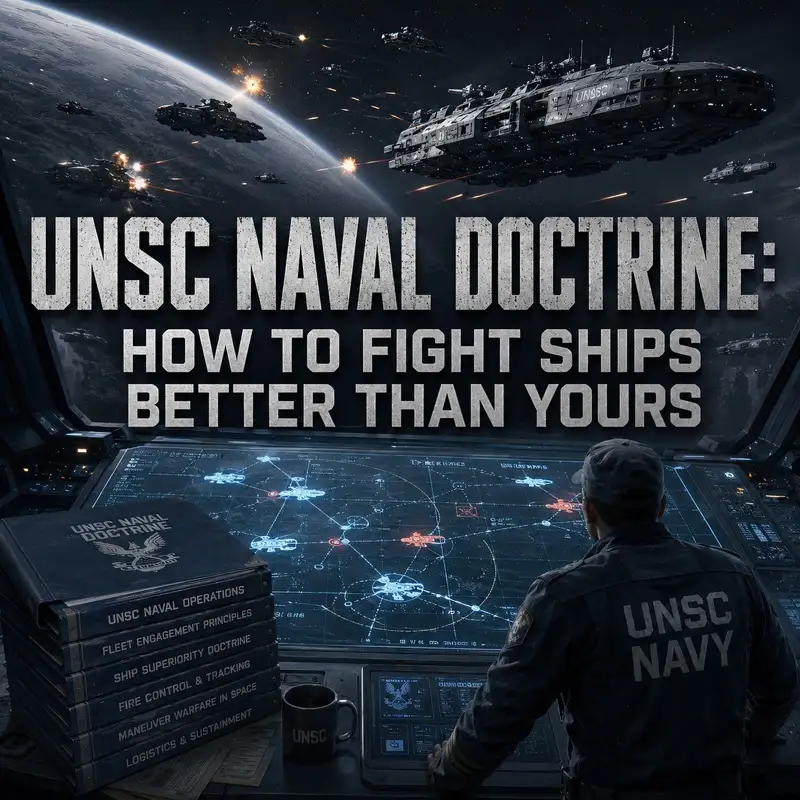
Commander Jacob Keyes studied the tactical display above Sigma Octanus Four and saw the kind of problem that had killed human captains for twenty-seven years. The Covenant ships were better protected, harder-hitting, and more capable of surviving mistakes. His destroyer, Iroquois, could not win by exchanging fire until one side broke. Human armor did not regenerate. Covenant shields did. A plasma strike that missed could still force a defensive maneuver. A magnetic accelerator round that missed became a very fast contribution to interplanetary debris. Keyes therefore did not ask how to outgun the enemy. He asked how to make the enemy fight the wrong battle.
The maneuver later called the Keyes Loop used astrogation, timing, and the enemy’s expectations to place Iroquois on an attack vector the Covenant formation did not anticipate. It did not improve the destroyer’s armor or increase the power of its reactor. It created a brief local advantage, which Keyes converted into accurate fire before the enemy could recover. That was the central principle of United Nations Space Command naval doctrine during the Covenant War. Human ships could not become better Covenant ships. They had to control the geometry, timing, information, and purpose of the engagement well enough that superior technology did not decide the first exchange.
The imbalance was severe. Covenant warships carried energy shields that recovered if given time. Their plasma weapons and energy projectors could cripple human vessels at ranges and with effects human armor was never designed to endure. Their slipspace systems were generally more capable, giving them strategic mobility and more accurate arrival. Human ships carried dangerous weapons, especially magnetic accelerator cannons, Archer missiles, and nuclear warheads. The problem was surviving long enough to employ them effectively.
No reliable universal ratio stated that three human ships always equaled one Covenant ship, or that any fixed number guaranteed success. Classes, crews, commanders, artificial-intelligence support, ammunition, and position all changed the result. An orbital-defense platform was not a frigate. A damaged Covenant corvette was not an assault carrier. The Navy needed concentration, but no formula could turn every concentration into victory.
Prewar doctrine had been developed against human opponents. Patrols, convoy protection, blockade, counterinsurgency, and expeditionary operations rewarded endurance, command and control, troop capacity, and reach across distant colonies. They did not prepare crews for an enemy that could absorb a direct hit and return fire with plasma. The Navy repurposed its existing structure. Battle groups, carriers, prowlers, logistics commands, and shipboard artificial intelligences became the framework for solving a problem no peacetime exercise had adequately described.
The first doctrinal answer was concentration of fire. A single magnetic accelerator round might strain a Covenant shield without collapsing it. Several rounds arriving together could overload the defensive envelope, especially when followed immediately by missiles or nuclear weapons. The objective was not simply to put more fire into space. It was to make several ships behave like one battery. Captains had to align their spinal weapons, calculate the same target motion, charge on schedule, and fire within a narrow window. If one ship was late, the target’s shields might recover before the final impacts arrived. A coordinated volley could kill. A loosely organized series of impressive shots could merely inform the enemy which ships to destroy first.
This made fire control a fleet function. The battle group commander selected the priority target. Shipboard teams converted that decision into firing solutions. Where available, artificial intelligences processed sensor data, predicted maneuver, deconflicted missiles, and synchronized weapons faster than a biological staff. They reduced delay, not uncertainty. Sensors could be damaged, emissions deceptive, and a ship scheduled to fire might lose power before the countdown ended. A perfect solution still depended on several large machines remaining operational at the same moment.
Target selection was as important as accuracy. Covenant command ships, carriers, and vessels carrying energy projectors threatened an entire defense, but they were also the hardest targets to kill. Escorts might be easier to destroy, and their loss could open a formation or reduce point defense. A commander had to choose between the greatest threat, the most vulnerable target, and the ship whose destruction best served the mission. Naval doctrine demanded effects, not trophies.
The magnetic accelerator cannon shaped maneuver because most human capital ships carried it along the hull’s main axis. The vessel had to point toward the predicted intercept. Alignment exposed intentions, limited defensive movement, and created firing lanes other friendly ships had to avoid. Formations maneuvered to bring several bows onto one target without colliding, masking sensors, or crossing the routes used by missiles and fighters. The weapon was powerful. It also required the fleet to arrange itself around firing it.
Missiles filled many of the gaps. They could approach from different bearings, carry nuclear warheads, force Covenant point defenses to divide attention, and exploit a shield weakened by kinetic impact. They could also be intercepted, deceived, or exhausted. Nuclear weapons were especially valuable because their energy could overload shields, damage multiple systems, or turn prepared minefields into ambushes. They were not automatic ship killers. Detonation distance, shielding, target orientation, and enemy defenses mattered. A commander who treated every nuclear device as a guaranteed victory would soon possess fewer nuclear devices and the same enemy fleet.
Formation doctrine balanced concentration against survival. Ships needed to mass fires, but clustering too tightly presented plasma weapons with a dense target. Escorts screened carriers and damaged vessels. Prowlers watched enemy movement, seeded mines, and supplied electronic intelligence. Frigates and destroyers could fire early, then withdraw before the response arrived. The ideal formation created overlapping sensors and weapons without one obvious point of failure. The actual formation often consisted of whichever ships had emerged from slipspace and still answered communications.
Reconnaissance was the beginning of every successful engagement. Prowlers and other intelligence assets searched for fleet composition, approach vectors, emissions, and signs of Covenant intent. Early warning allowed defenders to disperse civilian traffic, protect orbital infrastructure, and choose where to place mines or reserve forces. It also allowed commanders to avoid a battle whose outcome was already obvious. Stealth did not make a prowler invulnerable, and intelligence could become obsolete while moving between systems. Even so, the difference between detecting a Covenant fleet before it reached firing position and detecting it after plasma appeared on the sensors was usually measured in ships, evacuation capacity, and civilian lives.
Human commanders used celestial bodies and orbital infrastructure as parts of the plan. Moons masked movement. Asteroid fields complicated detection and offered locations for mines or hidden craft. Gravity wells altered courses and created predictable paths. Stations and defense platforms added weapons that did not carry slipspace drives or months of stores. Space was not terrain in the same way as a mountain pass, but it still imposed constraints. The best officers treated the local system as another weapon.
Preston Cole became the clearest example. His campaigns showed that massed human forces could destroy Covenant ships, usually at costs the United Nations Space Command could not sustain. Cole studied enemy reactions and increasingly relied on deception and prepared conditions rather than direct exchange. At Psi Serpentis, he drew a pursuing Covenant force into a trap built around the environment and nuclear weapons, then destroyed the formation at the possible cost of his own command. Whether Cole survived remains unresolved. The tactical point does not. He arranged a disaster the enemy entered voluntarily.
Cole’s name was also attached to a rule that sometimes mattered more than victory. The Cole Protocol required human ships to deny the Covenant navigation data that could reveal Earth or other colonies. Databases were purged, retreat routes controlled, and compromised vessels could not be allowed to lead the enemy home. A captain might have to destroy information, abandon the safest course, or sacrifice a ship after the local battle was lost. One surviving enemy vessel could otherwise turn defeat into the discovery of another human world.
Keyes demonstrated the same preference for creating a firing opportunity rather than accepting the obvious exchange. At Sigma Octanus Four, the Keyes Loop used movement and expectation as weapons. The enemy interpreted the destroyer’s course as a familiar tactical problem, then found Iroquois returning from an unexpected direction. Such actions are remembered as inspiration. They were also calculations involving reactor performance, navigation, weapon charge, enemy response time, and the willingness to place one ship where a small error would become fatal. Audacity worked because execution was exact.
Prepared planetary defenses offered another way to change the terms. Orbital magnetic accelerator platforms could carry guns far more powerful than those mounted on ordinary warships. A fleet defending beneath those weapons could maneuver the enemy into their firing zones, protect the platforms, and use them to punish Covenant capital ships. Reach’s defense network represented the mature form of this concept. It also exposed the dependency beneath it. Ground-based generators supplied the orbital guns. Once Covenant forces threatened those generators, the naval battle and the ground campaign became one problem. Space control depended on soldiers defending power infrastructure they could not move.
This relationship explains why the Navy could not solve every colony defense from orbit. Fighters protected approaches and attacked enemy aerospace forces. Marines and Army units defended generators, communications sites, and evacuation routes. Pelicans and other craft moved personnel between ground positions and ships. Naval guns could support surface forces, but orbital fire risked civilians, infrastructure, and friendly troops. A fleet that ignored the ground might lose the systems keeping it in the fight. A ground commander who assumed the fleet would remain overhead indefinitely was making a logistical promise on behalf of people currently being targeted by plasma.
Fighters, strike craft, and boarding forces also remained useful despite the scale of capital weapons. Fighters extended sensors, intercepted hostile craft, attacked exposed systems, and complicated point defense. Dropships delivered Marines and special operators to stations or damaged vessels. Boarding was dangerous, but it could capture intelligence, recover technology, or destroy a target that remained difficult to kill from outside. These missions were not substitutes for fleet combat. They exploited openings fleet combat created. A Spartan or Marine team could disable a critical system. It could not generate the orbital superiority required to reach that system without ships, pilots, intelligence, and a planned extraction route.
Human survivability doctrine relied on armor, compartmentalization, redundancy, and damage control because most wartime vessels lacked shields. Crews isolated breaches, rerouted power, fought fires, stabilized reactors, and kept weapons functioning after the ship had ceased to resemble its readiness report. Captains could turn damaged armor toward the enemy, withdraw crippled vessels behind the formation, or use a ship that had lost its main gun as a sensor or missile platform. Officially combat effective sometimes meant the vessel could still move and had not lost atmosphere everywhere.
Logistics determined whether one more action was possible. Magnetic accelerator projectiles, Archer missiles, nuclear warheads, fighter fuel, reactor components, and replacement crews had to come from somewhere. A victorious battle group could be useless if its magazines were empty and its ships required a yard that no longer existed. Covenant pressure steadily removed the industrial worlds supporting human doctrine. Fleet Command could order concentration, but concentration left other routes uncovered. The Navy was learning how to fight better ships while losing the system needed to keep learning.
Command doctrine accounted for slipspace uncertainty. Ships departing together could arrive separately. Messages from another system might describe conditions that no longer existed. A flagship could be destroyed before the next echelon knew command had passed. Senior leaders therefore established objectives while captains retained responsibility for execution. This was not a romantic preference for independence. It was the consequence of interstellar distance. A captain who waited for complete instructions could receive them after the evacuation failed.
Covenant superiority did not mean Covenant incompetence. Their fleets could form disciplined screens, deploy fighters against evacuation traffic, coordinate bombardment, and use geometric formations with precision. Their commanders possessed centuries of inherited doctrine, experienced Sangheili crews, and weapons that rewarded aggressive action. Human victories did not prove that the Covenant had forgotten how to fight. They usually occurred when a specific commander misread the situation, followed a political or religious priority, underestimated a human tactic, or entered an environment prepared for destruction. Once the Covenant recognized a tactic, repeating it became much more dangerous.
Political structure nevertheless created exploitable friction. Covenant ministries controlled different fleets and pursued objectives that did not always align. Artifact recovery could compete with immediate military destruction. Honor, status, and religious interpretation shaped what commanders considered acceptable. Some vessels were assigned hazardous duties because their crews or leaders carried political stigma. Human intelligence officers and captains could use those patterns, but only if they understood which Covenant formation they faced. Treating every enemy commander as proud, reckless, or eager for a duel was not doctrine. It was a convenient way to die while feeling culturally informed.
The mission often changed what victory meant. A colony-defense fleet might not be expected to destroy the Covenant force. Its task could be to keep carriers away from evacuation lanes, delay bombardment, protect transports until they entered slipspace, or preserve navigational data from capture. A ship sacrificed while buying several minutes could achieve its mission even if the enemy remained in control of orbit. Another ship might destroy a Covenant cruiser and still fail because the evacuation convoy was lost. Naval doctrine judged actions by the objective, though casualty reports and public memory naturally preferred cleaner categories.
Attrition remained the doctrine’s central contradiction. Concentrated fire could destroy a superior ship. Ambush could produce a favorable exchange. A brilliant captain could win. Yet humanity could not afford to spend several crews and hulls every time it killed one Covenant vessel. Large carriers and command ships concentrated capabilities that took years to create and could not be replaced after their shipyards fell. Human doctrine could improve the price. It could not make the war economically sustainable or symmetrical.
Attrition remained the doctrine’s central contradiction. Concentrated fire could destroy a superior ship. Ambush could produce a favorable exchange. A brilliant captain could win an engagement. Yet humanity could not afford to spend several trained crews and multiple hulls every time it killed one Covenant vessel. Large carriers and command ships concentrated capabilities that took years to create and could not be replaced after their shipyards fell. The Covenant also suffered valuable losses, especially among rare capital ships, but its military and industrial depth remained far greater for most of the war. Human doctrine could improve the price. It could not make the war economically symmetrical.
The doctrine failed when commanders accepted battle without preparation, divided fire across too many targets, lost reconnaissance, or allowed Covenant ships to close before the human formation completed its first volley. It also failed when strategic necessity forced fleets to defend fixed locations against overwhelming force. Reach could not maneuver away from its shipyards, population, and command facilities. Earth could not be hidden once discovered. A convoy could not abandon the civilians it existed to protect. Superior tactics create options. They do not remove political obligations, geography, or the enemy’s ability to bring more ships.
Postwar technology improved the fleet’s position. Selected human vessels gained energy shields, better sensors, more capable reactors, and access to systems derived from Covenant and Forerunner technology. New weapons and the Infinity’s enormous combat capacity gave commanders options their wartime predecessors had lacked. The underlying doctrine still mattered. Ships had to detect the enemy, coordinate fires, protect logistics, and keep command functioning. Advanced technology changed the margin for error. It did not repeal surprise, ammunition limits, boarding, or the consequences of placing too much capability aboard one flagship.
The Banished ambush at Zeta Halo demonstrated the point. The Infinity possessed weapons capable of tearing through major enemy vessels, but it entered an engagement shaped by enemy intelligence, prepared positioning, close-range attacks, and boarding forces. Its firepower could destroy targets placed before its guns. It could not restore the initiative once the formation had been disrupted and the flagship was being attacked from several directions. The lesson was not that wartime doctrine had become obsolete. It was that doctrine mattered most before the first shot, when reconnaissance, formation, readiness, and assumptions determined what kind of battle would occur.
United Nations Space Command naval doctrine fought better ships by refusing to measure success through equal exchange. It concentrated weapons against one target, used reconnaissance to choose the moment, treated planets and minefields as parts of the formation, synchronized kinetic rounds with missiles and nuclear weapons, and delegated enough authority for captains to act when the command network failed. It exploited enemy politics without assuming enemy stupidity. It accepted that some battles existed to delay, evacuate, conceal, or preserve rather than to hold orbit permanently.
The doctrine’s greatest victories came when a human commander created several seconds in which Covenant advantages did not fully apply. In those seconds, shields collapsed, missiles arrived, and a better ship died. The cost was that those opportunities often required risk, preparation, intelligence, and sacrifice that humanity could not reproduce indefinitely. Human officers learned how to win individual engagements against superior vessels. They never found a way to make those engagements cheap. The Navy survived by turning temporary advantage into one more convoy escaped, one more colony hidden, and one more battle the Covenant had expected to win without paying for it.