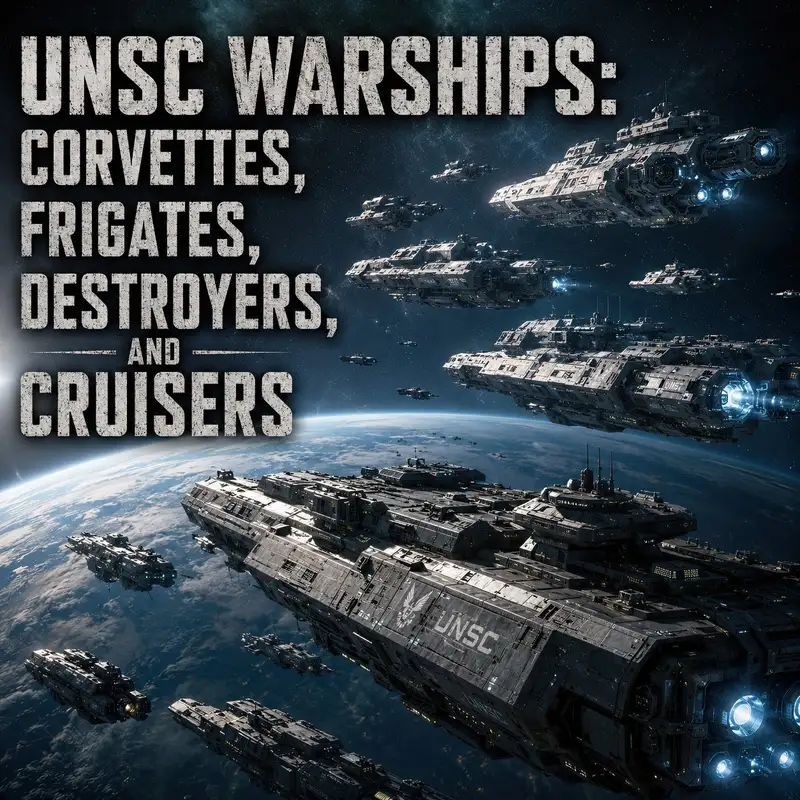
UNSC Warships: Corvettes, Frigates, Destroyers, and Cruisers
At three in the morning on July seventeenth, twenty-five fifty-two, the remote station Archimedes detected a Covenant formation moving toward Sigma Octanus Four. The destroyer Iroquois was the only United Nations Space Command warship in orbit. The frigates Gettysburg and Allegiance were still an hour away, while Vice Admiral Michael Stanforth’s Battle Group Leviathan needed several hours to reach the system. When the Covenant emerged with a carrier, a destroyer, and two frigates, Commander Jacob Keyes had one ship and millions of civilians behind it.
That opening situation explains more about human warship classes than a technical chart ever could. A destroyer was built to fight harder than a frigate of similar length. A cruiser could anchor a battle group and coordinate the larger action. A corvette could patrol, scout, and intercept at lower cost. None of those distinctions mattered if the appropriate ship was still in slipspace when the enemy arrived. Fleet design created options. Distance and warning determined whether a commander received them.
Corvette, frigate, destroyer, and cruiser were not steps on a perfectly ordered size ladder. They were mission classifications shaped by their era. The Scholte began as a state-of-the-art frigate and was later reclassified as a missile corvette after larger ships changed the standard. A Halberd-class light destroyer was only slightly longer than a Stalwart-class light frigate, yet carried almost twice the mass because more of its hull was devoted to armor, power, and weapons. Length alone could not explain the difference.
Most human warships shared a recognizable technological foundation. Fusion drives provided thrust and power. Shaw-Fujikawa translight engines carried them through slipspace. Titanium-A protected the hull. Magnetic accelerator cannons, missiles, point defense, sensors, cryogenic facilities, and artificial-intelligence support turned the structure into a combatant. The arrangement changed by class, but the military problem did not. The ship had to find the enemy, fire, survive the return volley, and remain able to do it again.
The magnetic accelerator cannon shaped the architecture of many United Nations Space Command warships. A spinal weapon ran through much of the hull and accelerated a dense projectile along the ship’s forward axis. Firing therefore depended on more than possessing the gun. The entire vessel had to be oriented toward the target. Capacitors had to charge. Sensors and fire-control systems had to calculate where the enemy would be when the round arrived. A captain maneuvered the ship partly so the ship itself could become the gun mount.
Corvettes occupied the smallest regular warship category. They were fast, comparatively inexpensive, and useful for patrol, interdiction, security, and picket duty. Most carried no fighter wing, and some had little room for anything beyond a shuttle, stores, and the crew required to keep the ship operating. That limitation was intentional. Human space contained far more routes, colonies, stations, and convoys than the Navy could cover with cruisers. A corvette placed a military presence where sending a capital ship would have been wasteful or impossible.
The Mako class demonstrated both the value and cost of that approach. Small Makos became common across human space and served military and security organizations. Persistent maintenance problems pushed the class toward retirement during the early Covenant War, although some remained in rear-area fleets and rebel hands. An inexpensive patrol ship is economical only until every maintenance period becomes an archaeological investigation.
The Gladius-class heavy corvette refined the small-combatant role. It carried a magnetic accelerator cannon, missiles, point defense, and strong sensors inside a low-profile slipspace-capable hull. A crew of only fifteen operated the ship, and there was no troop complement. Its size reduced cost and helped it avoid detection. It was also badly outgunned in a major fleet action, so Inner Colony battle groups normally kept it away from the center of the line.
The Lancer-class fast-attack corvette emphasized weapons over endurance. Rapid-fire naval coilguns allowed Lancer squadrons to harass Covenant ships before those opponents reached effective plasma range. Their magazines were limited, so a typical attack expended the available rods early and then withdrew to replenish. Fuel and stores restricted long deployments. Some Lancers even lost their slipspace drives so the space could hold more ammunition and improve crew accommodations, making them better local defenders and worse interstellar travelers.
These examples show what corvettes contributed. They watched approaches, escorted lower-value traffic, trained crews, enforced security, and gave planetary defenses an early warning screen. They also freed frigates, destroyers, and cruisers for missions that required more firepower or embarked personnel. Their weakness was equally clear. A corvette could report the Covenant fleet and perhaps delay it. It was rarely the ship expected to stop that fleet alone.
Frigates became the Navy’s most visible workhorses because they balanced combat capability with production cost and expeditionary utility. They were lighter and less protected than destroyers, but faster to build in numbers and flexible enough to escort fleets, defend planets, support fighters, deploy troops, and operate near a planetary surface. During the Covenant War, those numbers mattered. A single frigate was badly overmatched by most Covenant capital ships. Several frigates firing together could create a concentrated magnetic-accelerator and missile attack the enemy had to respect.
The Stalwart class represented the middle of the frigate spectrum. It balanced planetary defense and fleet escort with troop deployment. Stalwarts carried Marines, Orbital Drop Shock Troopers, Pelicans, drop pods, and ground vehicles. Their point-defense network helped screen larger vessels and nearby craft. A Stalwart could arrive as part of a fleet and then continue the campaign by placing troops and vehicles below it.
The Charon class placed greater emphasis on landing forces. Its enlarged hangar and cargo systems supported dropships, armor, and surface deployment. Forward Unto Dawn demonstrated that value on the Ark when it descended and delivered vehicles directly into the campaign. The class was designed to move combined-arms forces from orbit to the ground, accepting lighter armament than a frigate built primarily for fleet combat.
The Paris-class heavy frigate shifted the balance in the opposite direction. It carried additional armor, more point-defense weapons, and a larger offensive load while sacrificing much of the cargo and troop capacity found in lighter cousins. Paris frigates entered service shortly before the Covenant War and proved effective enough to be built in large numbers. They fought in wolfpacks, screened fleets, and supported orbital security. On Reach, Grafton and Saratoga provided atmospheric fire support, while Savannah supported Operation UPPER CUT before Covenant plasma destroyed it.
Those losses were not exceptional. Frigates frequently entered the engagement before the larger ships they protected and remained after the enemy had identified them as the easiest targets. Titanium armor could absorb fragments, missiles, and some conventional fire. Covenant plasma transferred enough heat to burn through plating, destroy sensors, and open compartments faster than human damage-control teams could contain the result. The Navy fielded frigates in numbers because they were useful and manufacturable, not because the sailors aboard them were considered inexpensive.
Destroyers concentrated more of the hull on surviving and returning fire. The Halberd class was nearly the same length as a Stalwart, but its heavier structure, thick armor, twin-linked magnetic accelerator battery, large missile load, and nuclear weapons gave it a very different purpose. It carried only a small Marine detachment and a confined hangar. The design spent less space on landing an army and more on attacking another warship.
Early in the Covenant War, Halberds operated in wolfpack task forces expected to hunt and harass enemy capital ships. Their operational life could be measured in weeks. Several destroyers would coordinate magnetic-accelerator fire, launch missiles, and attempt to disengage before Covenant plasma reached them. As the war consumed ships and crews, Halberds were increasingly built or configured with reduced systems and minimal complements for escort duty. The specialized attacker became another screen because the fleet needed screens more urgently than it needed procurement purity.
Iroquois showed what a destroyer could accomplish when maneuver, timing, and enemy assumptions aligned. Keyes drew two plasma torpedoes toward his ship, used emergency thrust to avoid them, and maneuvered so the pursuing weapons struck a Covenant destroyer. He then used a nuclear detonation to collapse the shields of the two frigates, followed by magnetic-accelerator rounds and missiles. The carrier withdrew after deploying ground forces. One human destroyer had removed three Covenant escorts from the battle.
The maneuver did not prove that a Halberd was normally superior to a Covenant task force. Iroquois had used the enemy’s weapons, a nuclear warhead, a dangerous atmospheric loop, and a collision that could have broken the ship. Afterward it required replacement armor, an engine overhaul, new electronic systems, magnetic components, and replenished ammunition. The destroyer had won and become dependent on a repair station before the larger battle had even begun. Tactical brilliance had converted a hopeless position into a repair schedule.
Cruisers occupied the fleet’s command and heavy-combat center. They carried larger weapons, thicker protection, stronger sensors, more extensive communications, and greater capacity for troops, dropships, fighters, and command personnel. Admirals favored cruisers because a flag staff required space, data links, redundant systems, and enough survivability to keep directing the battle after the first exchange. Losing one meant more than losing a gun platform. It could remove the command node coordinating every smaller ship around it.
The Halcyon-class light cruiser was an early attempt to combine attack, defense, transport, and endurance. It proved expensive and was judged less tactically useful than the Marathon class that replaced it. Its unusual internal structure nevertheless gave the hull exceptional resilience. The Pillar of Autumn’s extensive refit for Operation RED FLAG exploited that strength, adding firepower, power management, artificial-intelligence support, and embarked forces for an exceptional mission. Its performance should not be treated as the normal capability of every Halcyon. It was what an old hull could become after the Navy concentrated rare upgrades into one ship.
The Marathon-class heavy cruiser served as the backbone of major fleets through much of the Human-Covenant War. Its heavy armor, paired magnetic accelerator weapons, missiles, hangars, and command facilities allowed it to anchor both attack and defense formations. Vice Admiral Stanforth commanded from the Marathon-class Leviathan at Sigma Octanus Four. Other Marathons defended Reach and Earth. By the final year of the war, their declining numbers forced commanders to reserve many for the Inner Colonies and the Home Fleet.
The Valiant class pushed the command role further. This super-heavy cruiser compromised between cruiser flexibility and battleship power. Its flag facilities allowed an admiral to coordinate a battle group while its weapons contributed directly. Preston Cole used the Valiant-class Everest as his flagship. The design was powerful and expensive, a familiar combination that ensured every fleet wanted one and few received one.
Size did not free cruisers from the Covenant’s technological advantage. Energy projectors could cut through human capital ships. Plasma attacks stripped armor and overwhelmed damage control. A cruiser’s greater durability often meant it remained functional for another firing cycle, not that it was safe. Its large crew, command staff, fighters, troops, and ammunition also concentrated loss. The more capability a cruiser carried, the more of the fleet disappeared when it was destroyed.
A functioning battle group therefore used the classes as a system. Corvettes extended sensors, watched routes, and handled patrols. Frigates screened, escorted, supported fighters, and connected the fleet to the ground campaign. Destroyers added concentrated attack power and armor to the screen. Cruisers supplied command, heavy fire, sensors, embarked forces, and endurance. Carriers, prowlers, repair vessels, transports, and orbital-defense platforms completed the force. None of the four named categories was meant to conduct an interstellar war in isolation.
Their weapons also worked in sequence. Magnetic accelerator rounds attacked shields and hulls along predictable forward firing arcs. Nuclear weapons could overload shielding or create opportunities for conventional fire. Archer missiles became far more effective after shields weakened, though Covenant point defense could destroy them before impact. Human point-defense networks protected against fighters and incoming ordnance. Artificial intelligences and fire-control crews combined sensor data into firing solutions. The fleet had to align those effects faster than the enemy could maneuver or recover.
This made formation and timing more important than individual specifications. A cruiser could hold the center while frigates and destroyers maneuvered around it. Smaller ships could concentrate fire onto one Covenant target rather than distribute impressive but ineffective damage across several. Screens could absorb or evade attacks intended for the command ship. Once magnetic-accelerator capacitors began recharging, surviving the interval became the immediate mission. A fleet battle was not a collection of duels. It was an argument over who controlled the next firing cycle.
The Covenant usually entered that argument with superior shields, plasma weapons, energy projectors, sensors, and slipspace performance. Human forces compensated through massed fire, nuclear weapons, surprise, orbital platforms, artificial intelligence, and sacrifice. No universal exchange ratio described every battle. Readiness, commander quality, ship classes, fleet formation, local defenses, and the exact Covenant force all changed the result. A victorious ambush did not prove parity. It proved that technological superiority could still be punished when doctrine and circumstance created an opening.
The second naval action at Sigma Octanus Four showed the entire system more clearly than the Keyes Loop alone. Battle Group Leviathan finally arrived with cruisers, destroyers, frigates, and support vessels. When the Covenant returned fire after the human opening salvo, the repair station Cradle moved between the fleets and absorbed the attack, buying the warships time to recharge. The support vessel was destroyed. The fleet retained the ability to fire again. Naval logistics had become armor.
The battle ended as a rare human victory, but victory did not remove strategic danger. The Covenant had already placed forces on the colony, and the wider intelligence struggle continued. A tracking device aboard Iroquois helped lead the enemy to Reach. The destroyer’s survival, the fleet’s success, and the ground defense of Sigma Octanus Four all remained real achievements. They also helped connect one battle to the catastrophe that followed. Tactical success and strategic security were not the same condition.
Slipspace made that gap unavoidable. Ships departing together did not always arrive together, and distant headquarters often acted on information already overtaken by events. A corvette could detect an intrusion and still lack time to warn the cruiser beyond the system. A destroyer could hold the enemy and still be destroyed before the frigates arrived. Fleet organization assumed coordination. Interstellar war repeatedly turned that assumption into a request for improvisation.
Industry decided how much improvisation the Navy could afford. Corvettes and frigates covered more systems because they required fewer materials and smaller crews. Destroyers consumed more armor, weapons, and shipyard time. Cruisers demanded major construction facilities, large complements, command systems, and long repair periods. Every magnetic-accelerator round, missile pod, reactor component, sensor panel, and armor plate came from an industrial network the Covenant was steadily destroying.
Damage control continued the industrial battle inside the hull. Sailors isolated compartments, rerouted power, fought fires, sealed atmosphere, and kept weapons operating while plasma damage spread through systems never designed for that kind of heat. A depot could cut replacement armor for a Halberd relatively quickly. Damage to its internal structure still required skilled shipwrights. A ship officially listed as combat effective might be able to maneuver, communicate, and fire one weapon. Naval paperwork has always been generous with adjectives when replacements are unavailable.
Warships also carried the ground war within them. Stalwarts and Charons transported Marines, Orbital Drop Shock Troopers, Pelicans, tanks, and Warthogs. Cruisers carried fighters, drop pods, and larger command elements. Destroyers offered smaller detachments and less room for sustained planetary operations. Many corvettes carried no troops at all. The ship class chosen for an expedition determined not only what could fight in orbit, but what could be placed on the surface after orbit was contested.
The postwar Navy rebuilt with technology learned during the Covenant conflict. Autumn-class heavy cruisers were intended to form the core of new task forces, drawing on the modifications that had made the Pillar of Autumn unusually resilient. Their armor used localized shield reinforcement rather than full Covenant-style protection. Survivability improved, but the ships still depended on titanium, reactors, sensors, and functioning shipyards.
New frigates widened the range of available tools. Strident-class heavy frigates combined high speed, powerful magnetic-accelerator fire, and optional energy shielding, though production delays meant many never received complete shield systems. Anlace-class light frigates emphasized directed-energy weapons, reconnaissance, and electronic warfare. Mulsanne-class frigates replaced the traditional spinal cannon with a Brightlance laser and filled aggressive attack roles once associated with heavier frigates. The classification lines were becoming less distinct because the missions were becoming more varied.
New construction did not remove old ships. Halberd destroyers, Paris frigates, and surviving Marathons remained useful beside postwar classes. The Created uprising then disrupted shipyards, communications, and the centralized support on which the modern fleet depended. A technically superior vessel without access to its parts, software, ammunition, or trained maintenance personnel could become less useful than an older ship whose crew still knew how to keep it running.
Zeta Halo provided the final demonstration. The Mulsanne-class frigate Mortal Reverie was shot down during the Banished attack, ending its service as a naval combatant. Its wreck became a base for United Nations Space Command survivors. Personnel used the surviving structure for shelter, command, medical support, weapons storage, and defense until the Banished captured it. The frigate had lost the sky and continued contributing to the ground campaign because a warship is also power, compartments, tools, and people.
Corvettes, frigates, destroyers, and cruisers were therefore not competing answers to one question. They were a division of labor. Corvettes created presence and warning. Frigates supplied numbers, escort, and expeditionary reach. Destroyers concentrated firepower and survivability into an attack platform. Cruisers connected heavy weapons to command, aviation, and fleet endurance. Each class gained value from the others and exposed the fleet when too few of the others remained.
At Sigma Octanus Four, Iroquois fought alone because the classification system could not overcome time. The later victory required destroyers, frigates, cruisers, a repair station, ground forces, artificial intelligence, and crews willing to hold formation under plasma fire. Human warships never became interchangeable, and none erased the Covenant’s technological advantage. A ship class defined what a hull was built to do. The campaign was decided by whether the Navy could bring those hulls together before the colony ran out of time.