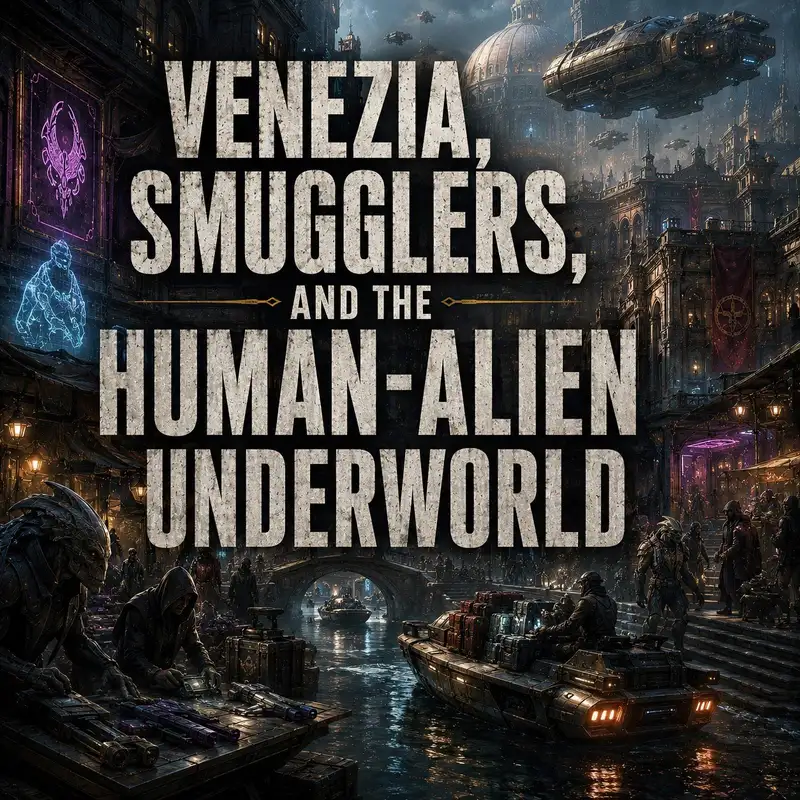
Venezia, Smugglers, and the Human-Alien Underworld
Captain Veronica Dare’s surveillance drone slipped through a ventilation shaft high above New Tyne and found an amphitheater filled with children. Armed guards watched the exits. A Yonhet power broker named M’raad explained that the children’s families had debts they could not repay. The children would settle those accounts by becoming mercenaries. Training, equipment, and contracts would be added to what they owed. Success might reduce the balance. Failure would create interest. On Venezia, even a human life could be entered into a ledger.
Dare had entered the city expecting to confirm an emerging security threat. She found an economy. The weapons, guards, alien brokers, and abducted students were parts of a larger system connecting smugglers, separatists, former Covenant personnel, salvagers, corporations, militias, and warlords. Venezia was not simply a lawless planet where criminals happened to gather. It had become the principal marketplace of a postwar underworld that could move almost anything across political boundaries. The central question is why that marketplace endured when nearly every major power knew where it was.
Venezia lies in the Orso system and was settled in twenty-four fifty as a human Outer Colony. New Tyne became its largest and most important city, surrounded by smaller farms, factories, airfields, and scattered settlements. Long winters and limited development encouraged a practical frontier culture. The planet was never one of humanity’s great industrial centers. Its importance came from distance, political estrangement, and the ability of local communities to operate beyond the daily reach of Earth.
Before twenty-five forty-three, Venezia cut communications with the Unified Earth Government and the United Nations Space Command. The decision was consistent with wider Outer Colony resistance, but Venezia went further than many separatist worlds. It created enough local authority to deny Earth routine access without building the kind of centralized state that could be easily pressured, infiltrated, or recognized as a conventional enemy government. The colony became independent in practice, even when Earth did not accept the political conclusion.
Going dark also helped Venezia survive the Human-Covenant War. The Covenant destroyed colonies it could locate, value, or use as steps toward additional human worlds. Venezia offered little reason for a major fleet to interrupt a campaign of extermination, and its separation from official human networks reduced its visibility. Survival was not evidence that the planet’s defenses could defeat the Covenant. It was evidence that strategic irrelevance can occasionally be an excellent defensive system, provided no one submits the correct coordinates.
The cost appeared in January twenty-five fifty-three when the damaged United Nations Space Command ship Ariadne sought assistance near Venezia. Militia leader Peter Moritz suspected that the emergency was a pretext for inserting government personnel onto the planet and refused to help. The ship was lost with its crew. From the militia’s perspective, caution protected independence. From the crew’s perspective, colonial sovereignty had become a death sentence issued without examining the reactor. Venezia’s security culture began with the assumption that every request might conceal an operation.
Local power centered on the Venezian Militia and its council, but the militia was not a professional army controlling every district through one chain of command. It included committed separatists, aging veterans, local guards, pilots, mechanics, and armed residents. Its equipment came from human military stocks, colonial stores, captured Covenant systems, purchases, and salvage. Authority depended on relationships as much as rank. The militia could keep New Tyne functioning and make foreign intervention expensive. It could not prevent every cartel, faction, or private army from building influence inside the same territory.
The end of the Covenant War transformed the population. Sangheili, Jiralhanae, Kig-Yar, Unggoy, Yonhet, and other former Covenant subjects arrived beside human deserters, refugees, smugglers, and political exiles. New Tyne’s offices, factories, transportation systems, entertainment districts, and spaceports became genuinely multispecies. That did not produce automatic reconciliation. Humans lived beside people whose fleets had burned human worlds. Former Covenant soldiers lived among a species they had been ordered to exterminate. Cooperation usually began with a contract rather than forgiveness.
What held the city together was not one shared law or religion. It was a network of bargains. A Kig-Yar captain needed human fuel processing. A human salvager needed Covenant navigation components. A Sangheili mercenary needed a place to repair armor without answering questions about the previous owner. A militia officer needed spare parts that the Unified Earth Government would never authorize for export. Violence remained common, but uncontrolled violence damaged business. New Tyne developed an order based on reputation, armed enforcement, and the understanding that everyone had something another faction might need.
The clearest early example involved the Covenant battlecruiser Pious Inquisitor. Kig-Yar pirate Sav Fel stole the ship and brought it into a market where a capital vessel could be discussed as privately held property. Staffan Sentzke, a prominent Venezian arms dealer and separatist, sought to purchase it. His motive was intensely personal. The United Nations Space Command had abducted his daughter Naomi for the Spartan Two program, replaced her with a dying flash clone, and concealed the truth for decades. Sentzke wanted answers and believed possession of a Covenant warship might force Earth to provide them.
The transaction drew the Office of Naval Intelligence to Venezia in twenty-five fifty-three. Kilo-Five infiltrated New Tyne, penetrated militia circles, and attempted to keep the battlecruiser from becoming a political weapon. The mission revealed the planet’s strategic character. A family grievance, an insurgent network, a Kig-Yar theft, a Covenant capital ship, and a classified human program had entered the same marketplace. None belonged to one government. Every participant understood that control of the ship mattered more than the legal theory explaining who owned it.
New Tyne’s physical infrastructure supported that trade. The airfield held human and Covenant aircraft, transports, and exfiltration craft. A quarry could be converted into a hidden hangar. Armories stored equipment acquired through channels no procurement officer would describe enthusiastically in an audit. Bars doubled as meeting sites and intelligence exchanges. Roads connected farms and workshops to a city whose space traffic could include civilian shuttles, military dropships, private raiders, and vessels whose transponders had experienced several changes in ownership.
The militia did not remain politically neutral. In July twenty-five fifty-three, it pledged support to the Keepers of the One Freedom, provided weapons, and gave the religious movement a safe haven in New Tyne. The Keepers combined Covenant faith with human and alien anti-government politics. Venezia supplied what their doctrine could not: storage, transportation, markets, and a population accustomed to dealing with factions no recognized state wished to host. The alliance showed how a local independence movement could become part of an interstellar insurgent network without surrendering formal control of its own planet.
Venezian personnel also cooperated with political actors on Gao who wanted greater distance from the Unified Earth Government. When a possible Forerunner ancilla became the objective of a crisis there, the militia and the Keepers attempted to exploit it. Their partnership was not based on complete trust. Each wanted the artifact, influence, or strategic advantage for itself. That was typical of Venezia’s alliances. Shared enemies created access. They did not remove the expectation that every partner might attempt to steal the valuable part of the agreement.
By twenty-five fifty-seven, Nor Fel’s clearing house had become one of New Tyne’s most important institutions. Salvagers delivered recovered armor plating, memory circuits, weapons, transport craft, machine components, and other military surplus. The clearing house cataloged the material, collected a percentage, and sold it through scheduled auctions. Customers included manufacturers, medical organizations, independent governments, religious groups, rebels, former Covenant factions, and representatives whose employers preferred not to appear on the invoice.
Nor’s success depended on rules. She avoided moving the heaviest ordnance, preserved a reputation for reliable transactions, and operated carefully enough that even the United Nations Space Command maintained a buyer in New Tyne rather than attempting to destroy the market. The arrangement was an admission of limits. Human authorities wanted stolen military property recovered and dangerous technology monitored. They also understood that a raid would disperse sellers, destroy sources, and turn a predictable auction into hundreds of private deals conducted through less visible ports.
Independent salvagers made the system possible. Crews such as Rion Forge’s Ace of Spades searched battlefields, wreck sites, abandoned colonies, and debris fields for material the original owners could no longer recover. Salvage law attempted to define what should be reported or returned. Distance and profit supplied alternative interpretations. A reactor component taken from a dead cruiser might keep a frontier settlement operating, restore a pirate ship, or become part of a weapon aimed at the government that built it. The object did not determine the politics. The buyer did.
Information moved through the same economy. A bartender could identify a crew that had recently returned from an unusual wreck. A Kig-Yar transport operator could place an intelligence officer inside a restricted construction site. A broker could provide the location of a lost ship without ever touching the cargo. Establishments such as Stavros’s bar, Tiny Birds, and later the Baggage Claim mattered because informal spaces created the trust that official communications lacked. On Venezia, intelligence was rarely classified first. It was priced.
Smuggling across interstellar space still required real logistics. A ship needed a functioning slipspace drive, navigational data, fuel, atmosphere, crew, maintenance, and a destination willing to accept the cargo. Human, Covenant, and Banished components did not become compatible because the customs declaration was fraudulent. Successful smugglers therefore relied on mechanics, Huragok when available, forged transponder records, safe anchorages, and brokers who knew which port officials could be bribed. The underworld survived through technical competence as much as criminal audacity.
This helps explain why the United Nations Space Command never simply invaded. Venezia had an armed militia, anti-aerospace defenses, mixed aircraft, urban infrastructure, and a population that would interpret intervention through decades of colonial conflict. An assault could destroy warehouses while renewing the wider Insurrection, killing alien residents, and forcing the Swords of Sanghelios to answer questions about human treatment of former Covenant subjects. Occupying New Tyne would require ground forces, police, intelligence networks, and a replacement economy. Destroying a marketplace is easier than replacing everything people bought there.
Human authorities also benefited from the market. The Office of Naval Intelligence infiltrated the militia, cultivated alien contacts, tracked auctions, inserted buyers, and used Venezia to observe factions that would otherwise remain hidden. A smuggler who believed every government official was an enemy could still sell information to one through an intermediary. This created a familiar intelligence contradiction. The planet was condemned as a threat while its brokers supplied warning about other threats. Closing the market would remove danger and collection access in roughly equal proportions.
Cortana’s Created imposed only limited control over Venezia after twenty-five fifty-eight. The planet’s uneasy peace had developed before Guardian rule, and larger strategic centers demanded more attention. With the United Nations Space Command weakened and Created oversight thin, local power brokers expanded operations. The absence of a dominant state did not produce freedom for everyone. It allowed organizations with money, weapons, and transport to define which forms of coercion counted as ordinary commerce.
M’raad’s janissary project was the clearest result. Families unable to repay debts surrendered children or had them seized. The recruits would be trained and contracted to multiple customers, with a share of their earnings applied to balances designed to grow through discipline charges and failure. Some programs also pursued augmentation, using illicit medical research and technologies derived from earlier efforts to create enhanced soldiers. The objective was not to reproduce a Spartan exactly. It was to manufacture a marketable fighter at a price a cartel, corporation, colony, or warlord could afford.
Janissaries were not a Banished creation, though Banished commanders represented potential customers. Independent criminal, corporate, colonial, and insurgent groups pursued their own programs. Waverly-class augmentors, part of the rumbledrug tradition once used by insurgents against Spartans, offered one dangerous path. Medical companies and security partners saw a different problem: the United Nations Space Command could no longer protect every colony or commercial route. Private enhanced soldiers looked like a solution to institutional collapse. They also created an industry in which failed medical trials and disposable recruits remained outside public accounting.
Operation Sonata placed Dare inside that system on September twenty-second, twenty-five fifty-nine. Her mission was reconnaissance, not rescue. She recorded the recruits, identified M’raad, and escaped after Alpha-Nine personnel intervened against the power broker’s guards. The intelligence was valuable. The children remained. Dare understood that a direct intervention could ignite war with Venezia while the Infinity prepared for operations against Cortana. Strategic priorities converted immediate victims into a later problem, which is one of the more reliable ways for a later problem to become heavily armed.
The political network was already widening. The Venezian Militia supported the Keepers, the Keepers had entered an alliance with the Banished, and the New Colonial Alliance was escalating raids across Outer Colony regions, with some attacks flown under Banished colors. These relationships did not create one unified command. They created access. A local militia could provide safe harbor. A religious movement could provide recruits. A separatist organization could identify human targets. A Banished war chief could provide ships and heavy weapons. Each participant retained enough independence to deny responsibility for what the others did next.
Venezia’s value attracted even more secretive actors. The San’Shyuum High Lord Dovo Nesto established himself near New Tyne because the colony offered concealment, mixed traffic, purchasable officials, and little interest from major governments. From there, his Order of Restoration coordinated efforts to rebuild Covenant power. A world founded by human separatists had become a hiding place for a surviving member of the species that had directed humanity’s extermination. The arrangement was not ideological. Nesto paid, local networks moved his personnel, and discretion became another export.
On November twenty-first, twenty-five fifty-nine, a joint United Nations Space Command and Swords of Sanghelios operation attempted to capture Nesto at the township of Staithe. The target was protected inside a settlement built around a drydocked human frigate, warehouses, mixed landing platforms, and anti-aerospace guns. Banished forces under War Chief Severan were present for their own reasons and evacuated Nesto. Fighting spread from the surface into orbit. The capture failed, and Venezia briefly became the center of a battle among powers that had all used its secrecy before deciding someone else had used it too well.
The engagement demonstrated why the planet could no longer be dismissed as a criminal backwater. Venezia supported military docks, concealed headquarters, mixed fleets, local defenses, and enough commercial traffic to hide strategic movements. The Swords could not simply deploy on a human colony without coordinating with the United Nations Space Command. Human commanders could not treat every vessel as hostile without attacking civilians and intelligence assets. The Banished could exploit local neutrality while preparing operations elsewhere. The underworld had become infrastructure for interstellar war.
Most residents were not cartel leaders or intelligence officers. They were farmers, construction workers, teachers, mechanics, transport crews, children riding maglev trains, and families trying to survive long winters. Their city contained ordinary apartments, restaurants, bars, workshops, and schools beside armories and clearing houses. The same transport network that moved a student to class could deliver that student to M’raad’s guards. The underworld was dangerous precisely because it was woven into normal life rather than separated behind one fortified gate.
Multispecies coexistence was equally complicated. Prejudice, wartime memory, and raiding persisted. So did personal debts of gratitude. A Yonhet bartender at the Baggage Claim could offer shelter and fuel to a Sangheili pilot who had protected local camps from raiders, while human patrons remained suspicious of both. Old Covenant currency still held value beside human credits and barter. These interactions did not prove that postwar reconciliation had succeeded. They proved that local relationships could become stronger than the political categories inherited from the war.
Venezia therefore possessed law, but much of it was private. Contracts, clan obligations, militia orders, auction rules, debt claims, and armed reputation governed behavior. Those systems protected commerce more effectively than they protected vulnerable people. A broker with a ship could negotiate. A power broker with guards could enforce repayment. A child whose family owed money could be reclassified as collateral. The planet’s independence from Earth prevented one form of external control while enabling local authorities to build others.
Its durability came from distribution. There was no single underworld headquarters whose destruction would end smuggling. Closing one clearing house would move auctions to another broker. Arresting one militia leader would not remove every clan, cartel, separatist, or alien shipmaster. Every major faction also had reasons to preserve at least part of the system. Governments wanted intelligence and recovered property. Warlords wanted weapons. Colonies wanted medicine and spare parts. Refugees wanted passage. Criminals wanted profit. A market serving everyone becomes difficult to attack without also attacking one’s own supply chain.
The strategic danger was not that Venezia could defeat the galaxy’s major powers in open war. It was that it allowed smaller powers to acquire capabilities once controlled by states and empires. A salvaged drive could give an insurgent force strategic mobility. A clearing-house auction could transfer military sensors to a pirate fleet. A janissary contract could provide augmented fighters to a colony that lacked Spartans. A hidden San’Shyuum could coordinate restoration from a human settlement. The planet lowered the cost of entry into interstellar conflict.
Venezia survived because it offered something stronger powers needed and something weaker groups could not obtain elsewhere. It provided distance from Earth, freedom from Covenant caste, access to salvage, mixed technical expertise, political shelter, and a way to convert grievance into military capability. The price was paid by those with the least bargaining power. Ships, weapons, and information changed hands under negotiated terms. Children did not.
New Tyne’s spaceports could place a human freighter, a Kig-Yar shuttle, a Sangheili dropship, and a Banished contractor on the same traffic board without requiring any of them to recognize the same government. That was Venezia’s achievement and its warning. The planet was not outside the postwar order. It was the place where the new order was being assembled from stolen parts, private contracts, and unresolved wars. Every faction could find a customer there. Almost anyone could become the merchandise.