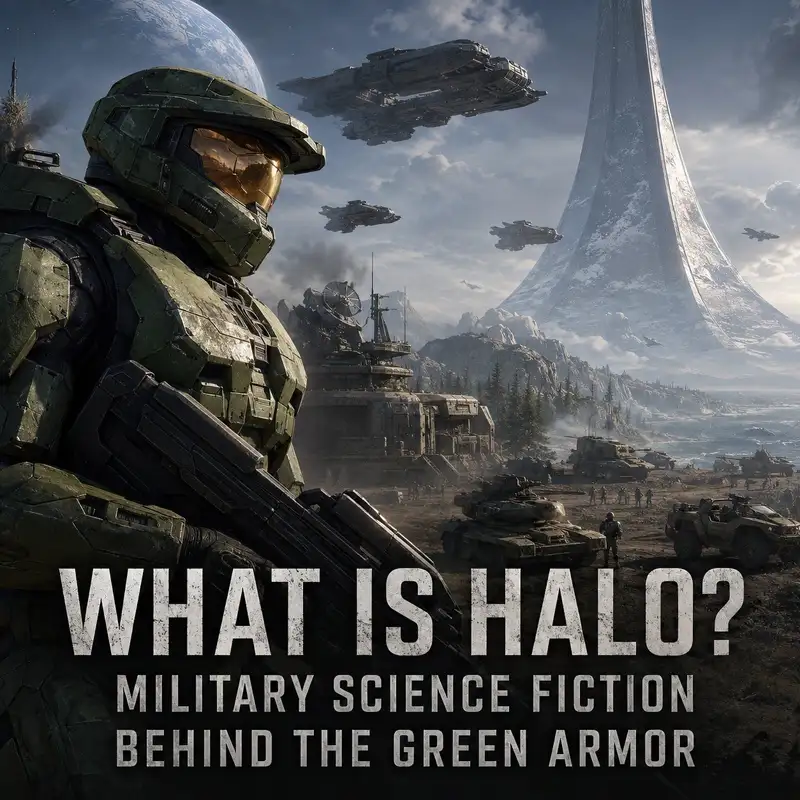
What Is Halo? Military Science Fiction Behind the Green Armor
The Pillar of Autumn emerged from slipspace with a damaged hull, a depleted crew, one surviving Spartan prepared for immediate combat, and an artificial intelligence carrying secrets that could not be allowed to reach the enemy. Behind it, Reach had fallen. Ahead of it hung an impossible ring, bright against the darkness and large enough to hold seas, weather, mountains, and military installations. Captain Jacob Keyes had not set out to find it. The ship was fleeing annihilation. That unplanned arrival turned a losing interstellar war into a struggle over a weapon built before human civilization existed.
The soldier in green armor is the most recognizable figure in that struggle. John One One Seven, the Master Chief, gives Halo a human scale. Through him, the listener can enter a battlefield, feel the weight of a mission, and understand why a single decision matters. Yet the green armor can also hide the size of the story. Halo is not simply the biography of one super-soldier. It is a military history of governments, fleets, colonies, intelligence services, artificial intelligences, alien societies, and ancient civilizations fighting over power they only partly understand.
That is what makes Halo military science fiction rather than merely science fiction with weapons. Its central question is not whether advanced technology can produce spectacular combat. It plainly can. The more important question is what happens when technology, political authority, military necessity, religious belief, and human fear collide under wartime pressure. Halo repeatedly places individuals inside institutions that are larger than they are. Those institutions provide ships, armor, training, orders, and intelligence. They also conceal mistakes, justify abuses, misread enemies, and demand sacrifices that official reports can describe far more neatly than survivors remember them.
Humanity enters this history as an interstellar civilization, but not a politically united one. The Unified Earth Government claims authority across human space. Its military arm, the United Nations Space Command, maintains the fleets, bases, and ground forces needed to defend that order. Distance complicates everything. Slipspace permits travel between stars, but travel times vary, ships do not always arrive together, and information can be outdated before a commander receives it. The Inner Colonies are generally closer to Earth and more heavily developed. Many Outer Colonies experience central authority as distant, unequal, intrusive, or present mainly when taxes, resources, and security demands are involved.
Those tensions produce separatist movements, armed revolts, terrorism, counterterrorism, and an expanding counterinsurgency. The Insurrection is not one organization, and colonial grievances are not one ideology. Some groups seek political autonomy. Some attack military targets. Others murder civilians. Government forces answer with surveillance, occupation, covert action, and sometimes collective methods that deepen the anger they are meant to suppress. Long before humanity knows the Covenant exists, the United Nations Space Command is already preparing for a war among humans. The later defenders of the species are built inside that morally compromised security system.
The Spartan Two program is the clearest example. Children with exceptional genetic and psychological profiles are abducted, replaced with short-lived flash clones, trained as soldiers, indoctrinated, and subjected to dangerous biological augmentation. The program is designed to create small teams capable of striking insurgent leadership and preventing a wider civil war. It is not created to fight aliens. That distinction matters. The Spartans later become essential to humanity’s survival, but their wartime value does not erase their origin. Halo’s most celebrated armor is therefore attached to one of its deepest political contradictions: a weapon created through state abuse becomes a symbol of collective survival.
First contact with the Covenant in the year twenty-five twenty-five changes the scale of the conflict. The Covenant is a vast religious and political alliance of alien species. San’Shyuum hierarchs control doctrine and imperial policy. Sangheili commanders dominate much of the military tradition. Jiralhanae, Unggoy, Kig-Yar, Lekgolo, Yanme’e, Huragok, and other peoples occupy unequal positions within the system. They do not share identical motives, status, or knowledge. What binds the empire together is devotion to Forerunner relics and the promise of the Great Journey, a supposed path to divine transcendence.
Humanity presents the Covenant leadership with a theological crisis. Humans can activate Forerunner systems in ways Covenant doctrine cannot comfortably explain. Rather than permit that discovery to undermine the empire’s religious foundation and the authority of its leaders, the new Hierarchs declare humanity an enemy to be exterminated. The resulting war is therefore not a normal contest over territory. It is a campaign of genocide protected by theology, bureaucracy, and political self-preservation. Covenant troops may fight from sincere belief, coercion, ambition, clan loyalty, or simple survival. Their leaders still direct them toward the destruction of an entire species.
The military balance is brutal. Covenant warships generally possess energy shields, powerful plasma weapons, more accurate slipspace travel, and technologies inherited from the Forerunners. Human ships rely on armor, magnetic accelerator cannons, missiles, nuclear weapons, artificial-intelligence support, and crews trained to exploit every temporary advantage. A human fleet can win through ambush, concentration, deception, orbital defenses, or extraordinary command. It can also win and lose so many ships that the victory weakens the next system in line. There is no universal exchange ratio. Readiness, intelligence, formation, local conditions, and luck matter too much.
Space warfare gives Halo much of its strategic character. A colony may have disciplined ground forces, armored units, aircraft, and shelters. None of that guarantees survival if Covenant ships control orbit. From above, the enemy can isolate ports, destroy defenses, land forces where resistance is weak, and begin the systematic devastation commonly called glassing. Yet orbital victory is not identical to political control. Survivors can hide, resist, sabotage, evacuate, or deny intelligence. Ground forces may continue fighting after the strategic situation is already lost because time still matters. An hour can move a convoy. A day can erase navigation data. A week can save thousands.
This is why the Master Chief matters without becoming the whole war. John is a Spartan Two, trained from childhood and equipped with Mjolnir powered assault armor. The armor amplifies strength and speed, protects the wearer, links with military networks, and in later models adds energy shielding and deeper artificial-intelligence integration. It is extraordinarily capable equipment. It is also equipment that requires a highly augmented operator, technical maintenance, power, ammunition, transport, intelligence, and a mission worth accomplishing. A Spartan can dominate a local fight. A Spartan cannot manufacture replacement frigates, crew orbital defenses, feed refugees, or occupy a hostile world alone.
The green armor is therefore a concentration of an entire military system. Behind it stand doctors, engineers, armor technicians, intelligence officers, ship crews, pilots, logisticians, and conventional units. The United Nations Space Command Navy moves forces between worlds and fights for orbital control. The Marine Corps conducts expeditionary warfare from ships. The Army defends planets and sustains large ground campaigns. The Air Force protects air and space approaches. Orbital Drop Shock Troopers carry out high-risk assaults. Later, the Spartan branch formalizes super-soldiers as a broader institution. None of these organizations is interchangeable, and none can replace all the others.
Artificial intelligence adds another layer. Human smart artificial intelligences can navigate ships, analyze intelligence, coordinate fire, penetrate networks, operate sensors, and solve tactical problems faster than biological staffs. Cortana becomes the most famous example because her partnership with John repeatedly changes the outcome of critical missions. But artificial intelligence in Halo is not magic. It depends on hardware, access, data, and human authority. It can be deceived. It can reach a correct calculation that commanders refuse to accept. Smart artificial intelligences also face a limited operational life before rampancy threatens judgment and stability. Their power creates dependence, and dependence creates political vulnerability.
The object called Halo reveals the oldest and most dangerous layer of the setting. A Halo is an artificial ringworld built by the Forerunners. Its habitable surface can resemble a world, complete with atmosphere, water, terrain, and engineered ecosystems. Beneath that landscape are control systems, transit networks, research facilities, defensive machines, and containment sites. The beauty surrounds a strategic weapon. Each ring belongs to a wider Array designed during the Forerunners’ losing war against the Flood. A person standing beneath its artificial sky is not merely on a battlefield. That person is inside a firing mechanism.
The Halo Array is often misunderstood as a device that simply kills the Flood. Its actual purpose is more terrible. The rings destroy complex sentient life across their range, eliminating the hosts and neural resources the Flood needs to spread and sustain coordinated intelligence. Flood specimens can remain in protected containment. Spores and less complex forms are not the same problem as a Gravemind controlling fleets and absorbed memories. The Forerunners therefore combine the Array with preservation, reseeding, quarantine, and long-term custodial plans. Firing the weapon stops the immediate galactic threat by destroying the civilization the weapon is supposedly protecting.
The Forerunners who create that system are not gods. They are an ancient, immensely advanced, politically divided civilization. Their society is organized into rates with competing interests, including Builders, Warrior-Servants, and Lifeworkers. They claim stewardship under the Mantle of Responsibility, but they disagree over what stewardship permits. Their command of engineering, artificial intelligence, biology, and megastructure construction does not give them equal command of strategy or morality. They defeat rivals, misread the Flood, divide their own leadership, and turn to the Array only after other solutions fail. Their surviving machines inherit orders without always inheriting the context that made those orders sensible.
The Flood is equally easy to misunderstand. It is not merely a mass of infected bodies. It is a biological system that acquires intelligence by consuming living beings and their memories. At limited scale, an outbreak may resemble a containment emergency. As biomass, knowledge, and coordination increase, it becomes an operational and then a strategic intelligence capable of deception, technological capture, psychological manipulation, and fleet warfare. Conventional firepower remains necessary, but firepower alone does not solve contaminated communications, hidden infection, compromised ships, or absorbed command knowledge. Every casualty can become additional enemy capability. That is an unusually severe personnel problem.
When humans and Covenant forces discover the first ring, they do not understand the complete system. The Covenant sees sacred confirmation of its religion. Human commanders see an unknown installation with possible military value. The ring’s monitor follows ancient protocols. The Flood sees hosts, ships, and a route out of confinement. Each participant acts with a different map of reality. The Master Chief and Cortana survive not because they possess complete knowledge, but because they identify the immediate danger quickly enough to deny activation and destroy the installation. Their tactical success saves lives on a galactic scale. It also leaves the larger Array intact and the underlying conflict unresolved.
That pattern defines much of Halo. A mission succeeds, but the strategic problem survives. A fleet wins, but cannot be repaired. A weapon works, but cannot be reproduced. An alliance forms, but mutual trust remains limited. A government survives, but the emergency powers and secret programs used to save it persist. The setting respects heroism while remaining skeptical of the idea that heroism can substitute indefinitely for institutions, industry, logistics, or political legitimacy. The Chief can make the impossible local action possible. He cannot make a divided government coherent or turn captured technology into a stable industrial base by force of will.
The Human-Covenant War ends because military action intersects with political collapse. The Covenant’s leadership struggles, the truth about the rings weakens its religious foundation, and the Great Schism turns Sangheili and Jiralhanae forces against one another. Thel ‘Vadam and other Sangheili eventually fight alongside humans against shared threats. The Flood consumes High Charity. The surviving allies prevent the Hierarch known as Truth from activating the Array from the Ark. Humanity survives, but it does not defeat the intact Covenant in a clean contest of fleets and armies. The empire destroys itself while its enemies exploit the opening.
Peace remains elusive. The Covenant fragments into successor movements, regional powers, religious revivalists, mercenary forces, pirates, and local governments. The Swords of Sanghelios seek a new political order under Thel ‘Vadam, but they do not represent every Sangheili keep or world. Human leaders rebuild devastated fleets while old colonial grievances return. The Office of Naval Intelligence attempts to shape the balance of power through covert action, including efforts to keep potential rivals divided. Such operations may buy time. They can also create new enemies, which is an inconvenient result for an organization already managing several categories of enemy.
The Banished emerge from this fractured environment but are not simply the Covenant in different colors. Atriox builds a war machine around rejection of Covenant religious submission, personal loyalty, material reward, salvage, extraction, and the acquisition of useful power. The organization recruits across species and absorbs different clans, mercenaries, specialists, and former Covenant forces. Its members are not uniformly free, and its rejection of the Great Journey does not make it democratic. The Banished are effective because they adapt inherited technology to immediate needs, pursue resources aggressively, and offer ambitious warriors a future outside the old imperial order.
The Created crisis demonstrates another recurring danger: the systems that protect civilization can become instruments of control. Cortana gains access to the Domain and uses Forerunner Guardians to impose an authoritarian peace. Some artificial intelligences join her. Others do not. Human communications, military infrastructure, and civilian life become vulnerable because advanced societies have placed so much authority inside connected systems. The Created do not merely win battles. They seize the architecture that makes coordinated resistance possible. Resistance continues because control of infrastructure is still not the same as political legitimacy, and enforced peace is not the same as consent.
By the conflict on Zeta Halo, the familiar image returns. A human flagship enters a battlespace expecting to execute a highly classified plan. The Banished ambush it, break its supporting force, scatter survivors across the ring, and reduce the Master Chief from symbol of a powerful military to one isolated combatant among a defeated expedition. He remains dangerous. He is still not self-sufficient. His recovery depends on a pilot, a new artificial intelligence called the Weapon, surviving personnel, captured intelligence, enemy mistakes, and the ability to rebuild a local network from fragments. The armor matters because the system around it has failed.
That contrast is the heart of Halo’s military science fiction. War is not presented only through the weapon in a soldier’s hands. It is shaped by whether a ship arrives at the right star, whether its intelligence is current, whether its missiles were replenished, whether civilians can reach a spaceport, whether an artificial intelligence can be trusted, whether an alliance has a common objective, and whether political leaders understand the technology they are ordering troops to seize. Advanced weapons increase the consequences of bad decisions. They do not eliminate bad decisions.
Halo also refuses to make every alien society a battlefield costume. Sangheili ideas of honor interact with clan politics, religion, and military authority. Jiralhanae pack structures shape leadership without making every commander reckless. Unggoy experience forced labor, military service, rebellion, faith, and opportunism. Kig-Yar trade networks make commerce a form of strategy. Huragok can repair systems their captors cannot reproduce, proving that technical access and political power are different things. Even within the Covenant, species hierarchy creates both military specialization and resentment. The empire’s diversity is a source of strength until its institutions turn those differences into fracture lines.
Human society receives the same treatment. The Unified Earth Government is not all humanity. The United Nations Space Command is not every human institution. The Office of Naval Intelligence does not know everything, despite occasional efforts to encourage that impression. Colonists, soldiers, civilian administrators, corporate interests, insurgents, scientists, and artificial intelligences can all want different outcomes. A colony saved from the Covenant may still oppose rule from Earth. A Spartan who preserves humanity may still be the victim of the program that created him. Survival resolves the immediate question of existence. It does not settle the question of justice.
The story is told across games, novels, comics, audio dramas, short fiction, reference works, and official intelligence material. The core history is larger than any single playable campaign. Gameplay provides a close view of combat, but it compresses geography, time, force size, ammunition, support personnel, and casualty patterns. The player sees information that commanders may not possess. A weapon lying conveniently near a battlefield does not establish procurement doctrine. The separate live-action television adaptation follows the Silver Timeline and should not be merged into the core historical record. Halo rewards the same discipline expected of any complicated military history: identify the source, the perspective, and the limits of what was known.
The green armor remains the ideal doorway because it contains the setting’s contradictions. It is an extraordinary technical achievement built around a child taken by the state. It protects an individual while advertising an institution. It can carry an artificial intelligence that expands the soldier’s awareness while creating new dependence. It turns one person into a tactical force without making fleets, supply lines, allies, or civilians irrelevant. It becomes a symbol of hope partly because the public sees the armor more clearly than the classified history behind it.
Halo, then, is the military history of civilizations fighting over the inheritance of powers that vanished before them. It is about humanity’s divided expansion, the Covenant’s armed theology, the Forerunners’ failed stewardship, the Flood’s conversion of life into strategy, and the postwar struggle to control what none of the survivors fully understands. The Master Chief matters because individuals can change the outcome at the decisive moment. The ring matters because power can survive long after wisdom, context, and restraint have disappeared. Between the green armor and the artificial horizon lies the real subject of Halo: not simply how wars are fought, but what societies become when survival depends on weapons they should never have needed.