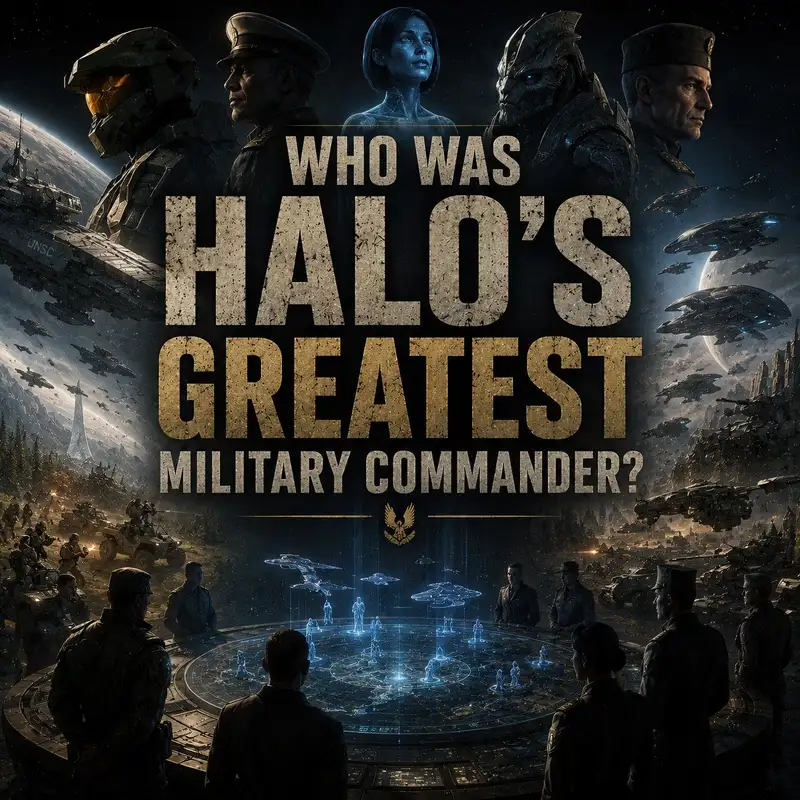
Who Was Halo’s Greatest Military Commander?
At Psi Serpentis in April of twenty-five forty-three, Admiral Preston Cole directed his surviving ships away from a Covenant armada and toward the gas giant Viperidae. The human fleet had already spent missiles, nuclear weapons, and irreplaceable hulls during a battle it could not win through ordinary exchange. Cole’s flagship continued toward the planet while the rest of Battle Group India withdrew. Then a massed nuclear detonation ignited the upper atmosphere and destroyed the Covenant force around it. Cole and the Everest disappeared inside the destruction.
That action is a natural place to begin asking who was Halo’s greatest military commander. It is also a dangerous place to stop. Spectacular destruction is not the same as good command. A commander must translate political purpose into military objectives, use incomplete intelligence, preserve enough force for the next mission, understand logistics, manage allies, and recognize when a tactical victory has created a strategic loss. The greatest commander should be judged not by the largest explosion, but by the quality of decisions made under the worst constraints.
Greatness also cannot be separated entirely from purpose. A commander may display remarkable skill while conducting genocide, enforcing occupation, or activating a weapon that destroys the population being defended. Skill remains analytically real, but the political object still matters. A campaign that secures personal authority while destroying the state is not equal to one that preserves people, institutions, and future choices. This standard does not require moral perfection. Halo offers very few candidates for that award. It requires recognizing that command is responsible for more than the efficiency of violence.
The scale of Halo’s wars complicates the comparison. Human officers fought with dozens or hundreds of ships. Covenant commanders directed fleets across systems. Forerunner ancillas controlled millions of vessels at machine speed. Spartan leaders decided engagements with four-person teams. Atriox built a military confederation from stolen equipment and personal loyalty. These were not equivalent jobs. A useful answer therefore needs several tests: relative strength, adaptability, strategic effect, institutional legacy, political judgment, and the cost imposed on one’s own force.
John One One Seven is the easiest famous candidate to remove from first place. He may be the most consequential soldier in the surviving record, but he was normally a senior enlisted special-operations leader, not a fleet admiral or theater commander. He directed teams, improvised after command collapse, and influenced campaigns through missions few others could perform. He did not allocate national industry, control interstellar logistics, or command the fleets whose sacrifice delivered him to the objective. Greatness at the point of contact is not identical to greatness in command.
At the opposite extreme stands Offensive Bias. If the question concerns the greatest single fleet victory, the Forerunner ancilla has the strongest claim. At the Maginot Sphere, Mendicant Bias arrived with a force hundreds of times larger. Offensive delayed it until the Halo Array fired, then exploited the sudden death of biological crews and Flood forms. Within minutes, it seized abandoned ships, forced collisions, and destroyed the superior fleet. No biological commander in the known record controlled more vessels or reacted faster.
Yet Offensive Bias had been designed for that opponent and that mission. Its victory depended on the Array killing almost every complex living mind across the battlefield. It did not preserve a civilization, negotiate a coalition, rebuild an institution, or decide whether the political objective justified the method. It executed the final military requirement of a strategy whose success proved that Forerunner strategy had already failed. Offensive Bias may have been the greatest battle commander. That is not enough for the broader title.
The Ur-Didact offers the reverse problem. He commanded the fifty-three-year siege of Charum Hakkor, defeated ancient humanity, designed the shield-world strategy, and understood large-scale warfare at a level later civilizations could barely study. He also allowed grief, pride, and the Gravemind’s manipulation to corrupt his judgment. His later plan turned civilians into Promethean weapons and treated permanent military domination as guardianship. He possessed extraordinary operational ability and became a strategic danger to the people he claimed to protect.
Mendicant Bias was even more powerful and even less deserving. It transformed Forerunner fleets, transit systems, and installations into instruments of the Flood. Its campaigns helped destroy the ecumene, but its defection followed prolonged manipulation by the Primordial. At the final battle, contempt for the enemy made it predictable. Power, intelligence, and access produced enormous effect without producing reliable judgment. A commander who wins for the wrong side after allowing an adversary to redefine the mission has not demonstrated the complete form of command being measured here.
Among biological commanders, Thel ’Vadam has one of the broadest records. As Supreme Commander, he led Covenant forces through campaigns that destroyed human fleets and colonies, culminating in the fall of Reach. As Arbiter, he rejected the Prophets, helped stop Delta Halo, joined humanity, killed Truth, and fought at the Ark. After the war, he built the Swords of Sanghelios and tried to turn a military rebellion into a durable political order.
Thel’s greatest strength was adaptation across political collapse. He learned that the authority directing his campaigns had lied about the war’s purpose, then revised not only his enemy identification but his understanding of Sangheili interests. Few commanders have crossed from imperial extermination to coalition warfare without losing the confidence of every side. His alliance with humanity helped end the Covenant and preserved both species from Halo and the Flood.
His claim is limited by the advantages and failures of his earlier command. Covenant technology gave his fleets stronger shields, weapons, and slipspace performance than their human opponents. The fall of Reach was a major victory, but one achieved within a war of annihilation against a materially weaker enemy. At Installation Zero Four, divided authority, religious restrictions, the Flood, and human improvisation destroyed the ring and much of his force. Thel became a better political leader after disgrace than he had been an independent strategic decision-maker before it.
Rtas ’Vadum may have been the sharper fleet commander. He combined special-operations experience with naval command, understood Flood containment, seized Shadow of Intent during the Great Schism, and turned the Fleet of Retribution into the alliance’s principal naval force. At the Ark, his ships defeated a loyalist force that outnumbered them roughly three to one, then supported the ground campaign against Truth. He also knew when to sterilize an outbreak, when to withdraw a damaged carrier, and when coalition interests required restraint.
If the category were best naval tactician, Rtas might win. His record shows concentration, aggression, containment judgment, and the ability to fight with former enemies. The limitation is scale of responsibility. He usually served a strategic purpose defined with Thel and allied leaders rather than creating the political-military system himself. He was an exceptional shipmaster and fleet commander. He did not shape an entire civilization’s war doctrine as deeply as the strongest human candidate.
Atriox presents perhaps the most modern challenge. He began as an expendable Covenant assault soldier and built the Banished into a multi-species confederation. He understood that rebellion without supply would collapse after the first successful mutiny. Banished raids therefore targeted weapons, depots, ships, labor, and industrial resources. Each captured system supported the next operation. Atriox converted grievance into logistics and logistics into political loyalty.
He also refused battles that favored the Covenant, recruited useful specialists across species lines, and allowed subordinate clans enough independence to adapt. At the Ark, he defeated Red Team personally and established control over major installations. Later, his forces surprised the Infinity at Zeta Halo, broke the flagship before it could deploy fully, and scattered the United Nations Space Command presence across the ring. These were not accidents produced by physical strength. They were operational successes built on intelligence, preparation, and concentration against vulnerable command systems.
Atriox’s weakness is the institution behind the victories. Banished authority remains intensely personal. Clans, war chiefs, mercenaries, and occupied populations follow for different reasons. Succession after the loss of a senior leader often produces rivalry rather than orderly transfer. The organization can absorb technology faster than it can create stable governance. Atriox built one of the galaxy’s most adaptive war machines, but its long-term political purpose remains conquest, extraction, and autonomy under his authority. He is the greatest insurgent founder in the record. Whether he is the greatest commander depends on wars that remain unfinished.
Captain James Cutter offers the strongest case from operational improvisation. The Spirit of Fire was a converted colony ship, not a first-line battlecruiser. Cutter used it to support combined-arms operations on Harvest and Arcadia, pursued the Covenant into Shield World Zero Four Five Nine, and sacrificed the ship’s slipspace drive to destroy a Forerunner fleet before the enemy could claim it. Decades later, stranded at the Ark, he fought Atriox with obsolete equipment, no route home, and no supporting fleet.
Cutter’s force destroyed Enduring Conviction, denied the Banished a newly constructed Halo, and forced a technologically superior enemy into a prolonged contest. He achieved these effects by combining Spartans, Marines, aircraft, artillery, logistics, artificial intelligence, and Forerunner systems rather than expecting one arm to solve every problem. His limitation is not competence. It is the narrower theater and unresolved result. He has kept his command alive and dangerous. He has not yet ended the war on the Ark.
Fleet Admiral Terrence Hood deserves recognition for a different reason. He held the human command structure together after Reach, directed the defense of Earth, accepted an alliance with the Sangheili, and preserved enough political continuity for reconstruction. Commanding a last stand is less visually satisfying than winning a maneuver battle because much of the work consists of deciding what cannot be reinforced. Hood’s achievement was survival of the state. His record, however, is stronger in strategic stewardship than in repeated operational innovation.
The strongest near-winners share one quality. They understood that military power is a system. Rtas needed a carrier, crews, containment discipline, and political agreement. Atriox needed depots, foundries, recruits, and a story explaining why they should remain loyal. Cutter needed workshops, aircraft, ground forces, and artificial intelligence aboard a vessel that could not leave the theater. Thel needed keeps and shipmasters willing to turn a rebellion into government. The greatest commander should therefore be the one who improved the system, not merely the one who performed most impressively inside it.
These comparisons leave Preston Cole. His claim does not rest only on Psi Serpentis. It begins with the condition of the force he inherited. Humanity entered the Covenant War without energy shields, with slower ships, weaker weapons in most direct engagements, less accurate strategic intelligence, and an industrial base unable to replace losses at the rate required. Cole could not solve the technological imbalance. He had to make the imbalance temporarily irrelevant at selected points.
At Harvest in twenty-five twenty-six, the first massed human counterattack fired magnetic accelerator rounds, missiles, and nuclear weapons against one Covenant vessel and failed to penetrate its defenses. A subordinate attempted to order withdrawal. Cole countermanded the retreat and reorganized the surviving force around synchronized fire. Human weapons that were ineffective in sequence became useful when concentrated inside one shield-recovery cycle. The Covenant ship was destroyed. Thirteen of Cole’s forty vessels were lost.
That exchange was not sustainable, and Cole understood it. The value of the battle was not that humanity had discovered a reliable ratio for victory. It had discovered a method. Concentrate fire. Sequence weapons with different flight times. Use artificial intelligence and disciplined crews to create one brief interval of local superiority. Accept that the fleet surviving the victory may be unable to repeat it immediately. Cole taught the Navy to think in moments rather than assume a better ship would arrive before the next colony was attacked.
His later campaigns expanded that method. Cole used reconnaissance, deception, orbital geometry, gravity wells, nuclear effects, and fleet maneuver to arrange engagements before the first shot. He treated the star system as terrain. A planet could mask movement. An asteroid field could complicate pursuit. A missile salvo could force shield orientation or formation changes even when it did not destroy the target. Prowlers and navigation officers became as important as the ships receiving public credit.
He also understood logistics more clearly than commanders whose reputations were built around one brilliant attack. Ships required repair cycles, trained crews, missiles, reactor support, and compatible communications. Slipspace could separate a fleet that departed together. A damaged vessel listed as available might arrive too late or lack the acceleration required to hold formation. Cole’s plans depended on preparation because he knew courage could not manufacture ammunition after contact.
The Battle of the Great Bear gave him the intelligence that became his most important strategic contribution. A captured Sangheili confirmed that the Covenant intended extermination and knew less about human space than its military power suggested. Cole recognized enemy ignorance as strategic depth. If the Navy could not defend every colony, it could at least prevent damaged ships, captured databases, and artificial intelligences from guiding the Covenant toward the next one.
The Cole Protocol converted that insight into institutional behavior. Navigation data had to be purged. Artificial intelligences and compromised vessels could be destroyed. Retreat routes could not lead directly toward inhabited systems. The protocol imposed severe costs on crews already trying to survive, and it did not prevent every discovery. It did force the Covenant to search, track, interrogate, and exploit artifacts rather than move through a complete human route network. Cole turned information denial into a defensive layer no armor plate could provide.
The protocol’s deeper value was cultural. It taught captains that protecting information could outweigh preserving a hull and that a successful retreat still had strategic obligations. It forced navigation, intelligence, artificial-intelligence custody, and scuttling procedures into the same command problem. The rules were harsh and sometimes impossible to execute cleanly, but they gave dispersed ships a common defensive logic when communication with higher headquarters was delayed or absent. Cole had converted one admiral’s insight into behavior that could survive the admiral.
His political judgment also exceeded the simple categories of the prewar military. Cole had fought Insurrectionists and had personal ties to Lyrenne Castilla, the commander of the rebel ship Bellicose. During the Covenant War, he understood that human political enemies could still be partners against extermination. At the Rubble, he promoted Jacob Keyes after Keyes protected civilians and cooperated with rebels instead of applying the Cole Protocol as an excuse to abandon them. At Psi Serpentis, evidence suggests an independent human force associated with Castilla helped shape the battle.
This did not make Cole a democratic reformer or erase the deception used during his earlier career. At the Callisto incident, he exploited a surrender and request for medical assistance to lure an insurgent vessel into point-blank attack. Senior command wanted the result and avoided ruling clearly on the method. Cole’s record contains manipulation, political compromise, heavy casualties, and a willingness to spend ships when the objective demanded it.
The difference is that he generally understood what he was spending and what the expenditure could achieve. He did not confuse killing Covenant ships with saving a colony. He recognized that a favorable exchange could still be strategic failure if glassing continued. He rewarded subordinates who preserved the mission’s purpose rather than its most literal wording. He knew that a fleet exists to protect populations, industry, information, and future freedom of action, not merely to produce a larger number in the enemy-loss column.
Psi Serpentis became the final test of that understanding. Cole accumulated ordnance, prepared the system through reconnaissance, coordinated his own fleet, and appears to have arranged support from forces outside normal United Nations Space Command control. He drew more than three hundred Covenant ships toward terrain chosen in advance. The battle consumed much of Battle Group India and ended with the detonation at Viperidae. The victory removed an enormous enemy formation at a cost humanity could not have afforded in a conventional engagement.
The lingering possibility that Cole staged his death complicates the verdict. Evidence suggests Everest may have escaped through a concealed slipspace transition while another damaged ship remained on the fatal course. If he survived, the battle was both strategic victory and personal withdrawal from a war that had consumed most of his life. That possibility changes the biography. It does not change the command effect. The Covenant fleet was destroyed, the surviving human ships escaped, and the Navy retained the doctrine he had spent years building.
Cole did not win the Human-Covenant War. No commander did. The Covenant collapsed through the interaction of human resistance, the Flood, the Great Schism, Sangheili rebellion, artificial intelligence, and operations whose participants rarely understood the entire picture. Cole’s greatness lies in making survival more likely before any of those favorable developments could be predicted.
Under a narrower definition, other commanders surpass him. Offensive Bias commanded the greatest single fleet action. Rtas ’Vadum may have been the finest pure shipmaster. Thel ’Vadam achieved the greatest transformation from imperial commander to coalition leader. Atriox built the most successful rebellion against Covenant authority. James Cutter produced the most impressive sustained campaign from isolation. John One One Seven remains the most consequential small-unit leader.
The broad title belongs to Preston Cole because he best combined all levels of command under the worst material conditions. He changed tactics at Harvest, operational planning across later campaigns, strategic information policy through the Cole Protocol, and political practice by cooperating with human enemies when survival required it. His methods could be taught, repeated, modified, and used after he disappeared. That institutional legacy matters more than any one victory.
Cole’s final image is not the gas giant igniting. It is the fleet before the detonation: damaged ships holding formation, crews waiting to fire on a timetable, prowlers reporting from positions prepared days earlier, navigators carrying routes no enemy could be allowed to recover, and a commander asking an inferior force to create one superior moment. Halo produced commanders with larger fleets, stronger weapons, faster minds, and grander political authority. None taught so much with so little while leaving the next commander more capable than the one before.