Why Humanity Survived a War It Could Not Win
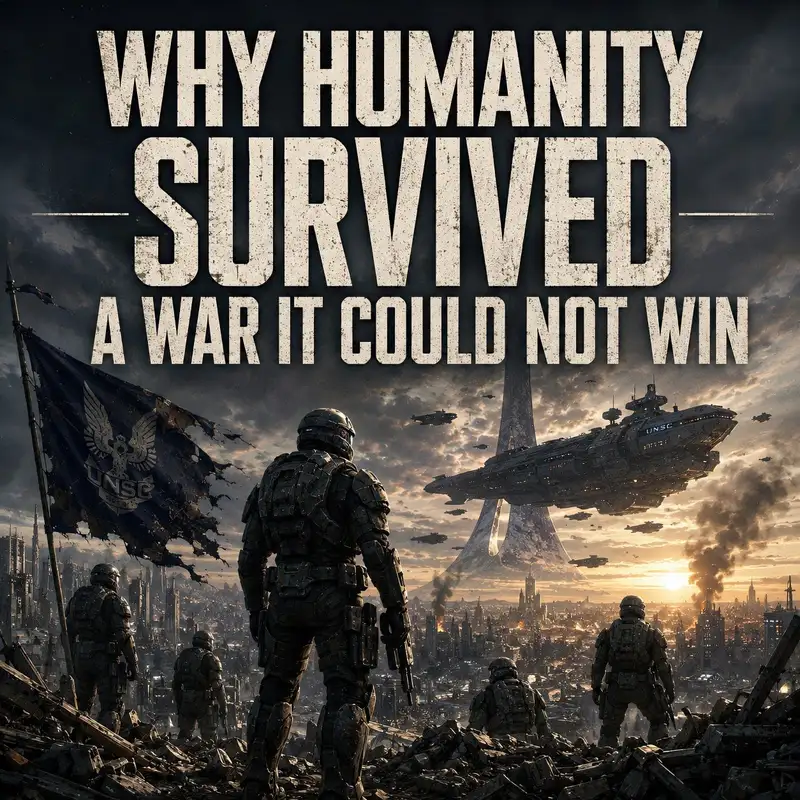
When Forward Unto Dawn emerged above the Ark in December of twenty-five fifty-two, humanity had not assembled the fleet required to win the war. Its naval contribution centered on one frigate carrying Marines, naval personnel, the Master Chief, and a commander responsible for far more than one ship should have been asked to decide. The larger striking force belonged to Sangheili who had been enemies only weeks earlier. Reach was gone. Earth was wounded. Most of the colonies that had once sustained the war were destroyed, occupied, or cut off. Ahead, the Prophet of Truth was preparing to activate the Halo Array.
The force that reached the Ark was not stronger than the Covenant war machine humanity had fought since Harvest. That war machine no longer existed as one coherent enemy. The Covenant had split along political and species lines, High Charity had fallen to the Flood, and Sangheili commanders had turned their ships against the Hierarch who ordered their destruction. Humanity survived because it delayed defeat long enough to reach that rupture, preserved enough military capability to exploit it, and accepted an alliance that no prewar planner could have placed in an operations order.
The war began in twenty-five twenty-five with an asymmetry that made conventional victory improbable. Covenant warships carried energy shields, plasma weapons, more capable slipspace drives, and sensors built on technology humanity could not reproduce. Human ships depended on armor, magnetic accelerator cannons, missiles, nuclear weapons, and artificial intelligence to create narrow firing opportunities. One Covenant vessel could require several human ships to defeat, and the surviving human formation might be too damaged to fight the next engagement.
The political problem was worse than the technological one. Covenant leaders had not come to seize territory, negotiate access, or compel a limited surrender. The Hierarchs declared humanity an enemy whose existence threatened the religious foundation of their empire. Their decision concealed the evidence that humans could activate Forerunner systems the Covenant considered sacred. The resulting war aim was extermination. Humanity could not offer a concession that satisfied it, because the secret being protected was humanity itself.
The Unified Earth Government entered that war with a military designed partly for another conflict. The United Nations Space Command had spent decades fighting separatism, piracy, and terrorism across human colonies. Its ships could patrol trade routes, land Marines, and defeat armed human opponents. They were not organized or equipped for an alien fleet able to burn a colony from orbit after destroying its defenders. The Spartan Two program was tactically exceptional, but it had been created for counterinsurgency rather than interstellar survival.
The first years therefore produced more warning than victory. Harvest was contested repeatedly. At Chi Ceti Four, Spartans proved that Covenant ships could be boarded and destroyed, but Samuel Zero Three Four died ensuring the demolition succeeded. Human commanders learned that Covenant shields could be overloaded, that plasma weapons were devastating against unshielded hulls, and that alien crews could still be deceived. Every lesson was purchased with ships and people humanity replaced more slowly than the enemy.
Distance gave humanity its first durable advantage. Human civilization was spread across many systems, and the Covenant did not possess a complete map of them at the beginning of the war. Slipspace travel was fast by interstellar standards but variable, difficult to coordinate, and dependent on navigation. An enemy fleet still had to locate a world, reach it, and bring enough support to destroy resistance. A colony lost in one system did not automatically reveal every colony beyond it.
The Cole Protocol turned that geography into deliberate denial. Human ships purged navigation data, avoided direct routes toward Earth, and faced destruction rather than capture when their records could expose additional worlds. The protocol did not stop every tracking device, prisoner, recovered database, or careless retreat. It did force the Covenant to keep searching. Each search consumed time, ships, intelligence effort, and logistical support. Humanity could not reverse the invasion. It could make the invasion slower.
That time was often bought by colonies expected to fall. Local garrisons defended spaceports and communications long enough for transports to leave. Naval escorts protected convoys instead of pursuing damaged enemy ships. Army units held generators whose orbital guns might fire only a few more times. Marines and militias delayed ground forces searching for navigation data or Forerunner relics. The Covenant’s need to recover sacred technology sometimes prevented immediate glassing and created hours or days for resistance. That was not mercy. It was a conflict between the empire’s religious priorities and its most efficient method of extermination.
Industrial mobilization kept those delaying actions possible. Shipyards repaired hulls that official reports described as combat effective with considerable generosity. Colonies supplied minerals, food, components, munitions, and trained personnel. Factories continued producing rifles, missiles, vehicles, and replacement armor while refugee populations moved inward. The United Nations Space Command survived as an institution because its logistical network kept creating usable forces after individual fleets were destroyed. The network shrank every year, but it did not collapse all at once.
Human commanders also learned to fight the enemy as a system rather than as a collection of superior ships. Several vessels concentrated magnetic accelerator fire against one target, followed with missiles or nuclear weapons, and tried to strike the hull before its shield recovered. Artificial intelligences fused sensor tracks and compressed the firing sequence. Fighters complicated point defense. Damaged ships became cover, decoys, or weapons. These methods did not erase the technology gap. They made the gap expensive enough that some engagements could be survived.
Preston Cole embodied the value and the limit of adaptation. His campaigns around Harvest restored confidence and taught the fleet how to coordinate against Covenant formations. At Psi Serpentis, deception, nuclear weapons, and the environment around a gas giant destroyed a much larger enemy force. The victory became part of naval legend. It could not become routine doctrine. The conditions were unique, the cost was severe, and an enemy that understood the method would not provide the same opportunity twice.
Special operations attacked places where a small force could produce a larger effect. During Operation Silent Storm, Spartans and conventional assault forces struck Covenant logistics and later the support complex at Zhoist. They destroyed matériel, disrupted forward supply, and bought humanity information and time during the first year of the war. Later raids targeted shipyards, refineries, command stations, excavation sites, and navigation data. The objective was rarely to hold territory. It was to remove one capability the larger Covenant force needed.
Those missions carried a price hidden by the word successful. Alpha Company was lost during Operation Prometheus after destroying a Covenant shipyard. Most of Beta Company died during Operation Torpedo while eliminating a refinery on Pegasi Delta. Their targets mattered because humanity lacked a safer way to affect them. Strategic sabotage converted trained young soldiers into delays against an enemy with greater depth. The missions helped humanity survive. They also revealed how little conventional strength remained available to solve the same problems.
Spartans were most effective when connected to fleets, intelligence, pilots, engineers, and ordinary troops. They could seize a corvette, destroy a reactor, recover an artificial intelligence, or protect a generator. They could not crew the convoys, repair the shipyards, feed the colonies, or occupy every route after the raid. The image of one armored figure surviving impossible fire was useful for morale. The war was sustained by millions of less visible actions performed by people whose armor did not recharge.
Artificial intelligence became another asymmetrical advantage. Human smart artificial intelligences calculated firing solutions, interpreted captured systems, managed navigation, attacked hostile networks, and gave commanders a speed of analysis the Covenant did not always match. Cortana could operate parts of a captured Covenant ship and later understand enough of Halo to prevent its activation. That did not mean humanity understood Covenant or Forerunner technology at scale. It meant rare artificial minds could create temporary access under conditions industry could not reproduce.
Captured technology gradually improved human capability. Covenant weapons, shield components, wreckage, and the knowledge of Huragok gave researchers evidence from which to work. Energy shielding eventually reached Mjolnir armor, improving Spartan survivability in the final year of the war. Other advances appeared in prototypes and selected programs. Humanity had learned enough to adapt. It had not captured the Covenant’s factories, technical culture, or imperial supply network. One successful integration was not technological equality.
Intelligence mattered because humanity could not defend every world. Prowlers watched enemy movement, recovered communications, inserted special teams, and sometimes provided the only warning a fleet would receive. The Office of Naval Intelligence concealed programs, manipulated public morale, and made decisions that remain morally difficult to defend. It also found targets, protected routes, and kept strategic information from an enemy seeking Earth. Survival depended on the same institution’s genuine competence and its willingness to spend people without telling them the complete purpose.
By the final year, none of these adaptations had changed the broad direction of the war. The Outer Colonies had been devastated. Inner Colony defenses were under pressure. Experienced crews, pilots, and technical specialists were disappearing faster than training systems could replace them. Punic-class supercarriers and other major ships had been lost in holding actions that bought evacuations and time but could not be repeated indefinitely. Humanity was becoming tactically more dangerous while becoming strategically smaller.
Reach was the clearest expression of that contradiction. Its fleet, orbital defense platforms, military bases, shipyards, training commands, and intelligence facilities made it humanity’s principal fortress beyond Earth. The super magnetic accelerator cannons above the planet could destroy Covenant warships. Groundside generators kept those guns firing. Spartans, Army units, Marines, pilots, and naval crews defended different parts of one connected system. The weapons worked. The Covenant attacked the connections.
Human forces destroyed the concealed supercarrier Long Night of Solace, defended generators, evacuated civilians, denied classified facilities, and inflicted losses in orbit. Those were real successes. A larger Covenant force arrived, broke the orbital network, expanded the ground invasion, and began glassing the planet. Reach fell because local victories could not restore a defense system once its fleet, power, communications, and surface positions stopped supporting one another. Humanity lost the world built to make its final conventional stand before Earth.
What escaped Reach mattered more than the defenders could have known. The Pillar of Autumn carried Cortana, the Master Chief, surviving personnel, and a set of coordinates derived from Forerunner information recovered at Sigma Octanus Four. The cruiser emerged near Installation Zero Four with Covenant ships behind it. The voyage did not rescue a fleet or reveal a weapon humanity could safely use. It brought both sides to a place where the nature of the war changed.
On Alpha Halo, human and Covenant forces discovered the Flood and learned that the ring was intended to stop the parasite by destroying its available hosts and coordinated intelligence. The Master Chief and Cortana prevented Guilty Spark from activating the installation, then destroyed the ring through the Pillar of Autumn’s reactors. Humanity lost most of the cruiser’s survivors and one of its remaining major ships. It also denied the Covenant an object of religious victory and prevented an extinction mechanism from firing.
The survivors then found a threat aimed directly at Earth. Around the command station Unyielding Hierophant, the Covenant had assembled a massive invasion force. Operation First Strike infiltrated the station, sabotaged its reactors, and used the captured Ascendant Justice to draw enemy ships close before detonation. Spartans, artificial intelligence, naval personnel, and senior officers died completing the plan. Most of the assembled force was destroyed. Earth had not been saved permanently. It had been given time it would not otherwise have possessed.
The Covenant still reached Earth, but the opening attack revealed another accident of survival. The Prophet of Regret had discovered the planet without realizing it was humanity’s homeworld and arrived with a force too small for deliberate conquest. Earth’s orbital grid and Home Fleet inflicted losses, even as boarding teams destroyed platforms and opened a route over New Mombasa. Regret withdrew through slipspace toward Delta Halo. The battle continued, but humanity had survived the first contact with its final refuge because the attacker had not understood what it found.
On Delta Halo, the Master Chief killed Regret. The assassination removed a Hierarch and gave the Prophet of Truth the opportunity to accelerate a political transition already underway. Jiralhanae forces replaced Sangheili guards. Sangheili commanders and councilors were purged. Units that had served together for generations began killing one another across the empire. Humanity did not design the Great Schism. A human operation struck the moment at which Truth chose to exploit the Covenant’s oldest fault lines.
Those fault lines had been built into the empire. The Sangheili commanded much of the military but remained subordinate to San’Shyuum religious authority. Jiralhanae advancement threatened their position. Subject species endured unequal status, coercion, and rival chains of patronage. The Hierarchs concealed evidence about humanity and Halo because truth endangered their rule. The Covenant appeared unified while victory continued to validate the Great Journey. Once its leadership ordered one founding partner destroyed and the sacred rings were revealed as weapons, military obedience became civil war.
The Flood made that collapse irreversible by taking High Charity. The Covenant lost its capital, population center, religious seat, administrative network, and major concentration of ships and supplies inside one outbreak. The Gravemind gained biomass, knowledge, and interstellar transport. Truth escaped with loyal forces, but he no longer commanded the empire that had begun the war. The enemy threatening Earth was still lethal. It was no longer capable of applying the Covenant’s full political and industrial power as one system.
Thel ‘Vadam and other Sangheili did not become human allies because old crimes had been forgiven. They learned that the Hierarchs had betrayed them, that Halo would kill rather than transcend them, and that Truth intended to fire the Array. Humans and Sangheili possessed a common enemy and a common need to prevent activation. Rtas ‘Vadum’s ships brought naval strength humanity could no longer provide. Human forces brought intelligence, Reclaimer access, and troops already committed to the same objective.
That coalition survived disagreement because its purpose was limited and immediate. Sangheili ships contained the Flood outbreak at Voi through glassing, an action Fleet Admiral Terrence Hood regarded with understandable hostility. Human and Sangheili commanders still passed through the portal together. They did not share a government, a history, or a vision of the peace that followed. They shared a judgment that Truth and the Halo Array were more dangerous than their mistrust of one another.
At the Ark, coalition forces attacked barrier installations, defeated Truth’s remaining loyalists, and stopped activation of the Array. The Arbiter killed Truth while the Master Chief and Cortana pursued a second problem inside the wreckage of High Charity. The unfinished replacement for Installation Zero Four offered a local way to strike the Flood, but firing it prematurely destroyed the ring and severely damaged the Ark. The war ended through another denial operation. The victors prevented several enemies from using systems nobody present could safely control.
Humanity had therefore not defeated an intact Covenant through superior battlefield performance. The Covenant lost strategic coherence through political betrayal, religious exposure, species war, the loss of High Charity, the Flood, and catastrophic fleet losses. Human and allied operations accelerated and exploited that collapse. Without the Schism, the surviving United Nations Space Command almost certainly lacked the fleet, industry, and population base to stop a unified empire from completing the extermination campaign.
Delay still deserves to be called strategy because the rupture would have meant nothing if humanity had already disappeared. The Cole Protocol protected locations. Convoys preserved populations and specialists. Shipyards returned damaged vessels to service. Artificial intelligences found opportunities. Spartans attacked bottlenecks. Marines, soldiers, pilots, and local militias held routes whose names rarely entered the final history. Each action preserved some part of the force or society needed when the Covenant finally became vulnerable.
Chance also mattered, which military institutions prefer to describe as opportunity after surviving it. Regret arrived at Earth without a full invasion fleet. The Pillar of Autumn reached Alpha Halo. The Master Chief survived long enough to carry Cortana through several collapsing operations. The Arbiter learned the truth while retaining enough authority to act on it. The Flood reached the Covenant capital before it reached Earth. None of these events was the product of a single human plan. Competence mattered because it allowed people to exploit circumstances they had not created.
The cost prevents survival from becoming a simple victory story. Colonies were glassed, populations displaced, fleets reduced, and industrial networks destroyed. Emergency military authority and Office of Naval Intelligence secrecy survived alongside the species. The Insurrection’s political causes did not vanish. Former Covenant peoples entered civil wars and humanitarian crises. Earth endured, but the postwar government inherited a smaller civilization with damaged institutions and enemies that had fragmented rather than disappeared.
Humanity survived because it denied the Covenant a quick, complete solution. It traded space for time, ships for evacuations, secrecy for uncertainty, and elite forces for damage against critical systems. It learned just enough alien technology to remain dangerous without becoming equal. It preserved command and political purpose after defeats that should have ended the war. When the Covenant fractured, humanity recognized that a former enemy’s fleet was more valuable than another attempt to fight alone.
At the Ark, one human frigate and a Sangheili strike force stood where a conventional victory fleet should have been. Their presence did not prove that humanity had become stronger than the Covenant. It proved that survival can depend on preserving enough people, knowledge, and military capability to reach the moment when a superior enemy can no longer turn power into a coherent decision. Humanity did not win the war it had been fighting since Harvest. It survived until that war became a different one, then prevented the remaining Covenant leadership from deciding how everyone else would die.