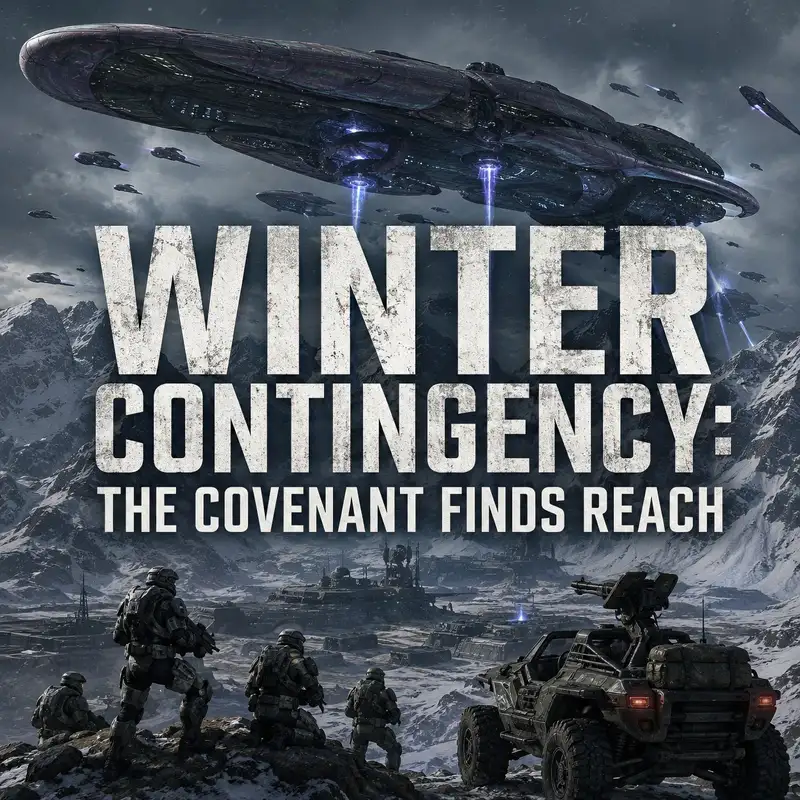
Winter Contingency: The Covenant Finds Reach
Early on July twenty-fourth, twenty-five fifty-two, Noble Team flew toward a communications failure that looked familiar. Visegrad Relay had gone silent. Army patrols sent into the surrounding countryside had stopped reporting. The working suspicion was sabotage by Insurrectionists, a serious problem on Reach but still a human one, bounded by known weapons, known motives, and a chain of command that could be identified. The Spartans found frightened civilians, dead soldiers, damaged equipment, and evidence that did not fit the briefing. Then Covenant troops opened fire. By the time Carter-A259 reported that there were no rebels and that the Covenant were on Reach, the enemy had already crossed the planet’s defensive perimeter, disabled a key communications node, and begun pursuing objectives deeper than simple reconnaissance. Winter Contingency was declared after contact was confirmed. The protocol began with a warning, but the warning arrived from inside the fortress.
Winter Contingency was the United Nations Space Command’s emergency response to confirmed Covenant invasion. It was not one elegant battle plan waiting in a sealed envelope. It was a framework for mobilization, intelligence control, command continuity, data denial, and rapid reassignment. On Reach, the declaration triggered an information lockdown intended to prevent panic while High Command assessed the scale of the intrusion. Units moved. Networks tightened. Sensitive installations reviewed destruction procedures. Commanders began deciding which reports were genuine, which routes remained secure, and which classified assets could be exposed. The system was designed to create order under catastrophic pressure. Its first problem was that the Covenant had shaped the pressure before the protocol began. The enemy had chosen where communications would fail, which civilians would be isolated, and what the first human report would look like.
Reach was the worst possible world on which to discover that distinction. It was a major fleet base, industrial center, intelligence hub, and the military anchor of Epsilon Eridani. Its orbital defenses protected more than cities. They protected shipyards, command facilities, logistics networks, research programs, and personnel required to continue the war. Reach had depth, hardened sites, military traffic, and forces that could overwhelm almost any human rebellion. Those strengths encouraged a particular image of invasion. The Covenant would appear in space, orbital sensors would identify them, naval formations would engage, and surface defenses would prepare beneath the shield of the fleet. Visegrad presented the opposite sequence. The first confirmed enemy was not a carrier on a tracking display. It was a Sangheili strike team standing beside a disabled relay. Reach’s defenses were formidable. They were also arranged around an expected direction of attack, and the Covenant had approached from another one.
The surprise was not caused by a complete absence of warning. Office of Naval Intelligence assessments had already identified the Epsilon Eridani system as being at extreme risk. By July nineteenth, one statistical model assigned the system an eighty-seven point two percent probability of Covenant attack. Senior officials even discussed whether an assault might create the opportunity for Operation Red Flag, the plan to capture a Covenant capital ship and seize a Prophet. That is strategic warning. It says the enemy is likely to come. It does not identify the hour, the landing zone, the target, or the force already hidden below the sensor picture. Probability can justify preparation, but it cannot substitute for contact. It can also create conflicting incentives. Defenders wanted to prevent an attack. Red Flag planners needed a valuable Covenant ship to survive long enough to be captured. Intelligence officers wanted secrecy. Civilians needed warning. Those objectives did not align neatly.
The decision to send Noble Team toward Visegrad was therefore reasonable even though the initial theory was wrong. Noble was a special-warfare unit operating under Army command, composed primarily of Spartan Threes with Jorge-Zero Five Two, a Spartan Two, serving alongside them. The team had the mobility, sensors, communications discipline, and combat power to investigate sabotage in difficult terrain without committing a conventional battalion to what might prove to be a local security problem. Its newest member, Spartan B Three One Two, had joined a formation already accustomed to missions where intelligence was incomplete and extraction could not be assumed. The assignment reflected Reach’s earlier wars as much as the Covenant conflict. Military infrastructure on the planet had long been protected against espionage, insurgent attack, and internal sabotage. When a relay failed in a remote district, commanders first reached for the category they had used before. The Covenant exploited that familiarity without needing to create it.
The force at Visegrad belonged to a Covenant formation with an objective different from the annihilation fleets humanity knew best. Supreme Commander Rho ‘Barutamee led the Fleet of Valiant Prudence, a force oriented toward archaeological reconnaissance and the recovery of Forerunner relics. Its elite scouts, the Devoted Sentries, were commanded by Field Marshal Orsu Lar ‘Ahtalee. They had been sent to silence Visegrad’s communications while tracking Professor Laszlo Sorvad, a scientist identified through intercepted human transmissions. Rho ‘Barutamee believed relics on Reach, which the Covenant called Sovolanu, might help lead him toward Maethrillian, the lost capital of the Forerunner ecumene. That objective made the first phase of the attack less recognizable to human defenders. An extermination fleet benefits from shock and overwhelming firepower. An artifact-retrieval force benefits from secrecy, selective violence, intact records, captured specialists, and enough time to search before heavier forces arrive.
The Covenant did not have to make every sensor on Reach blind. It needed to make separate failures appear unrelated long enough to establish a foothold. The communications relay was an ideal target because it connected a remote region to wider command networks and carried traffic useful to anyone listening before destroying it. Silencing the site delayed reports from local patrols. Attacking nearby settlements removed witnesses or drove them into hiding. Small teams could move through rugged countryside where a fleet-scale warning system offered little help. Covenant stealth technology, electronic suppression, and superior control of insertion gave those teams additional freedom. Human defenses were searching for the signature of a conventional assault. The Fleet of Valiant Prudence presented fragments: a dead patrol, a missing scientist, an interrupted signal, an isolated firefight. None initially described the scale of the force supporting it. That is how a fortress can possess excellent sensors and still misunderstand what they are seeing.
For Noble Team, the mission became reconnaissance by combat. The Spartans moved from civilian sites toward the relay while trying to determine whether the attackers were raiders, scouts, or the forward edge of something larger. That difference mattered. A raiding party could be destroyed locally. A reconnaissance force implied ships, landing zones, supply, and follow-on objectives. A planetary invasion required immediate mobilization beyond anything a single team could direct. The civilians encountered along the route were not background to the intelligence problem. Their testimony established that the attack had begun before the military understood it, and their displacement showed that the enemy had already affected movement and communications outside the relay itself. Noble Team’s armor and weapons gave the Spartans decisive advantages in local fights. They did not provide a complete operational picture. The team could clear a building, identify plasma damage, and track enemy movement. It could not see the hidden fleet behind every contact.
Inside and around Visegrad Relay, the Spartans encountered Sangheili Zealots from the Devoted Sentries. These were not ordinary occupation troops stumbling across a communications station. They were high-ranking religious specialists conducting a mission tied to Forerunner recovery. Their presence was intelligence in itself. The Covenant considered something in the area valuable enough to commit personnel trusted with sacred relics and sensitive searches. Noble Team disrupted the operation and forced the enemy to withdraw, but Field Marshal Orsu Lar ‘Ahtalee escaped. The tactical result was mixed. The relay site was no longer an uncontested Covenant position, surviving civilians could be recovered, and the United Nations Space Command obtained confirmation of the invasion. Yet the enemy commander, his knowledge, and part of his reconnaissance network remained active. Noble Team won the encounter that revealed the threat. It did not remove the system that had placed the threat on Reach.
Carter’s report changed the legal and operational status of every subsequent action. Before confirmation, commanders could treat the outage as security, law enforcement, or counterinsurgency. After confirmation, the Cole Protocol, planetary defense, fleet readiness, evacuation planning, and classified destruction measures all became immediate concerns. The distinction was not bureaucratic decoration. A colony facing rebels tries to preserve evidence, restore order, and arrest leaders. A colony facing the Covenant must assume that navigation data, communications archives, artificial intelligences, research facilities, and captured personnel may reveal other human worlds. The safest course for one mission might be unacceptable for the wider war. A damaged database could need destruction rather than recovery. A civilian transport could require escort ahead of a military unit. A secret installation might be defended because of what it contained, or demolished for the same reason. Winter Contingency converted every local decision into part of an interstellar security problem.
The information lockdown was the most controversial element of the initial response because it was both rational and costly. Reach supported enormous military activity, sensitive research, and a civilian population whose panic could obstruct roads, air corridors, hospitals, and spaceports. An uncontrolled announcement might have created false reports faster than High Command could verify them. It could also have alerted the Covenant that their concealment had failed and exposed which human facilities reacted first. Restricting information bought commanders time to separate genuine contacts from rumor. It also denied local governments, civilians, and many military units the time they needed to prepare independently. Families continued ordinary movement inside a battlespace that was no longer ordinary. Civilian pilots lacked the full reason for altered routes. Supporting formations received pieces of missions rather than the complete threat picture. Secrecy prevented panic by ensuring that many people did not yet know enough to panic. That was an achievement with an expiration date.
Reach High Command initially judged that the Covenant intrusion might be confined to a sparsely populated region and could be eliminated through a decisive ground campaign. Given the available evidence, the assessment was not absurd. The known enemy presence consisted of strike teams, aircraft, and localized positions rather than a visible armada. Reach possessed Army formations, Marines, aerospace units, armored vehicles, artillery, Spartans, and nearby naval forces. A limited bridgehead could be isolated, denied reinforcement, and destroyed. The difficulty was that the assessment treated the known contact as the enemy force rather than the visible portion of it. The Covenant had created an intelligence picture in which the defenders measured what had been exposed while the attacker protected what mattered. High Command prepared to crush a spearhead. The Fleet of Valiant Prudence was still deciding how much of the spear to reveal. By the time human commanders understood that distinction, the campaign had expanded beyond the district surrounding Visegrad.
The assault on Sword Base demonstrated that the relay was not an isolated act of sabotage. Sword Base was an Office of Naval Intelligence facility tied to sensitive research. When Covenant forces attacked, Noble Team was redirected to defend it and restore its defensive systems. The attack reinforced the artifact-retrieval pattern. The enemy was not selecting targets only for their military value. It was also searching for information, personnel, and Forerunner material that could matter within Covenant religious and political competition. That complicated human prioritization. A commander might see a research base as one hardened position among many. The Office of Naval Intelligence might see it as a repository whose loss could compromise decades of work. The Covenant might see the same location as sacred evidence. Three institutions could fight over one facility while defining the objective in entirely different terms.
As reconnaissance widened, the scale of the concealed deployment became harder to dismiss. Covenant forces had established landing and support infrastructure, moved armor and infantry into the region, and protected positions capable of sustaining further insertion. The United Nations Space Command responded with a combined-arms counteroffensive, bringing aircraft, armor, infantry, and naval fire into a battle that had begun as a relay inspection. This escalation revealed the central failure of the first assessment. The Covenant did not need to defeat Reach’s entire military before operating on the surface. It needed protected corridors, hidden command nodes, and enough local superiority to keep the human response fragmented. Once those corridors were established, every delay in recognizing them increased the cost of closing them. A platoon could silence witnesses. A corvette could support a sector. A supercarrier could sustain an invasion force while remaining concealed long enough to make the defenders argue over whether an invasion had truly begun.
The presence of the Long Night of Solace transformed the meaning of the ground contacts. The supercarrier served as the flagship of the Fleet of Valiant Prudence and supported the advance force operating on Reach. Its concealment meant that human commanders were not merely missing scattered dropships. They were misjudging the naval foundation of the entire campaign. Ground forces cannot remain indefinitely without ammunition, maintenance, reinforcements, command, and transport. The Covenant bridgehead possessed those functions because a capital ship and supporting vessels were present beyond the picture High Command first accepted. Once the supercarrier was exposed, the United Nations Space Command could direct operations against it. Before exposure, every firefight on the ground appeared smaller than the logistical structure behind it. The ship remained, in effect, an uncounted army. Its existence also explains why destroying local positions did not end the intrusion. The defenders were cutting branches while the trunk remained hidden.
Covenant intelligence deserves as much attention as Covenant stealth. The Devoted Sentries had intercepted human communications, identified Professor Sorvad, selected Visegrad as a communications target, and pursued data connected to the planet’s buried history. This was not omniscience. The Covenant still misunderstood humanity, competed internally, and interpreted evidence through religious doctrine. Yet on Reach, its scouts collected enough accurate information to act before the defenders assembled their own picture. Human intelligence had predicted that Reach was likely to be attacked. Covenant intelligence identified a particular scientist and communications node. The first was strategically impressive. The second was operationally useful. Wars are often decided in the space between those categories. A headquarters can know that danger is coming and still fail to warn the patrol driving toward the exact road the enemy has mined. Visegrad was that gap made physical: a sophisticated forecast above, a silent relay below, and no secure line connecting them in time.
Noble Team’s performance should be measured against what a Spartan unit could realistically accomplish. The team located survivors, defeated Covenant troops, reached the relay, identified the enemy, and provided the confirmation required to activate planetary emergency measures. Those were significant achievements. Without them, the Devoted Sentries might have retained more time to search, erase evidence, and expand their communications blackout. Yet the Spartans could not reverse the strategic surprise by themselves. They lacked authority over the fleet, control of civilian information, and visibility into every Office of Naval Intelligence program. They could not know how many Covenant ships were concealed or how many sites had already been compromised. Their most important weapon during Winter Contingency was not the rifle or Mjolnir armor. It was a credible report delivered quickly enough that High Command could no longer classify the event as a local disturbance. The Spartans turned ambiguity into warning. The command system still had to decide what to do with it.
The phrase that the Covenant found Reach can therefore be misleading. The Fleet of Valiant Prudence did not simply discover another human world and immediately begin the standard sequence of orbital destruction. It came because Reach contained relics that Rho ‘Barutamee believed could advance his search for the Forerunners’ lost capital. The planet was both a human military center and an archaeological objective inside Covenant religious politics. That combination encouraged infiltration before annihilation. It also gave humanity a temporary opportunity. A fleet interested only in extermination would have gained little from leaving communications stations, research sites, and specialists intact. The artifact hunters needed access, and access required time on the surface. Winter Contingency began during that interval. The tragedy was that the defenders interpreted the limited opening as evidence of a limited enemy. The Covenant’s unusual objective delayed the full destruction of Reach, but it also helped the first attackers enter without presenting the profile human planners expected.
The immediate result of Winter Contingency was not the fall of the planet. It was a race to replace a false picture with a usable one. High Command had to identify landing zones, determine what supported the ground force, defend Sword Base and other critical sites, preserve orbital readiness, and decide how much information to release. The Covenant had to protect its search, reinforce exposed positions, and prevent the defenders from locating the naval assets sustaining the campaign. Noble Team moved from investigation to defense and then into wider counteroffensive operations. Conventional units absorbed the expanding burden. Civilians became trapped between lockdown and escalation. Every new contact confirmed that Visegrad had not been the beginning of the invasion. It had been the point at which the invasion became impossible to deny. By then, the enemy had already gathered intelligence, moved troops, and selected targets. The declaration changed human behavior. It did not reset the battlefield.
Winter Contingency failed to save Reach because it began as a reaction to an enemy operation already in progress, not because the protocol itself was meaningless. It mobilized forces and gave commanders a common language for the crisis. It also exposed the limits of contingency planning. Reach had warning that an attack was likely, defenses designed to meet a fleet, Spartans capable of defeating almost any local force, and an intelligence service watching the Covenant’s advance. What it lacked was a shared understanding of the attack actually being conducted. The Fleet of Valiant Prudence arrived as archaeologists with an army, silenced the network that might expose them, and allowed human assumptions to provide the rest of the concealment. The decisive moment at Visegrad was not the first exchange of fire. It was the realization that the fortress had been looking outward while the enemy was already moving between its farms, relay stations, and classified facilities. Reach received its warning. The warning came from behind the perimeter.