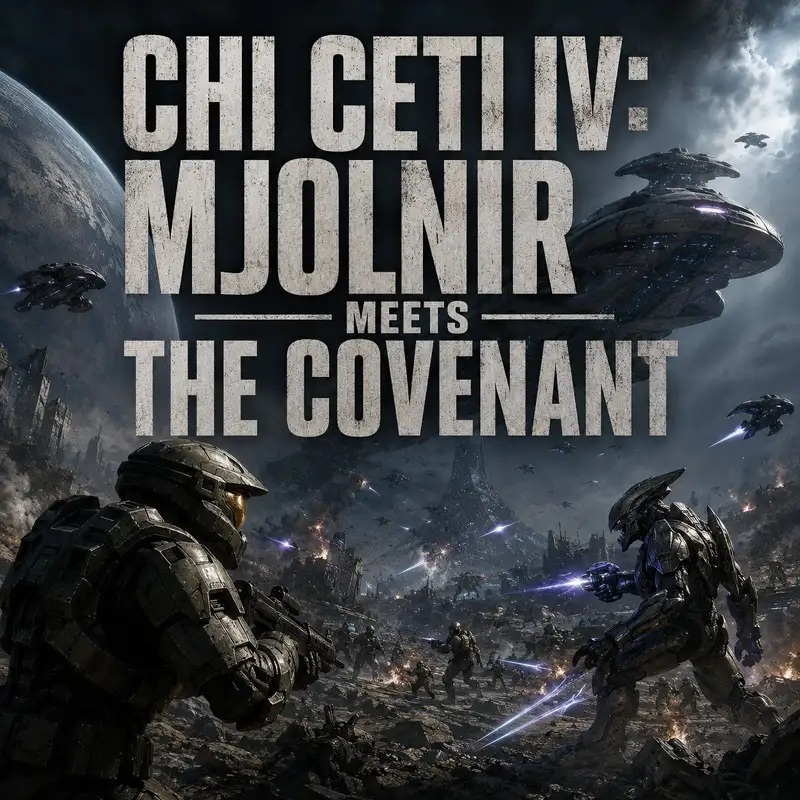
Chi Ceti IV: Mjolnir Meets the Covenant
Samuel Zero Three Four had survived abduction, augmentation, and the first minutes inside an alien warship. What trapped him was a hole in the pressure seal of the most advanced armor humanity had ever built. The plasma strike had not killed him outright. It had made his Mjolnir suit unfit for vacuum, while the only escape route crossed open space. Three missile warheads were already counting down beside the enemy vessel’s power system. John One One Seven and Kelly Zero Eight Seven could leave. Samuel could not. Chi Ceti Four would become one of humanity’s earliest clear naval victories over the Covenant, and the first proof that Mjolnir could help three soldiers destroy a starship. It also proved that armor was not invulnerability.
The battle on November twenty-seventh, twenty-five twenty-five was small by later standards. One human frigate faced one Covenant light cruiser above a remote colony. Yet the engagement joined three developments that would define the war. Humanity encountered Covenant shields and plasma weapons in direct naval combat. The Spartan Twos entered battle in armor designed for their augmented bodies. And the United Nations Space Command learned that a force outclassed in space might still win by combining naval fire, nuclear weapons, artificial intelligence, special operations, and a temporary opening exploited before it disappeared.
The Spartans had not been created for this enemy. Their original purpose was counterinsurgency. Roughly two months earlier, Blue Team had captured Colonel Robert Watts while wearing lightweight black armor. The Covenant’s destruction of Harvest changed the priority. The surviving candidates were rushed toward the final component of Catherine Halsey’s design, a powered system that could amplify their strength and speed without killing an ordinary wearer. Mjolnir had developed beside the Spartan Two program for fourteen years on the assumption that soldier and armor formed one weapon. The alien war turned that counterinsurgency tool into an emergency strategic asset.
The armor waited at the Damascus Materials Testing Facility in Vhalkem on Chi Ceti Four. The secluded installation belonged to the Office of Naval Intelligence’s Materials Group, where distance and security protected experimental hardware. Earlier exoskeletons offered strength at the price of bulk and external power. Mark Four placed protection, environmental support, sensors, communications, and force amplification around one operator. An armored Spartan weighed roughly half a ton, yet a neural interface let the suit respond quickly enough to feel less like a vehicle than an additional layer of the body.
That performance came from integration rather than one miraculous component. The outer shell resisted gunfire and dispersed limited energy from plasma. A sealed body layer and hydrostatic gel regulated temperature and absorbed shock. Reactive circuits amplified movement, while sensors and medical systems supported combat in toxic atmosphere or vacuum. The suit carried its own power, computer architecture, and battle-network links. It did not make decisions for the Spartan. It made each decision happen faster and with more force.
The Mark Four issued at Chi Ceti lacked one capability later audiences often associate with Mjolnir. It had no personal energy shield. Shielding would become a defining feature of later armor, but in twenty-five twenty-five the Spartans depended on physical plating, the suit’s refractive coating, their own movement, and whatever cover existed nearby. Plasma could still burn through. A damaged pressure seal could still turn vacuum into a fatal obstacle. Mark Four was the most advanced tactical armor humanity possessed, not a finished answer to Covenant weapons. Its first battle would expose that distinction almost immediately.
The designation Mark Four could also mislead. It was the first production Mjolnir model to enter real service, following earlier powered-armor concepts that remained too cumbersome or dependent on external power for practical deployment. The number reflected a development lineage, not three successful combat generations already waiting in storage. Chi Ceti was therefore not the routine issue of a mature family of equipment. It was the moment a long experimental program finally became a fielded weapon, under attack, with no reserve model available if the first one failed.
The Paris-class heavy frigate Commonwealth carried Halsey and the surviving Spartan Twos toward Chi Ceti Four under Captain Wallace. At seventeen fifty hours, the ship detected an intermittent sensor contact roughly eighty million kilometers away. Wallace initially treated the ghost as too distant to be an immediate threat. Halsey urged him to consider what reports from Harvest implied about Covenant slipspace precision. The enemy might not have to cross that distance through normal space. Wallace brought the frigate to general quarters. That decision placed crews at stations before the contact transformed from a questionable return into a warship three thousand kilometers away.
The light cruiser Unrelenting opened fire with pulse lasers. It struck Commonwealth’s communications systems, disabled the shipboard artificial intelligence, and damaged the navigation array. Wallace lost fire-control, damage-assessment, and navigation support at the beginning of an unfamiliar engagement. Human warships were designed to fight with artificial intelligence assistance and intact networks. The loss slowed calculations, complicated internal coordination, and forced officers to judge damage with fewer reliable inputs. Commonwealth now had to learn Covenant capability through degraded information and manual workarounds while facing tactical mobility the human Navy could not match.
Wallace answered with one hundred eighty Archer missiles. Unrelenting evaded roughly half. The rest struck energy shielding and failed to reach the hull. This was the war’s central naval problem in miniature. Human missiles could place enormous destructive power near a target, but Covenant shielding converted a successful firing solution into an ineffective attack. The defender needed only enough maneuver, point defense, and shielding to keep warheads away from vulnerable structure. Commonwealth learned that volume of fire did not guarantee damage.
The magnetic accelerator cannon performed better. A heavy round penetrated the cruiser’s defensive field and struck the bow, deforming the hull and starting internal fires. Commonwealth prepared a second shot while Unrelenting charged a plasma torpedo. The weapons crossed almost together. The second magnetic accelerator round punched through the alien vessel. The plasma attack tore into the frigate, forced emergency venting to contain damage, and destroyed the cannon that had made the human ship dangerous. The exchange established an early rule of the war. Human kinetic weapons could hurt Covenant ships when they reached the hull, but the firing ship often had to survive return fire long enough to earn that chance. Both vessels survived. Only one still possessed its principal weapon and superior speed.
Commonwealth carried three Shiva nuclear missiles, but the range was too short for a safe launch. John suggested that the cruiser would stop to answer a direct challenge. Wallace sent Longsword drones forward, then launched a Shiva. The blast destroyed the decoys and further damaged Unrelenting. The cruiser disengaged long enough for Commonwealth to pass Chi Ceti Four. Halsey and the Spartans departed in a Pelican while the frigate withdrew to conduct repairs and lure the enemy away from the classified facility.
This was already an extraordinary damage-control performance. Wallace had lost artificial intelligence support, communications, navigation hardware, fighters, and his magnetic accelerator cannon. He still created a delivery window, preserved his passengers, and kept the enemy focused on the frigate. The Spartans reached Mjolnir because a conventional Navy crew absorbed the first exchange and remained functional after the ship ceased to resemble its readiness report.
The descent to Damascus consumed time Commonwealth did not have. The underground facility was reached by a long elevator, and technicians issued in minutes a system developed over years. Every delay below the surface reduced Wallace’s freedom to maneuver above it. Suits were fitted, interfaces checked, and operators familiarized with amplified movement while the facility’s remaining personnel prepared to evacuate. The Spartans adapted quickly because their augmentations and training had been designed around the armor. Mjolnir was not equipment any infantry unit could distribute. Each suit depended on a rare operator, specialized maintenance, secure software, and a classified industrial chain.
The effect was immediate. Existing strength became greater and reaction time shorter. The suit did not replace skill. It punished poor control by amplifying it. Years of training allowed the Spartans to use the power without becoming hazards to themselves or everyone nearby. Halsey had not merely built stronger armor or stronger soldiers. She had matched two systems whose combined performance exceeded what either could deliver alone.
While the Spartans prepared to return, Commonwealth detected Unrelenting moving to reengage. The frigate’s slipspace drive remained offline and its magnetic accelerator cannon was gone. The damaged cruiser was still faster. Halsey, the facility staff, and the Spartans departed in the Pelican with the armor. The original plan had been delivery and extraction. The new plan required the equipment to prove itself before its users had completed their first hour inside it.
During the flight, John learned that Mark Four could support extravehicular operations with maneuvering equipment. He proposed boarding Unrelenting. The frigate’s magnetic accelerator rounds had punched a breach into the cruiser, creating access its damaged guns could no longer exploit. The Pelican carried Anvil Two missiles whose warheads could serve as demolition charges. The proposal converted transportation ordnance into naval demolition and the new armor into a delivery system. Mjolnir allowed the Spartans to cross vacuum, carry those charges, and fight after reaching the hull. A damaged enemy ship had become a special-operations target.
The plan required Commonwealth to distract a superior opponent while its classified passengers attempted an untested boarding. The frigate fired another Archer salvo, not to destroy Unrelenting but to force its pulse lasers into action and shape the shield’s behavior. The Navy supplied the timing. The Spartans used thruster packs to cross the remaining distance. Mjolnir supplied protection, life support, strength, and control. The warheads supplied the ship-killing effect.
John, Kelly, and Samuel crossed the distance and entered through the cannon breach. Mjolnir did not make orbital interception simple. The three-person boarding action depended on distance, velocity, shield behavior, and a narrow approach window aligning at once. There was no ground beneath them, no position to hold, and no practical way to stop and try again. Extraordinary personal capability still means little when the target moves a fraction too soon.
Inside Unrelenting, the Spartans moved through pressure doors into compartments that still held atmosphere. They encountered Kig-Yar defenders and followed radiation toward a large power chamber. Their mission was not to clear the ship or capture its bridge. Three people could not occupy a cruiser. Their purpose was demolition: locate a catastrophic vulnerability, plant the charges, and leave before the crew isolated the intrusion. The armor made them dominant nearby. Survival still depended on speed and an open exit route.
A plasma bolt struck Samuel and breached his suit. The armor prevented immediate death, proving its protection. The same hit destroyed the pressure integrity required for the return through vacuum, proving its limit. Mark Four could operate as a spacecraft around one soldier only while the seal remained intact. The team lacked emergency patches that might have restored it, and the countdown allowed no engineering improvisation. Their first combat use revealed a maintenance requirement through the least forgiving test. Future Spartans would carry sealing equipment because Samuel did not.
The trio placed their warheads beside the power system and set a three-minute countdown. Samuel remained to protect them. The team could not carry an armored Spartan through vacuum while preserving the time and maneuverability needed to escape, and the breached suit would not keep him alive long enough to reach safety. Staying gave the mission its best chance and prevented the Covenant from disarming the explosives. Mjolnir had carried Samuel into the ship, protected him long enough to reach the objective, and left him combat capable after the strike. It failed at the one function extraction required.
John and Kelly retraced their path toward the hull. The cruiser’s energy shield created a final barrier. They waited for a pulse laser to fire and used the brief opening associated with the weapon discharge to pass through the defensive field. Their escape depended on understanding a behavior observed only minutes earlier and on Commonwealth continuing to pressure the enemy. The two Spartans cleared the vessel. Samuel remained with the charges. Unrelenting was destroyed, along with its crew and the first Spartan Two lost in combat.
The victory cannot be explained by one weapon. Halsey recognized the tactical slipspace threat. Wallace placed the ship at readiness, fought through damage, and reached the planet. Archers forced defensive reactions. Magnetic accelerator rounds breached the hull. A Shiva opened the delivery window. The Pelican carried the team. Thruster packs enabled interception. Mjolnir sustained the Spartans. Anvil warheads destroyed the cruiser. Samuel ensured detonation. This was combined arms extended into orbit, with naval fires creating access for a special-operations demolition mission. Remove any major part of that chain, and the three-person victory probably does not occur.
Chi Ceti exposed the Covenant advantage as clearly as the human victory. One light cruiser neutralized a massed missile attack, disabled the frigate’s artificial intelligence and communications, destroyed its navigation hardware and primary gun, survived two magnetic accelerator hits and a nuclear detonation, then returned. Commonwealth did not win through conventional naval superiority. It survived long enough for a boarding action to convert damage into destruction. Humanity had found a way to kill one Covenant warship, not a repeatable method available to every captain.
Boarding worked because Unrelenting was damaged, its breach remained accessible, its shield behavior could be exploited, Spartans were present, and demolition charges were available. Most battles would not offer that combination. A frigate could not assume a Spartan team would be aboard, and a team could not assume a cannon round would cut an entrance. Chi Ceti produced a doctrine of possibility, not a dependable fleet tactic.
For Mjolnir, the battle validated the engineering claim. The armor let augmented humans perform work no ordinary boarding party could complete in time. It supported vacuum movement, heavy demolition equipment, greater speed and strength, sensors, communications, and limited plasma protection. Three teenagers became capable of destroying a starship from within. That was a dramatic return on an expensive program, but a narrow use of power. Mjolnir could seize an opportunity. It could not manufacture one by itself.
Cost and scarcity remained strategic limits. Mark Four required specialized materials, secure production, individual fitting, expert maintenance, and operators who had survived years of training and lethal augmentation. It could not be issued across the Marine Corps or replaced like a rifle. An armored Spartan was valuable precisely because neither soldier nor equipment could be produced quickly. Chi Ceti showed why the program deserved protection and why Spartans could never substitute for fleets, shipyards, transport crews, and conventional forces.
Samuel’s death altered how the Spartans understood both armor and war. He had been among the strongest candidates and one of John’s closest friends. Mjolnir made him more capable than ever. It did not bring him home. Later propaganda would obscure Spartan deaths, but no slogan could change the knowledge carried by those who watched one of their own remain beside a countdown. The first armored victory gave the program its first armored casualty.
On December first, a funeral service was held after Commonwealth rendezvoused with support. Samuel’s body could not be recovered. An empty casket was released into orbit around Chi Ceti Four. The gesture connected a classified weapons program to an old military requirement. Units need a way to mark absence even when secrecy limits what can be said and the battlefield keeps the dead. The casket contained no remains, but it carried a fact that every surviving Spartan understood. Their new armor changed the scale of what they could accomplish. It did not change the finality of losing a teammate.
The battle preserved Damascus and allowed Mjolnir development to continue. Engineers refined protection, environmental systems, sensors, software, power, and mission-specific components. Experimental shielding appeared later, and energy shields became a major Mark Five feature. Emergency patches became field equipment. These were not abstract laboratory improvements. Chi Ceti supplied evidence about what the suit could do, what Covenant weapons could do to it, and which small omission could decide whether a wounded Spartan returned.
The engagement changed how the United Nations Space Command viewed the Spartans. Operation Talon had shown they could penetrate a hidden human base. Chi Ceti showed that Mjolnir let them operate directly against Covenant technology and create effects far beyond their size. The program’s original political purpose and moral cost did not disappear. The strategic environment did. A force built to prevent human civil war had found a role against an enemy whose ships could destroy colonies.
Chi Ceti Four answered the question of what happened when Mjolnir met the Covenant. The armor did not erase the technological gap. It gave humanity a way to act inside that gap. Commonwealth could not win a conventional exchange, but it could wound the enemy. The Spartans could not replace the frigate, but they could enter the wound. The warheads could not reach the target alone, but Mjolnir could carry them. The victory belonged to the entire chain, and the loss revealed the chain’s weakest link.
The defining image is Samuel standing beside three armed warheads inside Unrelenting, wearing armor designed to make him stronger, faster, and harder to kill than any soldier before him. The suit had done all of that. One breach still separated him from John and Kelly, from Commonwealth, and from the war that continued without him. Chi Ceti proved that Mjolnir could turn a Spartan team into a ship-killing weapon. It also established the condition that would define Spartan success for decades: the armor could make the impossible achievable, but someone still had to pay for the opening.